Blohm und Voss Bv 141
by Gene Smith
grwhiskey@brightok.net
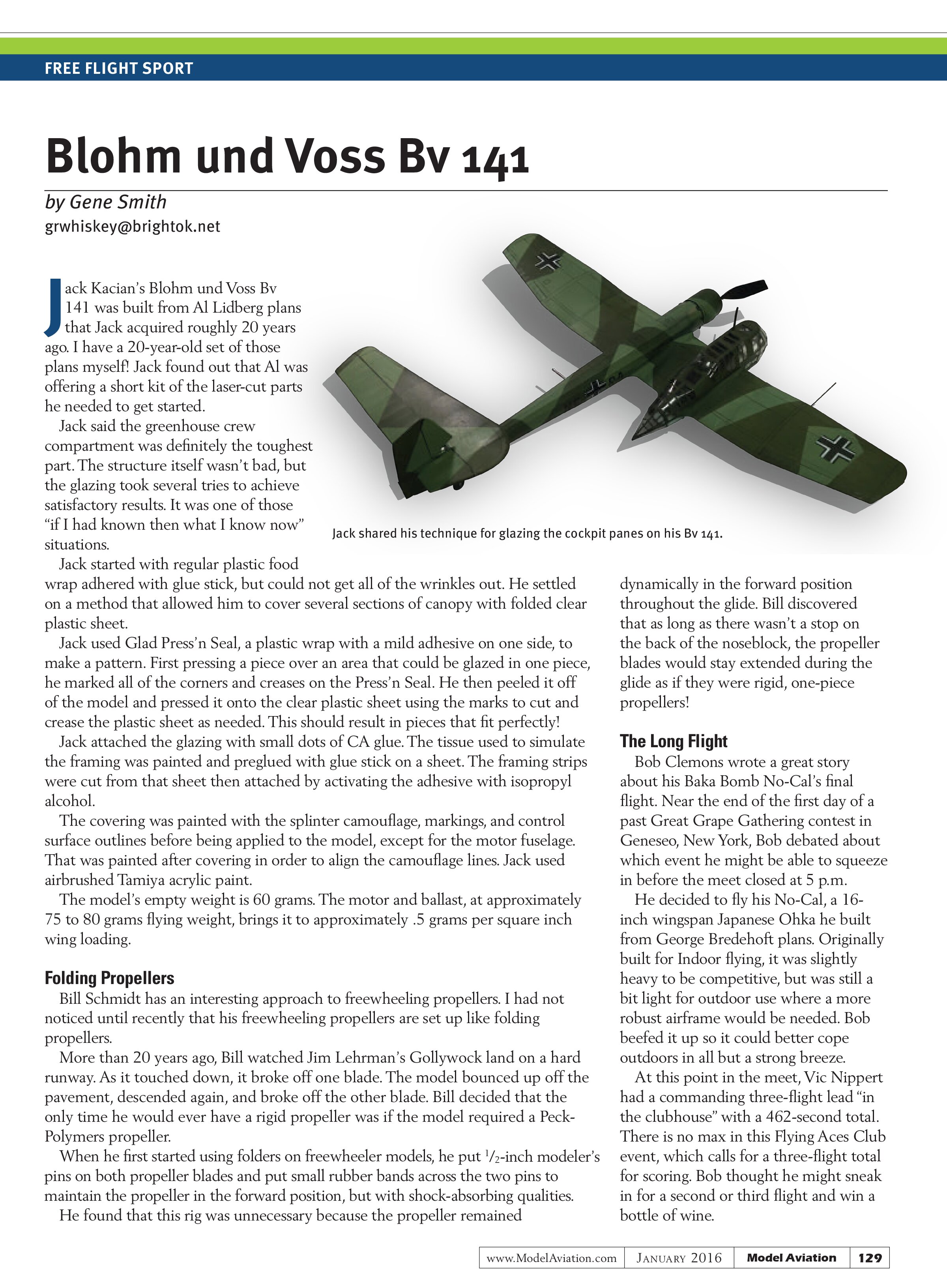
Jack Kacian’s Blohm und Voss Bv 141 was built from Al Lidberg plans that Jack acquired roughly 20 years ago. I have a 20-year-old set of those plans myself! Jack found out that Al was offering a short kit of the laser-cut parts he needed to get started.

Jack said the greenhouse crew compartment was definitely the toughest part. The structure itself wasn’t bad, but the glazing took several tries to achieve satisfactory results. It was one of those “if I had known then what I know now” situations.
Jack started with regular plastic food wrap adhered with glue stick, but could not get all of the wrinkles out. He settled on a method that allowed him to cover several sections of canopy with folded clear plastic sheet.
Jack used Glad Press’n Seal, a plastic wrap with a mild adhesive on one side, to make a pattern. First pressing a piece over an area that could be glazed in one piece, he marked all of the corners and creases on the Press’n Seal. He then peeled it off of the model and pressed it onto the clear plastic sheet using the marks to cut and crease the plastic sheet as needed. This should result in pieces that fit perfectly!
Jack attached the glazing with small dots of CA glue. The tissue used to simulate the framing was painted and preglued with glue stick on a sheet. The framing strips were cut from that sheet then attached by activating the adhesive with isopropyl alcohol.
The covering was painted with the splinter camouflage, markings, and control surface outlines before being applied to the model, except for the motor fuselage. That was painted after covering in order to align the camouflage lines. Jack used airbrushed Tamiya acrylic paint.
The model’s empty weight is 60 grams. The motor and ballast, at approximately 75 to 80 grams flying weight, brings it to approximately .5 grams per square inch wing loading.
Folding Propellers
Bill Schmidt has an interesting approach to freewheeling propellers. I had not noticed until recently that his freewheeling propellers are set up like folding propellers.
More than 20 years ago, Bill watched Jim Lehrman’s Gollywock land on a hard runway. As it touched down, it broke off one blade. The model bounced up off the pavement, descended again, and broke off the other blade. Bill decided that the only time he would ever have a rigid propeller was if the model required a Peck-Polymers propeller.
When he first started using folders on freewheeler models, he put ½-inch modeler’s pins on both propeller blades and put small rubber bands across the two pins to maintain the propeller in the forward position, but with shock-absorbing qualities.
He found that this rig was unnecessary because the propeller remained dynamically in the forward position throughout the glide. Bill discovered that as long as there wasn’t a stop on the back of the noseblock, the propeller blades would stay extended during the glide as if they were rigid, one-piece propellers!
The Long Flight
Bob Clemons wrote a great story about his Baka Bomb No-Cal’s final flight. Near the end of the first day of a past Great Grape Gathering contest in Geneseo, New York, Bob debated about which event he might be able to squeeze in before the meet closed at 5 p.m.
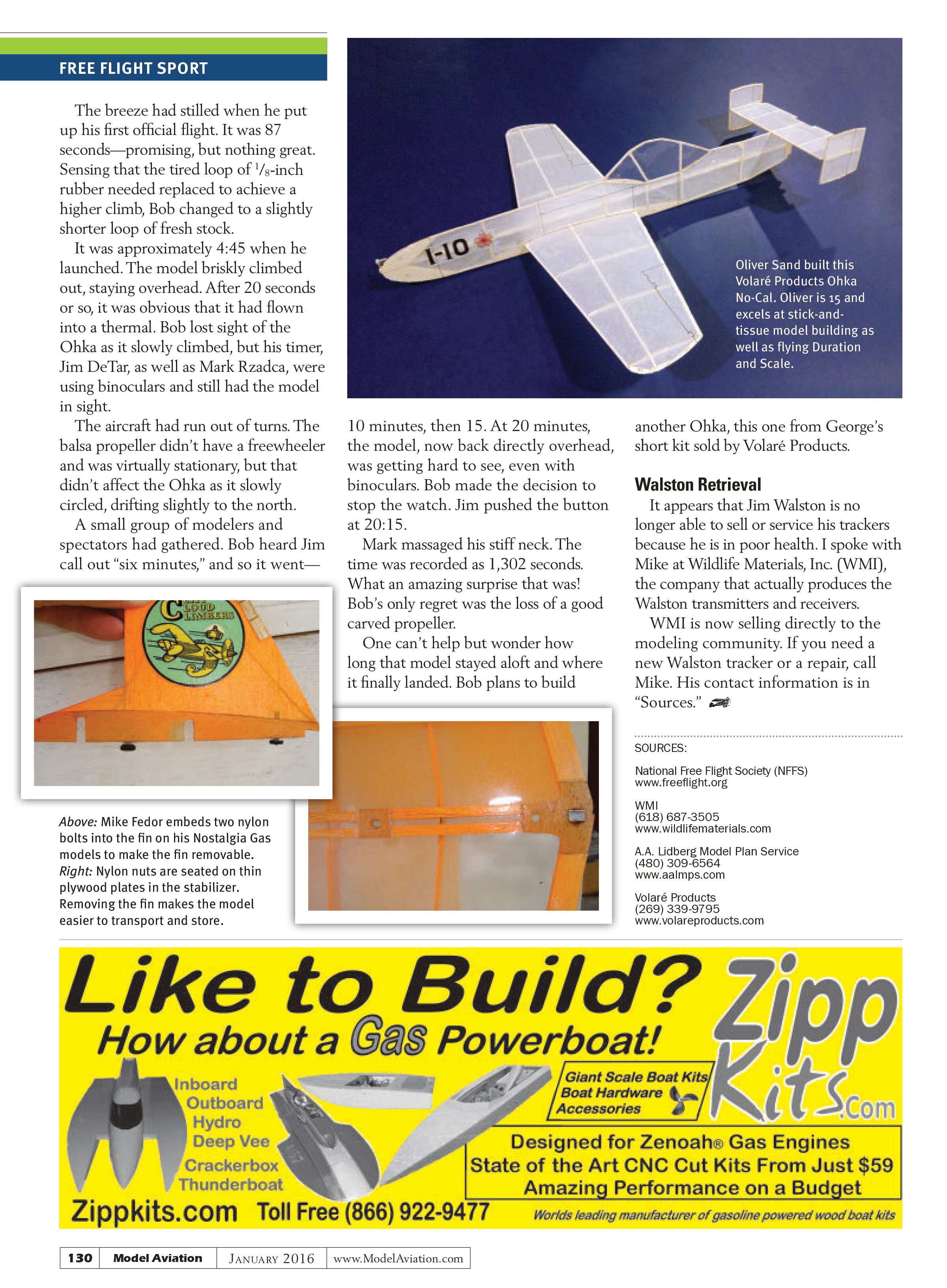
He decided to fly his No-Cal, a 16-inch wingspan Japanese Ohka he built from George Bredehoft plans. Originally built for Indoor flying, it was slightly heavy to be competitive, but was still a bit light for outdoor use where a more robust airframe would be needed. Bob beefed it up so it could better cope outdoors in all but a strong breeze.
At this point in the meet, Vic Nippert had a commanding three-flight lead “in the clubhouse” with a 462-second total. There is no max in this Flying Aces Club event, which calls for a three-flight total for scoring. Bob thought he might sneak in for a second or third flight and win a bottle of wine.
The breeze had stilled when he put up his first official flight. It was 87 seconds—promising, but nothing great. Sensing that the tired loop of ⅛-inch rubber needed replaced to achieve a higher climb, Bob changed to a slightly shorter loop of fresh stock.
It was approximately 4:45 when he launched. The model briskly climbed out, staying overhead. After 20 seconds or so, it was obvious that it had flown into a thermal. Bob lost sight of the Ohka as it slowly climbed, but his timer, Jim DeTar, as well as Mark Rzadca, were using binoculars and still had the model in sight.

The aircraft had run out of turns. The balsa propeller didn’t have a freewheeler and was virtually stationary, but that didn’t affect the Ohka as it slowly circled, drifting slightly to the north.
A small group of modelers and spectators had gathered. Bob heard Jim call out “six minutes,” and so it went—
10 minutes, then 15. At 20 minutes, the model, now back directly overhead, was getting hard to see, even with binoculars. Bob made the decision to stop the watch. Jim pushed the button at 20:15.
Mark massaged his stiff neck. The time was recorded as 1,302 seconds. What an amazing surprise that was! Bob’s only regret was the loss of a good carved propeller.
One can’t help but wonder how long that model stayed aloft and where it finally landed. Bob plans to build another Ohka, this one from George’s short kit sold by Volaré Products.

Above: Mike Fedor embeds two nylon bolts into the fin on his Nostalgia Gas models to make the fin removable. Right: Nylon nuts are seated on thin plywood plates in the stabilizer. Removing the fin makes the model easier to transport and store.

Walston Retrieval
It appears that Jim Walston is no longer able to sell or service his trackers because he is in poor health. I spoke with Mike at Wildlife Materials, Inc. (WMI), the company that actually produces the Walston transmitters and receivers.
WMI is now selling directly to the modeling community. If you need a new Walston tracker or a repair, call Mike. His contact information is in “Sources.”
Sources:
National Free Flight Society (NFFS)
www.freeflight.org
WMI
(618) 687-3505
www.wildlifematerials.com
A.A. Lidberg Model Plan Service
(480) 309-6564
www.aalmps.com
Volaré Products
(269) 339-9795
www.volareproducts.com