Focal Point
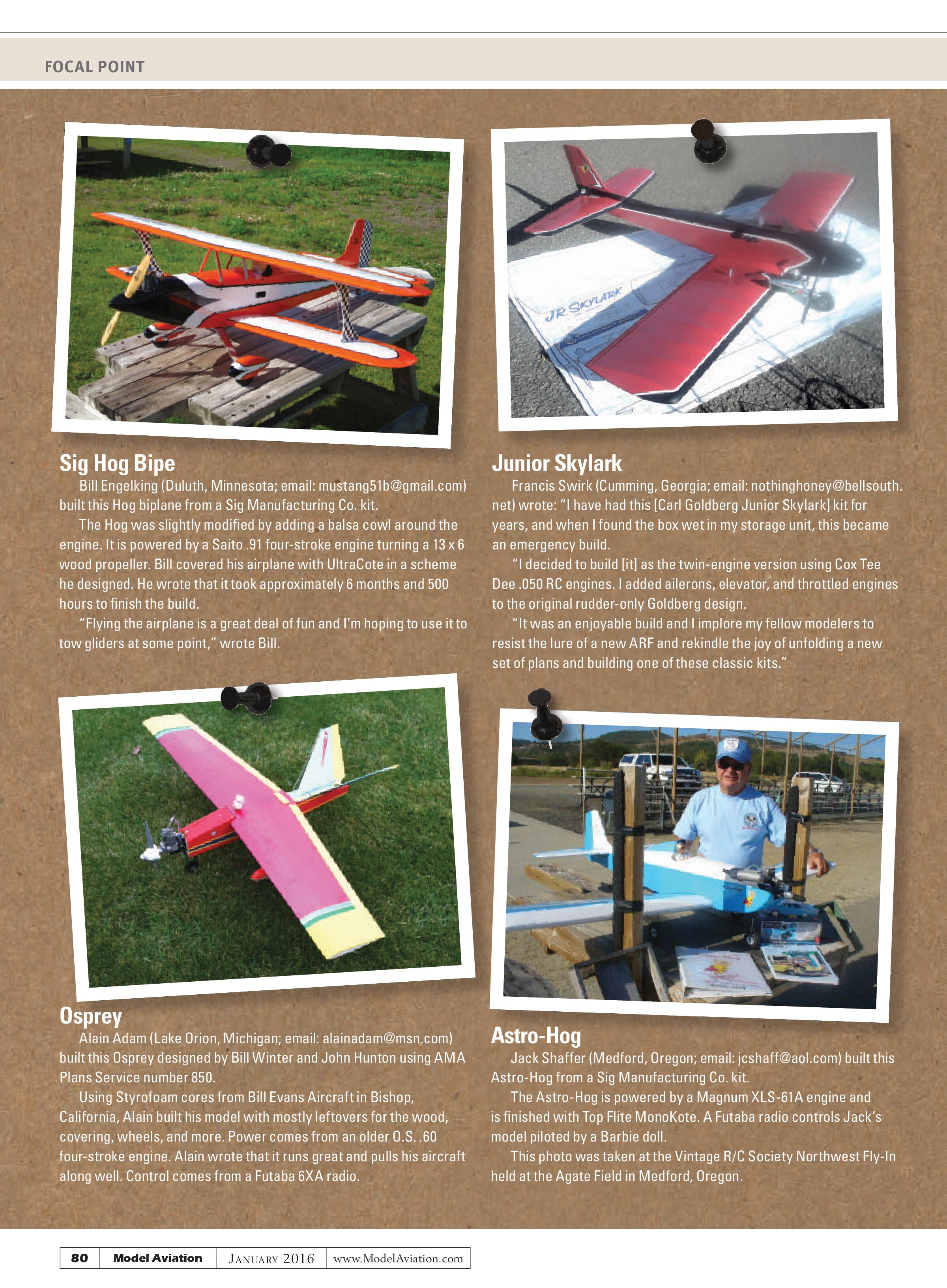
Sig Hog Bipe

Bill Engelking (Duluth, Minnesota; email: mustang51b@gmail.com) built this Hog biplane from a Sig Manufacturing Co. kit.
The Hog was slightly modified by adding a balsa cowl around the engine. It is powered by a Saito .91 four-stroke engine turning a 13 x 6 wood propeller. Bill covered his airplane with UltraCote in a scheme he designed. He wrote that it took approximately 6 months and 500 hours to finish the build.
“Flying the airplane is a great deal of fun and I’m hoping to use it to tow gliders at some point,” wrote Bill.
Osprey

Alain Adam (Lake Orion, Michigan; email: alainadam@msn.com) built this Osprey designed by Bill Winter and John Hunton using AMA Plans Service number 850.
Using Styrofoam cores from Bill Evans Aircraft in Bishop, California, Alain built his model with mostly leftovers for the wood, covering, wheels, and more. Power comes from an older O.S. .60 four-stroke engine. Alain wrote that it runs great and pulls his aircraft along well. Control comes from a Futaba 6XA radio.
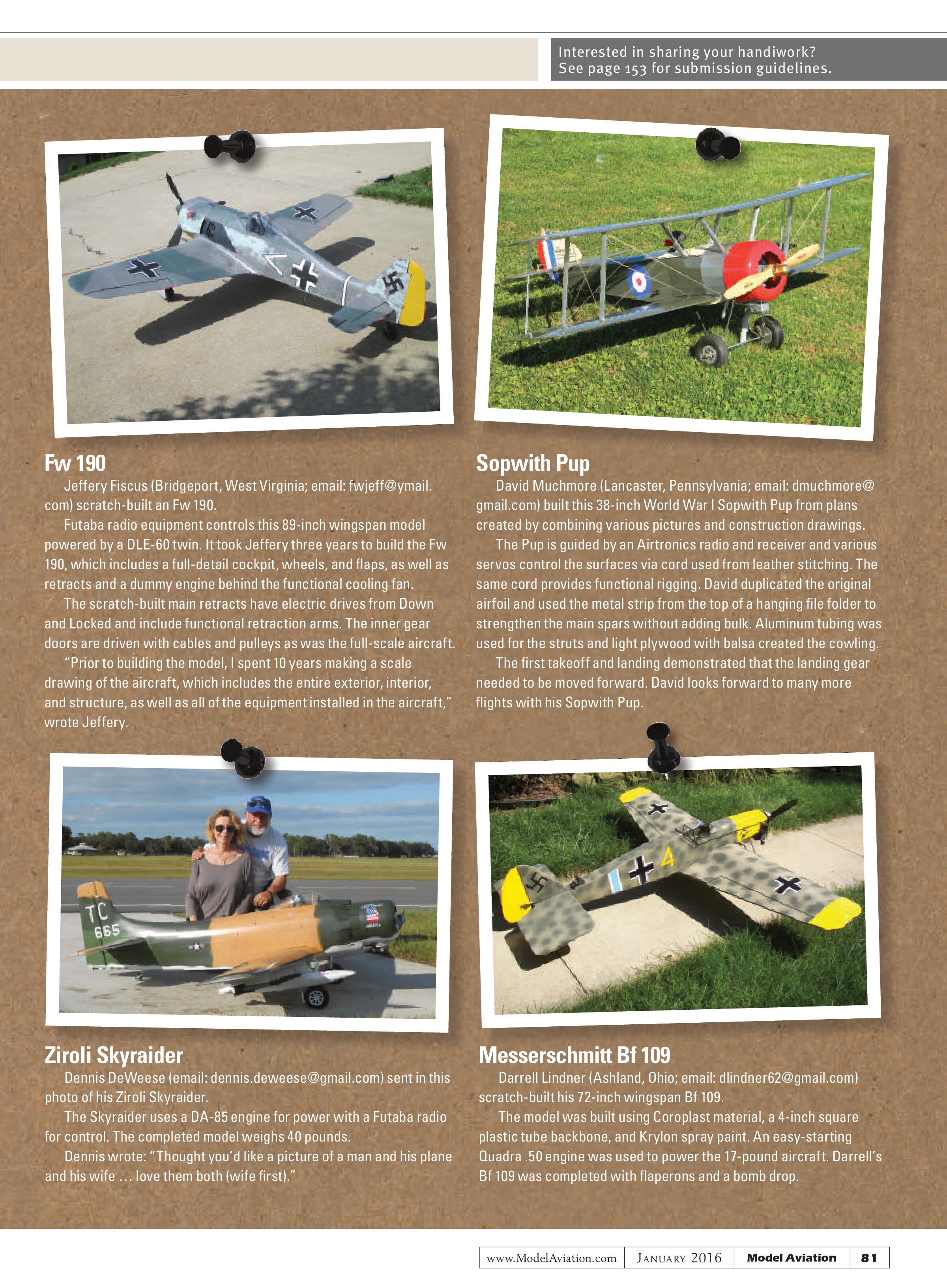
Junior Skylark

Francis Swirk (Cumming, Georgia; email: nothinghoney@bellsouth.net) wrote: “I have had this [Carl Goldberg Junior Skylark] kit for years, and when I found the box wet in my storage unit, this became an emergency build.
“I decided to build [it] as the twin-engine version using Cox Tee Dee .050 RC engines. I added ailerons, elevator, and throttled engines to the original rudder-only Goldberg design.
“It was an enjoyable build and I implore my fellow modelers to resist the lure of a new ARF and rekindle the joy of unfolding a new set of plans and building one of these classic kits.”
Astro-Hog

Jack Shaffer (Medford, Oregon; email: jcshaff@aol.com) built this Astro-Hog from a Sig Manufacturing Co. kit.
The Astro-Hog is powered by a Magnum XLS-61A engine and is finished with Top Flite MonoKote. A Futaba radio controls Jack’s model piloted by a Barbie doll.
This photo was taken at the Vintage R/C Society Northwest Fly-In held at the Agate Field in Medford, Oregon.
Fw 190

Jeffery Fiscus (Bridgeport, West Virginia; email: fwjeff@ymail.com) scratch-built an Fw 190.
Futaba radio equipment controls this 89-inch wingspan model powered by a DLE-60 twin. It took Jeffery three years to build the Fw 190, which includes a full-detail cockpit, wheels, and flaps, as well as retracts and a dummy engine behind the functional cooling fan.
The scratch-built main retracts have electric drives from Down and Locked and include functional retraction arms. The inner gear doors are driven with cables and pulleys as was the full-scale aircraft.
“Prior to building the model, I spent 10 years making a scale drawing of the aircraft, which includes the entire exterior, interior, and structure, as well as all of the equipment installed in the aircraft,” wrote Jeffery.
Ziroli Skyraider

Dennis DeWeese (email: dennis.deweese@gmail.com) sent in this photo of his Ziroli Skyraider.
The Skyraider uses a DA-85 engine for power with a Futaba radio for control. The completed model weighs 40 pounds.
Dennis wrote: “Thought you’d like a picture of a man and his plane and his wife … love them both (wife first).”
Sopwith Pup

David Muchmore (Lancaster, Pennsylvania; email: dmuchmore@gmail.com) built this 38-inch World War I Sopwith Pup from plans created by combining various pictures and construction drawings.
The Pup is guided by an Airtronics radio and receiver and various servos control the surfaces via cord used from leather stitching. The same cord provides functional rigging. David duplicated the original airfoil and used the metal strip from the top of a hanging file folder to strengthen the main spars without adding bulk. Aluminum tubing was used for the struts and light plywood with balsa created the cowling.
The first takeoff and landing demonstrated that the landing gear needed to be moved forward. David looks forward to many more flights with his Sopwith Pup.
Messerschmitt Bf 109

Darrell Lindner (Ashland, Ohio; email: dlindner62@gmail.com) scratch-built his 72-inch wingspan Bf 109.
The model was built using Coroplast material, a 4-inch square plastic tube backbone, and Krylon spray paint. An easy-starting Quadra .50 engine was used to power the 17-pound aircraft. Darrell’s Bf 109 was completed with flaperons and a bomb drop.