Rules proposals and control system failures
by Dick Perry
tailhooker@comcast.net
We are in the middle of the rules change cycle for the 2017-2018 AMA Competition Regulations. Proposals for changes to the rules are being accepted through March 15, 2016. Select “Competition & Events” then “Rule Proposals” on the AMA website to see which proposals have been submitted and to monitor the status of proposals as they pass through the process. You can download a rules-change proposal form at that site if you wish to submit a proposal of your own.
Contact the Control Line (CL) Navy Carrier Contest Board member in your AMA district to comment on any rules proposals. We appreciate having the input of district members when deliberating on proposals.
Voting is scheduled to occur on May 1, August 15, and September 15, 2016. Contest Board members would be happy to discuss any potential proposals with you before your submission.
Control System Failures
There have been a number of control system failures in recent years. These include line and control handle failures. The malfunctions usually occur during the pull test, which is appropriate because the pull test is intended to confirm control system integrity before flight.
There have also been failures during flight, but as far as I am aware, no failures have occurred in competition flying, only during practice—an excellent reason to conduct a pull test and system inspection before flying.
Line failures include the line breaking (not the terminations), although that type of failure is rare. It would likely be the result of damage to the line, such

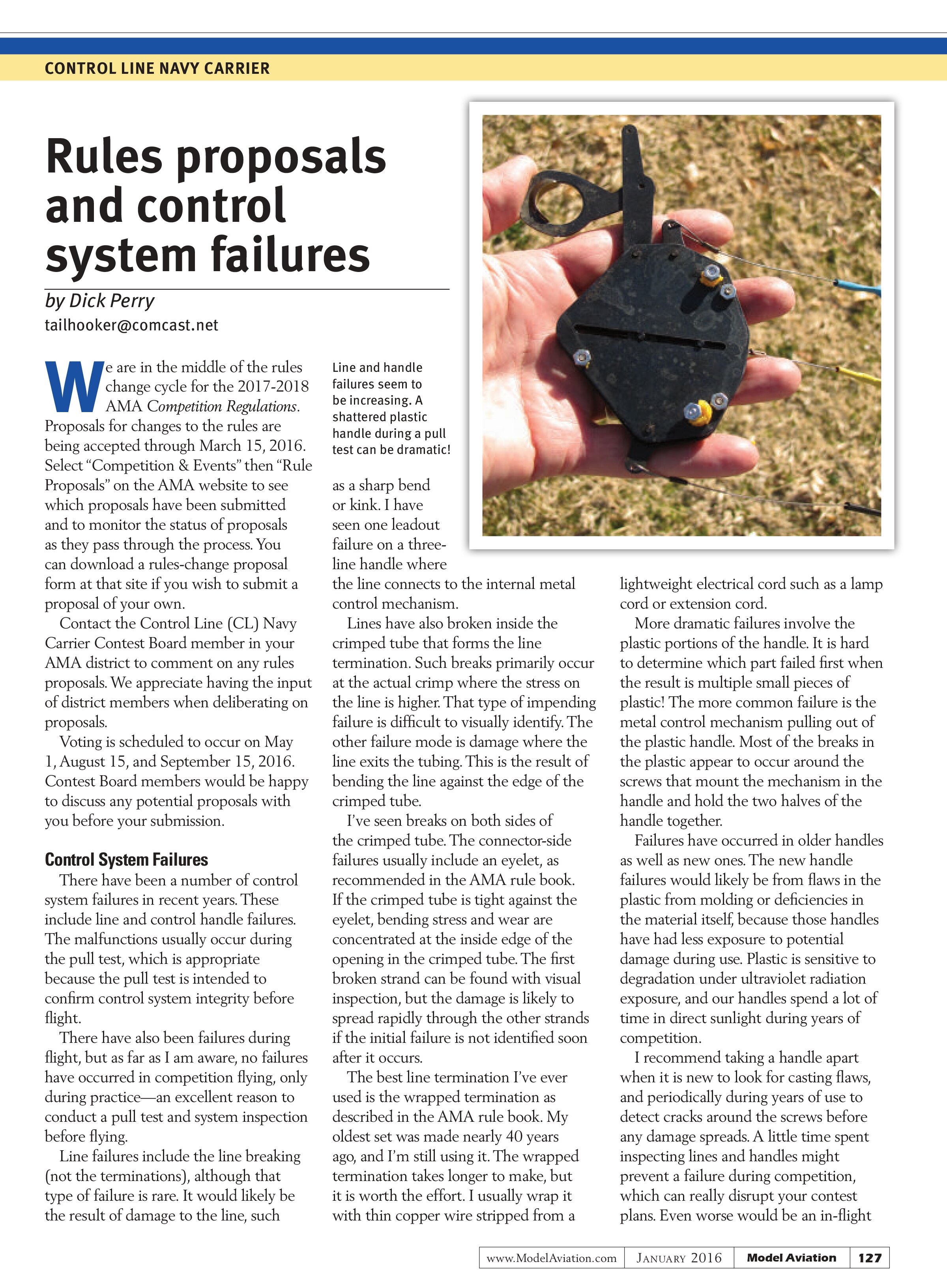
Line and handle failures seem to be increasing. A shattered plastic handle during a pull test can be dramatic! as a sharp bend or kink. I have seen one leadout failure on a three-line handle where the line connects to the internal metal control mechanism.
Lines have also broken inside the crimped tube that forms the line termination. Such breaks primarily occur at the actual crimp where the stress on the line is higher. That type of impending failure is difficult to visually identify. The other failure mode is damage where the line exits the tubing. This is the result of bending the line against the edge of the crimped tube.
I’ve seen breaks on both sides of the crimped tube. The connector-side failures usually include an eyelet, as recommended in the AMA rule book. If the crimped tube is tight against the eyelet, bending stress and wear are concentrated at the inside edge of the opening in the crimped tube. The first broken strand can be found with visual inspection, but the damage is likely to spread rapidly through the other strands if the initial failure is not identified soon after it occurs.
The best line termination I’ve ever used is the wrapped termination as described in the AMA rule book. My oldest set was made nearly 40 years ago, and I’m still using it. The wrapped termination takes longer to make, but it is worth the effort. I usually wrap it with thin copper wire stripped from a lightweight electrical cord such as a lamp cord or extension cord.
More dramatic failures involve the plastic portions of the handle. It is hard to determine which part failed first when the result is multiple small pieces of plastic! The more common failure is the metal control mechanism pulling out of the plastic handle. Most of the breaks in the plastic appear to occur around the screws that mount the mechanism in the handle and hold the two halves of the handle together.
Failures have occurred in older handles as well as new ones. The new handle failures would likely be from flaws in the plastic from molding or deficiencies in the material itself, because those handles have had less exposure to potential damage during use. Plastic is sensitive to degradation under ultraviolet radiation exposure, and our handles spend a lot of time in direct sunlight during years of competition.
I recommend taking a handle apart when it is new to look for casting flaws, and periodically during years of use to detect cracks around the screws before any damage spreads. A little time spent inspecting lines and handles might prevent a failure during competition, which can really disrupt your contest plans. Even worse would be an in-flight
failure that would destroy hours of building effort. I’m adding inspections to my routine at the beginning of each season.
Nats Analysis
The 2015 Nats brought out a few new models and some contestants whom we haven’t seen at the Nats for a while. Gene Wilems arrived from Florida in time for the unofficial events, after some difficulties with his vehicles at the beginning of the trip. Mike Anderson came from Iowa, with a large complement of aircraft, and entered nine events.
I won’t include many photos because most models were depicted in the NatsNews that was printed during the competition and published electronically on the AMA website (see “Sources” for the NatsNews link). I’ll concentrate on performance.
The continuing question is the competitiveness of electric-powered Carrier models compared with traditional internal-combustion counterparts. Electric performance is increasing as we learn more about that form of power and fine-tune the tradeoffs in high/low speeds and battery capacity versus weight.
With the extreme wind conditions during the Profile Carrier competition, comparing scores is invalid; however, gas engines continued to dominate in the Profile class, achieving better scores as a whole, in both high speed and low speed. Half of the gas contestants had high speeds of more than 80 mph, beating Mike Anderson’s 79.5 mph best speed for the electrics. Electric low speeds were better than all but Eric Conley’s and
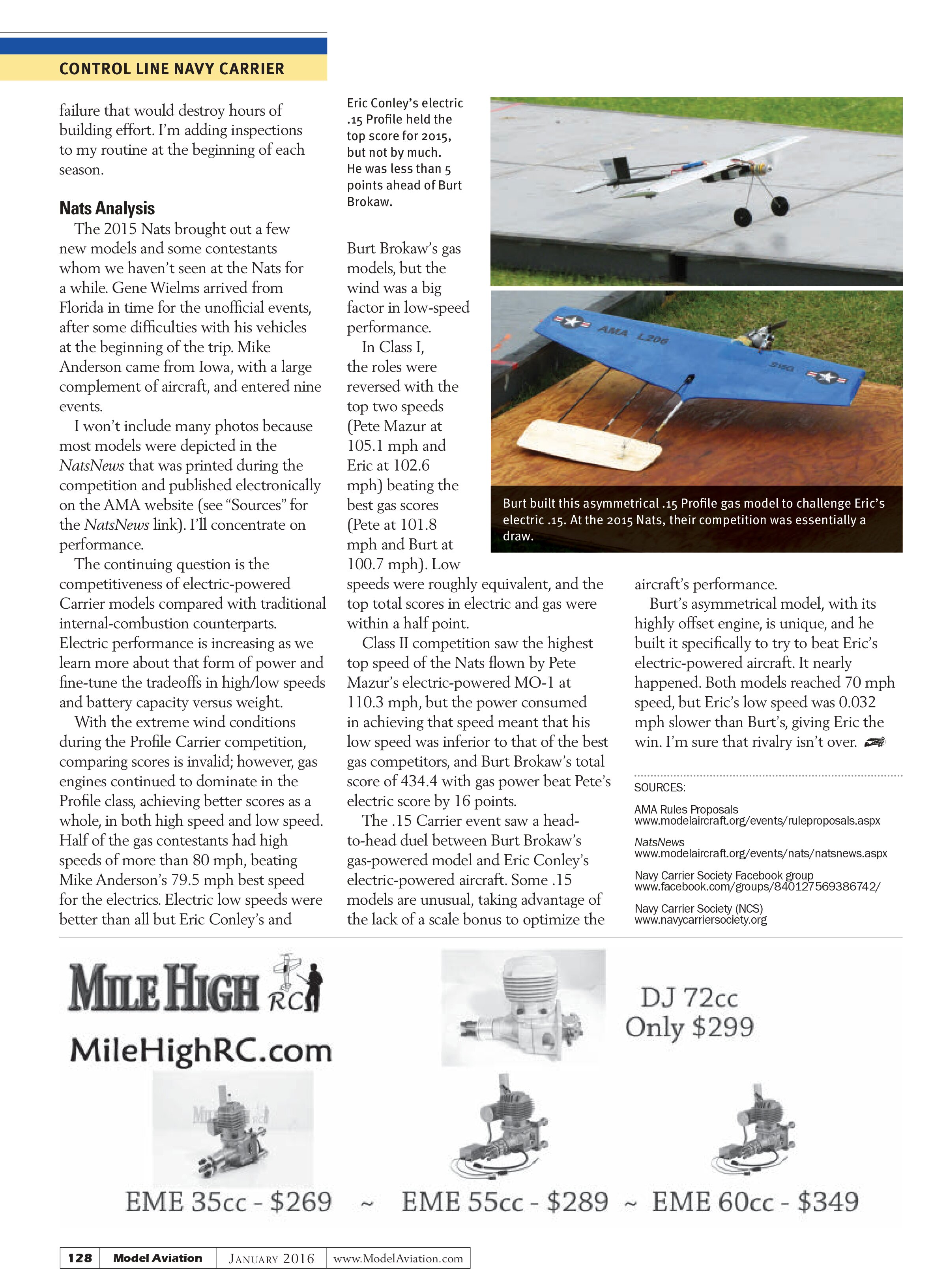
Eric Conley’s electric .15 Profile held the top score for 2015, but not by much. He was less than 5 points ahead of Burt Brokaw.

Burt Brokaw’s gas models, but the wind was a big factor in low-speed performance.

In Class I, the roles were reversed with the top two speeds (Pete Mazur at 105.1 mph and Eric at 102.6 mph) beating the best gas scores (Pete at 101.8 mph and Burt at 100.7 mph). Low speeds were roughly equivalent, and the top total scores in electric and gas were within a half point.
Class II competition saw the highest top speed of the Nats flown by Pete Mazur’s electric-powered MO-1 at 110.3 mph, but the power consumed in achieving that speed meant that his low speed was inferior to that of the best gas competitors, and Burt Brokaw’s total score of 434.4 with gas power beat Pete’s electric score by 16 points.
The .15 Carrier event saw a head-to-head duel between Burt Brokaw’s gas-powered model and Eric Conley’s electric-powered aircraft. Some .15 models are unusual, taking advantage of the lack of a scale bonus to optimize the aircraft’s performance.
Burt’s asymmetrical model, with its highly offset engine, is unique, and he built it specifically to try to beat Eric’s electric-powered aircraft. It nearly happened. Both models reached 70 mph speed, but Eric’s low speed was 0.032 mph slower than Burt’s, giving Eric the win. I’m sure that rivalry isn’t over.
SOURCES:
AMA Rules Proposals
www.modelaircraft.org/events/ruleproposals.aspx
NatsNews
www.modelaircraft.org/events/nats/natsnews.aspx
Navy Carrier Society Facebook group
www.facebook.com/groups/840127569386742/
Navy Carrier Society (NCS)
www.navycarriersociety.org