F2B Team Selection contest
by Bob Hunt
robinhunt@rcn.com

The 2015 FAI F2B Control Line (CL) Aerobatics US Team Selection contest is history. This contest has set the standard for future selections in terms of administration, efficiency, site selection, and preparation.
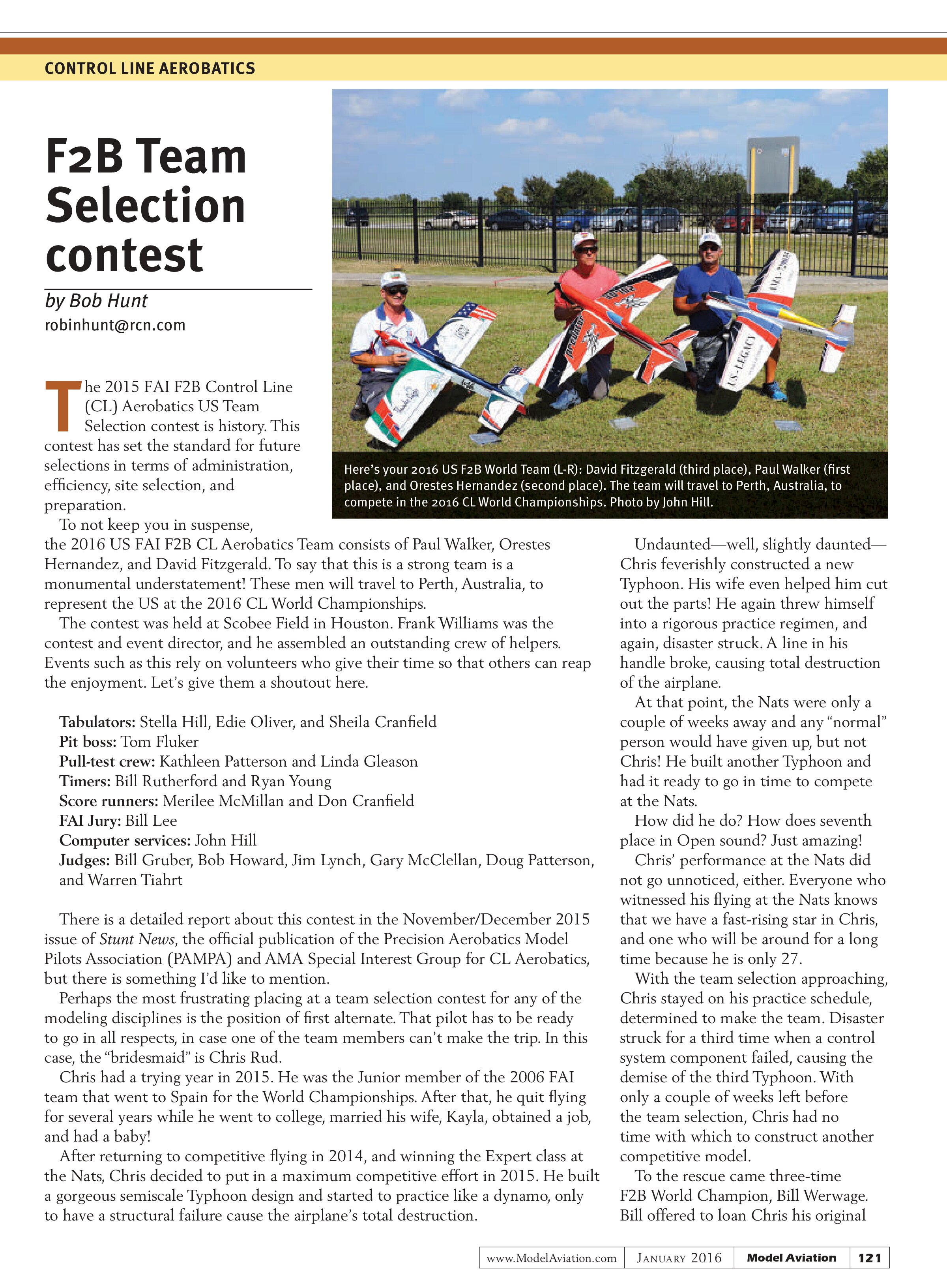
To not keep you in suspense, the 2016 US FAI F2B CL Aerobatics Team consists of Paul Walker, Orestes Hernandez, and David Fitzgerald. To say that this is a strong team is a monumental understatement! These men will travel to Perth, Australia, to represent the US at the 2016 CL World Championships.
The contest was held at Scobee Field in Houston. Frank Williams was the contest and event director, and he assembled an outstanding crew of helpers. Events such as this rely on volunteers who give their time so that others can reap the enjoyment. Let’s give them a shoutout here.
Tabulators: Stella Hill, Edie Oliver, and Sheila Cranfield
Pit boss: Tom Fluker
Pull-test crew: Kathleen Patterson and Linda Gleason
Timers: Bill Rutherford and Ryan Young
Score runners: Merilee McMillan and Don Cranfield
FAI Jury: Bill Lee
Computer services: John Hill
Judges: Bill Gruber, Bob Howard, Jim Lynch, Gary McClellan, Doug Patterson, and Warren Tiahrt
There is a detailed report about this contest in the November/December 2015 issue of Stunt News, the official publication of the Precision Aerobatics Model Pilots Association (PAMPA) and AMA Special Interest Group for CL Aerobatics, but there is something I’d like to mention.
Perhaps the most frustrating placing at a team selection contest for any of the modeling disciplines is the position of first alternate. That pilot has to be ready to go in all respects, in case one of the team members can’t make the trip. In this case, the “bridesmaid” is Chris Rud.
Chris had a trying year in 2015. He was the Junior member of the 2006 FAI team that went to Spain for the World Championships. After that, he quit flying for several years while he went to college, married his wife, Kayla, obtained a job, and had a baby!
After returning to competitive flying in 2014, and winning the Expert class at the Nats, Chris decided to put in a maximum competitive effort in 2015. He built a gorgeous semiscale Typhoon design and started to practice like a dynamo, only to have a structural failure cause the airplane’s total destruction.
Undaunted—well, slightly daunted—Chris feverishly constructed a new Typhoon. His wife even helped him cut out the parts! He again threw himself into a rigorous practice regimen, and again, disaster struck. A line in his handle broke, causing total destruction of the airplane.
At that point, the Nats were only a couple of weeks away and any “normal” person would have given up, but not Chris! He built another Typhoon and had it ready to go in time to compete at the Nats.
How did he do? How does seventh place in Open sound? Just amazing! Chris’ performance at the Nats did not go unnoticed, either. Everyone who witnessed his flying at the Nats knows that we have a fast-rising star in Chris, and one who will be around for a long time because he is only 27.
With the team selection approaching, Chris stayed on his practice schedule, determined to make the team. Disaster struck for a third time when a control system component failed, causing the demise of the third Typhoon. With only a couple of weeks left before the team selection, Chris had no time with which to construct another competitive model.
To the rescue came three-time F2B World Champion, Bill Werwage. Bill offered to loan Chris his original
Junar model. In FAI, there is no Builder of the Model rule, and there are no appearance points, so this meant that Chris still had a chance. It’s worthy to note that the Junar airframe that Chris borrowed from Bill was built, and even flown in competition, three years before Chris was born!
This story illustrates the kind of dedication it takes to be a top-level CL Aerobatics pilot. There is no “quit” in Chris, and his story should serve as a beacon for those who aspire to make their mark in this event. First alternate! Not bad, young man, not bad.

Be a Square
I indicated in my last column that this time we would take a look at the outside loops. It dawned on me that all of the criteria that relates to inside loops can be applied to the outside loops as well, except for the obvious fact that we are giving “down” or “bottom” control to perform the maneuver instead of “up” or “top” control. Let’s get on with some discussion about the square maneuvers.
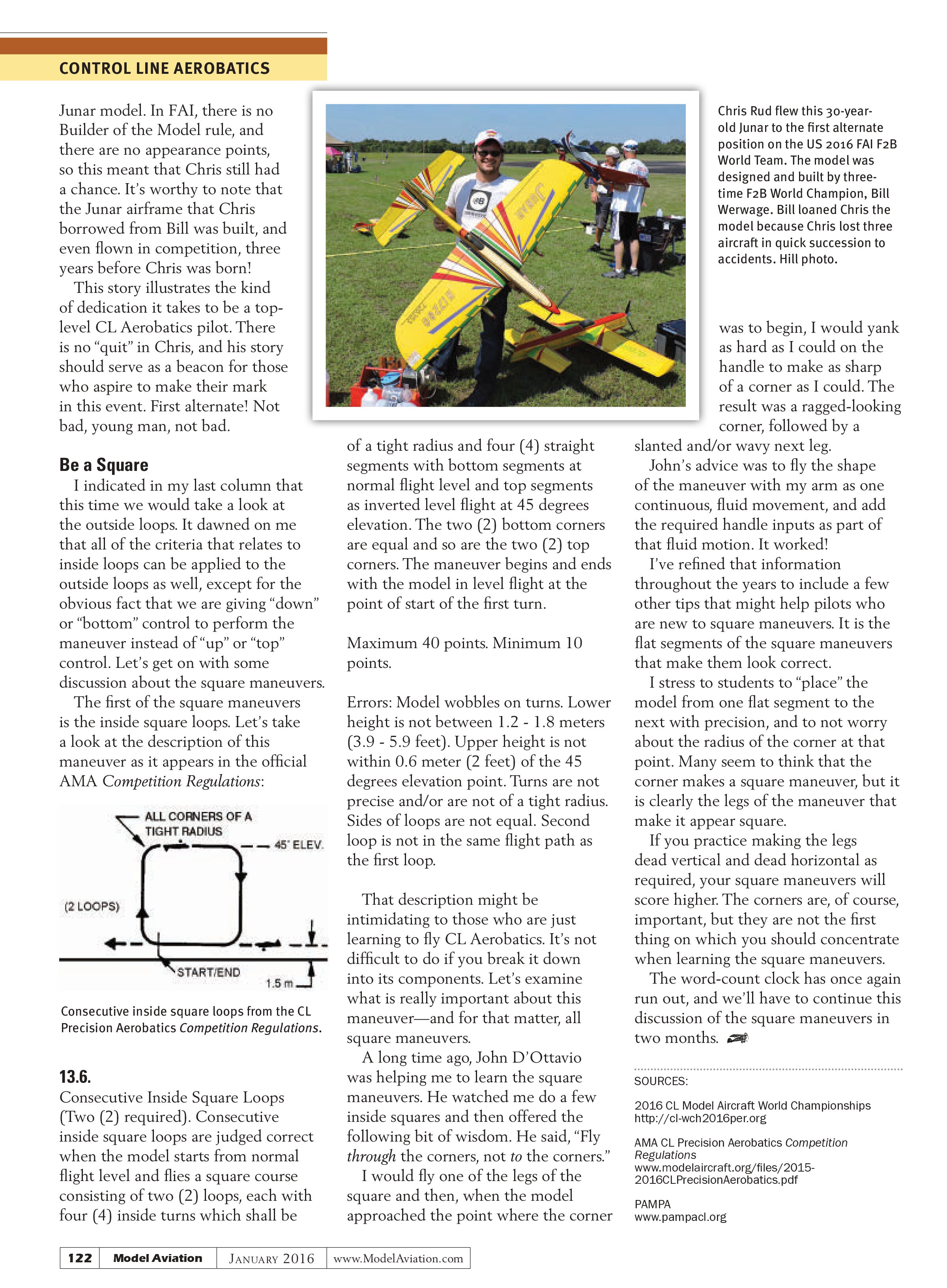
The first of the square maneuvers is the inside square loops. Let’s take a look at the description of this maneuver as it appears in the official AMA Competition Regulations:

13.6.
Consecutive Inside Square Loops (Two (2) required). Consecutive inside square loops are judged correct when the model starts from normal flight level and flies a square course consisting of two (2) loops, each with four (4) inside turns which shall be of a tight radius and four (4) straight segments with bottom segments at normal flight level and top segments as inverted level flight at 45 degrees elevation. The two (2) bottom corners are equal and so are the two (2) top corners. The maneuver begins and ends with the model in level flight at the point of start of the first turn.
Maximum 40 points. Minimum 10 points.
Errors: Model wobbles on turns. Lower height is not between 1.2 - 1.8 meters (3.9 - 5.9 feet). Upper height is not within 0.6 meter (2 feet) of the 45 degrees elevation point. Turns are not precise and/or are not of a tight radius. Sides of loops are not equal. Second loop is not in the same flight path as the first loop.
That description might be intimidating to those who are just learning to fly CL Aerobatics. It’s not difficult to do if you break it down into its components. Let’s examine what is really important about this maneuver—and for that matter, all square maneuvers.
A long time ago, John D’Ottavio was helping me to learn the square maneuvers. He watched me do a few inside squares and then offered the following bit of wisdom. He said, “Fly through the corners, not to the corners.”
I would fly one of the legs of the square and then, when the model approached the point where the corner was to begin, I would yank as hard as I could on the handle to make as sharp of a corner as I could. The result was a ragged-looking corner, followed by a slanted and/or wavy next leg.
John’s advice was to fly the shape of the maneuver with my arm as one continuous, fluid movement, and add the required handle inputs as part of that fluid motion. It worked!
I’ve refined that information throughout the years to include a few other tips that might help pilots who are new to square maneuvers. It is the flat segments of the square maneuvers that make them look correct.
I stress to students to “place” the model from one flat segment to the next with precision, and to not worry about the radius of the corner at that point. Many seem to think that the corner makes a square maneuver, but it is clearly the legs of the maneuver that make it appear square.
If you practice making the legs dead vertical and dead horizontal as required, your square maneuvers will score higher. The corners are, of course, important, but they are not the first thing on which you should concentrate when learning the square maneuvers.
The word-count clock has once again run out, and we’ll have to continue this discussion of the square maneuvers in two months.
SOURCES:
2016 CL Model Aircraft World Championships
http://cl-wch2016.per.org
AMA CL Precision Aerobatics Competition Regulations
www.modelaircraft.org/files/2015-2016CLPrecisionAerobatics.pdf
PAMPA
www.pampacl.org