
Thermal imaging for all
Patrick Sherman
lucidity@roswellflighttestcrew.com
The Roswell Flight Test Crew was fortunate to be given an early opportunity to integrate a thermal-imaging camera into our FPV systems. No doubt it helped that we were among the first to demonstrate how multirotor drones could assist firefighters, and also that FLIR Systems—the world’s leading manufacturer of thermal cameras—is located practically in our backyard.
Being a pioneer was not without its challenges, however. First, thermal-imaging cameras were absurdly expensive when we started experimenting with them—a bare camera core was $10,000. Had FLIR not provided us with the hardware to demonstrate its potential, it would have been completely beyond our means.
Second, actually making the camera work with our FPV system wasn’t a step that we could take for granted. The camera required its own stable and consistent power supply, which meant putting a separate battery onboard the aircraft—not an optimal solution when you’re trying to save weight.
Furthermore, the video signal coming out through its nonstandard connector was described as “NTSC-ish”—almost, but not exactly, like the National Television System Committee standard that is used for video transmission in the US.
However, the effort was worth it. The uses of a FLIR-equipped drone are myriad. Structural and wildland firefighting, building and industrial inspections, search and rescue, scientific research, environmental conservation, and wildlife management—the list goes on, but these applications would only achieve their full potential if thermal-imaging cameras could be made less expensive and easier to use.

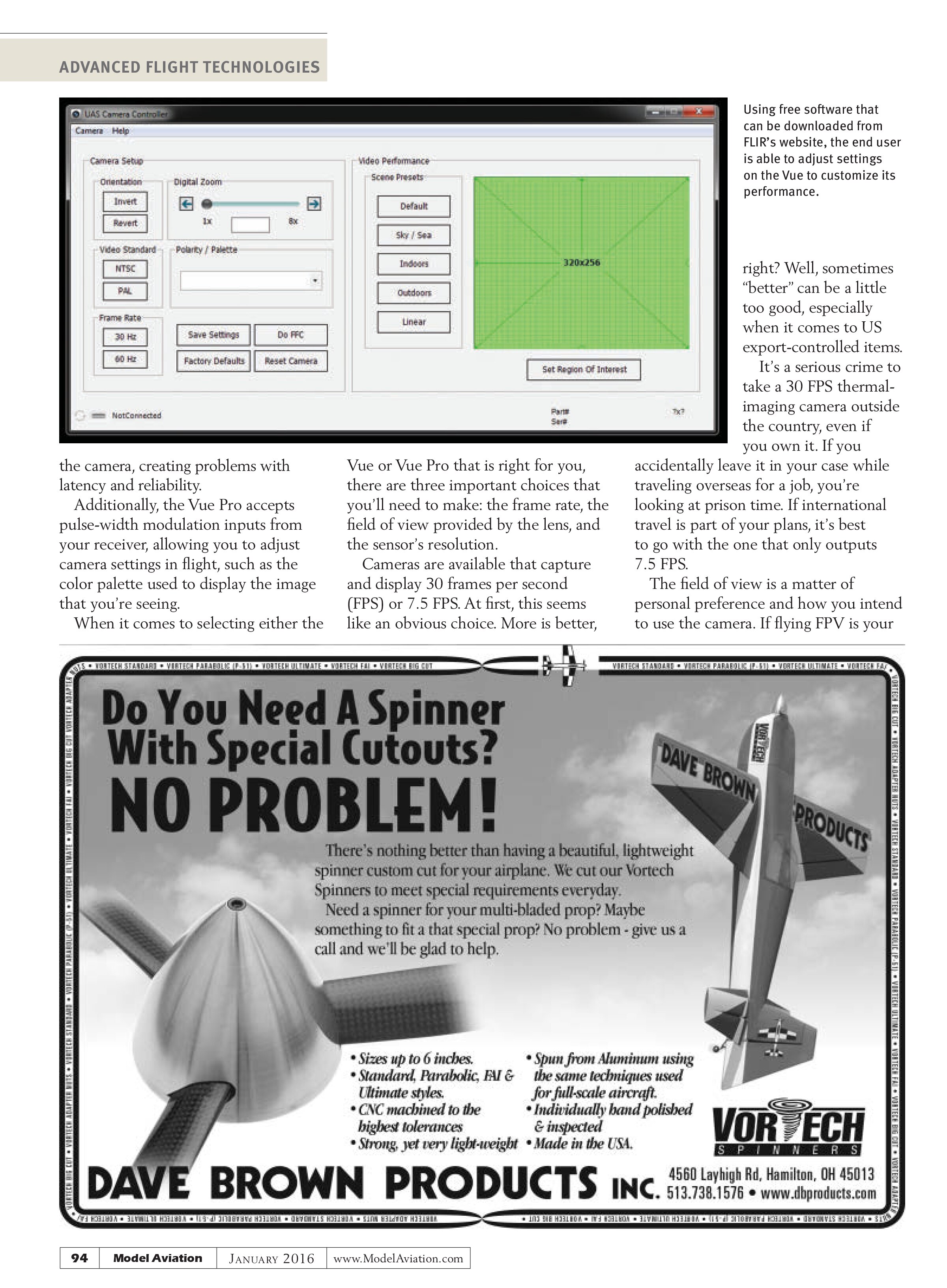
The Roswell Flight Test Crew has used FLIR thermal-imaging cameras to demonstrate the potential use of drones to first responders, as seen here during a structural firefighting exercise. The FLIR Vue makes this capability available at a fraction of the cost.
A Vue for You
Fortunately, FLIR Systems—now an ongoing sponsor of our adventures—saw the same potential that we did and set about building a camera specifically for drone use: the Vue, and now the Vue Pro. Physically, the Vue series of cameras closely resembles the FLIR Tau camera cores that we have used for the past several years. However, they have been streamlined and optimized for use on sUAS and the price has been drastically reduced to approximately $1,500 for a still-very-capable base model.
The Vue doesn’t include all of the same features as the Tau, but they aren’t features you will miss while you’re using the camera onboard a drone. The advantages are substantial.
First of all, power gets into the camera and video comes out through a standard 10-pin mini-USB connector—exactly the same as you would use for a GoPro HERO sports camera. That makes it easy to integrate into an existing FPV system. If that’s your plan, I suggest adding a remote camera switch to your aircraft, so that you can change back and forth between the FLIR and the more familiar view provided by your visible-light camera on the fly.
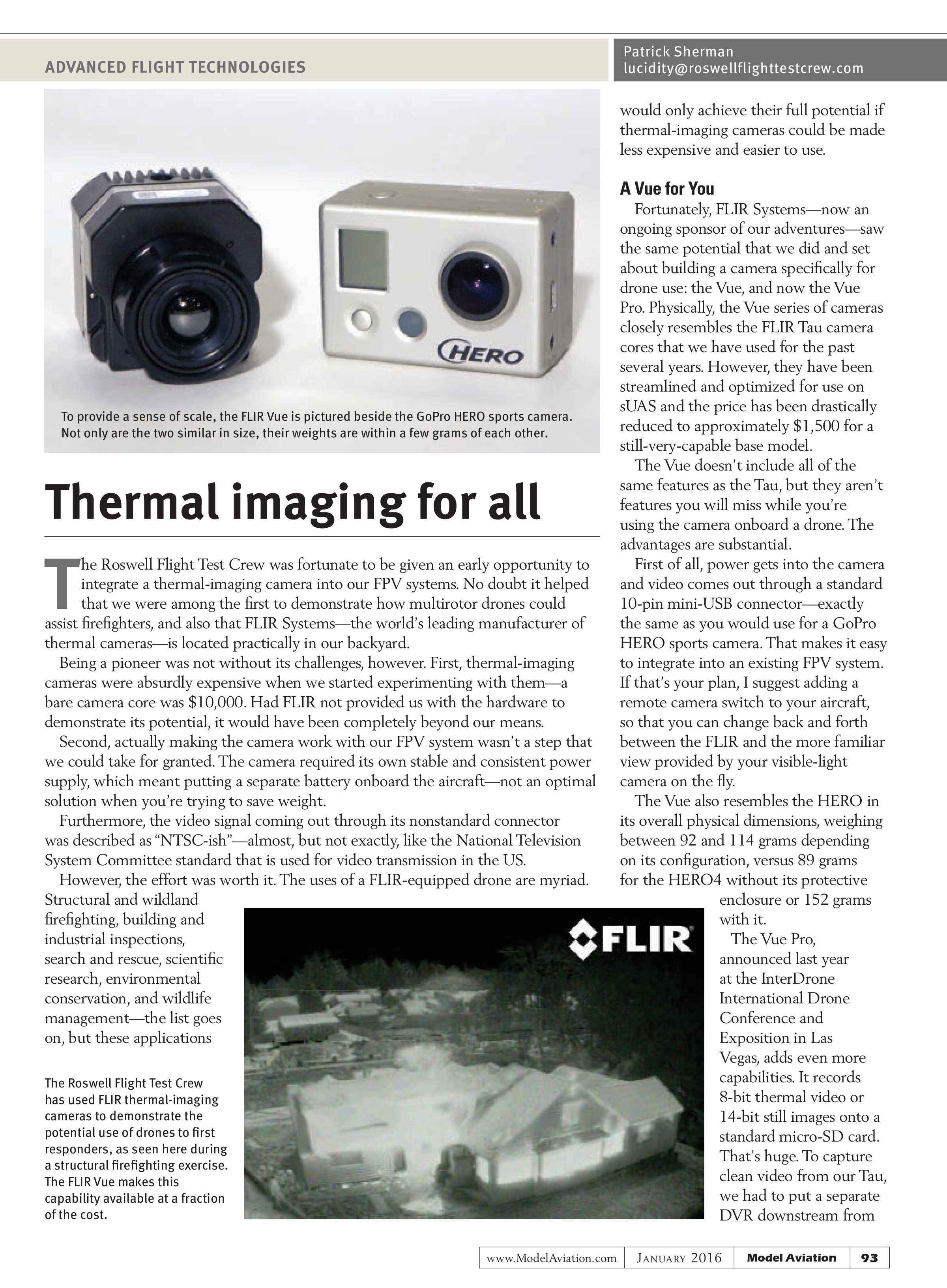
The Vue also resembles the HERO in its overall physical dimensions, weighing between 92 and 114 grams depending on its configuration, versus 89 grams for the HERO4 without its protective enclosure or 152 grams with it.
The Vue Pro, announced last year at the InterDrone International Drone Conference and Exposition in Las Vegas, adds even more capabilities. It records 8-bit thermal video or 14-bit still images onto a standard micro-SD card. That’s huge. To capture clean video from our Tau, we had to put a separate DVR downstream from
the camera, creating problems with latency and reliability.
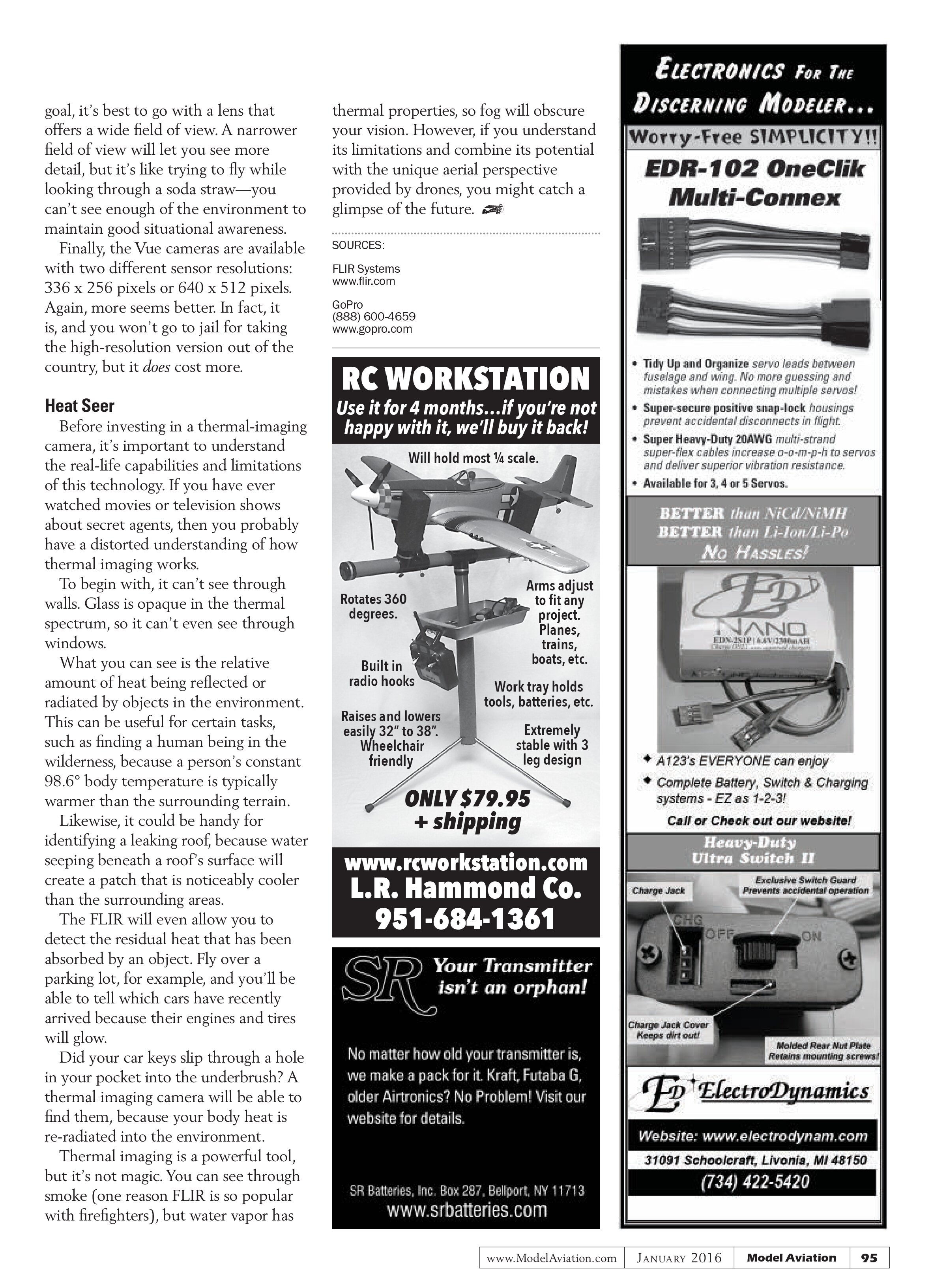
Additionally, the Vue Pro accepts pulse-width modulation inputs from your receiver, allowing you to adjust camera settings in flight, such as the color palette used to display the image that you’re seeing.
When it comes to selecting either the Vue or Vue Pro that is right for you, there are three important choices that you’ll need to make: the frame rate, the field of view provided by the lens, and the sensor’s resolution.
Cameras are available that capture and display 30 frames per second (FPS) or 7.5 FPS. At first, this seems like an obvious choice. More is better,

right? Well, sometimes “better” can be a little too good, especially when it comes to US export-controlled items. It’s a serious crime to take a 30 FPS thermal-imaging camera outside the country, even if you own it. If you accidentally leave it in your case while traveling overseas for a job, you’re looking at prison time. If international travel is part of your plans, it’s best to go with the one that only outputs 7.5 FPS.
The field of view is a matter of personal preference and how you intend to use the camera. If flying FPV is your goal, it’s best to go with a lens that offers a wide field of view. A narrower field of view will let you see more detail, but it’s like trying to fly while looking through a soda straw—you can’t see enough of the environment to maintain good situational awareness.
Finally, the Vue cameras are available with two different sensor resolutions: 336 x 256 pixels or 640 x 512 pixels. Again, more seems better. In fact, it is, and you won’t go to jail for taking the high-resolution version out of the country, but it does cost more.
Heat Seer
Before investing in a thermal-imaging camera, it’s important to understand the real-life capabilities and limitations of this technology. If you have ever watched movies or television shows about secret agents, then you probably have a distorted understanding of how thermal imaging works.
To begin with, it can’t see through walls. Glass is opaque in the thermal spectrum, so it can’t even see through windows.
What you can see is the relative amount of heat being reflected or radiated by objects in the environment. This can be useful for certain tasks, such as finding a human being in the wilderness, because a person’s constant 98.6° body temperature is typically warmer than the surrounding terrain.
Likewise, it could be handy for identifying a leaking roof, because water seeping beneath a roof’s surface will create a patch that is noticeably cooler than the surrounding areas.
The FLIR will even allow you to detect the residual heat that has been absorbed by an object. Fly over a parking lot, for example, and you’ll be able to tell which cars have recently arrived because their engines and tires will glow.
Did your car keys slip through a hole in your pocket into the underbrush? A thermal imaging camera will be able to find them, because your body heat is re-radiated into the environment.
Thermal imaging is a powerful tool, but it’s not magic. You can see through smoke (one reason FLIR is so popular with firefighters), but water vapor has thermal properties, so fog will obscure your vision. However, if you understand its limitations and combine its potential with the unique aerial perspective provided by drones, you might catch a glimpse of the future.
SOURCES:
FLIR Systems
www.flir.com
GoPro
(888) 600-4659
www.gopro.com