Tactic Ttx850 8-Channel Slt Transmitter
TERRY DUNN

An economical option for controlling your aircraft
Until recently, my advice for beginning fliers was to start out with a five or six-channel computer radio. Such a system would normally have all of the features that a rookie pilot should need for his or her first aircraft, but would not be so complex and expensive that it would intimidate new users.
My quandary arose with the advent of many new feature-rich ARFs. Gadgets such as flaps, lights, retractable landing gear, and stabilization systems are attractive to many pilots, but it only takes one or two of these add-on features to saturate the capability of a six-channel radio.
The Flyzone A6M2 Zero that I recently reviewed for Model Aviation, for instance, would make a fine first warbird, but it requires seven channels to articulate all of its included components.
Now my advice is to start out with a computer radio of at least eight channels, while still keeping a watchful eye on cost and complexity. The new Tactic TTX850 is among the radios that fit that criteria. This eight-channel system can handle the needs of nearly any airplane, helicopter, or multirotor, while still being easy to program. It is also one of the least-expensive eight-channel radios on the market.
What You Get
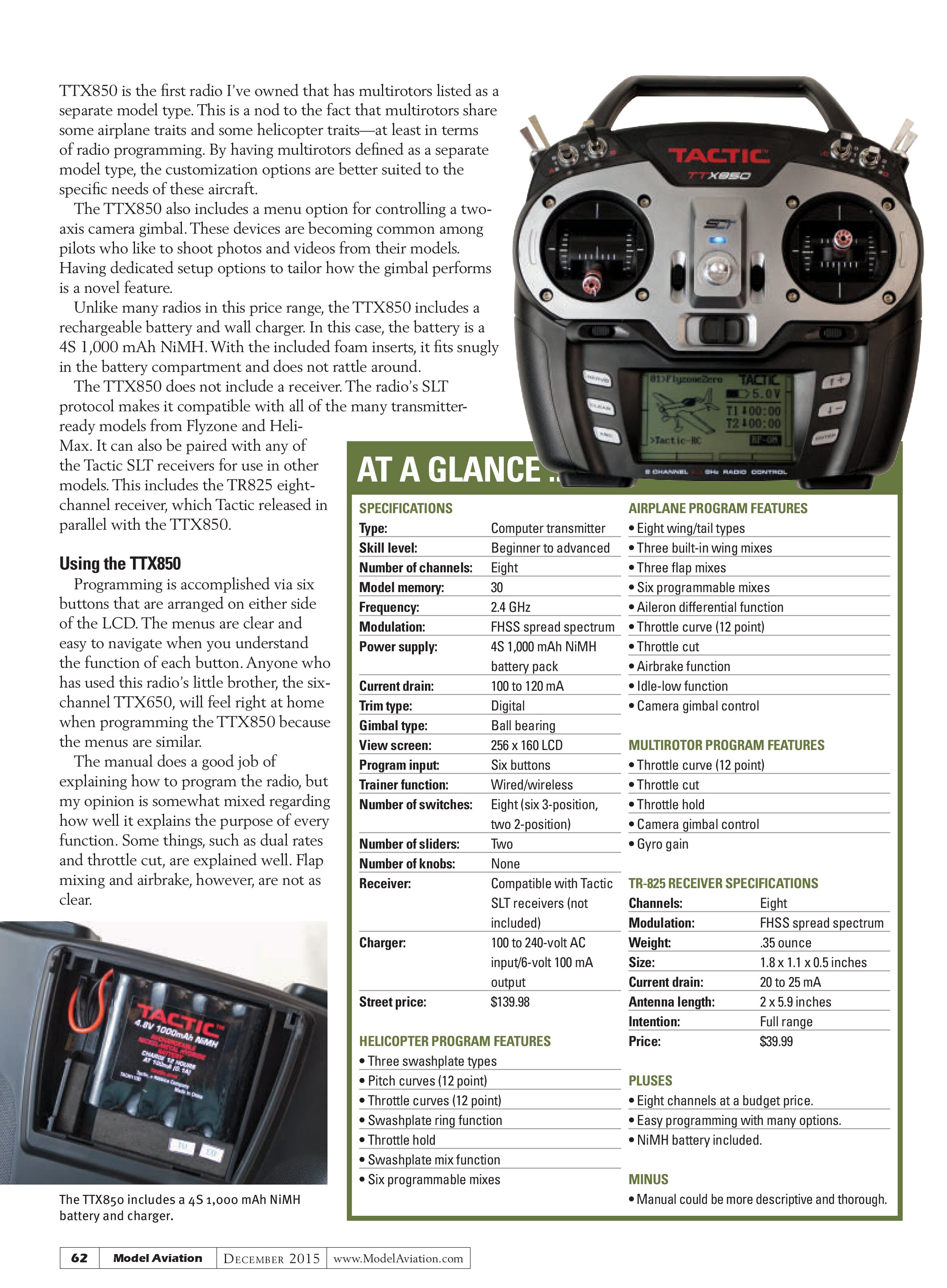
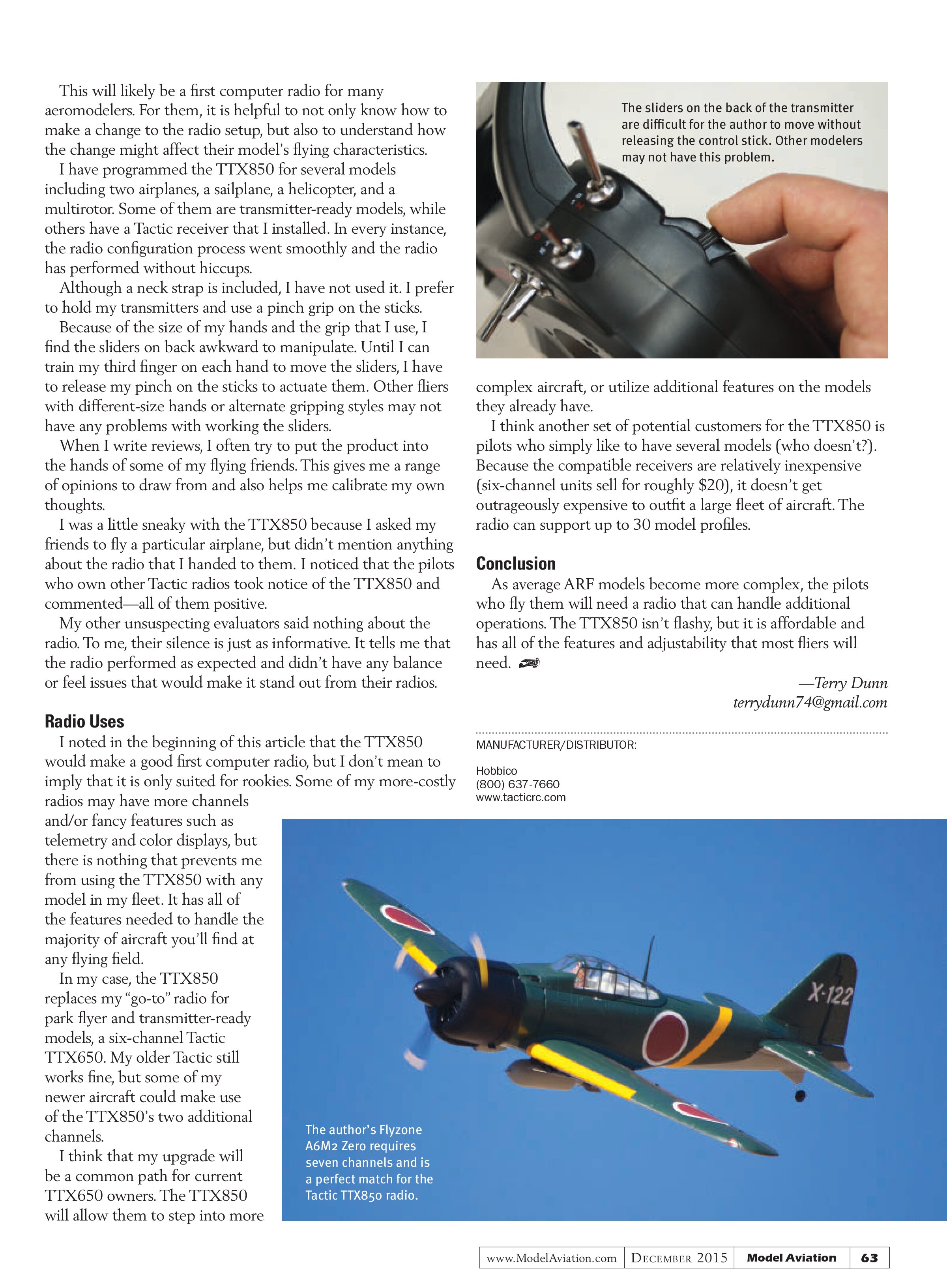
The TTX850 is a standard-size transmitter with a familiar layout. It comes with a ratcheted throttle, but the manual explains how to remove the ratcheting mechanism if you prefer to make it smooth. There are four 3-position switches on the radio face. Two more 3-position switches and two 2-position switches (one is momentary) are located on either side of the radio’s built-in handle. There are two sliders located on the backside of the case.
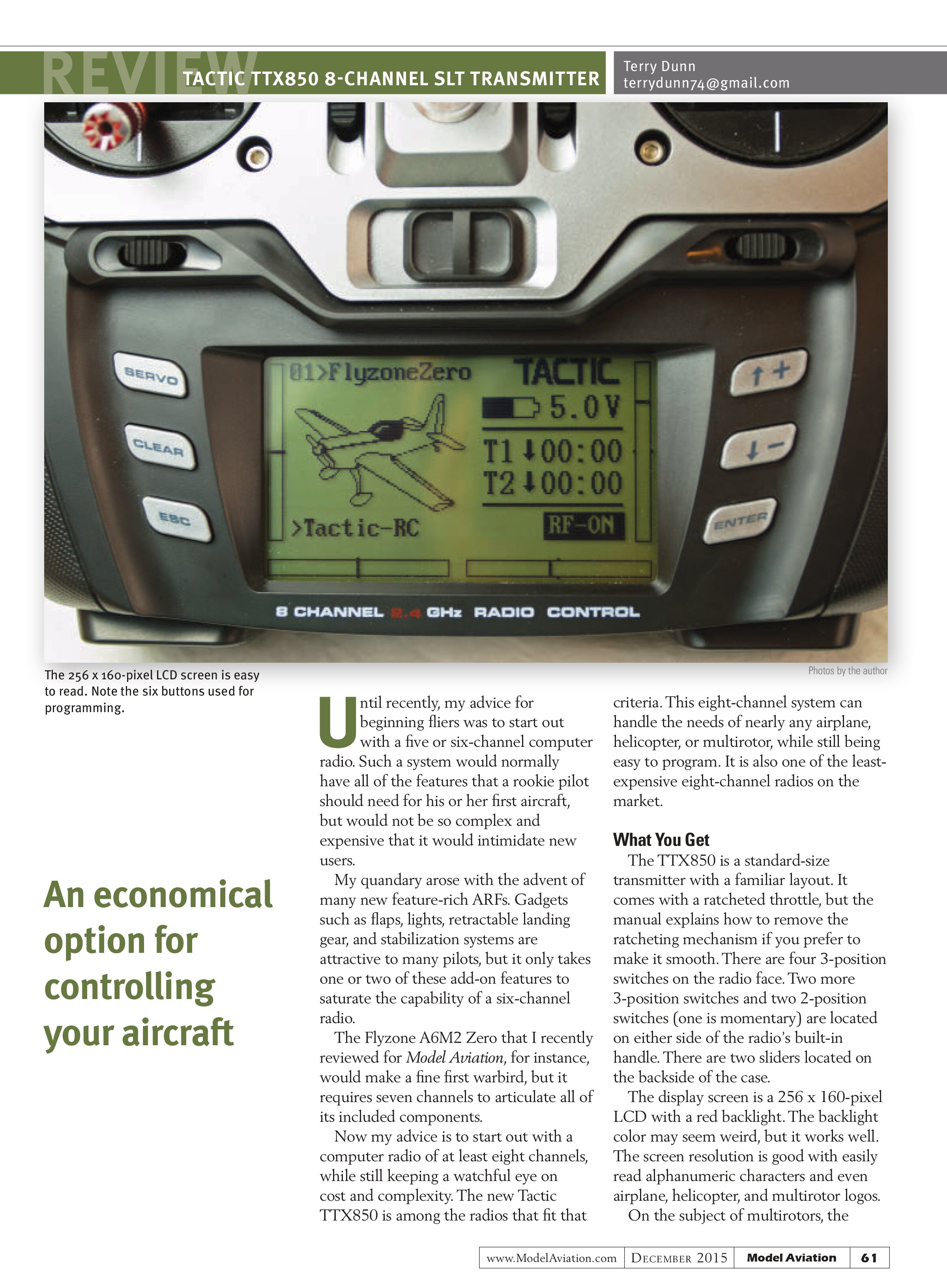
The display screen is a 256 x 160-pixel LCD with a red backlight. The backlight color may seem weird, but it works well. The screen resolution is good with easily read alphanumeric characters and even airplane, helicopter, and multirotor logos. On the subject of multirotors, the
TTX850 is the first radio I’ve owned that has multirotors listed as a separate model type. This is a nod to the fact that multirotors share some airplane traits and some helicopter traits—at least in terms of radio programming. By having multirotors defined as a separate model type, the customization options are better suited to the specific needs of these aircraft.
The TTX850 also includes a menu option for controlling a two-axis camera gimbal. These devices are becoming common among pilots who like to shoot photos and videos from their models. Having dedicated setup options to tailor how the gimbal performs is a novel feature.
Unlike many radios in this price range, the TTX850 includes a rechargeable battery and wall charger. In this case, the battery is a 4S 1,000 mAh NiMH. With the included foam inserts, it fits snugly in the battery compartment and does not rattle around.
The TTX850 does not include a receiver. The radio’s SLT protocol makes it compatible with all of the many transmitter-ready models from Flyzone and Heli-Max. It can also be paired with any of the Tactic SLT receivers for use in other models. This includes the TR825 eight-channel receiver, which Tactic released in parallel with the TTX850.
Using the TTX850
Programming is accomplished via six buttons that are arranged on either side of the LCD. The menus are clear and easy to navigate when you understand the function of each button. Anyone who has used this radio’s little brother, the six-channel TTX650, will feel right at home when programming the TTX850 because the menus are similar.
The manual does a good job of explaining how to program the radio, but my opinion is somewhat mixed regarding how well it explains the purpose of every function. Some things, such as dual rates and throttle cut, are explained well. Flap mixing and airbrake, however, are not as clear.


At a Glance
Specifications
Type: Computer transmitter
Skill level: Beginner to advanced
Number of channels: Eight
Model memory: 30
Frequency: 2.4 GHz
Modulation: FHSS spread spectrum
Power supply: 4S 1,000 mAh NiMH battery pack
Current drain: 100 to 120 mA
Trim type: Digital
Gimbal type: Ball bearing
View screen: 256 x 160 LCD
Program input: Six buttons
Trainer function: Wired/wireless
Number of switches: Eight (six 3-position, two 2-position)
Number of sliders: Two
Number of knobs: None
Receiver: Compatible with Tactic SLT receivers (not included)
Charger: 100 to 240-volt AC input/6-volt 100 mA output
Street price: $139.98
Helicopter Program Features
- Three swashplate types
- Pitch curves (12 point)
- Throttle curves (12 point)
- Swashplate ring function
- Throttle hold
- Swashplate mix function
- Six programmable mixes
Airplane Program Features
- Eight wing/tail types
- Three built-in wing mixes
- Three flap mixes
- Six programmable mixes
- Aileron differential function
- Throttle curve (12 point)
- Throttle cut
- Airbrake function
- Idle-low function
- Camera gimbal control
Multirotor Program Features
- Throttle curve (12 point)
- Throttle cut
- Throttle hold
- Camera gimbal control
- Gyro gain
TR-825 Receiver Specifications
Channels: Eight
Modulation: FHSS spread spectrum
Weight: .35 ounce
Size: 1.8 x 1.1 x 0.5 inches
Current drain: 20 to 25 mA
Antenna length: 2 x 5.9 inches
Intention: Full range
Price: $39.99
Pluses
- Eight channels at a budget price.
- Easy programming with many options.
- NiMH battery included.
Minus
- Manual could be more descriptive and thorough.
This will likely be a first computer radio for many aeromodelers. For them, it is helpful to not only know how to make a change to the radio setup, but also to understand how the change might affect their model’s flying characteristics.
I have programmed the TTX850 for several models including two airplanes, a sailplane, a helicopter, and a multirotor. Some of them are transmitter-ready models, while others have a Tactic receiver that I installed. In every instance, the radio configuration process went smoothly and the radio has performed without hiccups.
Although a neck strap is included, I have not used it. I prefer to hold my transmitters and use a pinch grip on the sticks.
Because of the size of my hands and the grip that I use, I find the sliders on back awkward to manipulate. Until I can train my third finger on each hand to move the sliders, I have to release my pinch on the sticks to actuate them. Other fliers with different-size hands or alternate gripping styles may not have any problems with working the sliders.
When I write reviews, I often try to put the product into the hands of some of my flying friends. This gives me a range of opinions to draw from and also helps me calibrate my own thoughts.
I was a little sneaky with the TTX850 because I asked my friends to fly a particular airplane, but didn’t mention anything about the radio that I handed to them. I noticed that the pilots who own other Tactic radios took notice of the TTX850 and commented—all of them positive.
My other unsuspecting evaluators said nothing about the radio. To me, their silence is just as informative. It tells me that the radio performed as expected and didn’t have any balance or feel issues that would make it stand out from their radios.
Radio Uses
I noted in the beginning of this article that the TTX850 would make a good first computer radio, but I don’t mean to imply that it is only suited for rookies. Some of my more-costly radios may have more channels and/or fancy features such as telemetry and color displays, but there is nothing that prevents me from using the TTX850 with any model in my fleet. It has all of the features needed to handle the majority of aircraft you’ll find at any flying field.
In my case, the TTX850 replaces my “go-to” radio for park flyer and transmitter-ready models, a six-channel Tactic TTX650. My older Tactic still works fine, but some of my newer aircraft could make use of the TTX850’s two additional channels.
I think that my upgrade will be a common path for current TTX650 owners. The TTX850 will allow them to step into more complex aircraft, or utilize additional features on the models they already have.

I think another set of potential customers for the TTX850 is pilots who simply like to have several models (who doesn’t?). Because the compatible receivers are relatively inexpensive (six-channel units sell for roughly $20), it doesn’t get outrageously expensive to outfit a large fleet of aircraft. The radio can support up to 30 model profiles.
Conclusion
As average ARF models become more complex, the pilots who fly them will need a radio that can handle additional operations. The TTX850 isn’t flashy, but it is affordable and has all of the features and adjustability that most fliers will need.
—Terry Dunn
terrydunn74@gmail.com
MANUFACTURER/DISTRIBUTOR:
Hobbico
(800) 637-7660
www.tacticrc.com