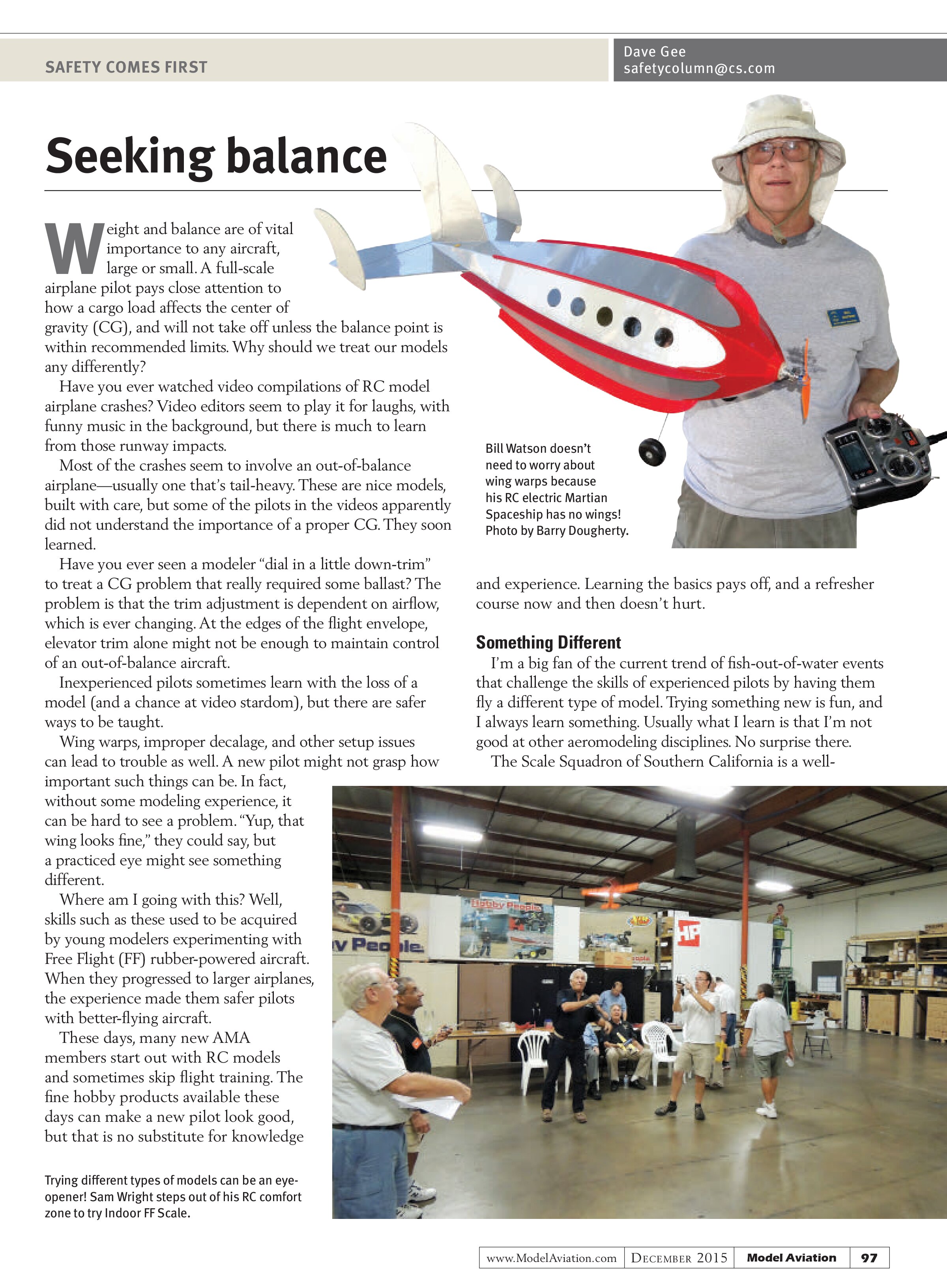
Seeking balance
Dave Gee
safetycolumn@cs.com
Weight and balance are of vital importance to any aircraft, large or small. A full-scale airplane pilot pays close attention to how a cargo load affects the center of gravity (CG), and will not take off unless the balance point is within recommended limits. Why should we treat our models any differently?
Have you ever watched video compilations of RC model airplane crashes? Video editors seem to play it for laughs, with funny music in the background, but there is much to learn from those runway impacts.
Most of the crashes seem to involve an out-of-balance airplane—usually one that’s tail-heavy. These are nice models, built with care, but some of the pilots in the videos apparently did not understand the importance of a proper CG. They soon learned.
Have you ever seen a modeler “dial in a little down-trim” to treat a CG problem that really required some ballast? The problem is that the trim adjustment is dependent on airflow, which is ever changing. At the edges of the flight envelope, elevator trim alone might not be enough to maintain control of an out-of-balance aircraft.
Inexperienced pilots sometimes learn with the loss of a model (and a chance at video stardom), but there are safer ways to be taught.
Wing warps, improper decalage, and other setup issues can lead to trouble as well. A new pilot might not grasp how important such things can be. In fact, without some modeling experience, it can be hard to see a problem. “Yup, that wing looks fine,” they could say, but a practiced eye might see something different.
Where am I going with this? Well, skills such as these used to be acquired by young modelers experimenting with Free Flight (FF) rubber-powered aircraft. When they progressed to larger airplanes, the experience made them safer pilots with better-flying aircraft.
These days, many new AMA members start out with RC models and sometimes skip flight training. The fine hobby products available these days can make a new pilot look good, but that is no substitute for knowledge

and experience. Learning the basics pays off, and a refresher course now and then doesn’t hurt.
Something Different
I’m a big fan of the current trend of fish-out-of-water events that challenge the skills of experienced pilots by having them fly a different type of model. Trying something new is fun, and I always learn something. Usually what I learn is that I’m not good at other aeromodeling disciplines. No surprise there.
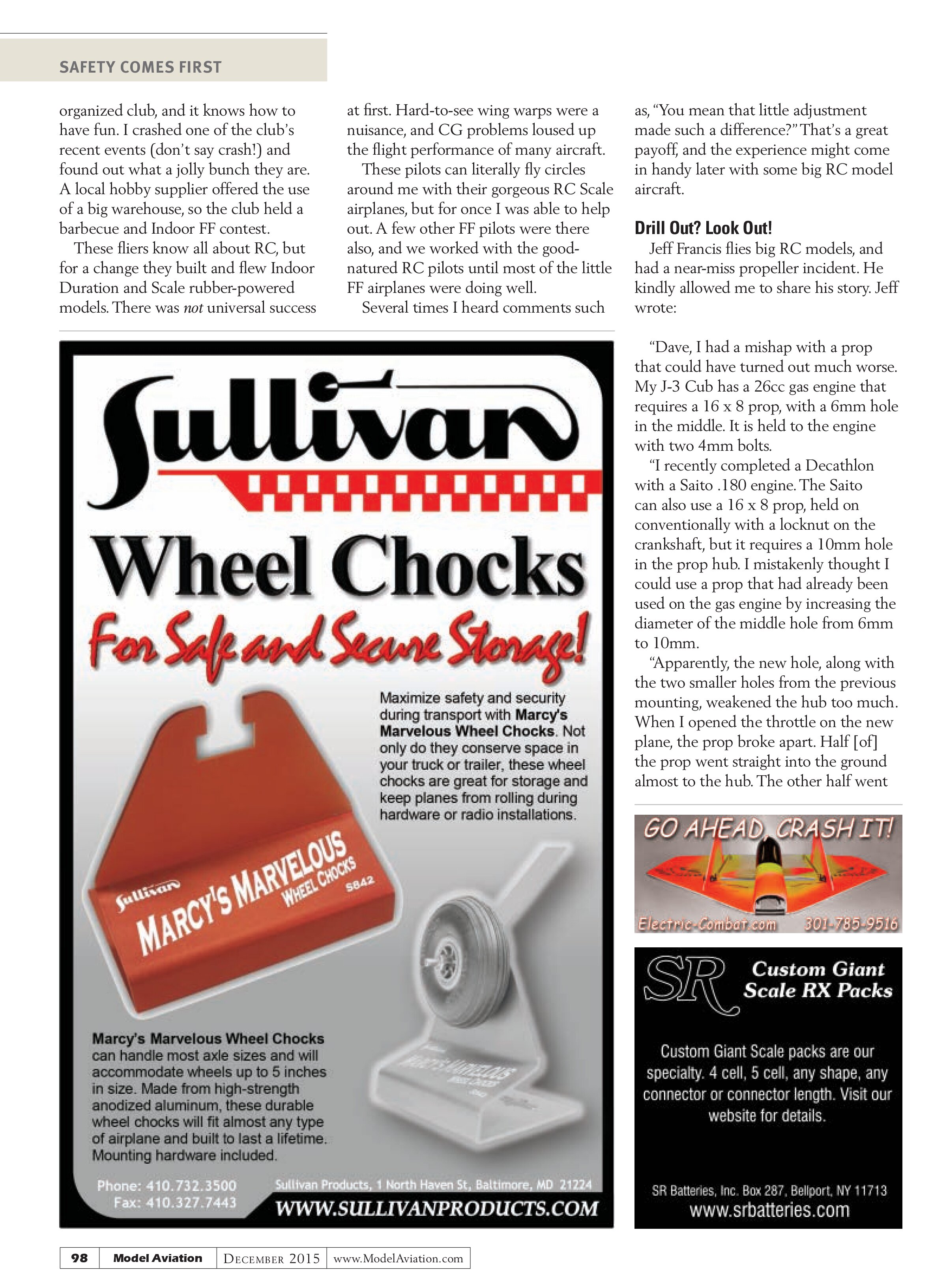
The Scale Squadron of Southern California is a well-

organized club, and it knows how to have fun. I crashed one of the club’s recent events (don’t say crash!) and found out what a jolly bunch they are. A local hobby supplier offered the use of a big warehouse, so the club held a barbecue and Indoor FF contest.
These fliers know all about RC, but for a change they built and flew Indoor Duration and Scale rubber-powered models. There was not universal success at first. Hard-to-see wing warps were a nuisance, and CG problems loused up the flight performance of many aircraft. These pilots can literally fly circles around me with their gorgeous RC Scale airplanes, but for once I was able to help out. A few other FF pilots were there also, and we worked with the good-natured RC pilots until most of the little FF airplanes were doing well.
Several times I heard comments such as, “You mean that little adjustment made such a difference?” That’s a great payoff, and the experience might come in handy later with some big RC model aircraft.
Drill Out? Look Out!
Jeff Francis flies big RC models, and had a near-miss propeller incident. He kindly allowed me to share his story. Jeff wrote:
“Dave, I had a mishap with a prop that could have turned out much worse. My J-3 Cub has a 26cc gas engine that requires a 16 x 8 prop, with a 6mm hole in the middle. It is held to the engine with two 4mm bolts.
“I recently completed a Decathlon with a Saito .180 engine. The Saito can also use a 16 x 8 prop, held on conventionally with a locknut on the crankshaft, but it requires a 10mm hole in the prop hub. I mistakenly thought I could use a prop that had already been used on the gas engine by increasing the diameter of the middle hole from 6mm to 10mm.
“Apparently, the new hole, along with the two smaller holes from the previous mounting, weakened the hub too much. When I opened the throttle on the new plane, the prop broke apart. Half [of] the prop went straight into the ground almost to the hub. The other half went