Mastering partial snap rolls
by John Glezellis
jglezellis@gmail.com
As newcomers advance through the ranks of International Miniature Aerobatic Club (IMAC) competition, they should realize that certain maneuvers build upon others. Although basic elements remain the same, each figure contains increasingly more difficult components that pilots must perform.
The topic of this month’s column is partial snap rolls, which can be challenging to consistently execute because of the aircraft’s orientation throughout the rotation of the maneuver. In addition to exploring the judging criteria for the basic form of this maneuver, I will examine the physical setup of an aircraft and certain control techniques needed to have a model that has a consistent performance.

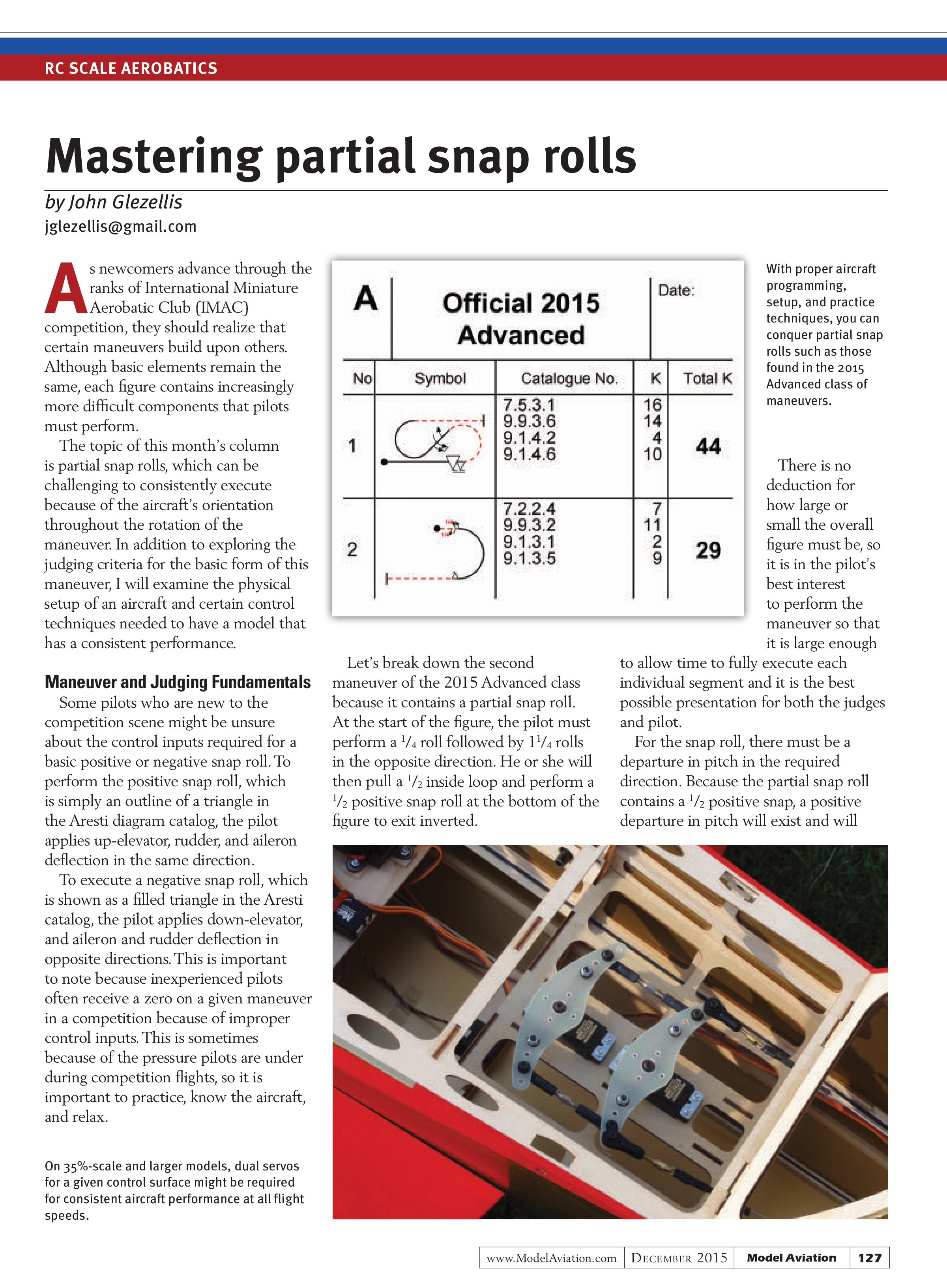
With proper aircraft programming, setup, and practice techniques, you can conquer partial snap rolls such as those found in the 2015 Advanced class of maneuvers.
There is no deduction for how large or small the overall figure must be, so it is in the pilot’s best interest to perform the maneuver so that it is large enough to allow time to fully execute each individual segment and it is the best possible presentation for both the judges and pilot.
Maneuver and Judging Fundamentals
Some pilots who are new to the competition scene might be unsure about the control inputs required for a basic positive or negative snap roll. To perform the positive snap roll, which is simply an outline of a triangle in the Aresti diagram catalog, the pilot applies up-elevator, rudder, and aileron deflection in the same direction.
To execute a negative snap roll, which is shown as a filled triangle in the Aresti catalog, the pilot applies down-elevator, and aileron and rudder deflection in opposite directions. This is important to note because inexperienced pilots often receive a zero on a given maneuver in a competition because of improper control inputs. This is sometimes because of the pressure pilots are under during competition flights, so it is important to practice, know the aircraft, and relax.
Let’s break down the second maneuver of the 2015 Advanced class because it contains a partial snap roll. At the start of the figure, the pilot must perform a ¹/₄ roll followed by 1¹/₄ rolls in the opposite direction. He or she will then pull a ¹/₂ inside loop and perform a ¹/₂ positive snap roll at the bottom of the figure to exit inverted.
For the snap roll, there must be a departure in pitch in the required direction. Because the partial snap roll contains a ¹/₂ positive snap, a positive departure in pitch will exist and will to allow time to fully execute each individual segment and it is the best possible presentation for both the judges and pilot.

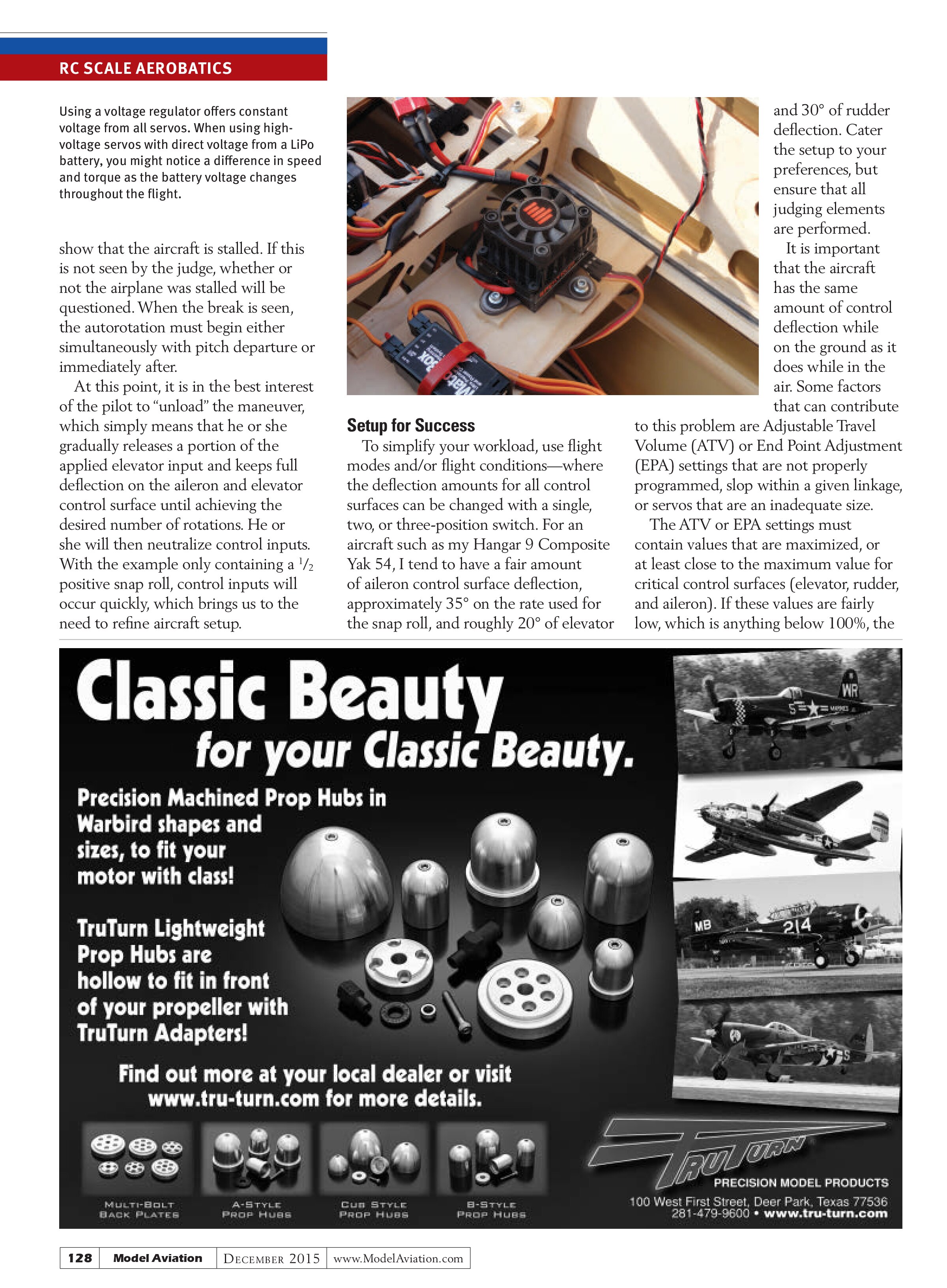
Using a voltage regulator offers constant voltage from all servos. When using high-voltage servos with direct voltage from a LiPo battery, you might notice a difference in speed and torque as the battery voltage changes throughout the flight.
show that the aircraft is stalled. If this is not seen by the judge, whether or not the airplane was stalled will be questioned. When the break is seen, the autorotation must begin either simultaneously with pitch departure or immediately after.
At this point, it is in the best interest of the pilot to “unload” the maneuver, which simply means that he or she gradually releases a portion of the applied elevator input and keeps full deflection on the aileron and elevator control surface until achieving the desired number of rotations. He or she will then neutralize control inputs. With the example only containing a ¹/₂ positive snap roll, control inputs will occur quickly, which brings us to the need to refine aircraft setup.

Setup for Success
To simplify your workload, use flight modes and/or flight conditions—where the deflection amounts for all control surfaces can be changed with a single, two, or three-position switch. For an aircraft such as my Hangar 9 Composite Yak 54, I tend to have a fair amount of aileron control surface deflection, approximately 35° on the rate used for the snap roll, and roughly 20° of elevator and 30° of rudder deflection. Cater the setup to your preferences, but ensure that all judging elements are performed.
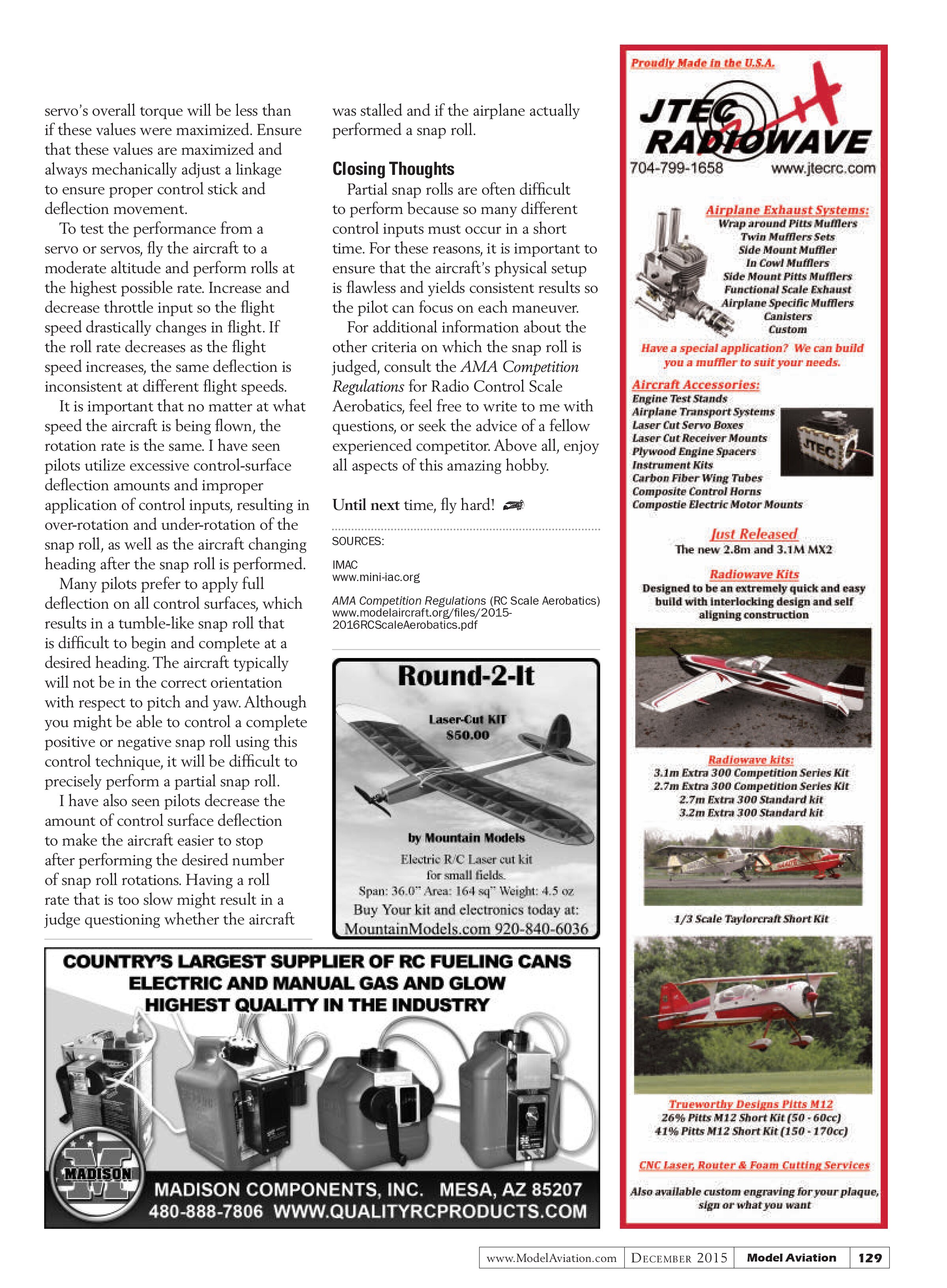
It is important that the aircraft has the same amount of control deflection while on the ground as it does while in the air. Some factors that can contribute to this problem are Adjustable Travel Volume (ATV) or End Point Adjustment (EPA) settings that are not properly programmed, slop within a given linkage, or servos that are an inadequate size.
The ATV or EPA settings must contain values that are maximized, or at least close to the maximum value for critical control surfaces (elevator, rudder, and aileron). If these values are fairly low, which is anything below 100%, the servo’s overall torque will be less than if these values were maximized. Ensure that these values are maximized and always mechanically adjust a linkage to ensure proper control stick and deflection movement.
To test the performance from a servo or servos, fly the aircraft to a moderate altitude and perform rolls at the highest possible rate. Increase and decrease throttle input so the flight speed drastically changes in flight. If the roll rate decreases as the flight speed increases, the same deflection is inconsistent at different flight speeds.
It is important that no matter at what speed the aircraft is being flown, the rotation rate is the same. I have seen pilots utilize excessive control-surface deflection amounts and improper application of control inputs, resulting in over-rotation and under-rotation of the snap roll, as well as the aircraft changing heading after the snap roll is performed.
Many pilots prefer to apply full deflection on all control surfaces, which results in a tumble-like snap roll that is difficult to begin and complete at a desired heading. The aircraft typically will not be in the correct orientation with respect to pitch and yaw. Although you might be able to control a complete positive or negative snap roll using this control technique, it will be difficult to precisely perform a partial snap roll.
I have also seen pilots decrease the amount of control surface deflection to make the aircraft easier to stop after performing the desired number of snap roll rotations. Having a roll rate that is too slow might result in a judge questioning whether the aircraft was stalled and if the airplane actually performed a snap roll.
Closing Thoughts
Partial snap rolls are often difficult to perform because so many different control inputs must occur in a short time. For these reasons, it is important to ensure that the aircraft’s physical setup is flawless and yields consistent results so the pilot can focus on each maneuver.
For additional information about the other criteria on which the snap roll is judged, consult the AMA Competition Regulations for Radio Control Scale Aerobatics, feel free to write to me with questions, or seek the advice of a fellow experienced competitor. Above all, enjoy all aspects of this amazing hobby.
Until next time, fly hard!
SOURCES:
IMAC
www.mini-iac.org
AMA Competition Regulations (RC Scale Aerobatics)
www.modelaircraft.org/files/2015-2016RCScaleAerobatics.pdf