Building an FPV racer
Chris Mulcahy
cspaced@gmail.com

At the 2014 Heli Extravaganza, held at Triple Tree Aerodrome in Woodruff, South Carolina, I got my first taste of FPV racing. A course was set up on the southern side of the 3-D line that consisted of yellow caution tape to mark the way, with a few natural obstacles thrown into the mix.
My friend, Tim King, was responsible for the course layout, and he offered to let me use his 250-class FPV quadcopter to race the course. After a few laps, I was hooked, and unofficially achieved the fastest lap time! Of course, when Tim got his quadcopter back, the propellers were slightly shorter and an antenna may or may not have been broken (I think it was like that before I started!).
There is a certain amount of sheer exhilaration associated with FPV flying, and that exhilaration is increased exponentially when you add racing to the mix! Outside of helicopters, I enjoy Pylon Racing, so it wasn’t much of a leap for me to get interested in FPV racing. As the Heli Extravaganza wound down, I vowed that I would build my own 250 FPV quadcopter racer for this year’s race!
Fast forward to 11 months later, and here I am scrambling to get one together before I headed to Triple Tree in September. I’m definitely late to the party with this one! I turned to the man who gave me my first taste of FPV racing, Tim, and together we figured out what the best setup would be.
My strategy for building this racer was simple: build it cheap. I should actually say inexpensive because cheap is not really the right word. My logic was that I would be racing hard—right on the ragged edge—so there would inevitably be crashes along the way. As much punishment as this thing was going to take, I wanted it to be tough and inexpensive—something that could take a licking and keep on ticking!
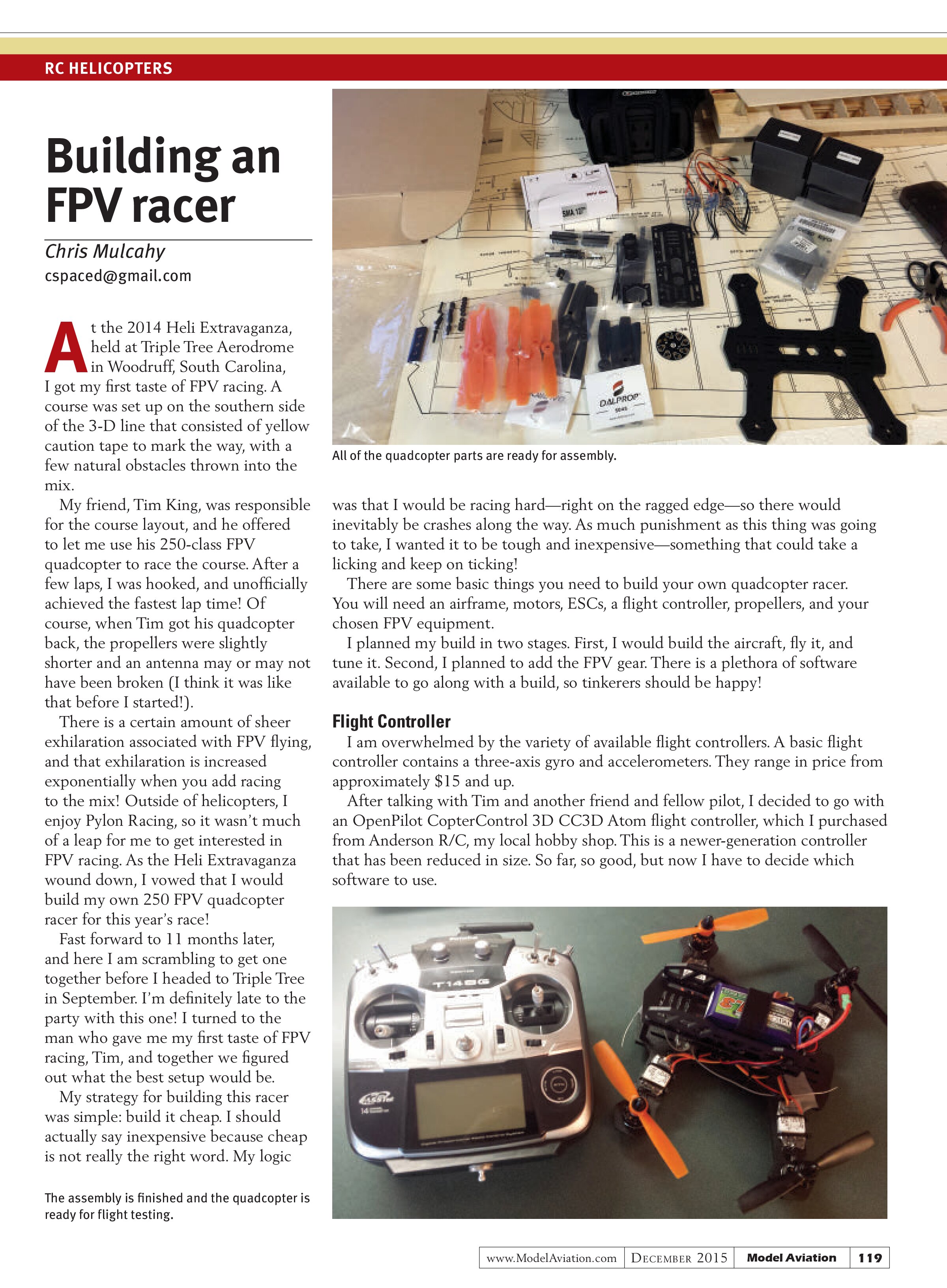
There are some basic things you need to build your own quadcopter racer. You will need an airframe, motors, ESCs, a flight controller, propellers, and your chosen FPV equipment.
I planned my build in two stages. First, I would build the aircraft, fly it, and tune it. Second, I planned to add the FPV gear. There is a plethora of software available to go along with a build, so tinkerers should be happy!
Flight Controller
I am overwhelmed by the variety of available flight controllers. A basic flight controller contains a three-axis gyro and accelerometers. They range in price from approximately $15 and up.
After talking with Tim and another friend and fellow pilot, I decided to go with an OpenPilot CopterControl 3D CC3D Atom flight controller, which I purchased from Anderson R/C, my local hobby shop. This is a newer-generation controller that has been reduced in size. So far, so good, but now I have to decide which software to use.
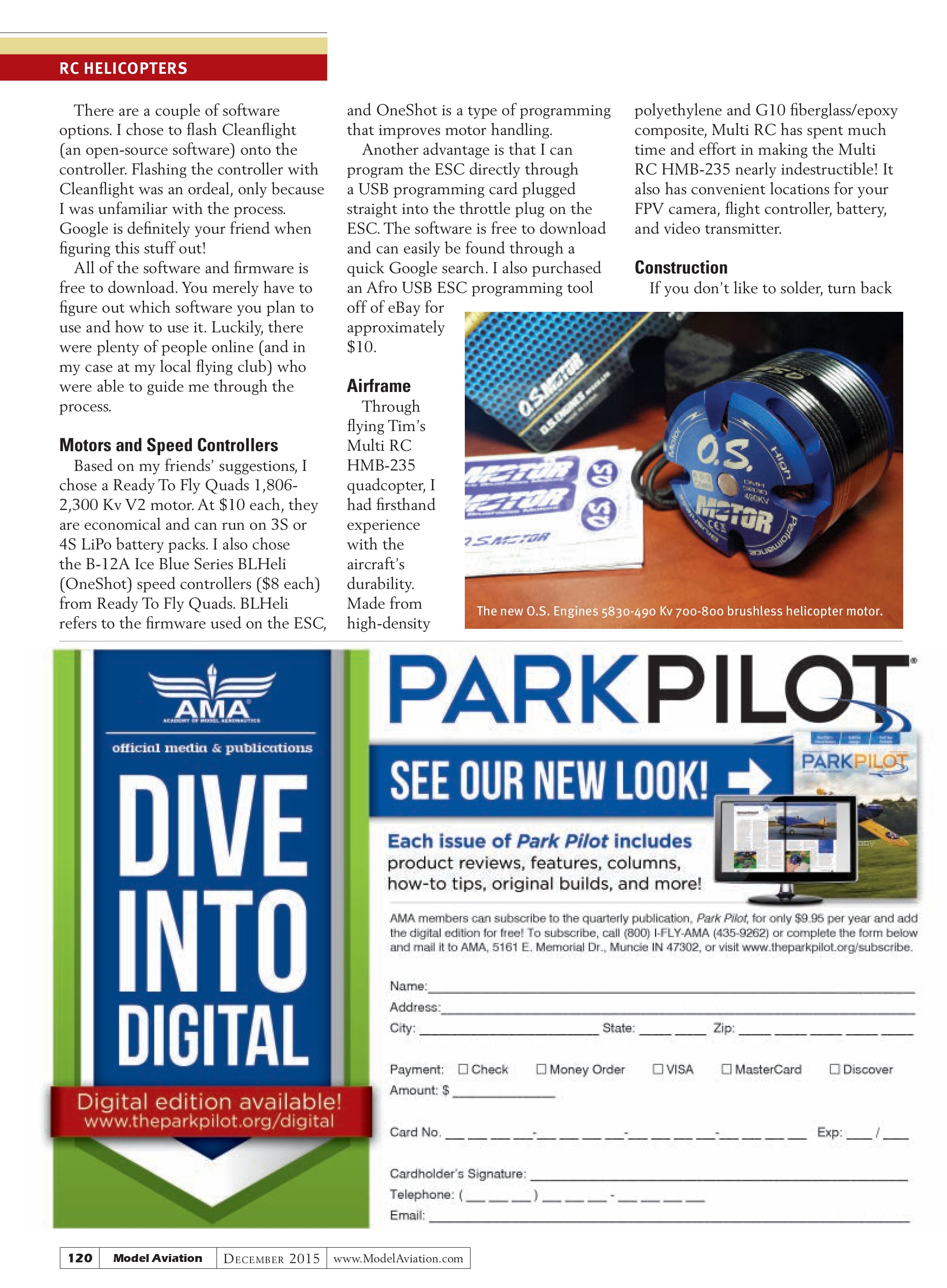
The assembly is finished and the quadcopter is ready for flight testing.

There are a couple of software options. I chose to flash Cleanflight (an open-source software) onto the controller. Flashing the controller with Cleanflight was an ordeal, only because I was unfamiliar with the process. Google is definitely your friend when figuring this stuff out!
All of the software and firmware is free to download. You merely have to figure out which software you plan to use and how to use it. Luckily, there were plenty of people online (and in my case at my local flying club) who were able to guide me through the process.
Motors and Speed Controllers
Based on my friends’ suggestions, I chose a Ready To Fly Quads 1,806-2,300 Kv V2 motor. At $10 each, they are economical and can run on 3S or 4S LiPo battery packs. I also chose the B-12A Ice Blue Series BLHeli (OneShot) speed controllers ($8 each) from Ready To Fly Quads. BLHeli refers to the firmware used on the ESC, and OneShot is a type of programming that improves motor handling.
Another advantage is that I can program the ESC directly through a USB programming card plugged straight into the throttle plug on the ESC. The software is free to download and can easily be found through a quick Google search. I also purchased an Afro USB ESC programming tool off of eBay for approximately $10.
Airframe
Through flying Tim’s Multi RC HMB-235 quadcopter, I had firsthand experience with the aircraft’s durability. Made from high-density polyethylene and G10 fiberglass/epoxy composite, Multi RC has spent much time and effort in making the Multi RC HMB-235 nearly indestructible! It also has convenient locations for your FPV camera, flight controller, battery, and video transmitter.

Construction
If you don’t like to solder, turn back now! There is some soldering involved in building the quad. I shortened all of the motor wires and soldered them directly to the ESCs. The ESCs were then soldered directly to the power distribution board (I had a small board in my box of spare parts).
I didn’t worry about motor direction because I could program that later with my programming tool, otherwise I would have to test the motor direction and switch two of the wires around if the motors needed to be reversed. The motors bolt onto the frame, and double-sided foam tape and 3M dual lock were used to secure everything else.
Improvise
Because there are no instructions, I tried to come up with the best way to mount the equipment. I decided that I needed to make some platforms that I could screw onto the quadcopter frame. I have access to a nice 3-D printer, so I was able to draw my parts in 3-D and print them. Voilà! I had instant parts specifically for my quad.
You could do something similar with spare bits of carbon fiber, G10 material, or even plywood. You just need to be inventive.
Flying
I made sure everything in the software was correctly set up. I used a custom-built cable to operate my flight controller via the S.Bus system on my Futaba receiver. Satisfied that everything was ready, I did a quick test hover, tested directions and flight modes, and was ready to go!
I plan to fly the quadcopter, fine-tune its settings, and then install the FPV gear. I’ll touch on the FPV gear installation in next month’s column, by which time my racer will have had its trial by fire at the Heli Extravaganza!
New O.S. Motor
I’ve been using O.S. Engines electric motors in small electric airplanes for a while now, and have found them to be reliable, with plenty of power to get the job done.
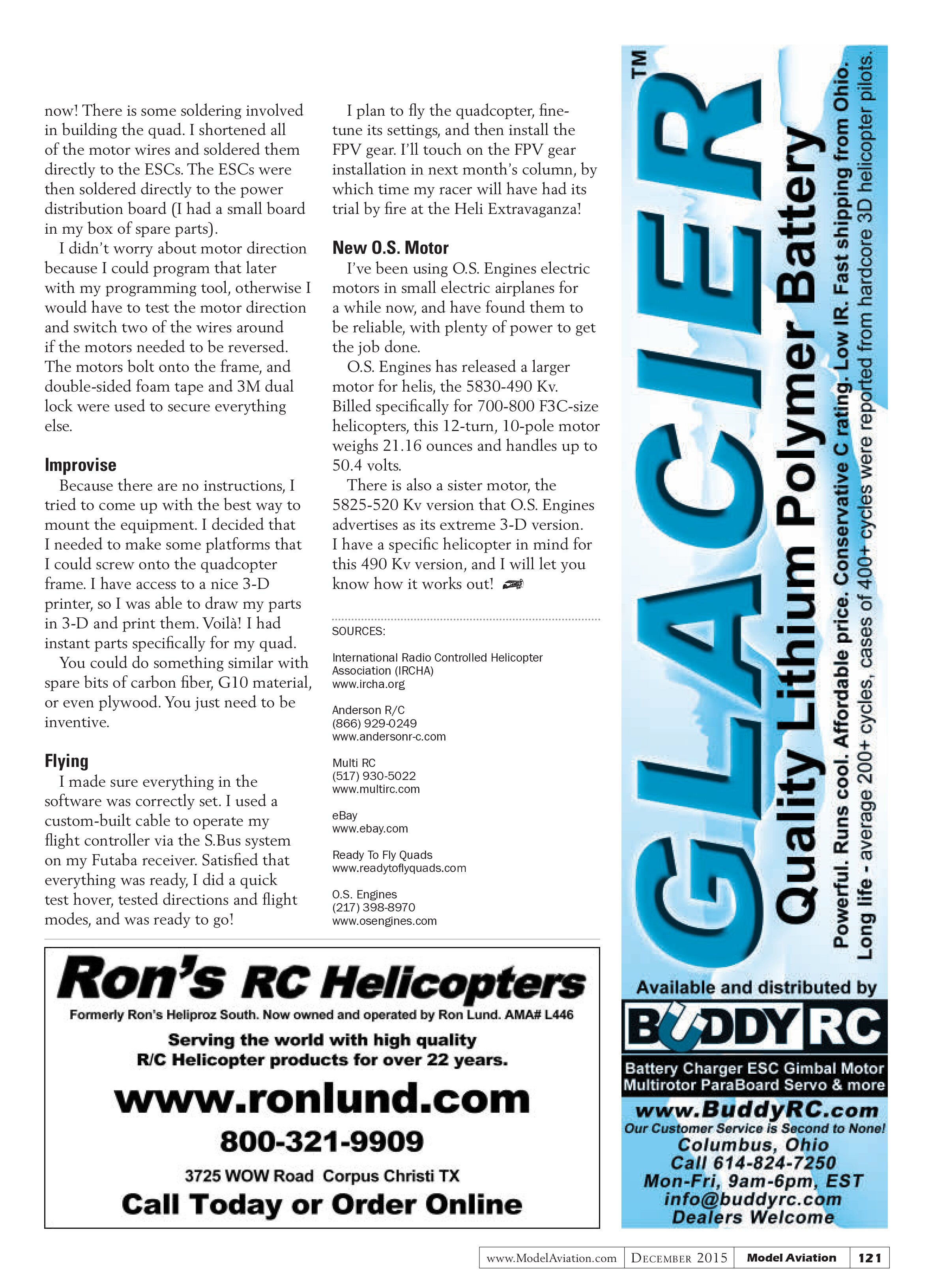
O.S. Engines has released a larger motor for helis, the 5830-490 Kv. Billed specifically for 700-800 F3C-size helicopters, this 12-turn, 10-pole motor weighs 21.16 ounces and handles up to 50.4 volts.
There is also a sister motor, the 5825-520 Kv version that O.S. Engines advertises as its extreme 3-D version. I have a specific helicopter in mind for this 490 Kv version, and I will let you know how it works out.
SOURCES:
International Radio Controlled Helicopter Association (IRCHA)
www.ircha.org
Anderson R/C
(866) 929-0249
www.anderson-r-c.com
Multi RC
(517) 930-5022
www.multirc.com
eBay
www.ebay.com
Ready To Fly Quads
www.readytoflyquads.com
O.S. Engines
(217) 398-8970
www.osengines.com