Elegant sailplane has the looks of an airliner in the sky


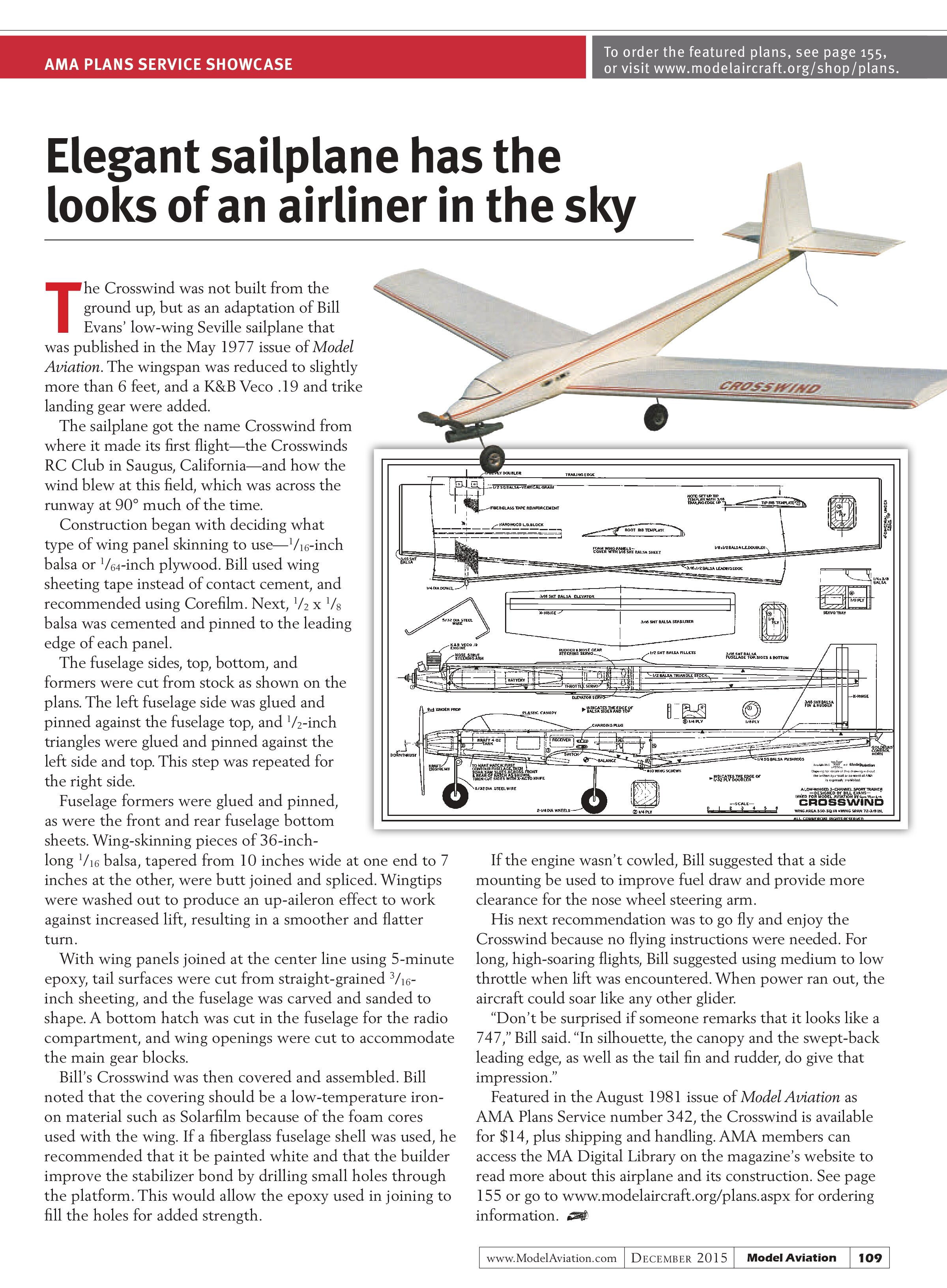
The Crosswind was not built from the ground up, but as an adaptation of Bill Evans’ low-wing Seville sailplane that was published in the May 1977 issue of Model Aviation. The wingspan was reduced to slightly more than 6 feet, and a K&B Veco .19 and trike landing gear were added.
The sailplane got the name Crosswind from where it made its first flight—the Crosswinds RC Club in Saugus, California—and how the wind blew at this field, which was across the runway at 90° much of the time.
Construction began with deciding what type of wing panel skinning to use—1/16-inch balsa or 1/64-inch plywood. Bill used wing sheeting tape instead of contact cement, and recommended using Corefilm. Next, 1/2 x 1/8 balsa was cemented and pinned to the leading edge of each panel.
The fuselage sides, top, bottom, and formers were cut from stock as shown on the plans. The left fuselage side was glued and pinned against the fuselage top, and 1/2-inch triangles were glued and pinned against the left side and top. This step was repeated for the right side.
Fuselage formers were glued and pinned, as were the front and rear fuselage bottom sheets. Wing-skinning pieces of 36-inch-long 1/16 balsa, tapered from 10 inches wide at one end to 7 inches at the other, were butt joined and spliced. Wingtips were washed out to produce an up-aileron effect to work against increased lift, resulting in a smoother and flatter turn.
With wing panels joined at the center line using 5-minute epoxy, tail surfaces were cut from straight-grained 3/16-inch sheeting, and the fuselage was carved and sanded to shape. A bottom hatch was cut in the fuselage for the radio compartment, and wing openings were cut to accommodate the main gear blocks.
Bill’s Crosswind was then covered and assembled. Bill noted that the covering should be a low-temperature iron-on material such as Solarfilm because of the foam cores used with the wing. If a fiberglass fuselage shell was used, he recommended that it be painted white and that the builder improve the stabilizer bond by drilling small holes through the platform. This would allow the epoxy used in joining to fill the holes for added strength.
If the engine wasn’t cowled, Bill suggested that a side mounting be used to improve fuel draw and provide more clearance for the nose wheel steering arm.
His next recommendation was to go fly and enjoy the Crosswind because no flying instructions were needed. For long, high-soaring flights, Bill suggested using medium to low throttle when lift was encountered. When power ran out, the aircraft could soar like any other glider.
“Don’t be surprised if someone remarks that it looks like a 747,” Bill said. “In silhouette, the canopy and the swept-back leading edge, as well as the tail fin and rudder, do give that impression.”
Featured in the August 1981 issue of Model Aviation as AMA Plans Service number 342, the Crosswind is available for $14, plus shipping and handling. AMA members can access the MA Digital Library on the magazine’s website to read more about this airplane and its construction. See page 155 or go to www.modelaircraft.org/plans.aspx for ordering information.