Rosecrans and Western
Bob Angel

The name Rosecrans and Western brings fond memories to many early Southern California modelers. Nationwide, there were many such regional flying sites that held abundant modeling history. Sadly, many—if not most—no longer exist.
Rosecrans and Western is today just another busy intersection in the greater Los Angeles area. Some time ago, I asked readers who wanted to share any history of such a site to write about it and send it in.
The response wasn’t overwhelming, but Bud Overn, from Tustin, California, sent a letter that contained fond remembrances of his first visit with his two older brothers to that beehive of activity at Rosecrans and Western. His letter closed by mentioning a song Bob Hope often sang: “Thanks for the Memories.”
Dave Lewis sent in an article from an old Fresno Model Club newsletter that was written by O.C. Randall, a well-known early modeler. Here’s an extraction:
“Early Sunday morning, December 7, 1941, a group from the Fresno Model club were driving south on old Highway 99 to a major contest at Rosecrans and Western. The date was burned into memory as they heard on the car radio about the Japanese attack on Pearl Harbor, leading us into WW II. But the story isn’t about that.
“The model meet went on as scheduled. Entry fees covered a box lunch for the fliers. Around noon they took a break and sat eating their lunches while waiting to watch a planned parachute demonstration.
“Soon a biplane flew over the field and a parachutist jumped. What happened next wasn’t part of the plan. Everyone watched as his chute streamed out of the pack, but failed to open! There were multiple power lines in the area. Instead of hitting the ground, the chutist hit those lines. He took a bounce back up before hitting the ground.
“This was quite a sight for a group of young modelers who scrambled across the field to the parachutist. They found him sitting upright, tangled in his parachute, living, breathing, and laughing a little at still being alive. He’d suffered only a broken leg. The modelers had much to talk about on the way back to Fresno.”
CL Aerobatics History
Instead of relaxing with a good book, I sometimes peruse two or three old modeling magazines. Francis Reynolds wrote a great technical column for Model Builder magazine for a number of years, right up until the magazine’s demise in 1996. He’s credited with being the first person to fly a Control Line (CL) model inverted and perform outside loops.
In the June 1996 issue of Model Builder, Francis’ column described how the model, which he’d named Moitle, performed those pioneering stunts.

assume that name was a “Brooklynese” corruption of the name Myrtle, which we often heard in old movies.
I normally would have only read Francis’ article plus John Pond’s “Plug Sparks” Old-Timer (OT) column, but that same issue contained a construction article for Moitle by Don Hutchinson. The model was a biplane with a symmetrical airfoil and was originally powered by a Super Cyclone spark-ignition engine.
In the June 1946 issue of Air Trails, Francis had presented an article about CL Aerobatics (Stunt) and conquering inverted flight. It wasn’t a construction article with plans, so he collaborated with Don to complete the plans for Moitle. Don flies OT CL Stunt events and had developed the article primarily for that genre. He points out that Moitle, built in 1944, is probably the oldest CL design capable of performing a competitive CL Stunt pattern.
More CL Notes
Jim Walker had thought he was the first to fly CL inverted, but a scribe decided that it was Francis Reynolds. The two later got together to compare notes.
Because up and down controls are reversed in inverted flight, Francis thought that he probably couldn’t master the reflexes necessary for inverted flight without reversing the lines, so he devised a handle that would rotate 180° when going inverted.
Jim used the same approach with a slightly different system, but both admitted that they had fewer crashes after they abandoned those gimmicks and flew with the regular handle. Oddly, Hal deBolt, whom I would have assumed had mastered every type of model flying, once confessed that he had never learned to fly CL aircraft inverted.
I learned CL flying the hard way, when a kid younger and smaller than I became my only mentor. I crashed three models merely attempting an inside loop, until I realized that most of the problem was the model I’d designed.
I was slow to figure out that the outer wing needed weight to counteract line drag. Otherwise, cranking in up-elevator brings the airplane up, over, and curling into the circle in a spiral figure 9.
Learning to fly inverted was easier with a properly set up, kit-built Ringmaster. I realized that years of flying fast models with too much engine and too little wing had developed a familiarity with using only up-control.
The secret was learning to push that handle into the down position. By doing S-shaped maneuvers starting from the bottom, you can get the feel of using the down-control. You can progressively elongate that center leg of the S into short, inverted flight segments, keeping in mind that you’re going to recover with full down movement.
Francis insisted, with some good arguments, that clockwise (viewed from above) CL flight is the proper way to go and he kept flying in that direction after most CL fliers had shifted to flying counterclockwise. Francis also cautioned that suddenly switching directions would ensure a crash. He’d proven that by trying to fly other fliers’ counterclockwise aircraft and crashing on two embarrassing occasions. He says your feedback as to up- or down-control input comes from the direction of your body’s rotation, not from watching the airplane.
As far as switching direction of travel to clockwise, it seems that it shouldn’t be a big problem if you don’t try flying inverted right away. And picturing it mentally, it might be easier if you also initially switch hands. In other words, if you fly right-handed and are switching from counterclockwise to clockwise, use your left hand to fly. But this whole scene is unlikely anyway.
Don Hutchinson inserted a caution in his Moitle article to use steel and not brass fittings in the control clevis/horn setup. He had lost a model because of a brass fitting failure. I assume he was referring to either the threaded brass adjusting rods that screw into clevises,

Buzz Averill
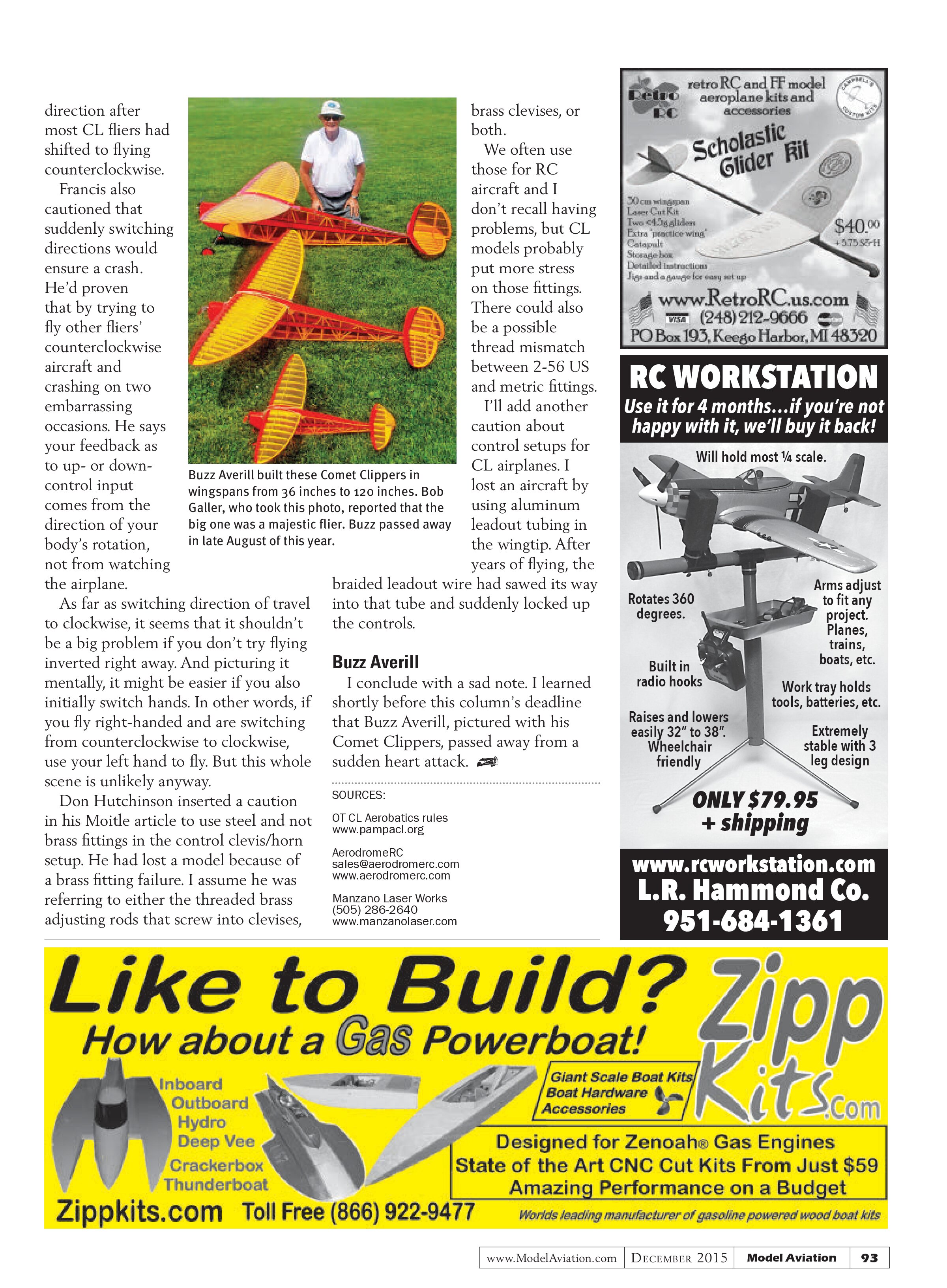
I conclude with a sad note. I learned shortly before this column’s deadline that Buzz Averill, pictured with his Comet Clippers, passed away from a sudden heart attack.