IRCHA Jamboree
Hell and quad pilots unite at the Crossroads of America
by Ray Stacy

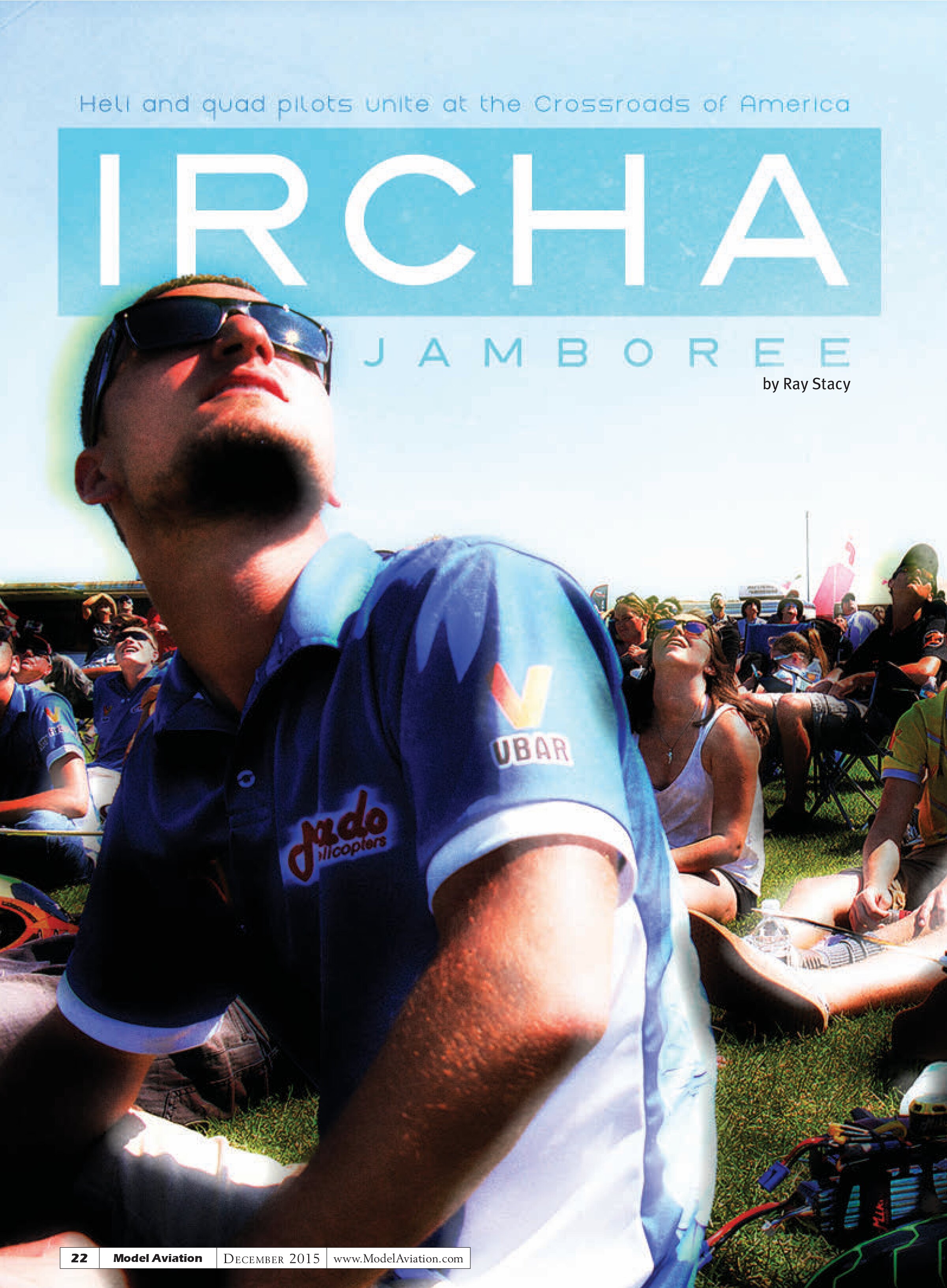
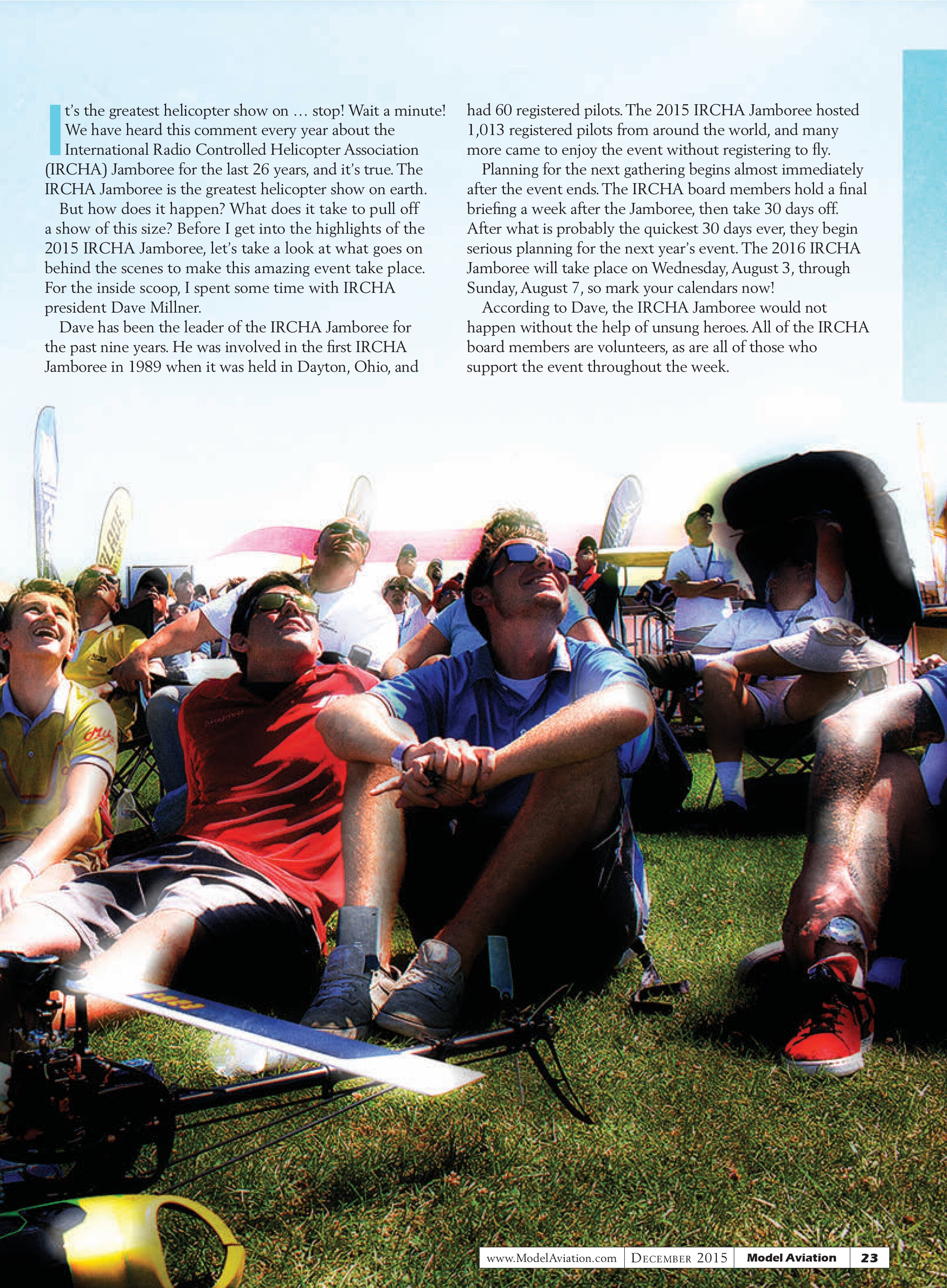
It’s the greatest helicopter show on … stop! Wait a minute! We have heard this comment every year about the International Radio Controlled Helicopter Association (IRCHA) Jamboree for the last 26 years, and it’s true. The IRCHA Jamboree is the greatest helicopter show on earth.
But how does it happen? What does it take to pull off a show of this size? Before I get into the highlights of the 2015 IRCHA Jamboree, let’s take a look at what goes on behind the scenes to make this amazing event take place. For the inside scoop, I spent some time with IRCHA president Dave Millner.
Dave has been the leader of the IRCHA Jamboree for the past nine years. He was involved in the first IRCHA Jamboree in 1989 when it was held in Dayton, Ohio, and had 60 registered pilots. The 2015 IRCHA Jamboree hosted 1,013 registered pilots from around the world, and many more came to enjoy the event without registering to fly.
Planning for the next gathering begins almost immediately after the event ends. The IRCHA board members hold a final briefing a week after the Jamboree, then take 30 days off. After what is probably the quickest 30 days ever, they begin serious planning for the next year’s event. The 2016 IRCHA Jamboree will take place on Wednesday, August 3, through Sunday, August 7, so mark your calendars now!
According to Dave, the IRCHA Jamboree would not happen without the help of unsung heroes. All of the IRCHA board members are volunteers, as are all of those who support the event throughout the week.

These people receive little recognition or thanks, and it’s time to fix that. I want to mention some of those unsung heroes, starting with IRCHA President Dave Millner; Vice President Charles Anderson; Secretary Shannon Lloyd; Treasurer Monte Brock; and Competition Coordinator Craig Bradley.
The board members are involved at the ground level. We need more people like this. Year after year, they somehow pull this event together and make it look good, while behind the


scenes it’s nonstop planning and coordinating to keep things organized and running smoothly.
Many AMA staff members also contribute to the Jamboree. Ilona Maine and Erin Dobbs work hard all year long to iron out the details for the event. Let’s not forget the AMA staff members who answer calls and handle camper registration, or those from the shipping department, the executive staff, and the people who put together this magazine.
The IRCHA Jamboree is held at the AMA’s International Aeromodeling Center (IAC) in Muncie, Indiana. By the time you and I get there, the grass is mowed, the tents are up, trash cans and porta-potties are in place, and I’m sure 100 other things have been taken care of. The amazing AMA maintenance staff, headed up by John Hawley, Josh Green, and Greg Messer make this happen. They have worked all summer during the Nats, then wrap up their year with a killer week at the IRCHA Jamboree.
Josh has been at every event that I have attended at the IAC. I always make it a point to thank him for his dedication at every event that I attend. I understand from AMA Executive Director Dave Mathewson that Josh’s compensation is a lifetime supply of energy drinks.
When you arrive at the event and get in line at the registration trailer, you are greeted by some of the nicest people whom I have ever met. Kandy Dudek, Sue Giles, and Helen Binkley have run that registration trailer for years and it has to be one of the smoothest operations around. They always have a smile and do their best to answer all questions.
Here is a short list of some key people on site without whose help the event would not happen. You may never hear their names, but you would know it if they didn’t show up: Jim Lloyd, Scott Riggs, Don Sanquenetti, Steve Darlington, Larry Broshar, Matt Hall, Dan Lucente, Steve and Gail Dixon, Kevin Cordell, Adam Hile and family, and countless other volunteers.
Let the Games Begin
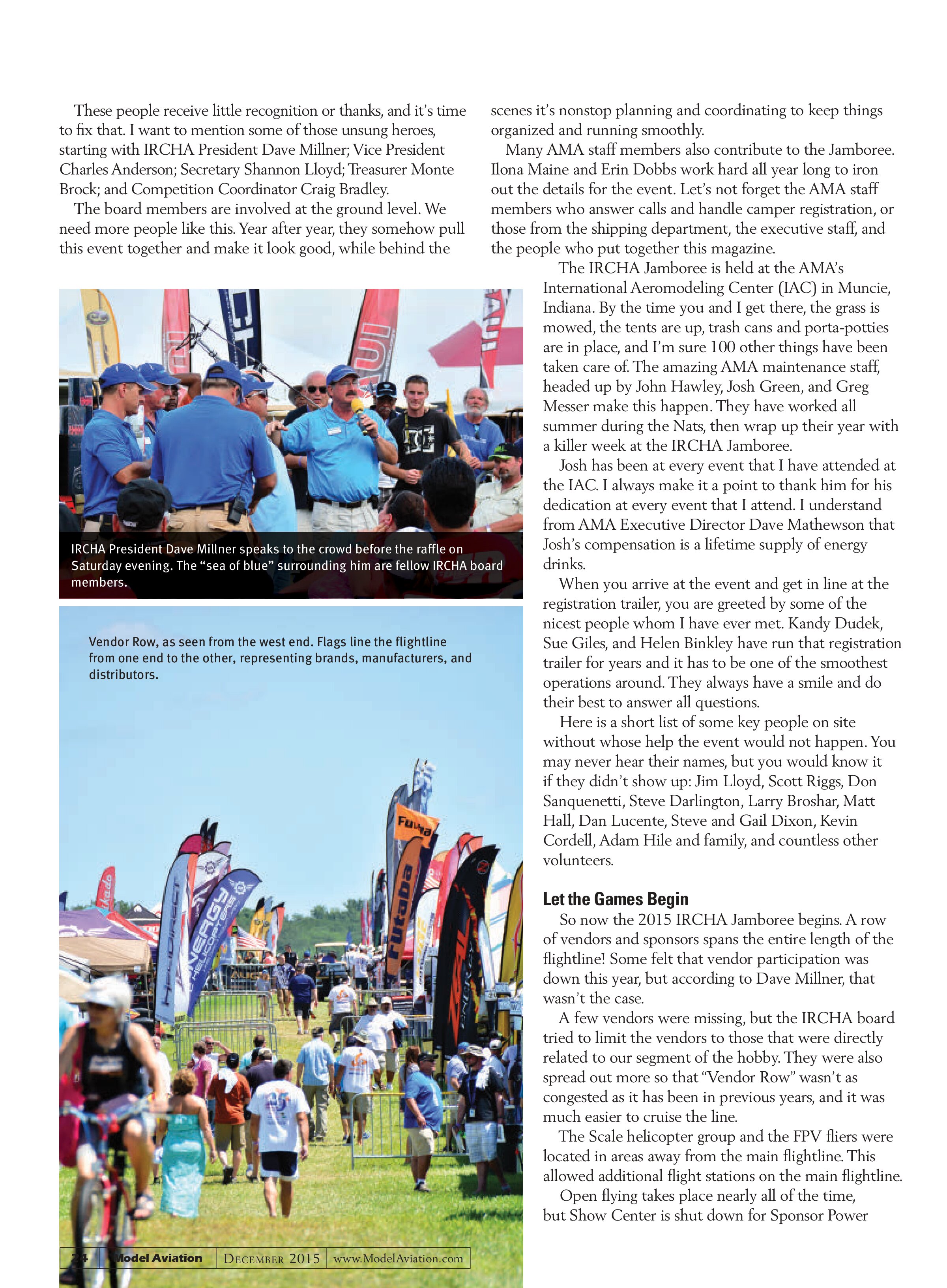
So now the 2015 IRCHA Jamboree begins. A row of vendors and sponsors spans the entire length of the flightline! Some felt that vendor participation was down this year, but according to Dave Millner, that wasn’t the case.
A few vendors were missing, but the IRCHA board tried to limit the vendors to those that were directly related to our segment of the hobby. They were also spread out more so that “Vendor Row” wasn’t as congested as it has been in previous years, and it was much easier to cruise the line.
The Scale helicopter group and the FPV fliers were located in areas away from the main flightline. This allowed additional flight stations on the main flightline.
Open flying takes place nearly all of the time, but Show Center is shut down for Sponsor Power
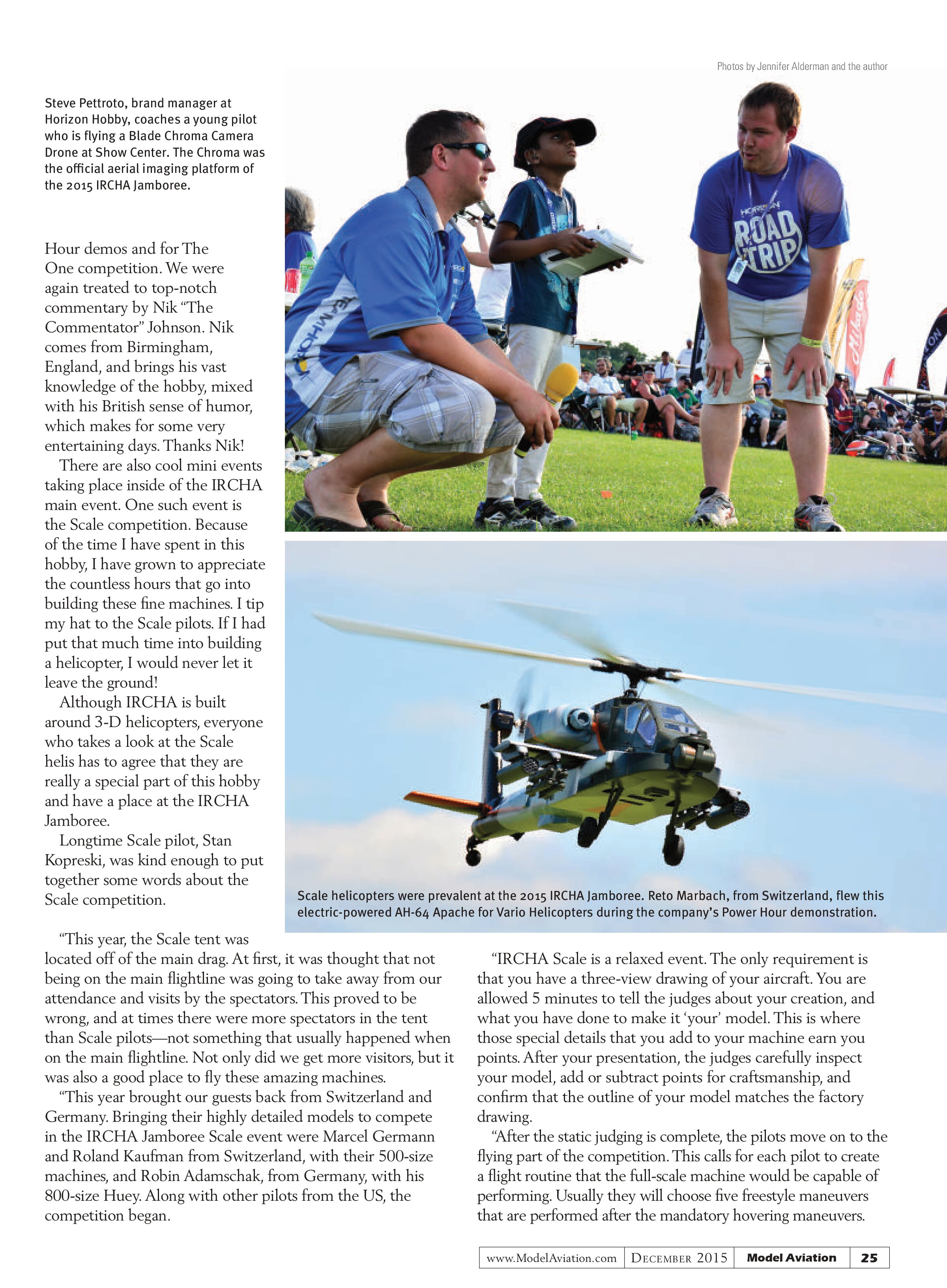
Steve Petrotto, brand manager at Horizon Hobby, coaches a young pilot who is flying a Blade Chroma Camera Drone at Show Center. The Chroma was the official aerial imaging platform of the 2015 IRCHA Jamboree.

Hour demos and for The One competition. We were again treated to top-notch commentary by Nik “The Commentator” Johnson. Nik comes from Birmingham, England, and brings his vast knowledge of the hobby, mixed with his British sense of humor, which makes for some very entertaining days. Thanks Nik!
There are also cool mini events taking place inside of the IRCHA main event. One such event is the Scale competition. Because of the time I have spent in this hobby, I have grown to appreciate the countless hours that go into building these fine machines. I tip my hat to the Scale pilots. If I had put that much time into building a helicopter, I would never let it leave the ground!
Although IRCHA is built around 3-D helicopters, everyone who takes a look at the Scale helis has to agree that they are really a special part of this hobby and have a place at the IRCHA Jamboree.
Longtime Scale pilot, Stan Kopreski, was kind enough to put together some words about the Scale competition.
“This year, the Scale tent was located off of the main drag. At first, it was thought that not being on the main flightline was going to take away from our attendance and visits by the spectators. This proved to be wrong, and at times there were more spectators in the tent than Scale pilots—not something that usually happened when on the main flightline. Not only did we get more visitors, but it was also a good place to fly these amazing machines.
“This year brought our guests back from Switzerland and Germany. Bringing their highly detailed models to compete in the IRCHA Jamboree Scale event were Marcel Germann and Roland Kaufman from Switzerland, with their 500-size machines, and Robin Adamschak, from Germany, with his 800-size Huey. Along with other pilots from the US, the competition began.
“IRCHA Scale is a relaxed event. The only requirement is that you have a three-view drawing of your aircraft. You are allowed 5 minutes to tell the judges about your creation, and what you have done to make it ‘your’ model. This is where those special details that you add to your machine earn you points. After your presentation, the judges carefully inspect your model, add or subtract points for craftsmanship, and confirm that the outline of your model matches the factory drawing.
“After the static judging is complete, the pilots move on to the flying part of the competition. This calls for each pilot to create a flight routine that the full-scale machine would be capable of performing. Usually they will choose five freestyle maneuvers that are performed after the mandatory hovering maneuvers.

“The mandatory maneuvers are the same as those used in the 518 Precision Scale event. They are hovering with clearing turns, followed by a 45° climbout, and a translational landing into the circle from where you started.
“As the flying started, the pilots were a bit nervous in front of the judges, but as the flight rounds went on, you could see that the confidence and smooth flying came back to them. After the flying was complete and the scores tallied, the top finishers

were announced. Congratulations to all. Please stop by next year and take a look at some of these amazing machines.”
Thank you, Stan!
IRCHA Speed Cup and FPV Racing
The 2015 IRCHA Speed Cup marked the event’s fifth year and it definitely lived up to all of the excitement surrounding the increase in speed popularity. With 29 competitors representing Germany, China, Taiwan, Japan, England, and the US, the IRCHA Speed Cup was a truly international competition.
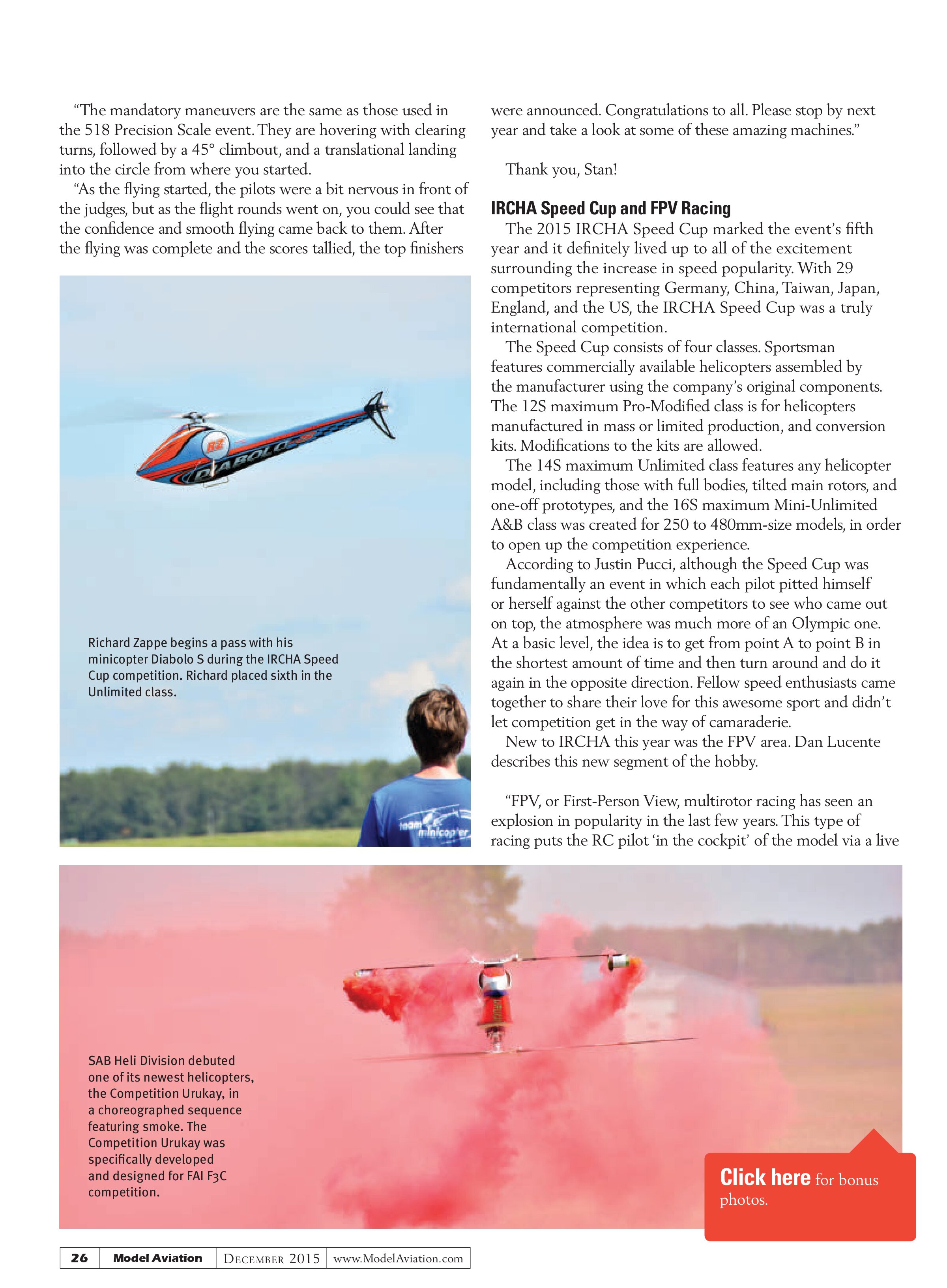
The Speed Cup consists of four classes. Sportsman features commercially available helicopters assembled by the manufacturer using the company’s original components. The 12S maximum Pro-Modified class is for helicopters manufactured in mass or limited production, and conversion kits. Modifications to the kits are allowed.
The 14S maximum Unlimited class features any helicopter model, including those with full bodies, tilted main rotors, and one-off prototypes, and the 16S maximum Mini-Unlimited A&B class was created for 250 to 480mm-size models, in order to open up the competition experience.
According to Justin Pucci, although the Speed Cup was fundamentally an event in which each pilot pitted himself or herself against the other competitors to see who came out on top, the atmosphere was much more of an Olympic one. At a basic level, the idea is to get from point A to point B in the shortest amount of time and then turn around and do it again in the opposite direction. Fellow speed enthusiasts came together to share their love for this awesome sport and didn’t let competition get in the way of camaraderie.
New to IRCHA this year was the FPV area. Dan Lucente describes this new segment of the hobby.
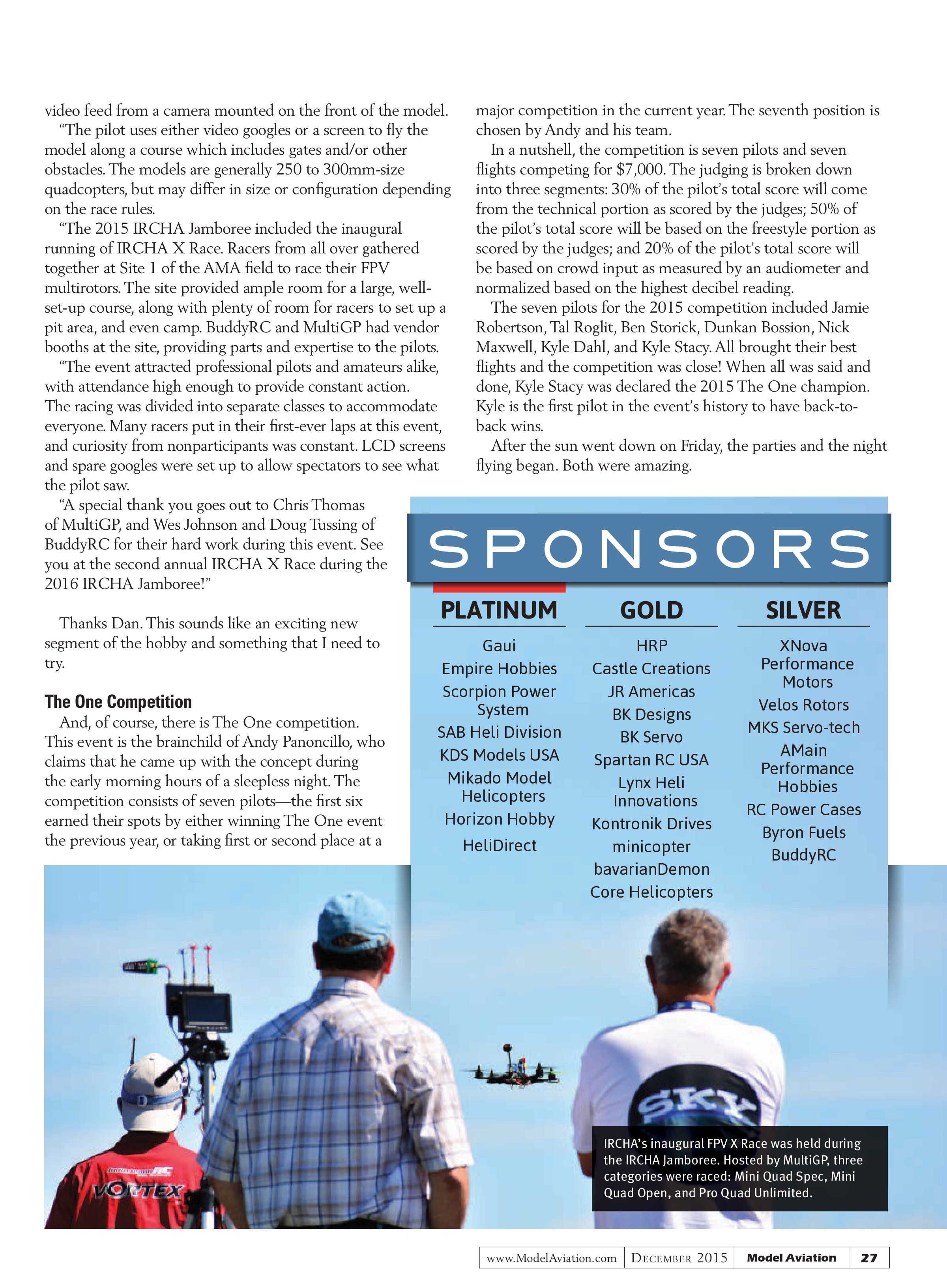
“FPV, or First-Person View, multirotor racing has seen an explosion in popularity in the last few years. This type of racing puts the RC pilot ‘in the cockpit’ of the model via a live video feed from a camera mounted on the front of the model. “The pilot uses either video goggles or a screen to fly the model along a course which includes gates and/or other obstacles. The models are generally 250 to 300mm-size quadcopters, but may differ in size or configuration depending on the race rules.
“The 2015 IRCHA Jamboree included the inaugural running of IRCHA X Race. Racers from all over gathered together at Site 1 of the AMA field to race their FPV multirotors. The site provided ample room for a large, well-set-up course, along with plenty of room for racers to set up a pit area, and even camp. BuddyRC and MultiGP had vendor booths at the site, providing parts and expertise to the pilots.
“The event attracted professional pilots and amateurs alike, with attendance high enough to provide constant action. The racing was divided into separate classes to accommodate everyone. Many racers put in their first-ever laps at this event, and curiosity from nonparticipants was constant. LCD screens and spare goggles were set up to allow spectators to see what the pilot saw.
“A special thank you goes out to Chris Thomas of MultiGP, and Wes Johnson and Doug Tussing of BuddyRC for their hard work during this event. See you at the second annual IRCHA X Race during the 2016 IRCHA Jamboree!”
Thanks Dan. This sounds like an exciting new segment of the hobby and something that I need to try.
The One Competition
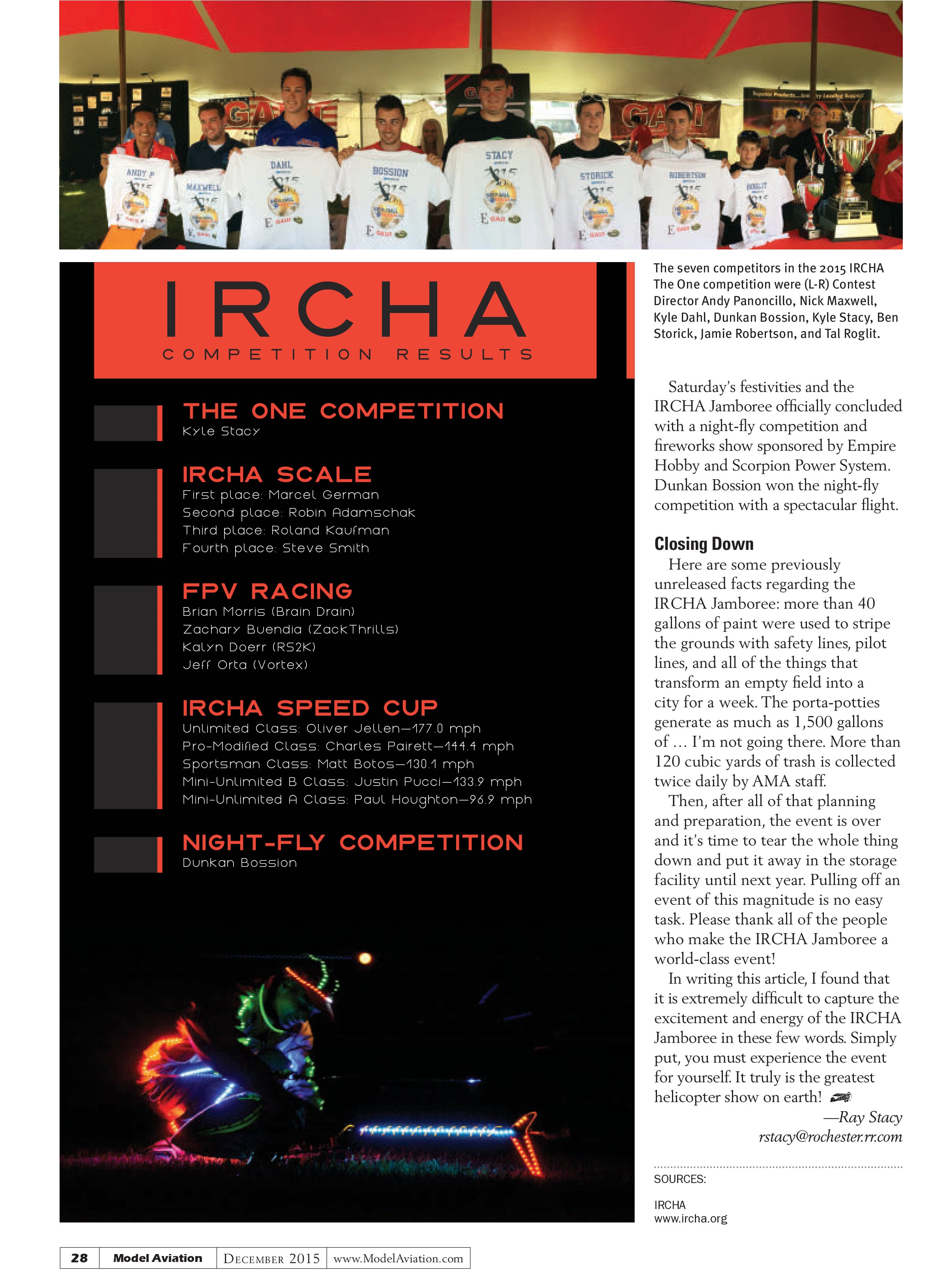
And, of course, there is The One competition. This event is the brainchild of Andy Panoncillo, who claims that he came up with the concept during the early morning hours of a sleepless night. The competition consists of seven pilots—the first six earned their spots by either winning The One event the previous year, or taking first or second place at a major competition in the current year. The seventh position is chosen by Andy and his team.
In a nutshell, the competition is seven pilots and seven flights competing for $7,000. The judging is broken down into three segments: 30% of the pilot’s total score will come from the technical portion as scored by the judges; 50% of the pilot’s total score will be based on the freestyle portion as scored by the judges; and 20% of the pilot’s total score will be based on crowd input as measured by an audiometer and normalized based on the highest decibel reading.
The seven pilots for the 2015 competition included Jamie Robertson, Tal Roglit, Ben Storick, Dunkan Bossion, Nick Maxwell, Kyle Dahl, and Kyle Stacy. All brought their best flights and the competition was close! When all was said and done, Kyle Stacy was declared the 2015 The One champion. Kyle is the first pilot in the event’s history to have back-to-back wins.
After the sun went down on Friday, the parties and the night flying began. Both were amazing.


Saturday’s festivities and the IRCHA Jamboree officially concluded with a night-fly competition and fireworks show sponsored by Empire Hobby and Scorpion Power System. Dunkan Bossion won the night-fly competition with a spectacular flight.
Closing Down
Here are some previously unreleased facts regarding the IRCHA Jamboree: more than 40 gallons of paint were used to stripe the grounds with safety lines, pilot lines, and all of the things that transform an empty field into a city for a week. The porta-potties generate as much as 1,500 gallons of … I’m not going there. More than 120 cubic yards of trash is collected twice daily by AMA staff.
Then, after all of that planning and preparation, the event is over and it’s time to tear the whole thing down and put it away in the storage facility until next year. Pulling off an event of this magnitude is no easy task. Please thank all of the people who make the IRCHA Jamboree a world-class event!
In writing this article, I found that it is extremely difficult to capture the excitement and energy of the IRCHA Jamboree in these few words. Simply put, you must experience the event for yourself. It truly is the greatest helicopter show on earth!
—Ray Stacy
rstacy@rochester.rr.com
SOURCES:
IRCHA
www.ircha.org