A mid-size heli that excels at 3-D flight
Chris Mulcahy

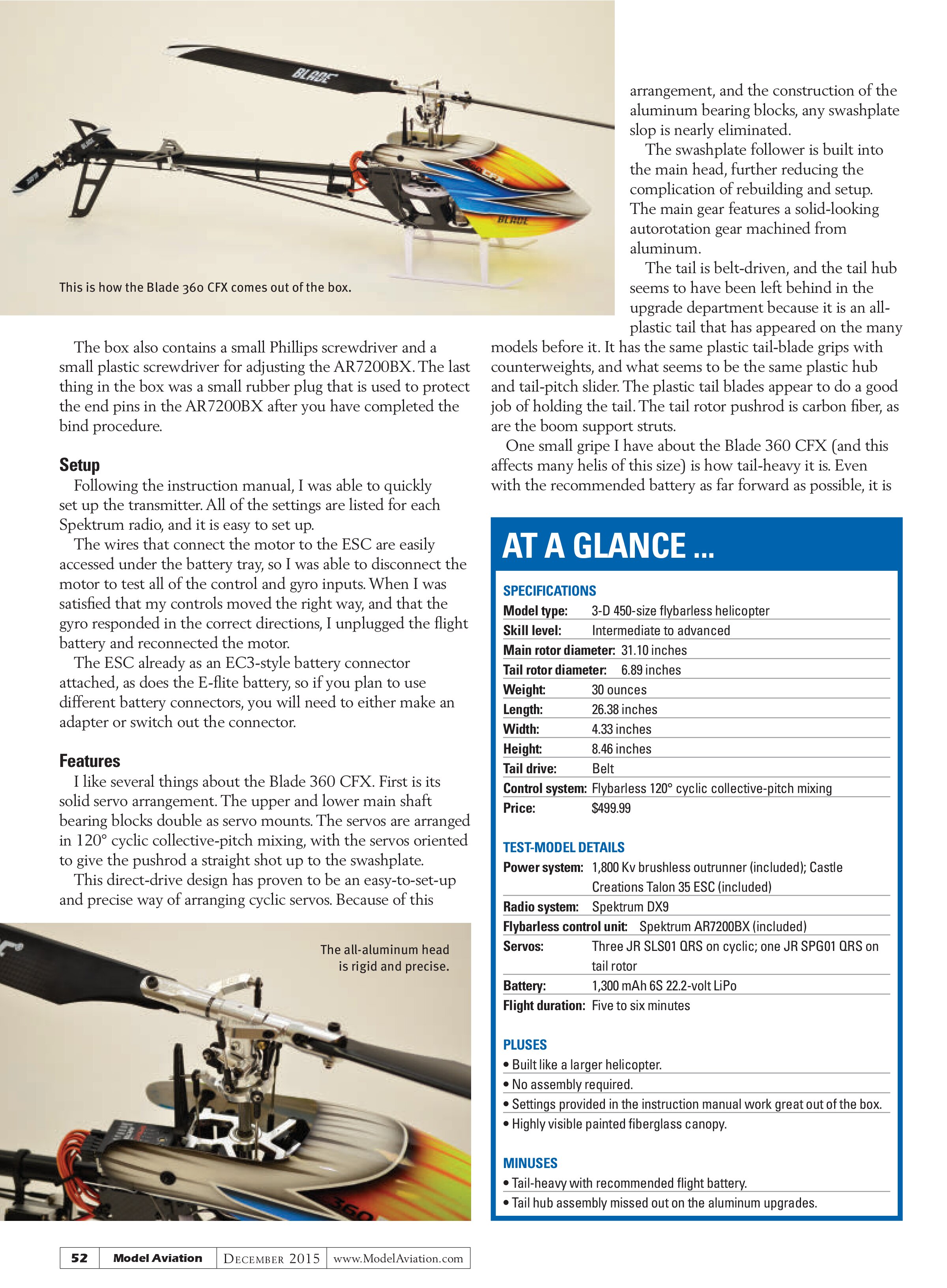
Blade continues to release popular models, and one of its latest offerings is the Blade 360 CFX helicopter. The Blade 360 CFX is a BNF basic model, compatible with Spektrum DSMX transmitters. The aircraft comes prebuilt and ready to fly. All you need to fly it is a flight battery and a compatible transmitter.
Despite the heli’s small size, it packs quite the punch in the power department—requiring a 6S 1,300 mAh LiPo flight battery. My friend, Tommy, loaned me his spare Spektrum DX9 transmitter to use with the Blade 360 CFX.
As its name might suggest, the Blade 360 CFX uses 360mm carbon-fiber main blades. The brain of the helicopter is the eight-channel Spektrum AR7200BX, which is a DSMX receiver and BeastX three-axis gyro combination.
The heart of the helicopter is an 1,800 Kv Blade Heli 360 motor, powered by a Castle Creations Talon 35 ESC. Servo power is provided by three Spektrum H3050 digital cyclic servos, and one Spektrum H3060 tail servo. All of the servos have a metal main body, which keeps the servos cool.
In the Box
The box has a convenient carrying handle, making it a good place to keep your Blade 360 CFX. The instruction manual is printed in several languages, and contains transmitter settings for a number of Spektrum transmitters. The back of the manual includes exploded parts diagrams and a parts list.
The helicopter comes preassembled, including all of the servo linkages and wiring. All you need to provide is a flight battery and transmitter.
I programmed the DX9 per the instruction manual, which only took a few minutes. I used the recommended E-flite 6S 1,300 mAh LiPo battery pack.
Also in the box is an assortment of Allen wrenches, plastic zip ties, a bind plug, foam tape, Velcro, and main shaft shims. An extra mounting pad for the AR7200BX is included in case you have to remove the receiver for any reason.

The box also contains a small Phillips screwdriver and a small plastic screwdriver for adjusting the AR7200BX. The last thing in the box was a small rubber plug that is used to protect the end pins in the AR7200BX after you have completed the bind procedure.
Setup
Following the instruction manual, I was able to quickly set up the transmitter. All of the settings are listed for each Spektrum radio, and it is easy to set up.
The wires that connect the motor to the ESC are easily accessed under the battery tray, so I was able to disconnect the motor to test all of the control and gyro inputs. When I was satisfied that my controls moved the right way, and that the gyro responded in the correct directions, I unplugged the flight battery and reconnected the motor.
The ESC already has an EC3-style battery connector attached, as does the E-flite battery, so if you plan to use different battery connectors, you will need to either make an adapter or switch out the connector.
Features
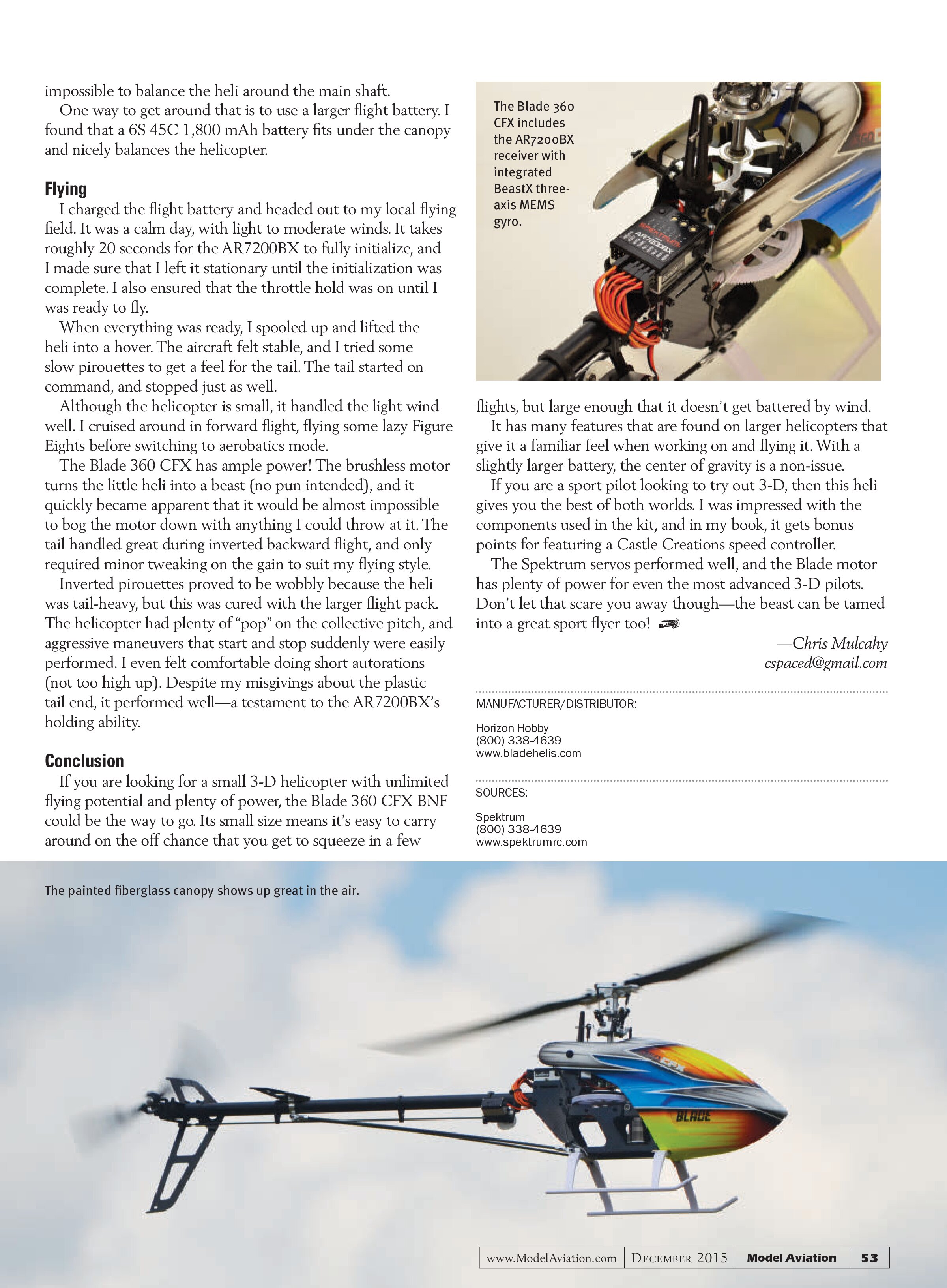
I like several things about the Blade 360 CFX. First is its solid servo arrangement. The upper and lower main shaft bearing blocks double as servo mounts. The servos are arranged in 120° cyclic collective-pitch mixing, with the servos oriented to give the pushrod a straight shot up to the swashplate.
This direct-drive design has proven to be an easy-to-set-up and precise way of arranging cyclic servos. Because of this arrangement, and the construction of the aluminum bearing blocks, any swashplate slop is nearly eliminated.
The swashplate follower is built into the main head, further reducing the complication of rebuilding and setup. The main gear features a solid-looking autorotation gear machined from aluminum.
The tail is belt-driven, and the tail hub seems to have been left behind in the upgrade department because it is an all-plastic tail that has appeared on the many models before it. It has the same plastic tail-blade grips with counterweights, and what seems to be the same plastic hub and tail-pitch slider. The plastic tail blades appear to do a good job of holding the tail. The tail rotor pushrod is carbon fiber, as are the boom support struts.
One small gripe I have about the Blade 360 CFX (and this affects many helis of this size) is how tail-heavy it is. Even with the recommended battery as far forward as possible, it is

impossible to balance the heli around the main shaft. One way to get around that is to use a larger flight battery. I found that a 6S 45C 1,800 mAh battery fits under the canopy and nicely balances the helicopter.
Flying
I charged the flight battery and headed out to my local flying field. It was a calm day, with light to moderate winds. It takes roughly 20 seconds for the AR7200BX to fully initialize, and I made sure that I left it stationary until the initialization was complete. I also ensured that the throttle hold was on until I was ready to fly.
When everything was ready, I spooled up and lifted the heli into a hover. The aircraft felt stable, and I tried some slow pirouettes to get a feel for the tail. The tail started on command, and stopped just as well.
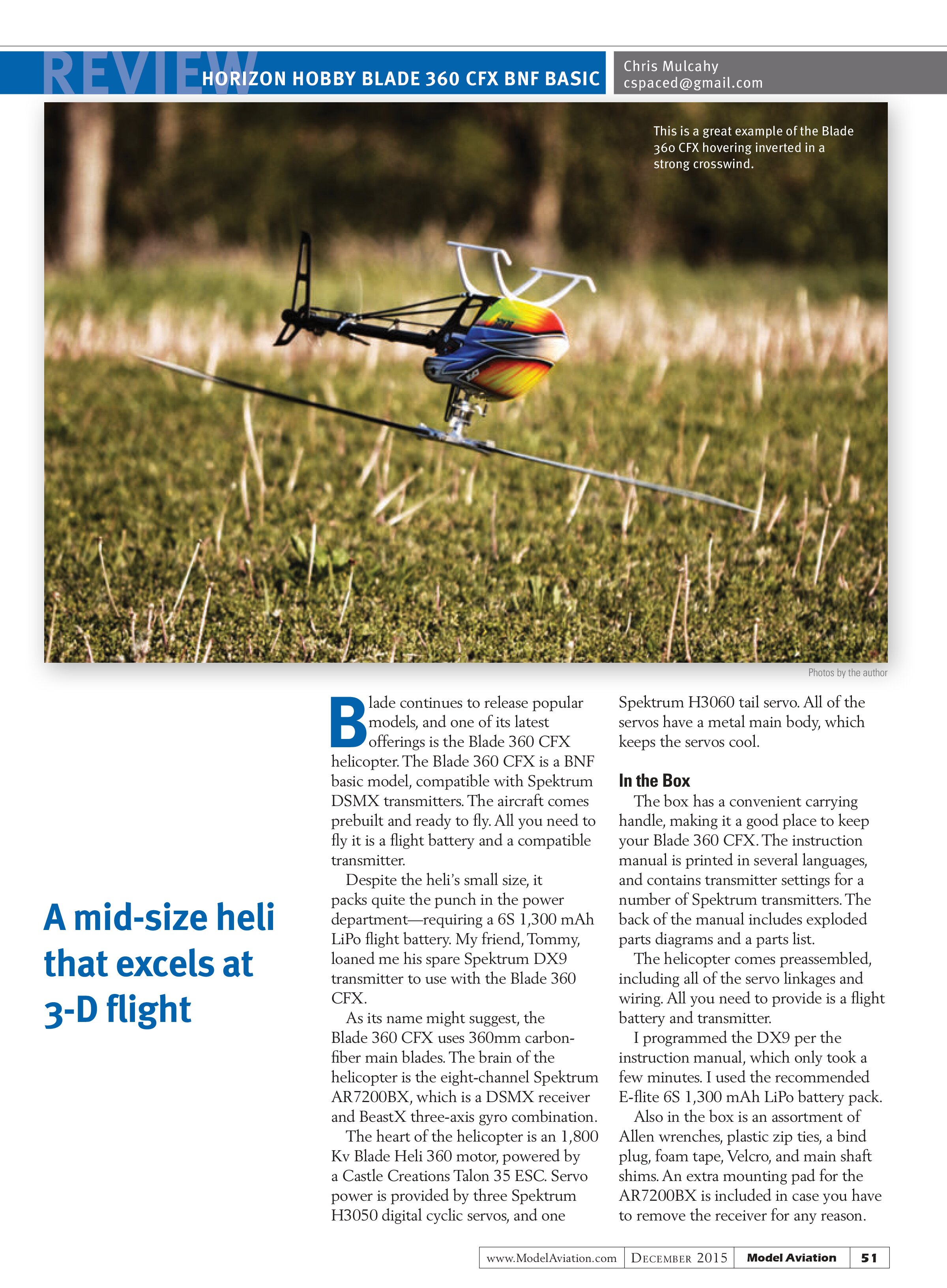
Although the helicopter is small, it handled the light wind well. I cruised around in forward flight, flying some lazy Figure Eights before switching to aerobatics mode.
The Blade 360 CFX has ample power! The brushless motor turns the little heli into a beast (no pun intended), and it quickly became apparent that it would be almost impossible to bog the motor down with anything I could throw at it. The tail handled great during inverted backward flight, and only required minor tweaking on the gain to suit my flying style.
Inverted pirouettes proved to be wobbly because the heli was tail-heavy, but this was cured with the larger flight pack. The helicopter had plenty of “pop” on the collective pitch, and aggressive maneuvers that start and stop suddenly were easily performed. I even felt comfortable doing short autorotations (not too high up). Despite my misgivings about the plastic tail end, it performed well—a testament to the AR7200BX’s holding ability.
Conclusion
If you are looking for a small 3-D helicopter with unlimited flying potential and plenty of power, the Blade 360 CFX BNF could be the way to go. Its small size means it’s easy to carry around on the off chance that you get to squeeze in a few

flights, but large enough that it doesn’t get battered by wind. It has many features that are found on larger helicopters that give it a familiar feel when working on and flying it. With a slightly larger battery, the center of gravity is a non-issue.
If you are a sport pilot looking to try out 3-D, then this heli gives you the best of both worlds. I was impressed with the components used in the kit, and in my book, it gets bonus points for featuring a Castle Creations speed controller.
The Spektrum servos performed well, and the Blade motor has plenty of power for even the most advanced 3-D pilots. Don’t let that scare you away though—the beast can be tamed into a great sport flyer too!
—Chris Mulcahy
cspaced@gmail.com
MANUFACTURER/DISTRIBUTOR:
Horizon Hobby
(800) 338-4639
www.bladehelis.com
SOURCES:
Spektrum
(800) 338-4639
www.spektrumrc.com