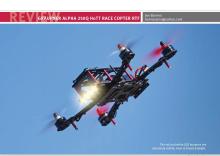
GRAUPNER ALPHA 250Q HoTT RACE COPTER RTF
Jon Barnes

The emergence and ensuing phenomenal growth of multirotor aircraft during the last few years has given pilots a variety of exciting new RC activities to pursue. Although quadcopters are available in a range of sizes, the 250mm class has emerged as one of the most popular sizes of all.
Component affordability and a form factor with the minimum real estate necessary to haul FPV gear aloft might be two reasons why the 250mm class has become so popular. Pilots have made the 250mm class frames the poster child for FPV racing.
The sight of brightly colored, arched pool noodles being used as a series of “gates” that delineate a race course has become common. Proof of the extreme popularity of 250mm FPV racing was the inaugural Fat Shark US National Drone Racing Championships at the California State Fair on July 15-17, 2015. More than 100 of the best FPV racers competed for prizes totaling more than $25,000.
The competition spanned three categories: a California-style speed and agility course, Invitational Freestyle, and Team Sport. With a motto of “buck up, you can sleep when you get home,” the event was billed as a non-stop FPV racing party.
Although some people who are interested in tasting the exhilaration and excitement of FPV racing enjoy the associated learning curve and the experience of building a 250mm racing frame, time-challenged pilots or those who want to get started right away will find themselves looking for a quicker path.
The new Graupner Alpha 250Q 250mm FPV racing quadcopter is sure to catch the attention of those in a hurry to compete. This product is notably the first turnkey FPV racing solution to be offered by a major manufacturer in the industry.
The package does not include absolutely everything needed for FPV-style racing. No FPV gear is included. A pilot will need to provide a video camera, a video transmitter, and a pair of
goggles or a video receiver/LCD display to get his or her FPV groove going.
What the Graupner Alpha 250Q does offer is a complete, preassembled, ready-to-fly 250mm carbon-fiber frame outfitted with a pretuned, high-performance, brushless power system and controlled by a powerful and versatile telemetry-capable Graupner radio system.
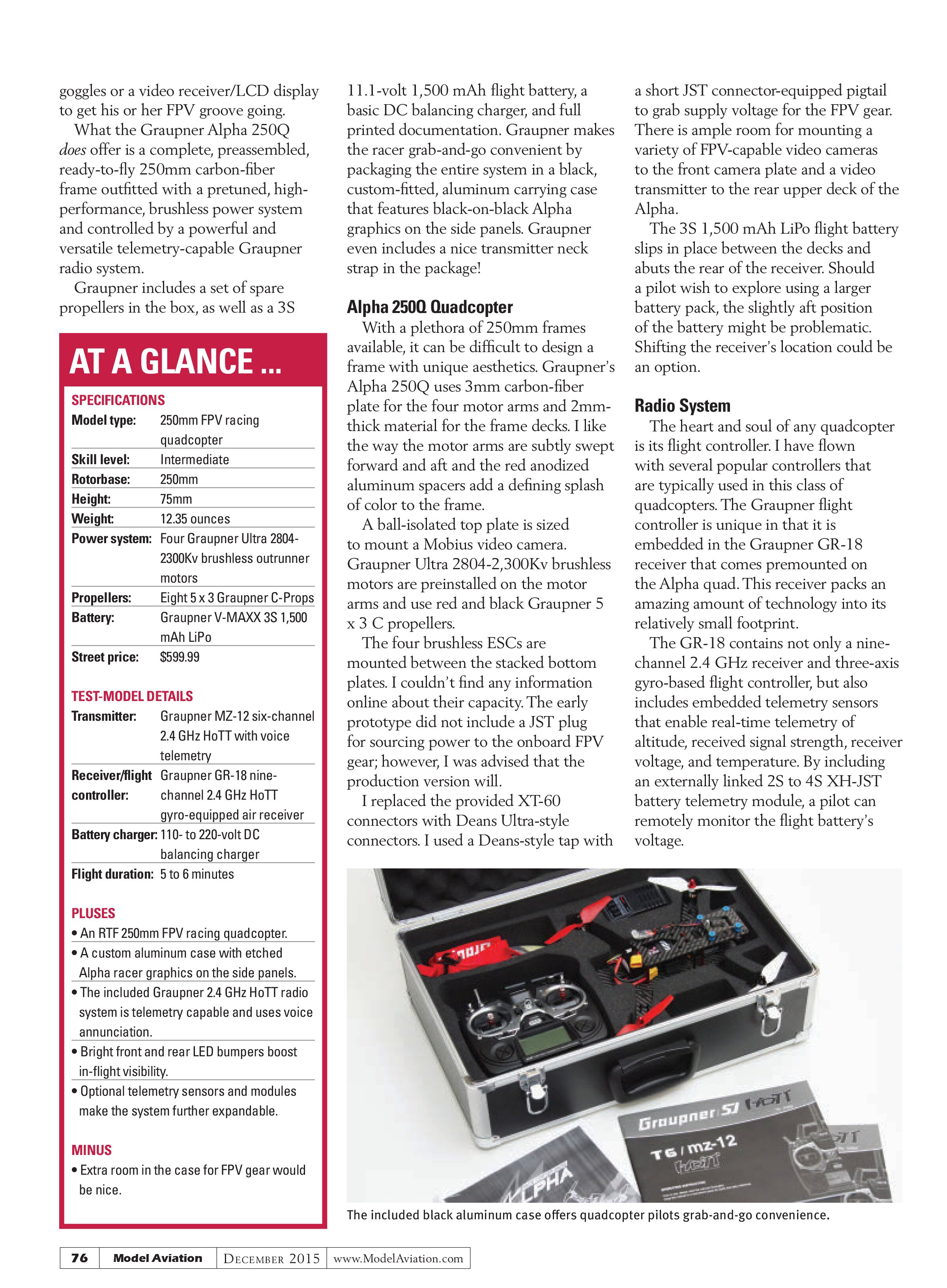
Graupner includes a set of spare propellers in the box, as well as a 3S 11.1-volt 1,500 mAh flight battery, a basic DC balancing charger, and full printed documentation. Graupner makes the racer grab-and-go convenient by packaging the entire system in a black, custom-fitted, aluminum carrying case that features black-on-black Alpha graphics on the side panels. Graupner even includes a nice transmitter neck strap in the package!
At a Glance ...
Specifications
Model type: 250mm FPV racing quadcopter
Skill level: Intermediate
Rotorbase: 250mm
Height: 75mm
Weight: 12.35 ounces
Power system: Four Graupner Ultra 2804-2300Kv brushless outrunner motors
Propellers: Eight 5 x 3 Graupner C-Props
Battery: Graupner V-MAXX 3S 1,500 mAh LiPo
Street price: $599.99
Test-Model Details
Transmitter: Graupner MZ-12 six-channel 2.4 GHz HoTT with voice telemetry
Receiver/flight controller: Graupner GR-18 nine-channel 2.4 GHz HoTT gyro-equipped air receiver
Battery charger: 110- to 220-volt DC balancing charger
Flight duration: 5 to 6 minutes
Pluses
- An RTF 250mm FPV racing quadcopter.
- A custom aluminum case with etched Alpha racer graphics on the side panels.
- The included Graupner 2.4 GHz HoTT radio system is telemetry capable and uses voice annunciation.
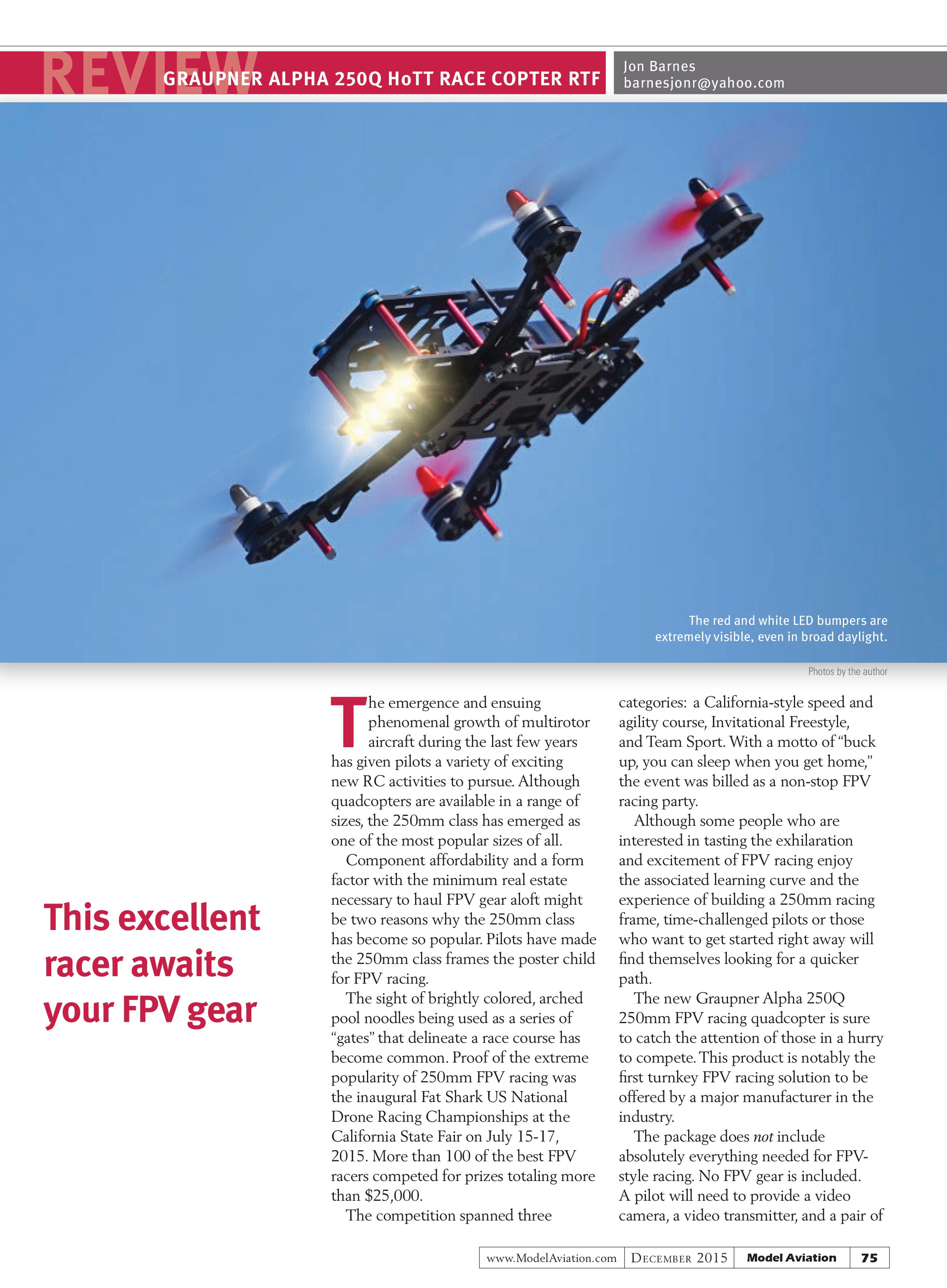
- Bright front and rear LED bumpers boost in-flight visibility.
- Optional telemetry sensors and modules make the system further expandable.
Minus
- Extra room in the case for FPV gear would be nice.
Alpha 250Q Quadcopter
With a plethora of 250mm frames available, it can be difficult to design a frame with unique aesthetics. Graupner’s Alpha 250Q uses 3mm carbon-fiber plate for the four motor arms and 2mm-thick material for the frame decks. I like the way the motor arms are subtly swept forward and aft and the red anodized aluminum spacers add a defining splash of color to the frame.
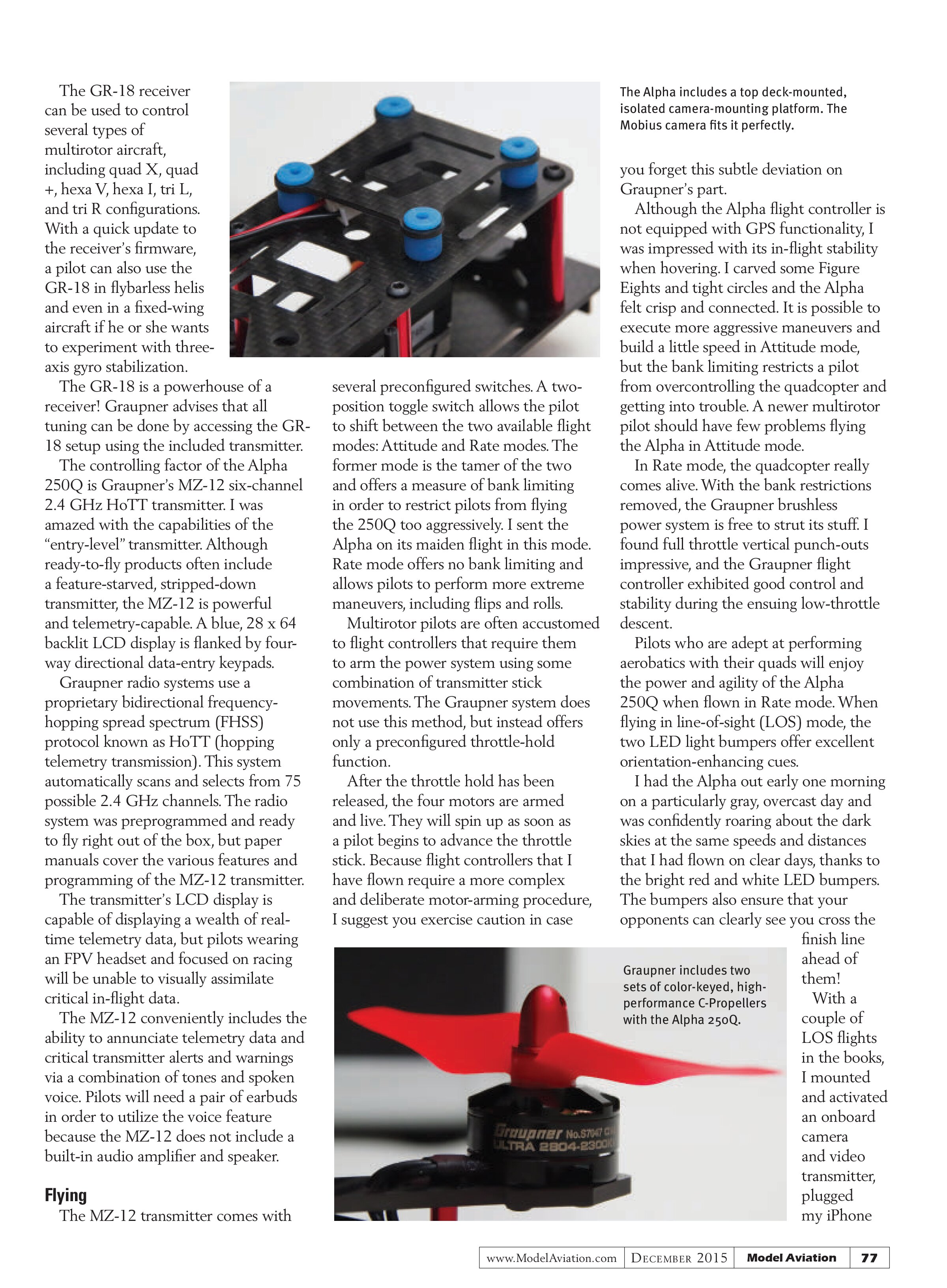
A ball-isolated top plate is sized to mount a Mobius video camera. Graupner Ultra 2804-2,300Kv brushless motors are preinstalled on the motor arms and use red and black Graupner 5 x 3 C propellers.
The four brushless ESCs are mounted between the stacked bottom plates. I couldn’t find any information online about their capacity. The early prototype did not include a JST plug for sourcing power to the onboard FPV gear; however, I was advised that the production version will.
I replaced the provided XT-60 connectors with Deans Ultra-style connectors. I used a Deans-style tap with a short JST connector-equipped pigtail to grab supply voltage for the FPV gear. There is ample room for mounting a variety of FPV-capable video cameras to the front camera plate and a video transmitter to the rear upper deck of the Alpha.
The 3S 1,500 mAh LiPo flight battery slips in place between the decks and abuts the rear of the receiver. Should a pilot wish to explore using a larger battery pack, the slightly aft position of the battery might be problematic. Shifting the receiver’s location could be an option.
Radio System
The heart and soul of any quadcopter is its flight controller. I have flown with several popular controllers that are typically used in this class of quadcopters. The Graupner flight controller is unique in that it is embedded in the Graupner GR-18 receiver that comes premounted on the Alpha quad. This receiver packs an amazing amount of technology into its relatively small footprint.
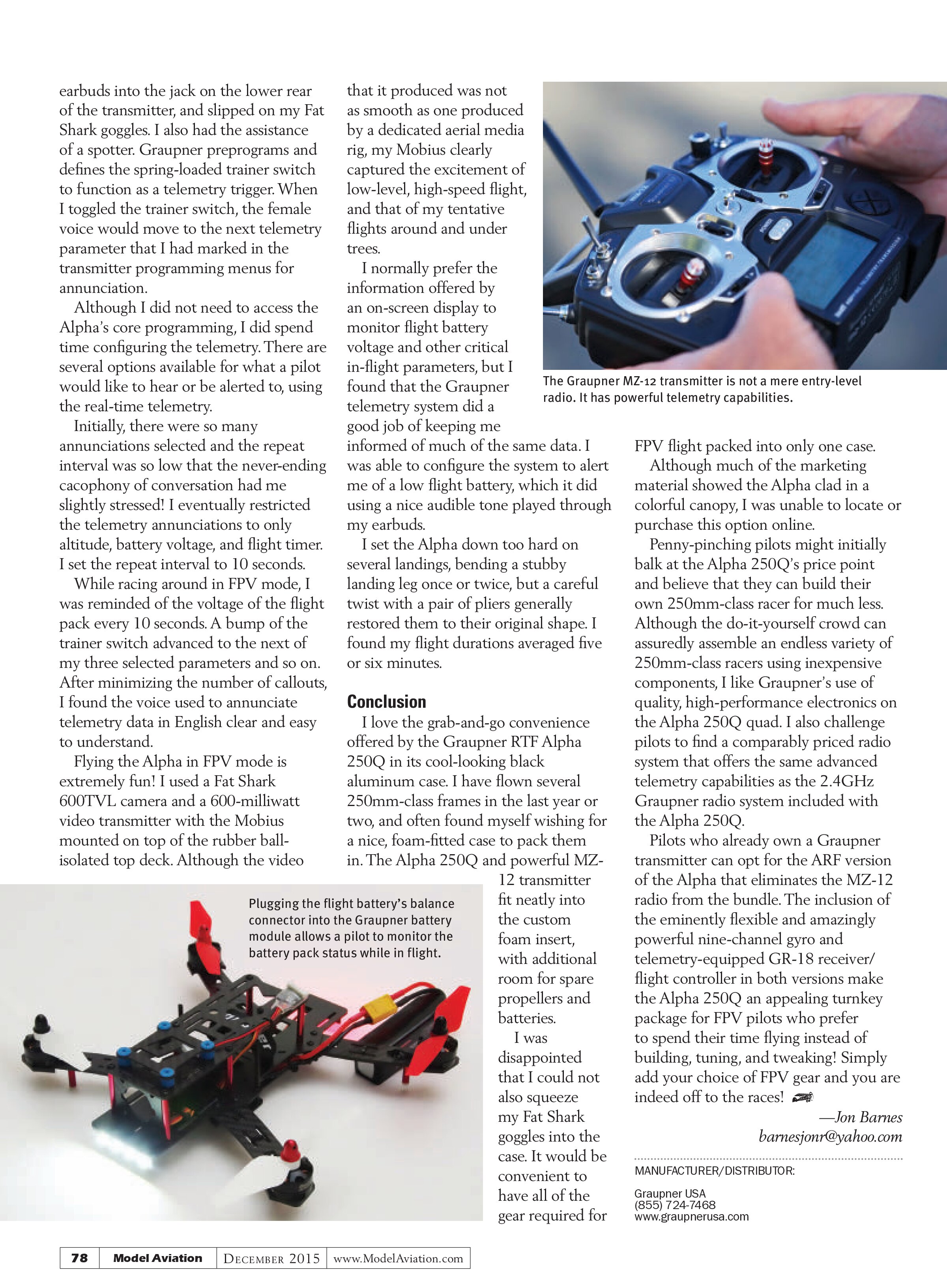
The GR-18 contains not only a nine-channel 2.4 GHz receiver and three-axis gyro-based flight controller, but also includes embedded telemetry sensors that enable real-time telemetry of altitude, received signal strength, receiver voltage, and temperature. By including an externally linked 2S to 4S XH-JST battery telemetry module, a pilot can remotely monitor the flight battery’s voltage.

The GR-18 receiver can be used to control several types of multirotor aircraft, including quad X, quad +, hexa V, hexa I, tri L, and tri R configurations. With a quick update to the receiver’s firmware, a pilot can also use the GR-18 in flybarless helis and even in a fixed-wing aircraft if he or she wants to experiment with three-axis gyro stabilization.
The GR-18 is a powerhouse of a receiver! Graupner advises that all tuning can be done by accessing the GR-18 setup using the included transmitter.
The controlling factor of the Alpha 250Q is Graupner’s MZ-12 six-channel 2.4 GHz HoTT transmitter. I was amazed with the capabilities of the “entry-level” transmitter. Although ready-to-fly products often include a feature-starved, stripped-down transmitter, the MZ-12 is powerful and telemetry-capable. A blue, 28 x 64 backlit LCD display is flanked by four-way directional data-entry keypads.
Graupner radio systems use a proprietary bidirectional frequency-hopping spread spectrum (FHSS) protocol known as HoTT (hopping telemetry transmission). This system automatically scans and selects from 75 possible 2.4 GHz channels. The radio system was preprogrammed and ready to fly right out of the box, but paper manuals cover the various features and programming of the MZ-12 transmitter.
The transmitter’s LCD display is capable of displaying a wealth of real-time telemetry data, but pilots wearing an FPV headset and focused on racing will be unable to visually assimilate critical in-flight data.
The MZ-12 conveniently includes the ability to annunciate telemetry data and critical transmitter alerts and warnings via a combination of tones and spoken voice. Pilots will need a pair of earbuds in order to utilize the voice feature because the MZ-12 does not include a built-in audio amplifier and speaker.
Flying
The MZ-12 transmitter comes with several preconfigured switches. A two-position toggle switch allows the pilot to shift between the two available flight modes: Attitude and Rate modes. The former mode is the tamer of the two and offers a measure of bank limiting in order to restrict pilots from flying the 250Q too aggressively. I sent the Alpha on its maiden flight in this mode. Rate mode offers no bank limiting and allows pilots to perform more extreme maneuvers, including flips and rolls.
Multirotor pilots are often accustomed to flight controllers that require them to arm the power system using some combination of transmitter stick movements. The Graupner system does not use this method, but instead offers only a preconfigured throttle-hold function.
After the throttle hold has been released, the four motors are armed and live. They will spin up as soon as a pilot begins to advance the throttle stick. Because flight controllers that I have flown require a more complex and deliberate motor-arming procedure, I suggest you exercise caution in case you forget this subtle deviation on Graupner’s part.

Although the Alpha flight controller is not equipped with GPS functionality, I was impressed with its in-flight stability when hovering. I carved some Figure Eights and tight circles and the Alpha felt crisp and connected. It is possible to execute more aggressive maneuvers and build a little speed in Attitude mode, but the bank limiting restricts a pilot from overcontrolling the quadcopter and getting into trouble. A newer multirotor pilot should have few problems flying the Alpha in Attitude mode.
In Rate mode, the quadcopter really comes alive. With the bank restrictions removed, the Graupner brushless power system is free to strut its stuff. I found full throttle vertical punch-outs impressive, and the Graupner flight controller exhibited good control and stability during the ensuing low-throttle descent.
Pilots who are adept at performing aerobatics with their quads will enjoy the power and agility of the Alpha 250Q when flown in Rate mode. When flying in line-of-sight (LOS) mode, the two LED light bumpers offer excellent orientation-enhancing cues.
I had the Alpha out early one morning on a particularly gray, overcast day and was confidently roaring about the dark skies at the same speeds and distances that I had flown on clear days, thanks to the bright red and white LED bumpers. The bumpers also ensure that your opponents can clearly see you cross the finish line ahead of them!
With a couple of LOS flights in the books, I mounted and activated an onboard camera and video transmitter, plugged my iPhone

earbuds into the jack on the lower rear of the transmitter, and slipped on my Fat Shark goggles. I also had the assistance of a spotter. Graupner preprograms and defines the spring-loaded trainer switch to function as a telemetry trigger. When I toggled the trainer switch, the female voice would move to the next telemetry parameter that I had marked in the transmitter programming menus for annunciation.
Although I did not need to access the Alpha’s core programming, I did spend time configuring the telemetry. There are several options available for what a pilot would like to hear or be alerted to, using the real-time telemetry.
Initially, there were so many annunciations selected and the repeat interval was so low that the never-ending cacophony of conversation had me slightly stressed! I eventually restricted the telemetry annunciations to only altitude, battery voltage, and flight timer. I set the repeat interval to 10 seconds.
While racing around in FPV mode, I was reminded of the voltage of the flight pack every 10 seconds. A bump of the trainer switch advanced to the next of my three selected parameters and so on. After minimizing the number of callouts, I found the voice used to announce telemetry data in English clear and easy to understand.
Flying the Alpha in FPV mode is extremely fun! I used a Fat Shark 600TVL camera and a 600-milliwatt video transmitter with the Mobius mounted on top of the rubber ball-isolated top deck. Although the video that it produced was not as smooth as one produced by a dedicated aerial media rig, my Mobius clearly captured the excitement of low-level, high-speed flight, and that of my tentative flights around and under trees.

I normally prefer the information offered by an on-screen display to monitor flight battery voltage and other critical in-flight parameters, but I found that the Graupner telemetry system did a good job of keeping me informed of much of the same data. I was able to configure the system to alert me of a low flight battery, which it did using a nice audible tone played through my earbuds.
I set the Alpha down too hard on several landings, bending a stubby landing leg once or twice, but a careful twist with a pair of pliers generally restored them to their original shape. I found my flight durations averaged five or six minutes.
Conclusion
I love the grab-and-go convenience offered by the Graupner RTF Alpha 250Q in its cool-looking black aluminum case. I have flown several 250mm-class frames in the last year or two, and often found myself wishing for a nice, foam-fitted case to pack them in. The Alpha 250Q and powerful MZ-12 transmitter fit neatly into the custom foam insert, with additional room for spare propellers and batteries. I was disappointed that I could not also squeeze my Fat Shark goggles into the case. It would be convenient to have all of the gear required for FPV flight packed into only one case.

Although much of the marketing material showed the Alpha clad in a colorful canopy, I was unable to locate or purchase this option online.
Penny-pinching pilots might initially balk at the Alpha 250Q’s price point and believe that they can build their own 250mm-class racer for much less. Although the do-it-yourself crowd can assuredly assemble an endless variety of 250mm-class racers using inexpensive components, I like Graupner’s use of quality, high-performance electronics on the Alpha 250Q quad. I also challenge pilots to find a comparably priced radio system that offers the same advanced telemetry capabilities as the 2.4GHz Graupner radio system included with the Alpha 250Q.
Pilots who already own a Graupner transmitter can opt for the ARF version of the Alpha that eliminates the MZ-12 radio from the bundle. The inclusion of the eminently flexible and amazingly powerful nine-channel gyro and telemetry-equipped GR-18 receiver/flight controller in both versions make the Alpha 250Q an appealing turnkey package for FPV pilots who prefer to spend their time flying instead of building, tuning, and tweaking! Simply add your choice of FPV gear and you are indeed off to the races!
—Jon Barnes
barnesjonr@yahoo.com
MANUFACTURER/DISTRIBUTOR:
Graupner USA
(855) 724-7468
www.graupnerusa.com