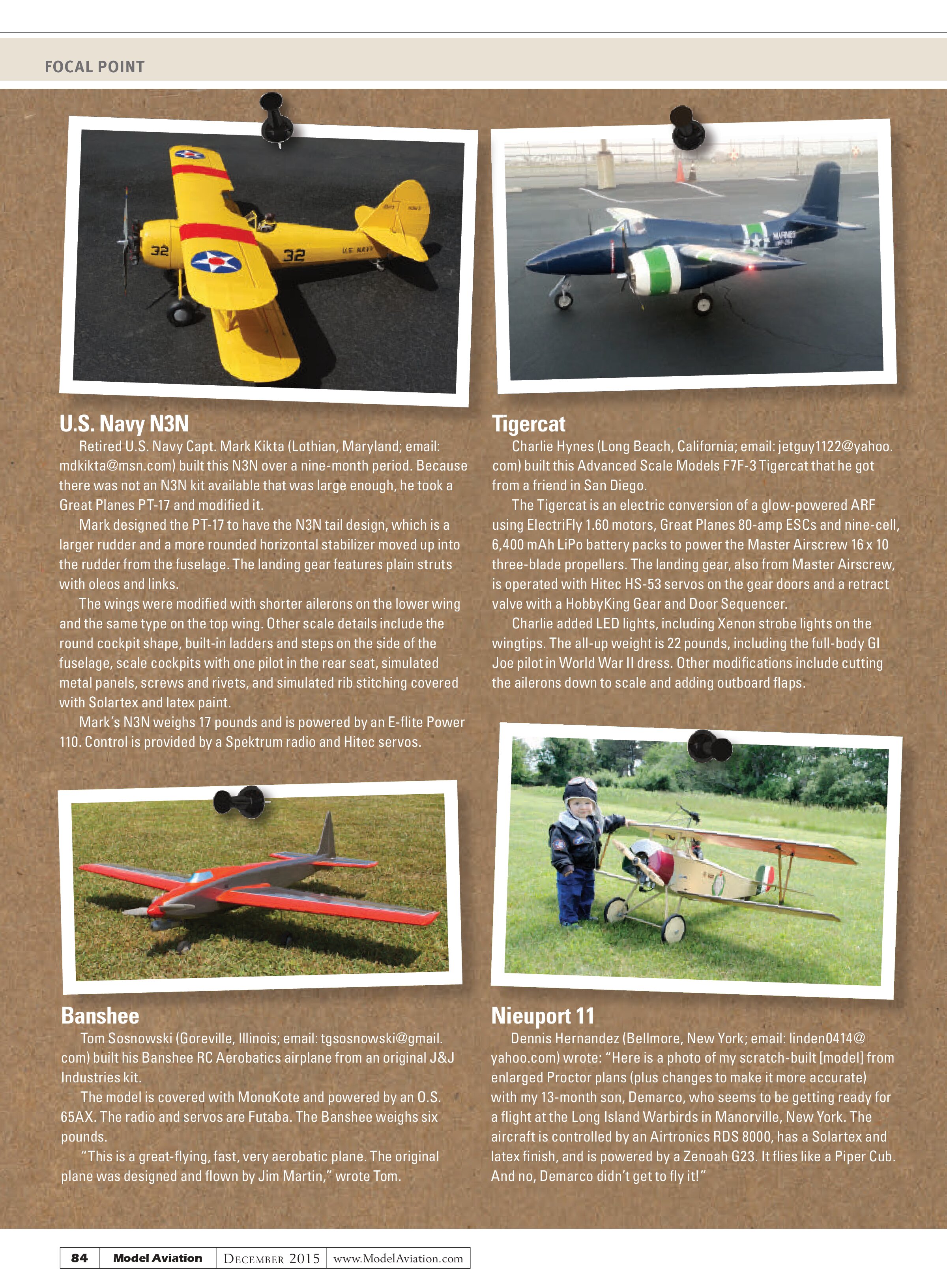
Focal Point

U.S. Navy N3N
Retired U.S. Navy Capt. Mark Kikta (Lothian, Maryland; email: mdkikta@msn.com) built this N3N over a nine-month period. Because there was not an N3N kit available that was large enough, he took a Great Planes PT-17 and modified it.
Mark designed the PT-17 to have the N3N tail design, which is a larger rudder and a more rounded horizontal stabilizer moved up into the rudder from the fuselage. The landing gear features plain struts with oleos and links.
The wings were modified with shorter ailerons on the lower wing and the same type on the top wing. Other scale details include the round cockpit shape, built-in ladders and steps on the side of the fuselage, scale cockpits with one pilot in the rear seat, simulated metal panels, screws and rivets, and simulated rib stitching covered with Solartex and latex paint.
Mark’s N3N weighs 17 pounds and is powered by an E-flite Power 110. Control is provided by a Spektrum radio and Hitec servos.

Banshee
Tom Sosnowski (Goreville, Illinois; email: tgsosnowski@gmail.com) built his Banshee RC Aerobatics airplane from an original J&J Industries kit.
The model is covered with MonoKote and powered by an O.S. 65AX. The radio and servos are Futaba. The Banshee weighs six pounds.
“This is a great-flying, fast, very aerobatic plane. The original plane was designed and flown by Jim Martin,” wrote Tom.

Tigercat
Charlie Hynes (Long Beach, California; email: jetguy1122@yahoo.com) built this Advanced Scale Models F7F-3 Tigercat that he got from a friend in San Diego.
The Tigercat is an electric conversion of a glow-powered ARF using ElectriFly 1.60 motors, Great Planes 80-amp ESCs and nine-cell, 6,400 mAh LiPo battery packs to power the Master Airscrew 16 x 10 three-blade propellers. The landing gear, also from Master Airscrew, is operated with Hitec HS-53 servos on the gear doors and a retract valve with a HobbyKing Gear and Door Sequencer.
Charlie added LED lights, including Xenon strobe lights on the wingtips. The all-up weight is 22 pounds, including the full-body GI Joe pilot in World War II dress. Other modifications include cutting the ailerons down to scale and adding outboard flaps.

Nieuport 11
Dennis Hernandez (Bellmore, New York; email: linden0414@yahoo.com) wrote: “Here is a photo of my scratch-built [model] from enlarged Proctor plans (plus changes to make it more accurate) with my 13-month son, Demarco, who seems to be getting ready for a flight at the Long Island Warbirds in Manorville, New York. The aircraft is controlled by an Airtronics RDS 8000, has a Solartex and latex finish, and is powered by a Zenoah G23. It flies like a Piper Cub. And no, Demarco didn’t get to fly it!”

Bristol F.2B
Gonzalo Bures (Puerto Rico; email: gonzalobures@gmail.com) built his Bristol F.2B from Kalderen and Welch Model Airplanes.
This World War I biplane spans 94 inches. A Saito 150 engine turns an 18 x 6 propeller. Guidance comes from a nine-channel Futaba radio with the elevator and rudder controlled through scale wiring.
The model includes a scale cockpit kitted by Kalderen and Welch, with all internal items, including a full-body pilot and gunner. All flying wires are utilized and required for flight.

Minion Air Force
Stanley Wagner (Fontana, California; email: stan7720@sbcglobal.net) assembled this Minion Air Force. Stanley wrote: “The Flying Minions on the left and right are based on the GWS Flying Pizza kits. The SlowMin in the middle is a GWS Slow Stick. All of the planes are powered with Grayson Hobby motors and ESCs and Tactic radio systems.”

Pete
Kurt Selbert (email: krselbert@gmail.com) built this Howard DGA-3 Pete from RCM Plans. Covered in Solartex, painted with latex, and powered by a Syssa 30cc gas engine, the Pete weighs in at 18 pounds. The kit and graphics were from Lazer Works, and email support from designer David Anderson helped Kurt complete the project.
“It was my first (and probably last) scratch-build and as such, was a steep learning curve,” wrote Kurt.

PBN Nomad
Dan Bogdan (email: dannoreen@aol.com) built this G&P Sales PBN Nomad. The Nomad spans 102 inches and weighs 21 pounds. It is powered by two O.S. 65AX engines. The retractable pontoons are Robart retracts controlled by Hitec servos and two Futaba mini servos for the engines.
The body is molded fiberglass and the wings are foam core with two layers of 1.5-ounce fiberglass cloth and resin, and finished with latex paint. The cowls and nacelles are premolded fiberglass. The decals are from Callie Graphics.
It took Dan two years to build the PBN Nomad.