Year-end wrap-up, rants, and raves
Greg Gimlick
maelectrics@gimlick.com

Merry Christmas, happy holidays, and happy New Year to everyone. Thanks for the emails and support every year. I apologize if yours was one that dropped through the cracks while I was on the road for three months this year, but I hope I got back to nearly everyone.
The Big Controversy
I had no idea when I wrote about only charging to 4.1 volts per cell on LiPo batteries that I would ignite the debate I did. Holy smokes! Engineers came out of the woodwork, along with the marketing people, and battles were afoot! Let’s just say that no one seems to agree whether it’s a good thing, a bad thing, or no thing at all.
I’ll leave it to the engineers to finish battling it out, but I will continue to believe that if you don’t run your batteries to the maximum limit on either the top or bottom end of the spectrum, you will benefit in the long run. Your mileage may vary, but I’m out of the argument ... you know where I stand.
Corrections
I really do appreciate people catching my errors and letting me know. The sooner I find them, the sooner I can get a correction printed. If it’s a bona fide safety issue, we can get the information online or quickly inserted into the next issue of Model Aviation.
There was an error in part of a sidebar definition within a feature I did this year that was technically incorrect. It should not have said: “... a 3,300 mAh battery pack is 3.3 amperes.” Somehow “ampere” found its way into the place of “amp-hour.” When this happens, all I can do is apologize. Fortunately, only a couple of people noticed.
What Are You Doing?
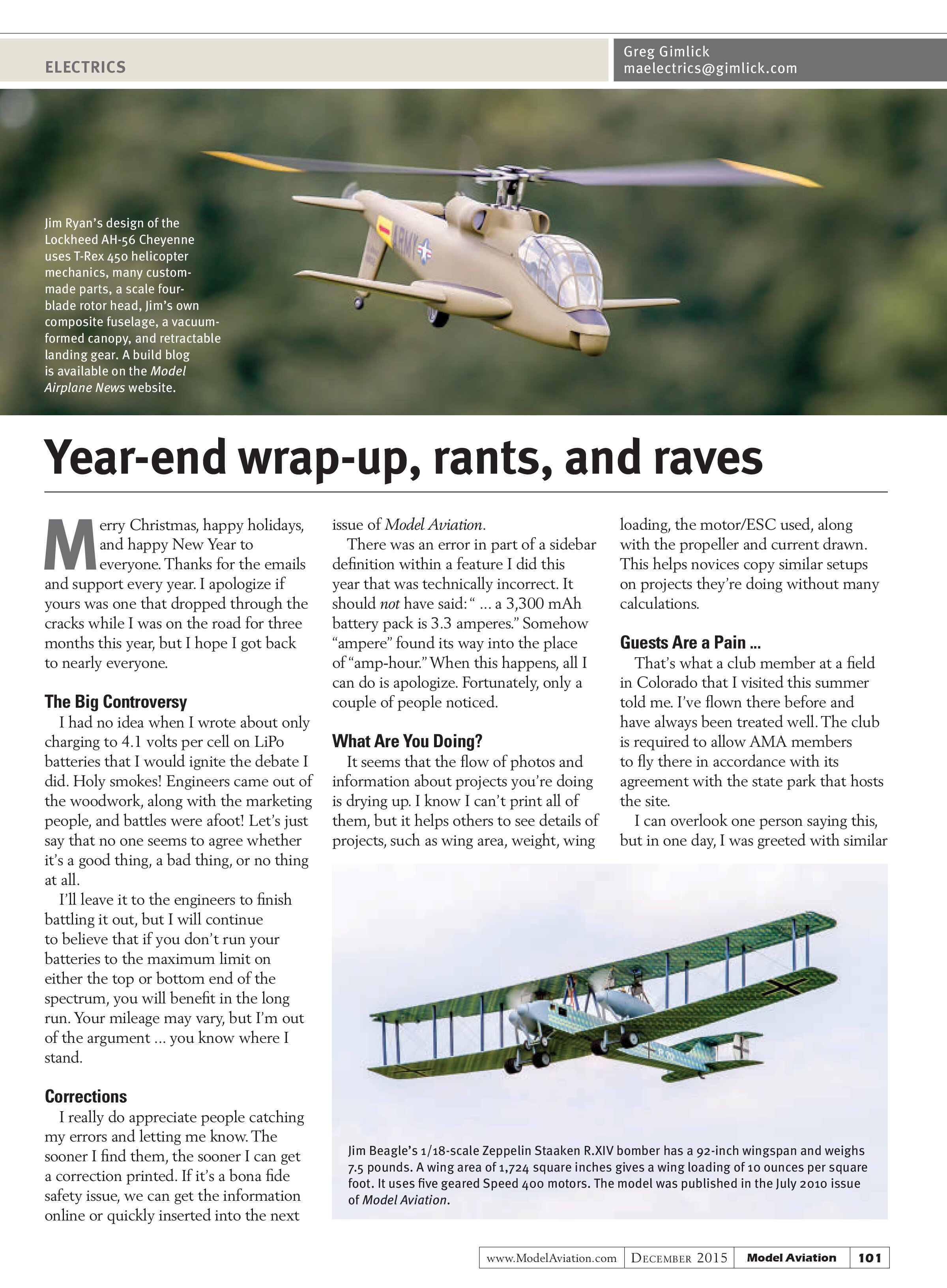
It seems that the flow of photos and information about projects you’re doing is drying up. I know I can’t print all of them, but it helps others to see details of projects, such as wing area, weight, wing loading, the motor/ESC used, along with the propeller and current drawn. This helps novices copy similar setups on projects they’re doing without many calculations.
Guests Are a Pain ...
That’s what a club member at a field in Colorado that I visited this summer told me. I’ve flown there before and have always been treated well. The club is required to allow AMA members to fly there in accordance with its agreement with the state park that hosts the site.
I can overlook one person saying this, but in one day, I was greeted with similar


sentiments three times. I know time can be taken up “entertaining” guests, but at a time when our hobby is in jeopardy, we all need to be ambassadors for the RC community.
I will try not to trouble them next year when I visit Denver again.
Future Topics
Batteries seem to be a hot topic and one of increasing interest. I encourage you to review the four-part series that Model Aviation published in 2015 and let us know if there are particular areas that still confuse you.
One upcoming topic will be to explain/clarify the 80% rule when discharging LiPo batteries. Let me know what else is puzzling you and I’ll work it into the schedule.
Remember, this is a bimonthly column, so information can take some time to show up in print. I do try to answer all emails.
Connectors
People seemed to appreciate the connector chart that the editor inserted into my feature article in the July 2015 issue. I agree that the editors did a great job putting that information together. It also raised a couple of questions.
Why do two connectors using the same size wire differ so in current ratings?
This primarily boils down to quality of materials, both in base metal and the plating used. The better the materials, the more efficient it will be, and the rating will be higher.
There is also the issue of surface area contact. The more area that makes physical contact, the better it can transfer power. This can also be affected by the quality of your soldering job and that’s outside the manufacturer’s control.
Why didn’t you include information about the current capacity of wire gauges?
I kept it simple. The larger the gauge, the less resistance, and the more current it will handle. That is very simplistic, but I encourage you to check the Electric Flyers Only, Inc. website and the Ampeer newsletter, where Ken Myers, editor of the newsletter, goes much deeper into this subject. It’s far more complicated than you can imagine and Ken has the page space for in-depth coverage of the topic.
A Great Electric Fly-In!
After getting “the bum’s rush” from the club in Denver, it was a pure joy to end up in Michigan at the 31st Annual Mid-America Electric Flies 2015! I haven’t been to this fly-in for 15 years and it was a blast to get back.
Nearly everything at this event is scratch-built or built from a kit, and many are designed by the builder/flier. There are precious few places in this country where you can find such a varied collection of unique subjects being modeled. This is also the home of Keith Shaw, who is one of the event’s contest directors. A deep pool of knowledge is represented up and down pit row and everyone makes you feel welcome.
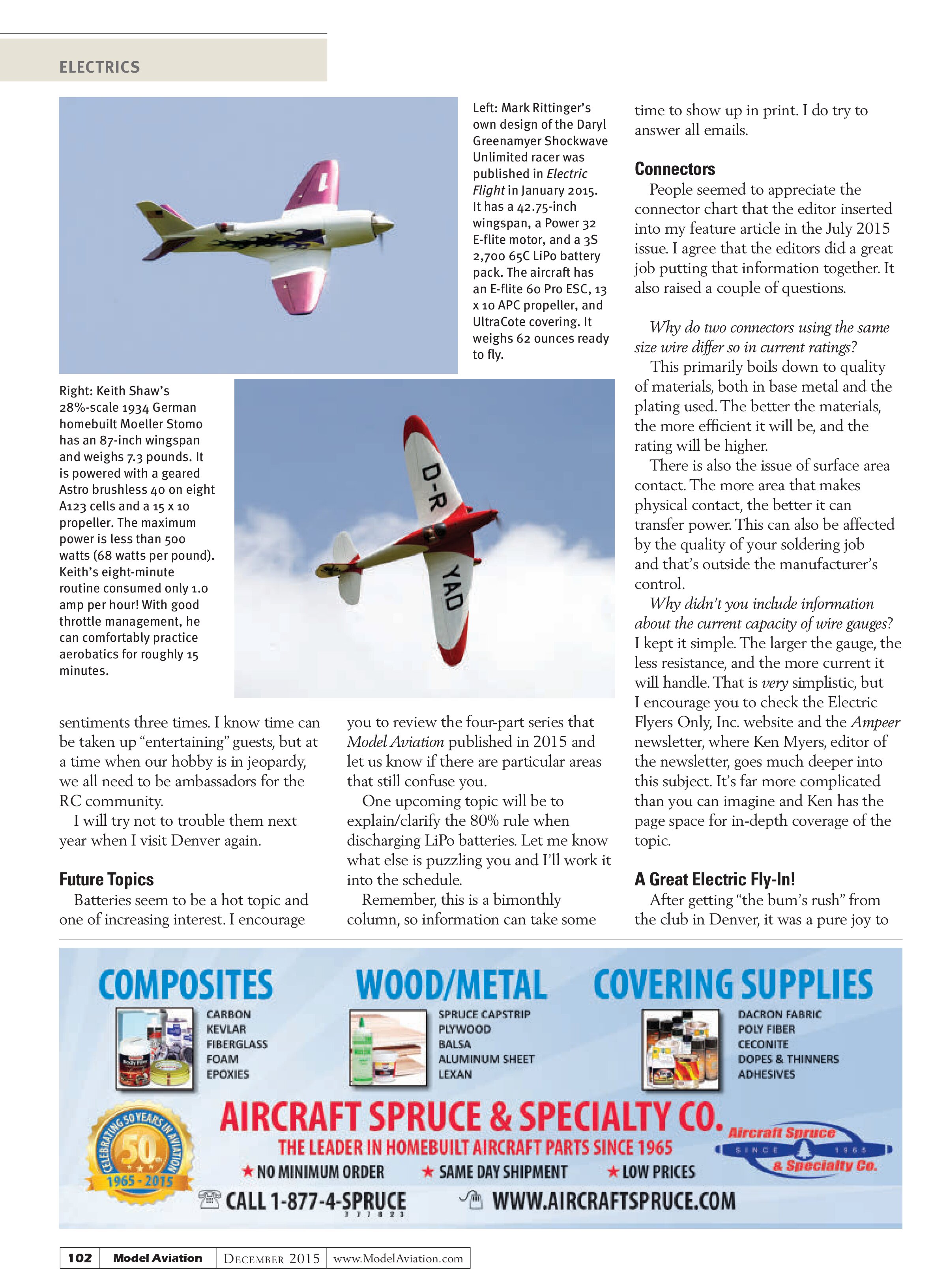
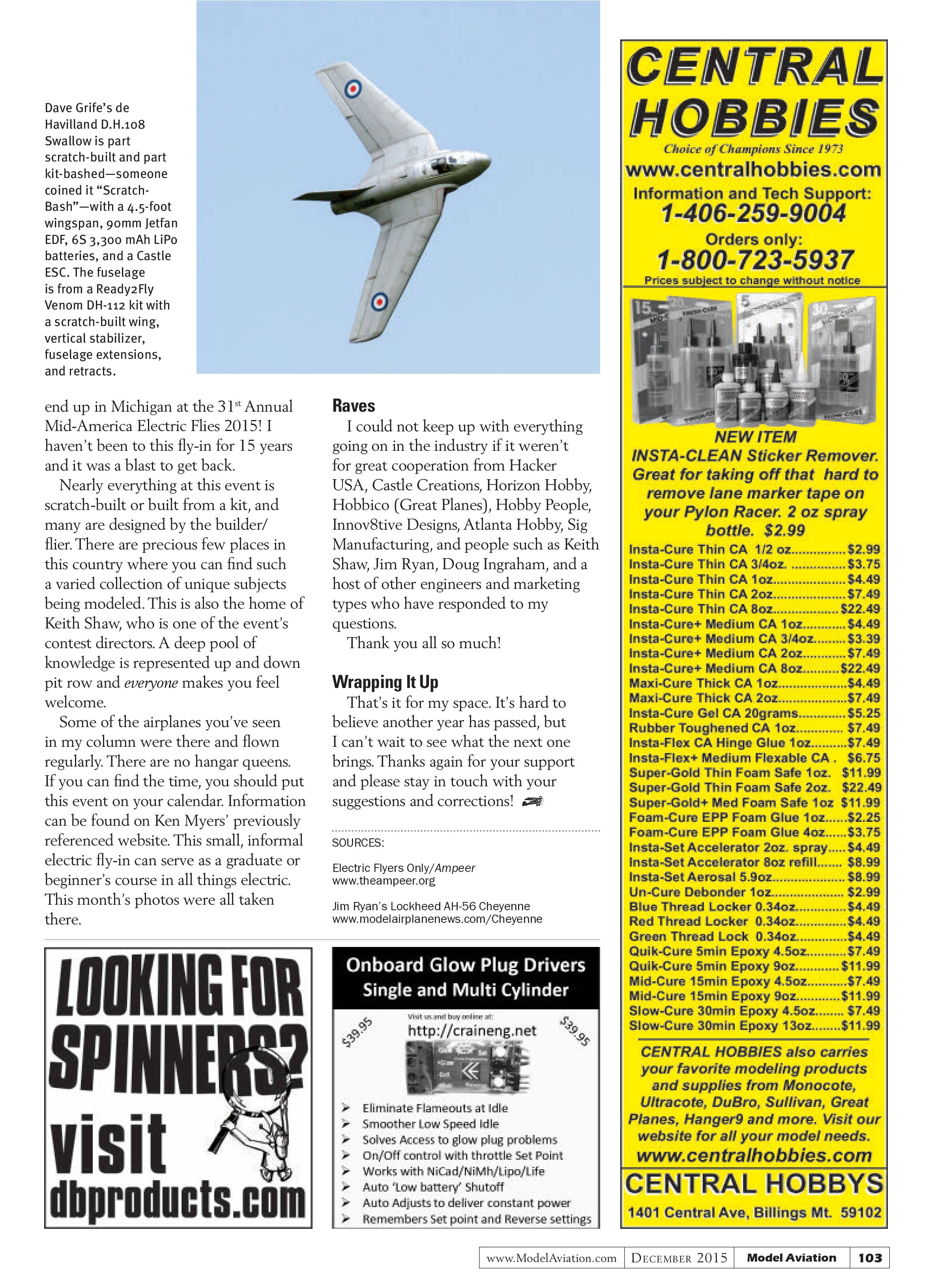
Some of the airplanes you’ve seen in my column were there and flown regularly. There are no hangar queens. If you can find the time, you should put this event on your calendar. Information can be found on Ken Myers’ previously referenced website. This small, informal electric fly-in can serve as a graduate or beginner’s course in all things electric. This month’s photos were all taken there.
Raves
I could not keep up with everything going on in the industry if it weren’t for great cooperation from Hacker USA, Castle Creations, Horizon Hobby, Hobbico (Great Planes), Hobby People, Innov8tive Designs, Atlanta Hobby, Sig Manufacturing, and people such as Keith Shaw, Jim Ryan, Doug Ingraham, and a host of other engineers and marketing types who have responded to my questions.
Thank you all so much!
Wrapping It Up
That’s it for my space. It’s hard to believe another year has passed, but I can’t wait to see what the next one brings. Thanks again for your support and please stay in touch with your suggestions and corrections!
SOURCES:
Electric Flyers Only/Ampeer
www.theampeer.org
Jim Ryan’s Lockheed AH-56 Cheyenne
www.modelairplanenews.com/Cheyenne