“Tell me and I’ll forget. Show me and I may remember. Involve me and I learn.” —Benjamin Franklin
Education Through Aviation
by Bill Pritchett, Education Director

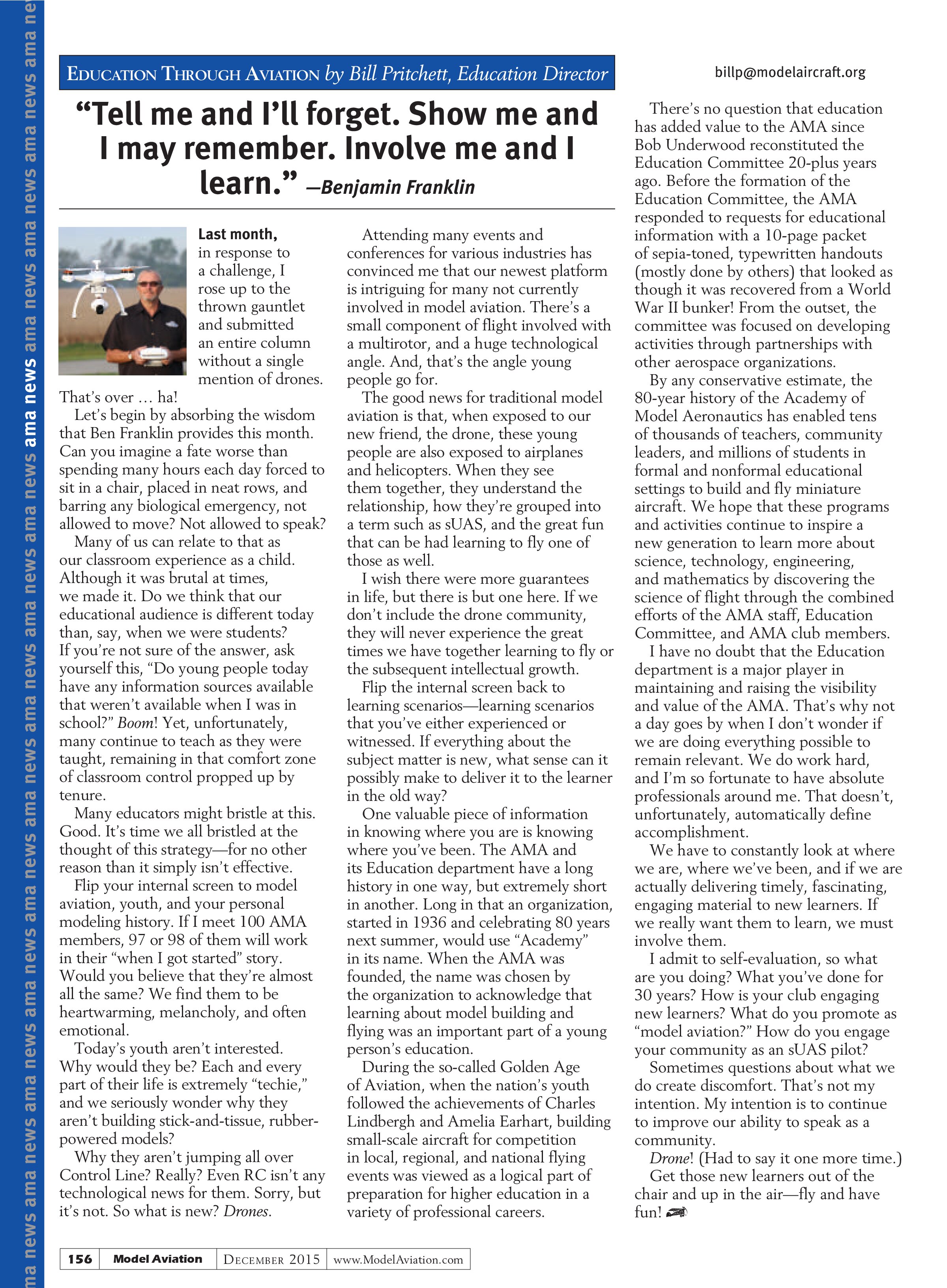
Last month, in response to a challenge, I rose up to the thrown gauntlet and submitted an entire column without a single mention of drones.
That’s over … ha!
Let’s begin by absorbing the wisdom that Ben Franklin provides this month. Can you imagine a fate worse than spending many hours each day forced to sit in a chair, placed in neat rows, and barring any biological emergency, not allowed to move? Not allowed to speak?
Many of us can relate to that as our classroom experience as a child. Although it was brutal at times, we made it. Do we think that our educational audience is different today than, say, when we were students? If you’re not sure of the answer, ask yourself this, “Do young people today have any information sources available that weren’t available when I was in school?” Boom! Yet, unfortunately, many continue to teach as they were taught, remaining in that comfort zone of classroom control propped up by tenure.
Many educators might bristle at this. Good. It’s time we all bristled at the thought of this strategy—for no other reason than it simply isn’t effective.
Flip your internal screen to model aviation, youth, and your personal modeling history. If I meet 100 AMA members, 97 or 98 of them will work in their “when I got started” story. Would you believe that they’re almost all the same? We find them to be heartwarming, melancholy, and often emotional.
Today’s youth aren’t interested. Why would they be? Each and every part of their life is extremely “techie,” and we seriously wonder why they aren’t building stick-and-tissue, rubber-powered models?
Why they aren’t jumping all over Control Line? Really? Even RC isn’t any technological news for them. Sorry, but it’s not. So what is new? Drones.
Attending many events and conferences for various industries has convinced me that our newest platform is intriguing for many not currently involved in model aviation. There’s a small component of flight involved with a multirotor, and a huge technological angle. And, that’s the angle young people go for.
The good news for traditional model aviation is that, when exposed to our new friend, the drone, these young people are also exposed to airplanes and helicopters. When they see them together, they understand the relationship, how they’re grouped into a term such as sUAS, and the great fun that can be had learning to fly one of those as well.
I wish there were more guarantees in life, but there is but one here. If we don’t include the drone community, they will never experience the great times we have together learning to fly or the subsequent intellectual growth.
Flip the internal screen back to learning scenarios—learning scenarios that you’ve either experienced or witnessed. If everything about the subject matter is new, what sense can it possibly make to deliver it to the learner in the old way?
One valuable piece of information in knowing where you are is knowing where you’ve been. The AMA and its Education department have a long history in one way, but extremely short in another. Long in that an organization, started in 1936 and celebrating 80 years next summer, would use “Academy” in its name. When the AMA was founded, the name was chosen by the organization to acknowledge that learning about model building and flying was an important part of a young person’s education.
During the so-called Golden Age of Aviation, when the nation’s youth followed the achievements of Charles Lindbergh and Amelia Earhart, building small-scale aircraft for competition in local, regional, and national flying events was viewed as a logical part of preparation for higher education in a variety of professional careers.
There’s no question that education has added value to the AMA since Bob Underwood reconstituted the Education Committee 20-plus years ago. Before the formation of the Education Committee, the AMA responded to requests for educational information with a 10-page packet of sepia-toned, typewritten handouts (mostly done by others) that looked as though it was recovered from a World War II bunker! From the outset, the committee was focused on developing activities through partnerships with other aerospace organizations.
By any conservative estimate, the 80-year history of the Academy of Model Aeronautics has enabled tens of thousands of teachers, community leaders, and millions of students in formal and nonformal educational settings to build and fly miniature aircraft. We hope that these programs and activities continue to inspire a new generation to learn more about science, technology, engineering, and mathematics by discovering the science of flight through the combined efforts of the AMA staff, Education Committee, and AMA club members.
I have no doubt that the Education department is a major player in maintaining and raising the visibility and value of the AMA. That’s why not a day goes by when I don’t wonder if we are doing everything possible to remain relevant. We do work hard, and I’m so fortunate to have absolute professionals around me. That doesn’t, unfortunately, automatically define accomplishment.
We have to constantly look at where we are, where we’ve been, and if we are actually delivering timely, fascinating, engaging material to new learners. If we really want them to learn, we must involve them.
I admit to self-evaluation, so what are you doing? What you’ve done for 30 years? How is your club engaging new learners? What do you promote as “model aviation?” How do you engage your community as an sUAS pilot?
Sometimes questions about what we do create discomfort. That’s not my intention. My intention is to continue to improve our ability to speak as a community.
Drone! (Had to say it one more time.) Get those new learners out of the chair and up in the air—fly and have fun!