One person can make a difference
View From HQ by Dave Mathewson, AMA Executive Director

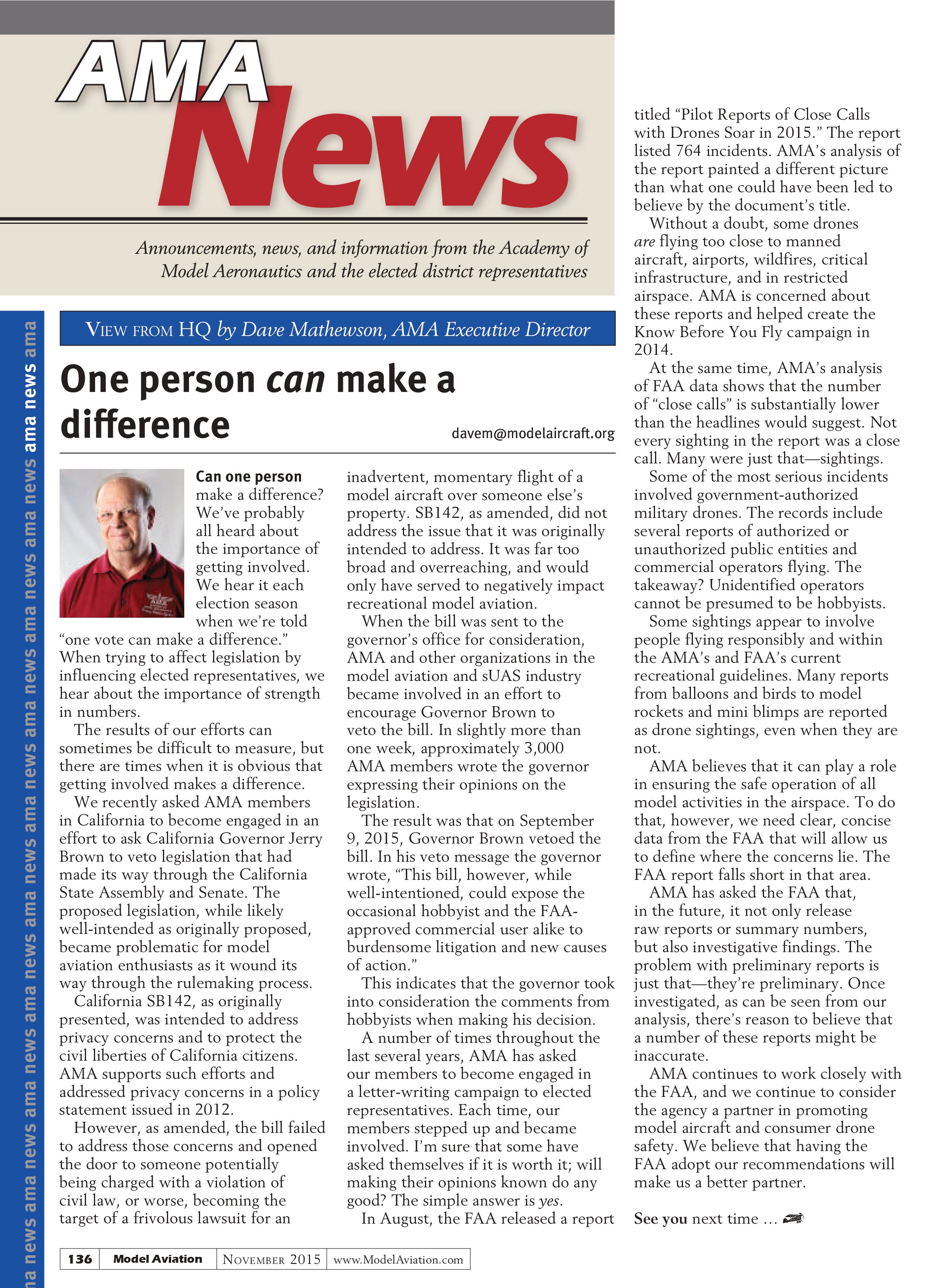
Can one person make a difference? We’ve probably all heard about the importance of getting involved. We hear it each election season when we’re told “one vote can make a difference.” When trying to affect legislation by influencing elected representatives, we hear about the importance of strength in numbers.
The results of our efforts can sometimes be difficult to measure, but there are times when it is obvious that getting involved makes a difference.
We recently asked AMA members in California to become engaged in an effort to ask California Governor Jerry Brown to veto legislation that had made its way through the California State Assembly and Senate. The proposed legislation, while likely well-intended as originally proposed, became problematic for model aviation enthusiasts as it wound its way through the rulemaking process.
California SB142, as originally presented, was intended to address privacy concerns and to protect the civil liberties of California citizens. AMA supports such efforts and addressed privacy concerns in a policy statement issued in 2012.
However, as amended, the bill failed to address those concerns and opened the door to someone potentially being charged with a violation of civil law, or worse, becoming the target of a frivolous lawsuit for an inadvertent, momentary flight of a model aircraft over someone else’s property. SB142, as amended, did not address the issue that it was originally intended to address. It was far too broad and overreaching, and would only have served to negatively impact recreational model aviation.
When the bill was sent to the governor’s office for consideration, AMA and other organizations in the model aviation and sUAS industry became involved in an effort to encourage Governor Brown to veto the bill. In slightly more than one week, approximately 3,000 AMA members wrote the governor expressing their opinions on the legislation.
The result was that on September 9, 2015, Governor Brown vetoed the bill. In his veto message the governor wrote, “This bill, however, while well-intentioned, could expose the occasional hobbyist and the FAA-approved commercial user alike to burdensome litigation and new causes of action.”
This indicates that the governor took into consideration the comments from hobbyists when making his decision.
A number of times throughout the last several years, AMA has asked our members to become engaged in a letter-writing campaign to elected representatives. Each time, our members stepped up and became involved. I’m sure that some have asked themselves if it is worth it; will making their opinions known do any good? The simple answer is yes.
In August, the FAA released a report titled “Pilot Reports of Close Calls with Drones Soar in 2015.” The report listed 764 incidents. AMA’s analysis of the report painted a different picture than what one could have been led to believe by the document’s title.
Without a doubt, some drones are flying too close to manned aircraft, airports, wildfires, critical infrastructure, and in restricted airspace. AMA is concerned about these reports and helped create the Know Before You Fly campaign in 2014.
At the same time, AMA’s analysis of FAA data shows that the number of “close calls” is substantially lower than the headlines would suggest. Not every sighting in the report was a close call. Many were just that—sightings.
Some of the most serious incidents involved government-authorized military drones. The records include several reports of authorized or unauthorized public entities and commercial operators flying. The takeaway? Unidentified operators cannot be presumed to be hobbyists.
Some sightings appear to involve people flying responsibly and within the AMA’s and FAA’s current recreational guidelines. Many reports from balloons and birds to model rockets and mini blimps are reported as drone sightings, even when they are not.
AMA believes that it can play a role in ensuring the safe operation of all model activities in the airspace. To do that, however, we need clear, concise data from the FAA that will allow us to define where the concerns lie. The FAA report falls short in that area.
AMA has asked the FAA that, in the future, it not only release raw reports or summary numbers, but also investigative findings. The problem with preliminary reports is just that—they’re preliminary. Once investigated, as can be seen from our analysis, there’s reason to believe that a number of these reports might be inaccurate.
AMA continues to work closely with the FAA, and we continue to consider the agency a partner in promoting model aircraft and consumer drone safety. We believe that having the FAA adopt our recommendations will make us a better partner.
See you next time …