How not to do it
Dave Gee
safetycolumn@cs.com
Here are a couple of quadcopter stories, and they’re both kind of sad. This isn’t secondhand information. I witnessed both incidents with my own little eyes.
A large, good-natured crowd had gathered to watch a fireworks show. As the group waited, a big, camera-carrying quadcopter lumbered into view overhead. It cruised around and hovered in various spots, sometimes right over the spectators. People realized that the operator was taking risks with their safety. If the machine had a mechanical failure it would fall into the crowd, with rotors flailing.
When the pyrotechnics began, this machine took positions between the audience and the fireworks display. As you might imagine, the crowd was distracted and irritated. People eventually began shouting at the unseen pilot and rooting for the quadcopter to get shot down by an errant skyrocket.
One thoughtless pilot made a bad impression on thousands of people, not to mention endangering them by flying in an unsafe way. How much good publicity will responsible pilots have to generate to overcome that one flight?
The second incident happened at a large public park filled with happy people. Someone insisted on operating a medium-size quadcopter far from the designated RC area, in a spot where people were walking dogs, playing ball, and picnicking.
The pilot flew it using the onboard camera, while remaining out of sight behind a hill. Worse yet, the quadcopter “buzzed” people, flying low and fast overhead. Again, the operator was taking chances with someone else’s safety. Not cool.
Eventually the quadcopter crashed and was damaged. It was purely by chance that the impact site was away

from humans. I actually heard a cheer, and when the pilot emerged to retrieve his model, people shouted “You got what you deserve!” This is not how I want the public to perceive our hobby!
There were several AMA members at the park and we discussed what actions could be taken. Our concern went beyond the immediate safety issue. We (unlike the quadcopter pilot) were worried about the public image of our sport.
If we reported the irresponsible pilot, the authorities might simply lump all modelers together and ban us all. What if some hothead decided to take direct action against the offending multirotor pilot? Imagine the unflattering news story: “Drone pilots scuffle over illegal airspace.” What a shame, in every way.
My friends said the pilot would never see this account of the incident because he probably isn’t even an AMA member. Given his demonstration of reckless flying, I bet they’re right.
Multirotors have two special features that make them especially prone to public relations debacles. Unlike most model aircraft, they need no runway or open area to start and end their flights. Thus, a new pilot might think the world is his or her airfield and be tempted to operate quadcopters in places where such activity is unwelcome or unsafe.
If equipped with the latest automatic stability features, little or no training or experience is required to fly a multirotor. Open the box and you’re an expert! Electronically enhanced flying skills won’t help if the person twisting the controls doesn’t know right from wrong.
I have nothing against multirotors—some of my best friends are quadcopter pilots. I even fly my own quadcopter (but not well, of course). These aircraft can be great fun when flown for sport or in competition.
Some pilots even use them to make a living by doing aerial photography. When operated safely and properly, multirotors can make the world a better place.
Aeromodelers fly just for the fun of it. We like the fact that our little machines bring joy to us and others. For instance, my quadcopter flying brings gladness to the hearts of shopkeepers who sell replacement propellers.
The procedures for safe operation of multirotor aircraft are nearly the same as for any model. Common sense and courtesy are the keys. When someone decides to fly without those two ingredients, it can give us all a black eye. If some
members of the public have a negative opinion of drones, it is probably the risky maneuvers of thoughtless pilots that made it that way.
Why They’re Called Choppers
Joel McDonald is anything but thoughtless. He has 20 years of model-flying experience and admits to being “paranoid about safety.” He kindly asked me to share the story of his recent close call, in hopes of saving someone else from the same, or worse, fate. Joel said:
“Prop safety issues are even more important when you’re dealing with multirotors. I had a small 250mm-class FPV racer on the table and I armed it to make sure the motors were functioning. I bumped the throttle a little higher than I meant to, and the aircraft hopped a few inches to the side and nearly fell to the ground.
“In a split-second panic, I cut the throttle and grabbed at the aircraft to keep it from falling, but in the process I accidentally bumped the throttle stick to half. My hand was directly over the aircraft when it jumped straight up with all four props spinning.
“Luckily, the only damage was to my pride and to the tip of a finger where the prop left a nice little bruise as a reminder.”
Joel said he now removes the propellers when tinkering with his aircraft.
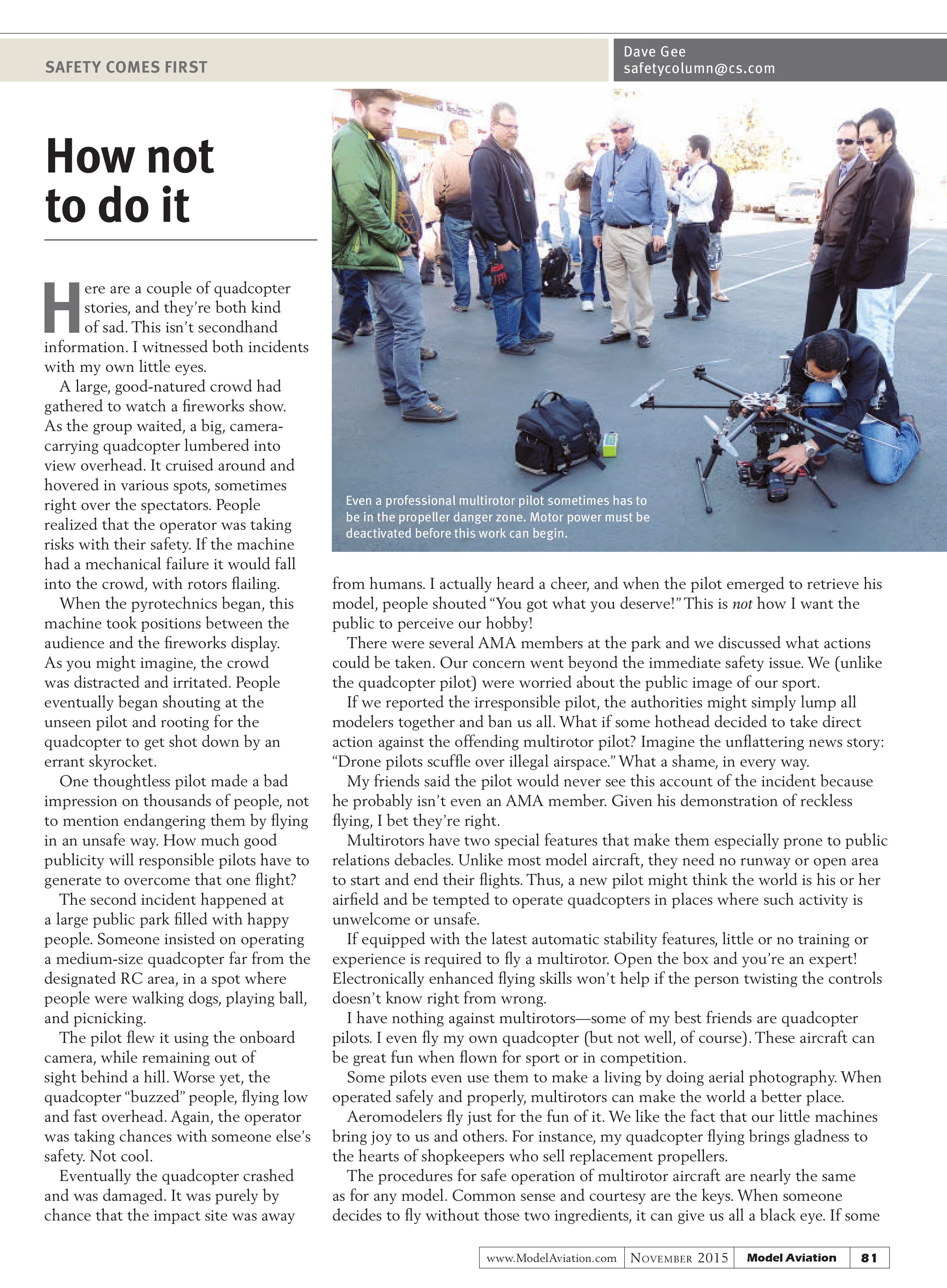
Multirotors make up for their lack of wings by carrying a lot of propeller blades. Extra care is needed when your body parts are within range. Some machines have master arming switches similar to conventional electric airplanes, while others are wired to allow easy disconnection of the motor circuit.
There may be times when we need to access the model, but taking all of the propellers off isn’t practical. That opens a window of vulnerability and requires special caution. Be methodical and plan your actions. Take a moment to think before you put your hand within the arc of a propeller blade. Murphy’s Law is always standing by—don’t get caught.
“Steel” Talking About Ammo Boxes?
Daniel Mitchell knows all about Murphy’s Law and sent me a clever tip that might help others dodge some trouble. He read my recent column about various types of LiPo battery charging containers, including military-surplus steel ammunition boxes. These seal tightly and won’t let hot gases escape. Drilling holes in them may or may not improve the situation.
Daniel said that the rubber seal around the lid is designed to be watertight. Removing most, but not all, of this seal still allows the lid to latch, but leaves a reasonable gap to release pressure in the event of a fire. It’s a simple, but clever, idea!
Neither of us has fire-tested this technique yet, but it seems to be a reasonable way to upgrade an ammunition can when used as a battery container. I think Daniel is a pretty sharp modeler.
Indoor Hazard
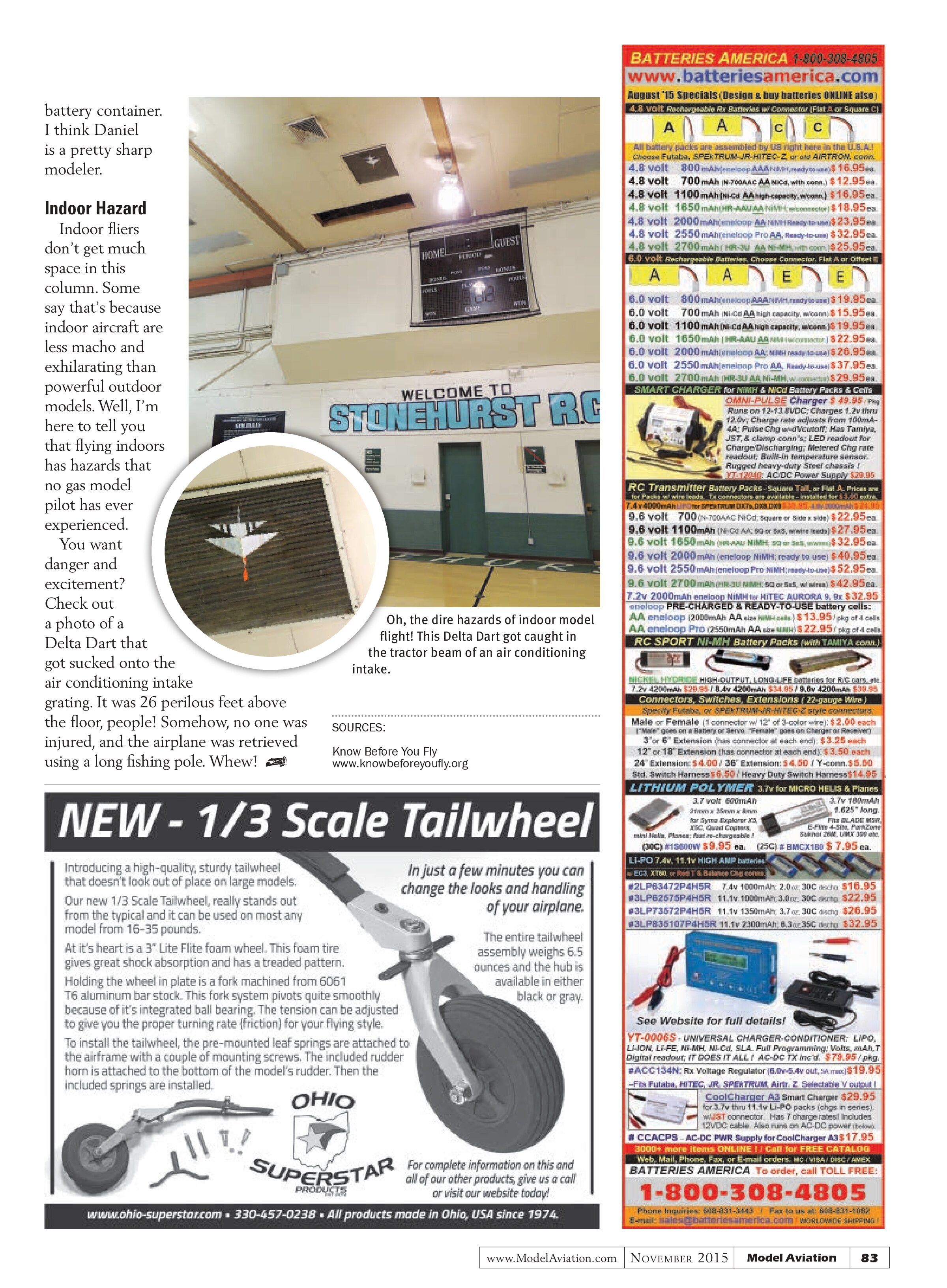
Indoor fliers don’t get much space in this column. Some say that’s because indoor aircraft are less macho and exhilarating than powerful outdoor models. Well, I’m here to tell you that flying indoors has hazards that no gas model pilot has ever experienced. You want danger and excitement? Check out a photo of a Delta Dart that got sucked onto the air conditioning intake grating. It was 26 perilous feet above the floor, people! Somehow, no one was injured, and the airplane was retrieved using a long fishing pole. Whew!

SOURCES:
Know Before You Fly
www.knowbeforeyoufly.org