
2015 Nats champions
by Aaron “AJ” Seaholm
aseaholm@gmail.com
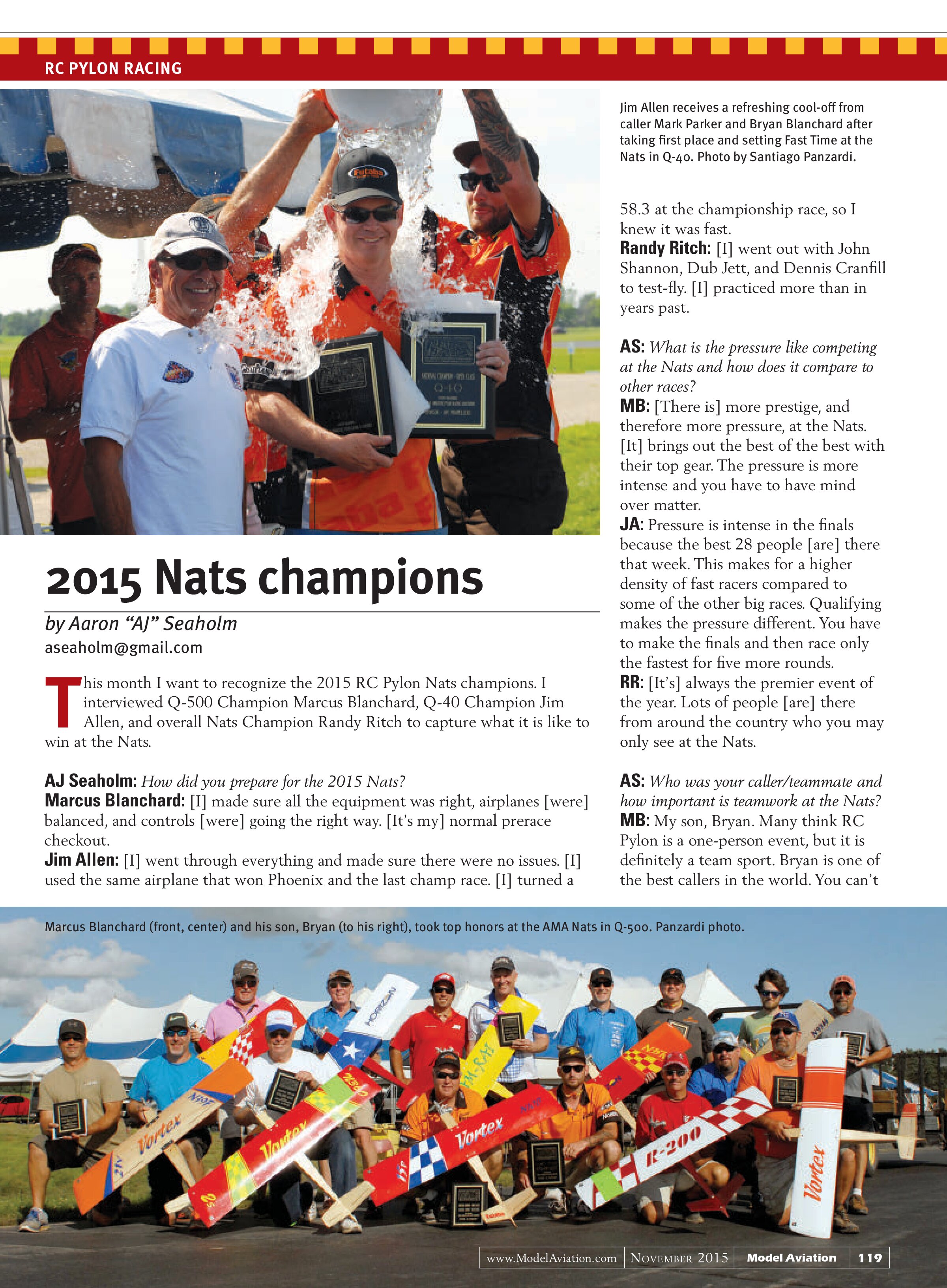
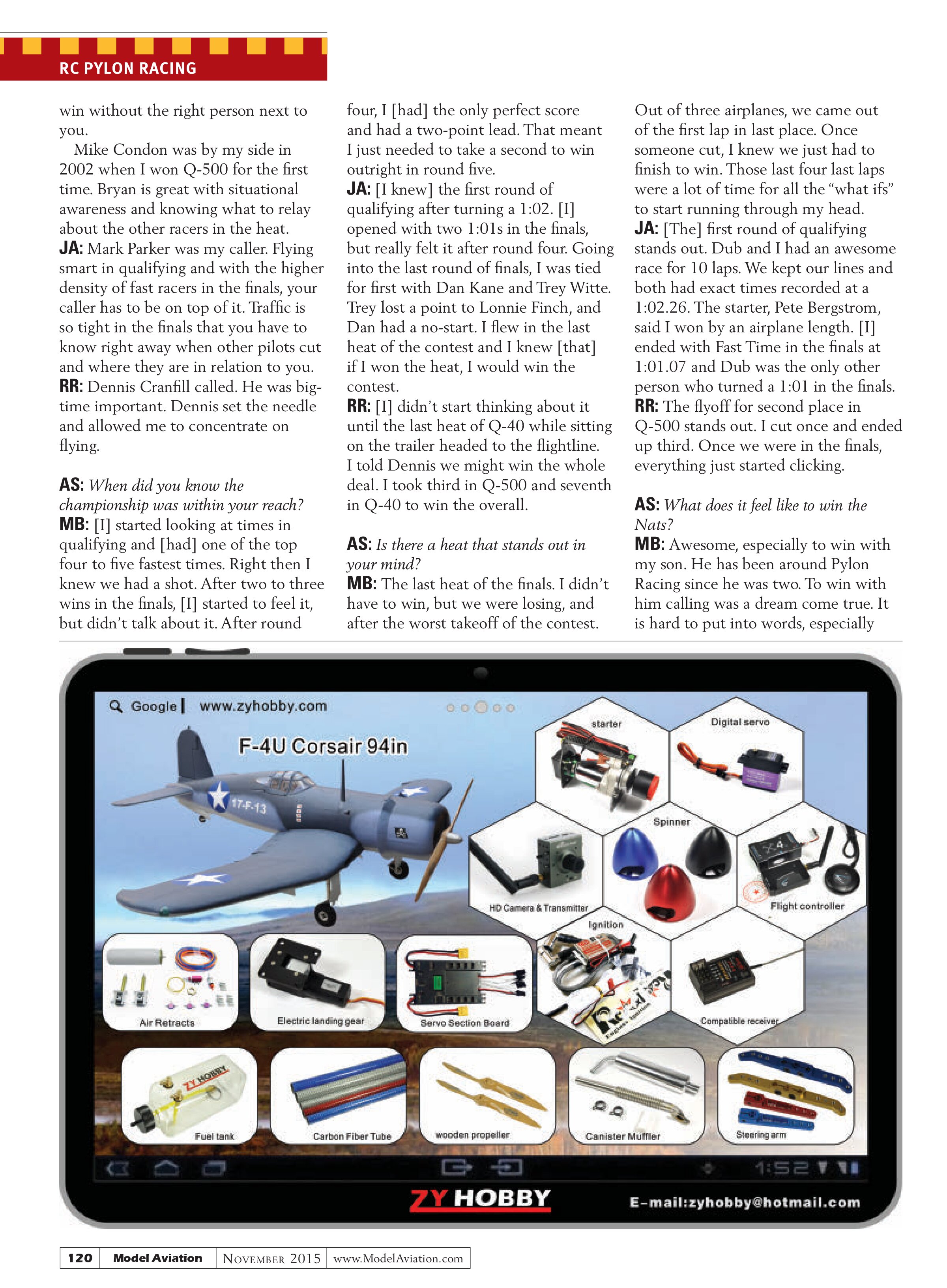
This month I want to recognize the 2015 RC Pylon Nats champions. I interviewed Q-500 Champion Marcus Blanchard, Q-40 Champion Jim Allen, and overall Nats Champion Randy Ritch to capture what it is like to win at the Nats.
AJ Seaholm: How did you prepare for the 2015 Nats?
Marcus Blanchard: [I] made sure all the equipment was right, airplanes [were] balanced, and controls [were] going the right way. [It’s my] normal prerace checkout.
Jim Allen: [I] went through everything and made sure there were no issues. [I] used the same airplane that won Phoenix and the last champ race. [I] turned a 58.3 at the championship race, so I knew it was fast.
Randy Ritch: [I] went out with John Shannon, Dub Jett, and Dennis Cranfill to test-fly. [I] practiced more than in years past.
AS: What is the pressure like competing at the Nats and how does it compare to other races?
MB: [There is] more prestige, and therefore more pressure, at the Nats. [It] brings out the best of the best with their top gear. The pressure is more intense and you have to have mind over matter.
JA: Pressure is intense in the finals because the best 28 people [are] there that week. This makes for a higher density of fast racers compared to some of the other big races. Qualifying makes the pressure different. You have to make the finals and then race only the fastest for five more rounds.
RR: [It’s] always the premier event of the year. Lots of people [are] there from around the country who you may only see at the Nats.
AS: Who was your caller/teammate and how important is teamwork at the Nats?
MB: My son, Bryan. Many think RC Pylon is a one-person event, but it is definitely a team sport. Bryan is one of the best callers in the world. You can’t

win without the right person next to you.
Mike Condon was by my side in 2002 when I won Q-500 for the first time. Bryan is great with situational awareness and knowing what to relay about the other racers in the heat.
JA: Mark Parker was my caller. Flying smart in qualifying and with the higher density of fast racers in the finals, your caller has to be on top of it. Traffic is so tight in the finals that you have to know right away when other pilots cut and where they are in relation to you.
RR: Dennis Cranfill called. He was big-time important. Dennis set the needle and allowed me to concentrate on flying.
AS: When did you know the championship was within your reach?
MB: [I] started looking at times in qualifying and [had] one of the top four to five fastest times. Right then I knew we had a shot. After two to three wins in the finals, [I] started to feel it, but didn’t talk about it. After round
four, I [had] the only perfect score and had a two-point lead. That meant I just needed to take a second to win outright in round five.
JA: [I knew] the first round of qualifying after turning a 1:02. [I] opened with two 1:01s in the finals, but really felt it after round four. Going into the last round of finals, I was tied for first with Dan Kane and Trey Witte. Trey lost a point to Lonnie Finch, and Dan had a no-start. I flew in the last heat of the contest and I knew [that] if I won the heat, I would win the contest.
RR: [I] didn’t start thinking about it until the last heat of Q-40 while sitting on the trailer headed to the flightline. I told Dennis we might win the whole deal. I took third in Q-500 and seventh in Q-40 to win the overall.
AS: Is there a heat that stands out in your mind?
MB: The last heat of the finals. I didn’t have to win, but we were losing, and after the worst takeoff of the contest.
Out of three airplanes, we came out of the first lap in last place. Once someone cut, I knew we just had to finish to win. Those last four last laps were a lot of time for all the “what ifs” to start running through my head.
JA: [The] first round of qualifying stands out. Dub and I had an awesome race for 10 laps. We kept our lines and both had exact times recorded at a 1:02.26. The starter, Pete Bergstrom, said I won by an airplane length. [I] ended with Fast Time in the finals at 1:01.07 and Dub was the only other person who turned a 1:01 in the finals.
RR: The flyoff for second place in Q-500 stands out. I cut once and ended up third. Once we were in the finals, everything just started clicking.
AS: What does it feel like to win the Nats?
MB: Awesome, especially to win with my son. He has been around Pylon Racing since he was two. To win with him calling was a dream come true. It is hard to put into words, especially winning it with a family member. [I’m] on cloud nine for sure. It is a different feeling than it was in 2002 too. [It] felt like a comeback—a resurgence.

JA: [It’s a] huge relief due to the pressure that builds as you get close to it. [It’s] tough to put into words, but [a] real satisfying feeling, especially knowing you beat the best there that week.
RR: [It’s] emotional, something special—truly special. I’ve been going to the Nats for a long time, on and off for the last 40 years. I don’t usually get emotional, but was that day.
AS: Is there anything else you would like to tell our readers?
MB: Pylon Racing has been a big part of my life with my son. [It’s a] good family event and competition. If you’re just getting started, work at it, learn how to trim the airplane, and get a good caller. Win or lose, it’s a great hobby.
JA: Special thanks [to] Dan, Mike, and Pete for putting on a quality event. You go to the Nats knowing it’s going to be a good contest because of those people. It’s worth it to put in the effort to be prepared to do as well as possible. The Nats is great, win or lose.
RR: The Nats is special. I hope other people can experience it. The other thing I’d say is don’t give up.
We were at the team trials for Control Line the week before the Pylon Nats. My 13-year-old son, Rylan, and I spent a lot of time prepping for that event. He and two other Juniors were trying out. He lost out to another competitor by the narrowest of margins.
Sunday night, we were down and out, wondering why it happened like it did. It was a low point for both of us, but I tried to explain to him that you have to persevere.
Fast-forward to Thursday and we were on the top [of] the world after so many years [of] attending the Pylon Nats. [It was an] emotional week for sure. Big thanks to my father, Dick Ritch, for getting me into models.
Congratulations Marcus, Jim, and Randy!
SOURCES:
National Miniature Pylon Racing Association (NMPRA)
www.nmpra.org