Jets Over Kentucky Week
by Jim Hiller
jetmodeler@earthlink.net
Jets Over Kentucky Week, held in Lebanon, Kentucky, July 5-12, 2015, was successful despite the weatherman’s best efforts to dampen the event.
Rain was the word of the week, and it rained every day but Saturday. Despite the weather, we had some great fun flying jets, talking jets, and camping in the mud. We flew every day and had a good time.
Lewis Patton did a great job of coordinating the event. He had plans in place to help the modelers and campers deal with the wet grounds. Plenty of straw was provided to cover the ground under the tents to allow for good walking surfaces. Thanks to all who pitched in, pulled campers and RVs out of the mud, and kept things moving and everyone having fun.
Friday evening was filled with the annual crowd-pleasing Night of Lights. Brightly lit turbine-powered models taxied down the runway for the spectators, followed by a fireworks display. Town residents came out and enjoyed the show along with the modelers.
The best part of this event was that so many vendors showed up with their latest offerings, and flew them during the show. Chief Aircraft now offers jets and brought some of its products, including a couple of Pilot RC Dolphins, for all to see. These 86-inch wooden sport jets were covered with UltraCote and appeared to fly well. They were powered by 140-size turbines and had an 84-inch fuselage. The jets are a low-cost alternative for a sport modeler.
Global Jet Club brought its full fleet of display aircraft. This included a T-33

to add to the fleet of FeiBao Thunderbirds that were seen at the event. This model has become a popular aircraft and it flies well.
KingTech Turbines, JetCat, and Jet Central provided great on-site support for turbine problems. Company representatives kept busy helping the modelers and answering their many questions.
KingTech Turbines representatives flew the new K-45G turbine—a neat little package for smaller-size jets. This turbine was mounted in a ¹⁄₁₀-scale Jet Hangar Hobbies A-7 Corsair II. The K-45G flew well. These smaller turbines can be a

handful in terms of reliability, but KingTech appeared to have this one running well. It was a good showing for this new product.
John Redman, of JetCat turbines, flew from California to provide support and help keep jets flying. I knew of at least one pilot on the field who was using a loaner turbine engine. The modeler had recently sent in his turbine for repairs, and John immediately sent him a JetCat engine on loan so he could fly at Jets Over Kentucky. Now that is service!
Jet Central, which now has Jose Melendez as the contact person in the US, was on site showing its latest Jet Central turbine offerings with the Power Pack setup. All are available in the new SP versions.
The power of the SP turbines is something special. They are powerful and reliable for their size. I have been flying the Rabbit SP at 24 pounds of thrust, the Rhino SP at an amazing 45 pounds of thrust, and the Mammoth SP at 50.5 pounds of thrust. They are all impressive turbine packages.
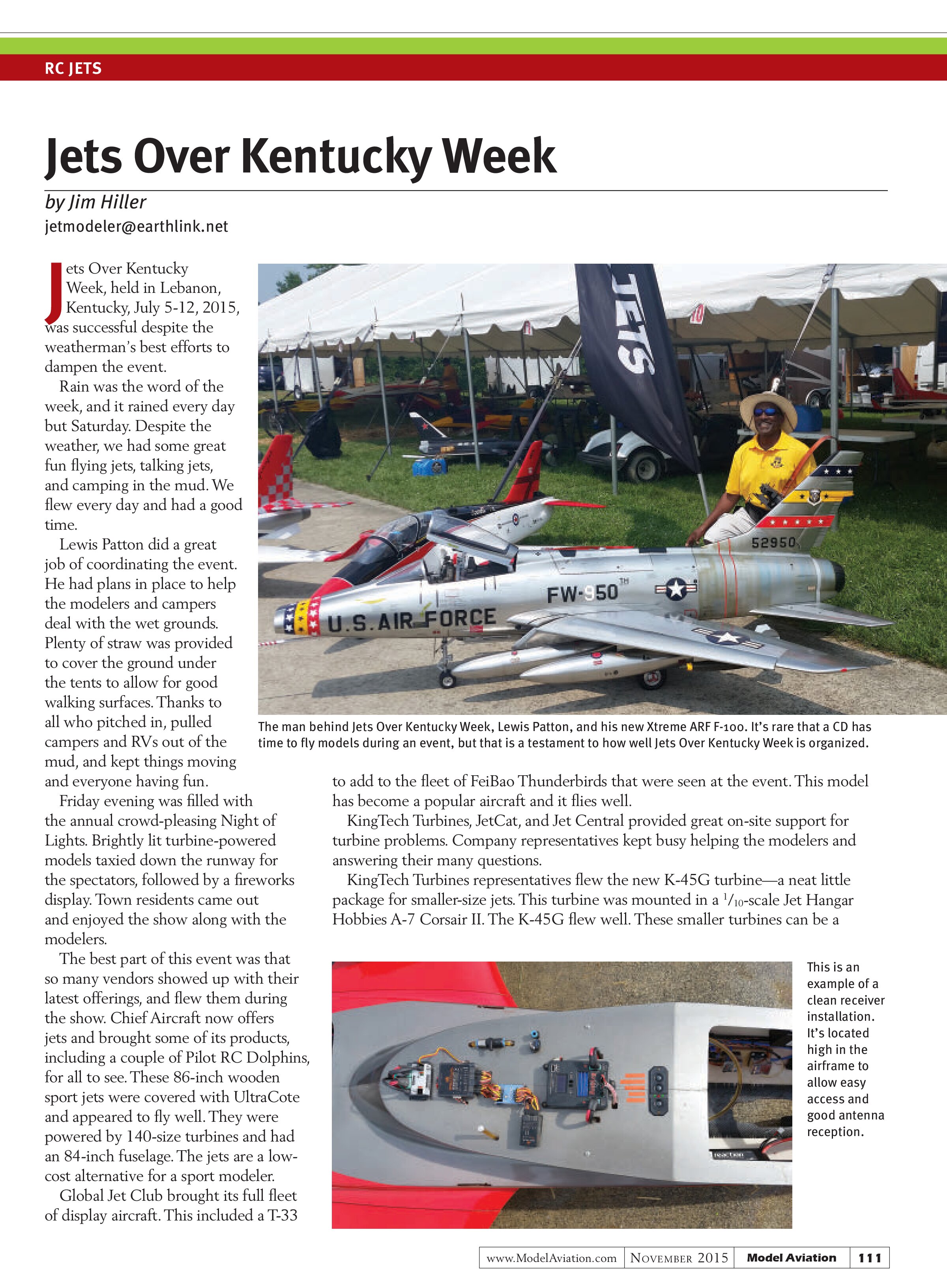
Contest director (CD) Lewis Patton got some flying in during this year’s Jets Over Kentucky Week with his new 110-inch-long Xtreme ARF F-100 Super Sabre with all of the details. The model is equipped with leading edge slats to slow it for approach and landing. Lewis made it look good.
He powered his model with a Jet Central Mammoth SP turbine, which moved the large F-100 through the sky with great authority. This was his first outing with the F-100, but he flew it with confidence. It was nice to see the CD of such a large gathering able to have everything running well enough to enjoy some flight time.
Antenna Location
In closing, I want to discuss antenna location on 2.4 GHz radios and how the location could prevent the antenna from receiving the transmitter’s signal. Think of the radio signal as line-of-sight only. If you can’t see at least one antenna from the angle the aircraft is in when holding the transmitter, you won’t have control.
We program our radios to go into a fail-safe position when this situation occurs, and if the signal is blocked, the turbine engine will shut down. What can block the signal? Metal, carbon fiber, and liquids can. A large fuel tank full of kerosene can also block the signal.
Metal objects in a typical jet include the nose-gear retract, the turbine, and a large tailpipe. All are usually located behind the receiver, along with the fuel tank. That means you have to think about antenna location when you view your model from the rear.
I’ve seen other modelers experience problems caused by antenna locations—all with radios that have the receiver antennas emanating from only the receiver.
I fly with older JR and Spektrum radios—both with remote antennas—so I don’t have to worry about hiding my receiver deep in the fuselage. When I do, I have the luxury of remote antennas spread throughout the airplane that seek a good transmitter signal, any of which will keep my aircraft flying.
This subject is important with the latest trend in radios where remote antennas are not available and there are typically only two antennas extending from the main receiver. Add to this the fact that there is no data logger to record antenna reception performance, and you have to be extra careful with antenna placement. A loss of signal could result in the loss of your airplane.
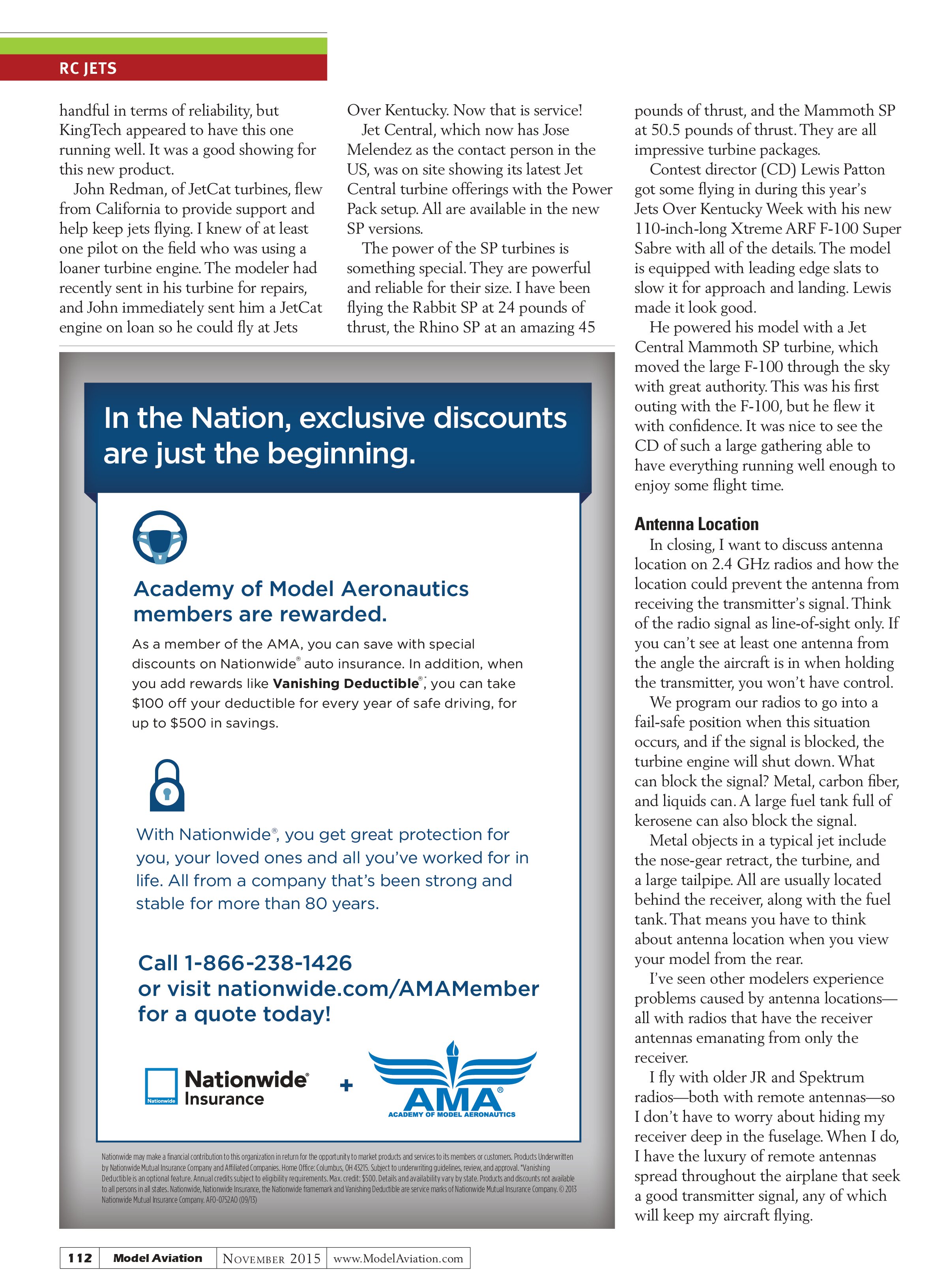
This receiver/antenna setup means you have to locate these receivers where their antennas are clear of the fuel tank, tailpipe, and any metal in the airframe. A good place to install such a receiver is up front in the cockpit area, but high in the airframe. The height of the forward hatch typically works well.
All of the problems I have experienced with these receivers without remote antennas have had one thing in common—the receiver was mounted low in the forward fuselage in front of the fuel tank. This resulted in a fail-safe experience with a programmed turbine shutdown.
Don’t be confused when your ground support unit indicates a normal shutdown. That means the receiver shut down the turbine. If you didn’t command it, then you had a fail-safe condition. Use care when choosing the antenna location and enjoy flying.
Sources:
Jet Pilots’ Organization (JPO)
www.jetpilots.org
Jets Over Kentucky Week
www.facebook.com/pages/Jets-over-Kentucky-Week-2015/1460340594231888
KingTech Turbines
(626) 793-4677
www.kingtechturbines.com
Global Jet Club
(866) 959-6888
www.globaljetclub.com
Jet Central USA
jetartessales@aol.com
www.jetcentralusa.com
JetCat USA
(661) 822-4812
www.jetcatusa.com
Jet Hangar Hobbies, Inc.
(562) 467-0260
www.jethangar.com
Xtreme ARF
support@xtremearf.com
www.xtremearf.com