Treasure Valley Pattern Contest
by Mike Riggs
rcaerobatics@gmail.com

The sixth Treasure Valley Pattern Contest was held outside of Boise, Idaho, during the weekend of June 6-7, 2015. It was the fifth time I have been honored to be the contest director of this event, and the first time I did not fly.
In a promotional effort years ago, I started offering my famous “good-weather guarantee.” As I recall, it rained all day Saturday the first year I made this bold statement. Throughout the years, it has become something of a joke.
This year the weather was not a joke. It was the best we have ever had. By Boise standards, the wind hardly blew at all—just a little high-wind thermal activity late Saturday afternoon. In sharp contrast to previous years with complaints of wind, snow, and rain, a few quips about upper 80° temperatures were muttered under the field’s sunshade.
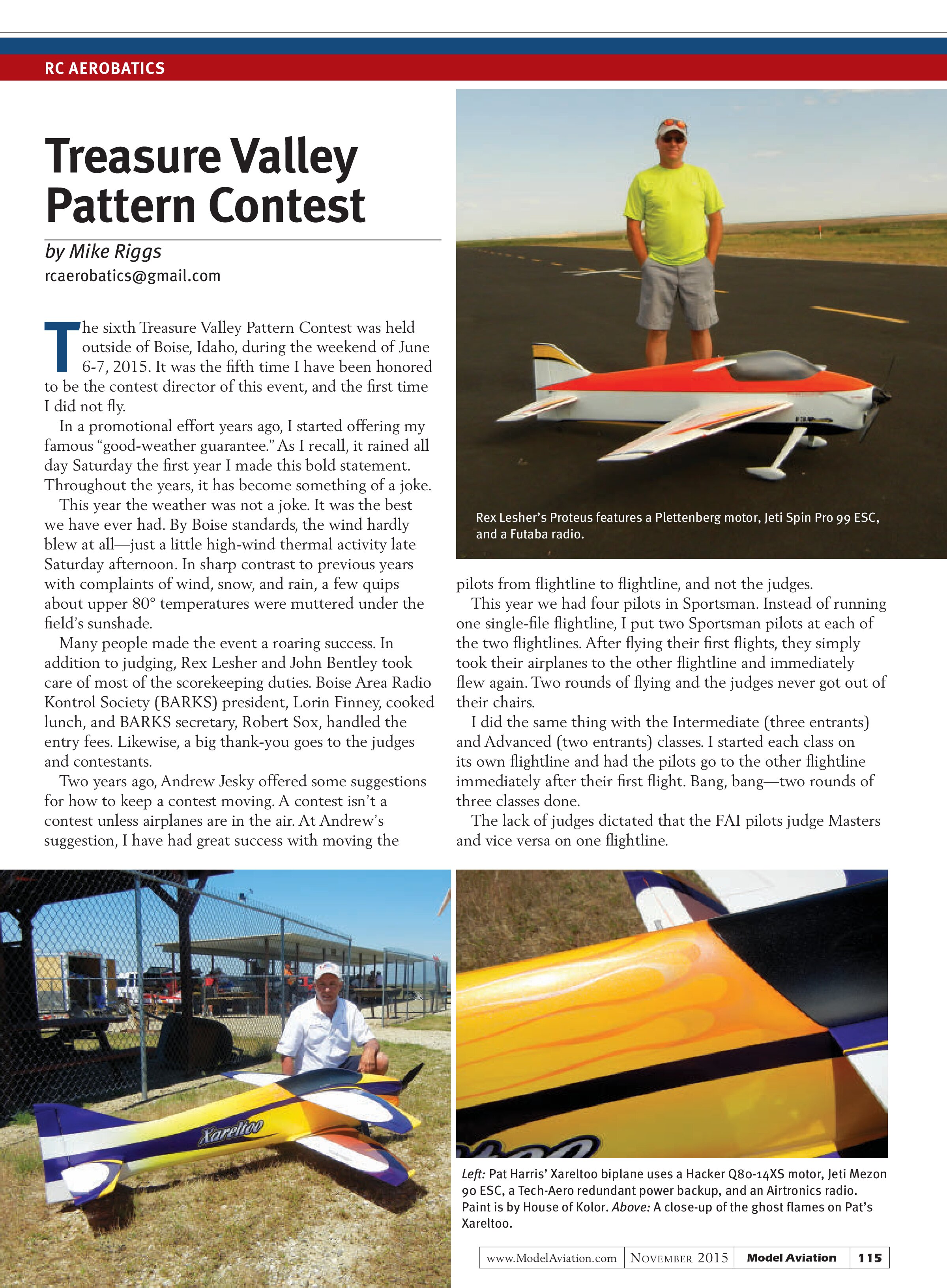
Many people made the event a roaring success. In addition to judging, Rex Lesher and John Bentley took care of most of the scorekeeping duties. Boise Area Radio Kontrol Society (BARKS) president, Lorin Finney, cooked lunch, and BARKS secretary, Robert Sox, handled the entry fees. Likewise, a big thank-you goes to the judges and contestants.
Two years ago, Andrew Jesky offered some suggestions for how to keep a contest moving. A contest isn’t a contest unless airplanes are in the air. At Andrew’s suggestion, I have had great success with moving the pilots from flightline to flightline, and not the judges.
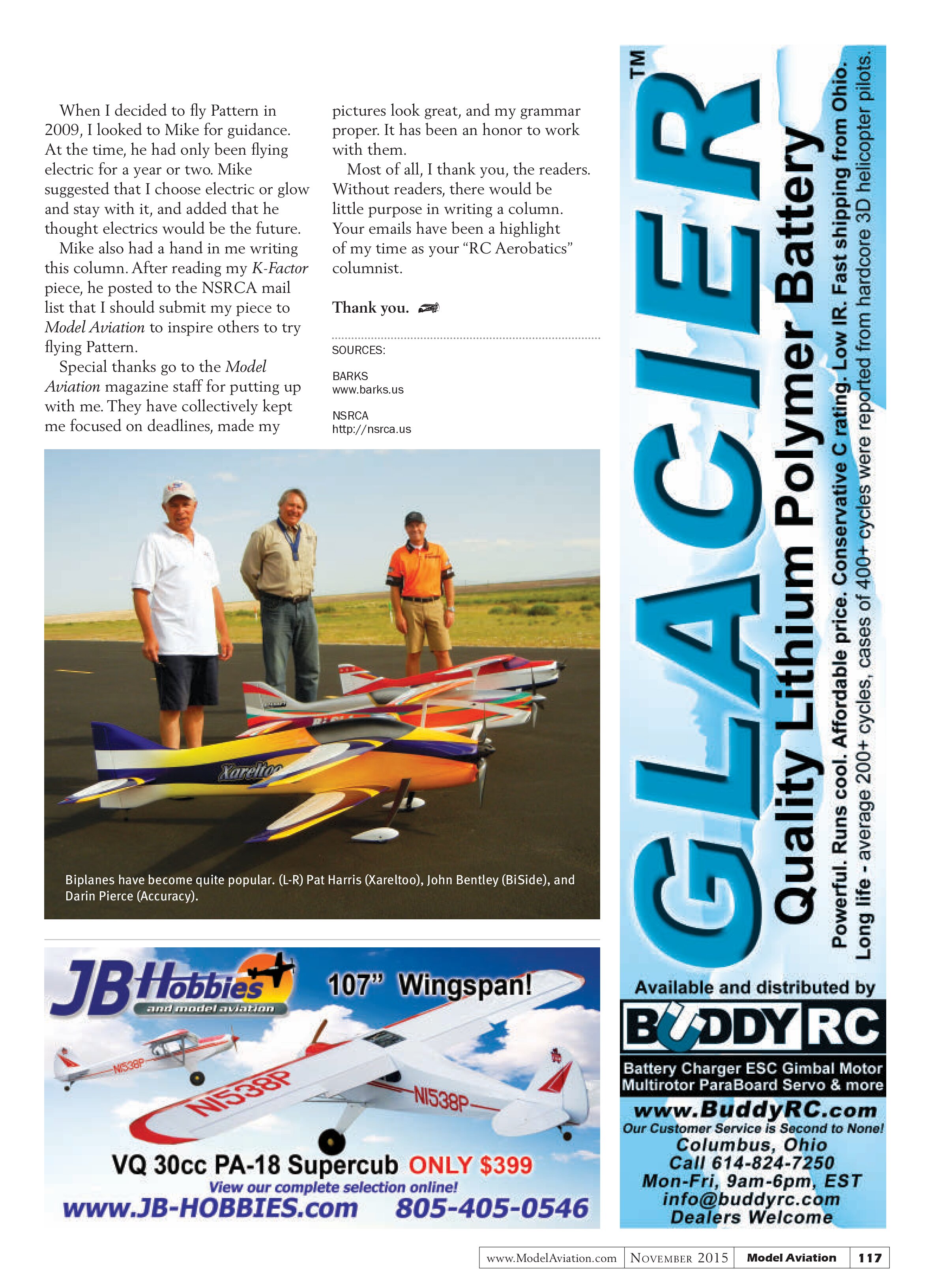
This year we had four pilots in Sportsman. Instead of running one single-file flightline, I put two Sportsman pilots at each of the two flightlines. After flying their first flights, they simply took their airplanes to the other flightline and immediately flew again. Two rounds of flying and the judges never got out of their chairs.
I did the same thing with the Intermediate (three entrants) and Advanced (two entrants) classes. I started each class on its own flightline and had the pilots go to the other flightline immediately after their first flight. Bang, bang—two rounds of three classes done.
The lack of judges dictated that the FAI pilots judge Masters and vice versa on one flightline.


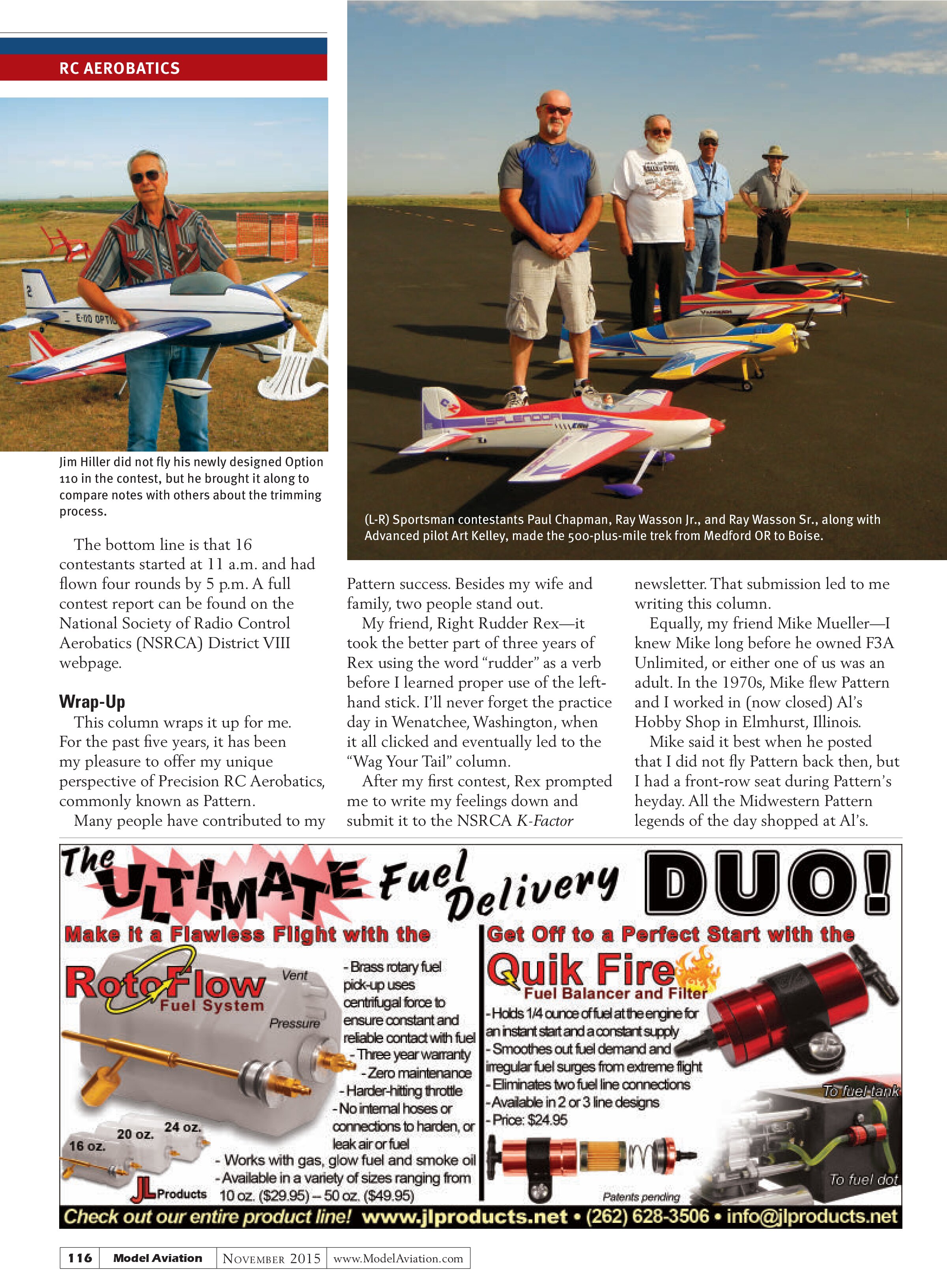
Jim Hiller did not fly his newly designed Option 110 in the contest, but he brought it along to compare notes with others about the trimming process.

The bottom line is that 16 contestants started at 11 a.m. and had flown four rounds by 5 p.m. A full contest report can be found on the National Society of Radio Control Aerobatics (NSRCA) District VIII webpage.
Wrap-Up
This column wraps it up for me. For the past five years, it has been my pleasure to offer my unique perspective of Precision RC Aerobatics, commonly known as Pattern.
Many people have contributed to my
Pattern success. Besides my wife and family, two people stand out.
My friend, Right Rudder Rex—it took the better part of three years of Rex using the word “rudder” as a verb before I learned proper use of the left-hand stick. I’ll never forget the practice day in Wenatchee, Washington, when it all clicked and eventually led to the “Wag Your Tail” column.
After my first contest, Rex prompted me to write my feelings down and submit it to the NSRCA K-Factor
newsletter. That submission led to me writing this column.
Equally, my friend Mike Mueller—I knew Mike long before he owned F3A Unlimited, or either one of us was an adult. In the 1970s, Mike flew Pattern and I worked in (now closed) Al’s Hobby Shop in Elmhurst, Illinois.
Mike said it best when he posted that I did not fly Pattern back then, but I had a front-row seat during Pattern’s heyday. All the Midwestern Pattern legends of the day shopped at Al’s.

When I decided to fly Pattern in 2009, I looked to Mike for guidance. At the time, he had only been flying electric for a year or two. Mike suggested that I choose electric or glow and stay with it, and added that he thought electrics would be the future.
Mike also had a hand in me writing this column. After reading my K-Factor piece, he posted to the NSRCA mail list that I should submit my piece to Model Aviation to inspire others to try flying Pattern.
Special thanks go to the Model Aviation magazine staff for putting up with me. They have collectively kept me focused on deadlines, made my
pictures look great, and my grammar proper. It has been an honor to work with them.
Most of all, I thank you, the readers. Without readers, there would be little purpose in writing a column. Your emails have been a highlight of my time as your “RC Aerobatics” columnist.
Thank you.
SOURCES:
BARKS
www.barks.us
NSRCA
http://nsrca.us