Education is the key to safe flying
Bob Brown
bobb@modelaircraft.org

I hope you had a great summer of flying. Although mine was exciting, a small number of non-AMA members flying drones caused me some heartburn. I believe that safe-flying education is the primary solution to this problem.
I do think, however, that a monetary penalty or fine by the FAA or local authorities might help. It would also be helpful if all our clubs would assist these hobbyists by allowing them to safely fly at a local club field.
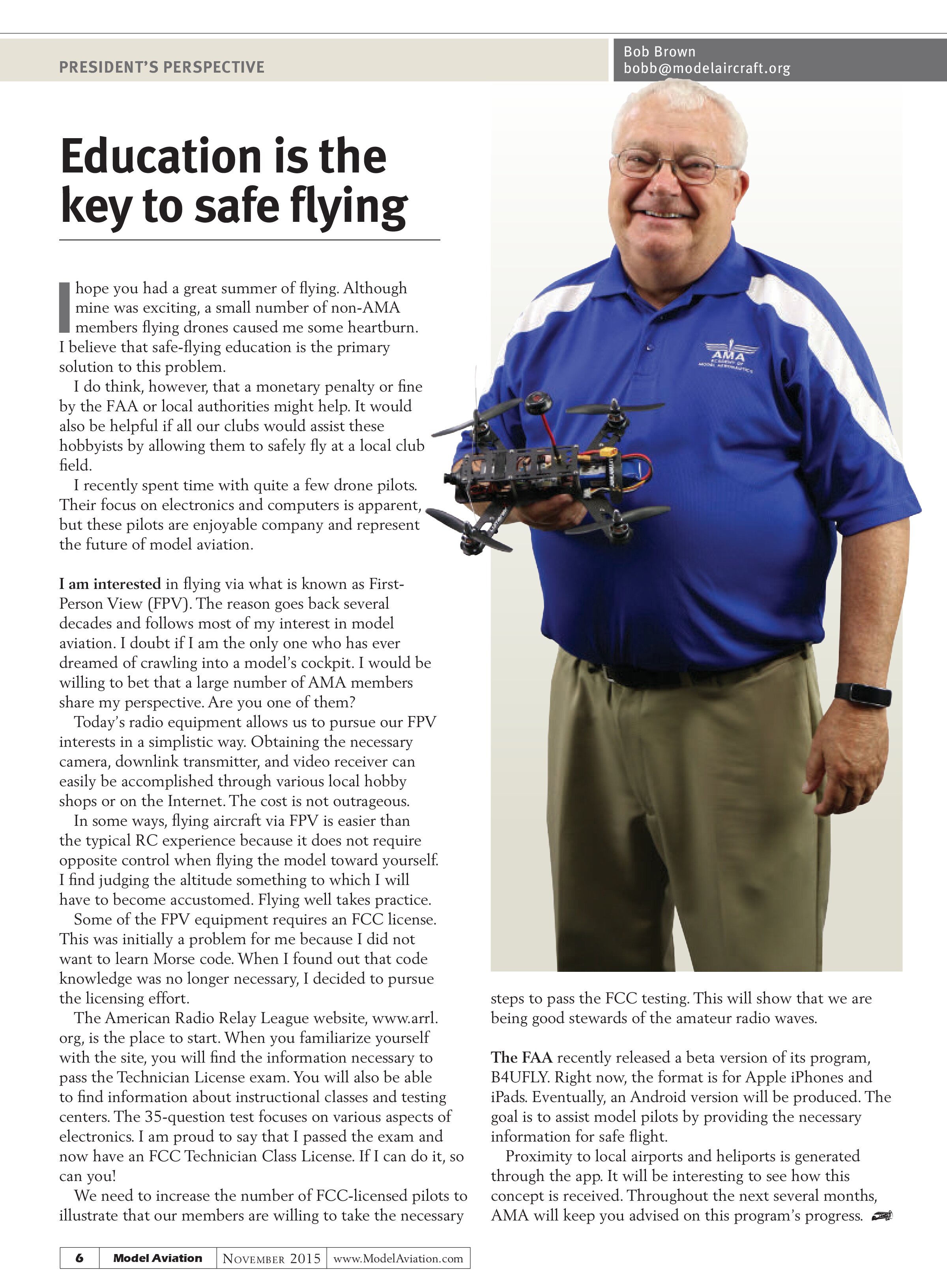
I recently spent time with quite a few drone pilots. Their focus on electronics and computers is apparent, but these pilots are enjoyable company and represent the future of model aviation.
I am interested in flying via what is known as First-Person View (FPV). The reason goes back several decades and follows most of my interest in model aviation. I doubt if I am the only one who has ever dreamed of crawling into a model’s cockpit. I would be willing to bet that a large number of AMA members share my perspective. Are you one of them?
Today’s radio equipment allows us to pursue our FPV interests in a simplistic way. Obtaining the necessary camera, downlink transmitter, and video receiver can easily be accomplished through various local hobby shops or on the Internet. The cost is not outrageous.
In some ways, flying aircraft via FPV is easier than the typical RC experience because it does not require opposite control when flying the model toward yourself. I find judging the altitude something to which I will have to become accustomed. Flying well takes practice.
Some of the FPV equipment requires an FCC license. This was initially a problem for me because I did not want to learn Morse code. When I found out that code knowledge was no longer necessary, I decided to pursue the licensing effort.
The American Radio Relay League website, www.arrl.org, is the place to start. When you familiarize yourself with the site, you will find the information necessary to pass the Technician License exam. You will also be able to find information about instructional classes and testing centers. The 35-question test focuses on various aspects of electronics. I am proud to say that I passed the exam and now have an FCC Technician Class License. If I can do it, so can you!
We need to increase the number of FCC-licensed pilots to illustrate that our members are willing to take the necessary steps to pass the FCC testing. This will show that we are being good stewards of the amateur radio waves.
The FAA recently released a beta version of its program, B4UFLY. Right now, the format is for Apple iPhones and iPads. Eventually, an Android version will be produced. The goal is to assist model pilots by providing the necessary information for safe flight.
Proximity to local airports and heliports is generated through the app. It will be interesting to see how this concept is received. Throughout the next several months, AMA will keep you advised on this program’s progress.