Sport Scale biplane brings a “sassy, go-go look” to CL
Jack W. Rose designed and built 11 full-scale Rose Parrakeet airplanes between 1931 and the beginning of World War II. His hope was to manufacture and sell them, so he went through much effort and expense to get a Civil Aviation Authority Approved Type Certificate. The sporting and aerobatic aircraft had a low wing loading and nearly asymmetrical airfoil, and was able to take off and land in 50 yards.


When Frank Beatty saw a full-scale Parrakeet in the fall of 1993, he wanted one, and his Control Line (CL) Sport Scale version was born. He used three-views from several sources. Surviving Parrakeets had been modified in many ways; therefore, his model would be a composite of markings and details from several airplanes.
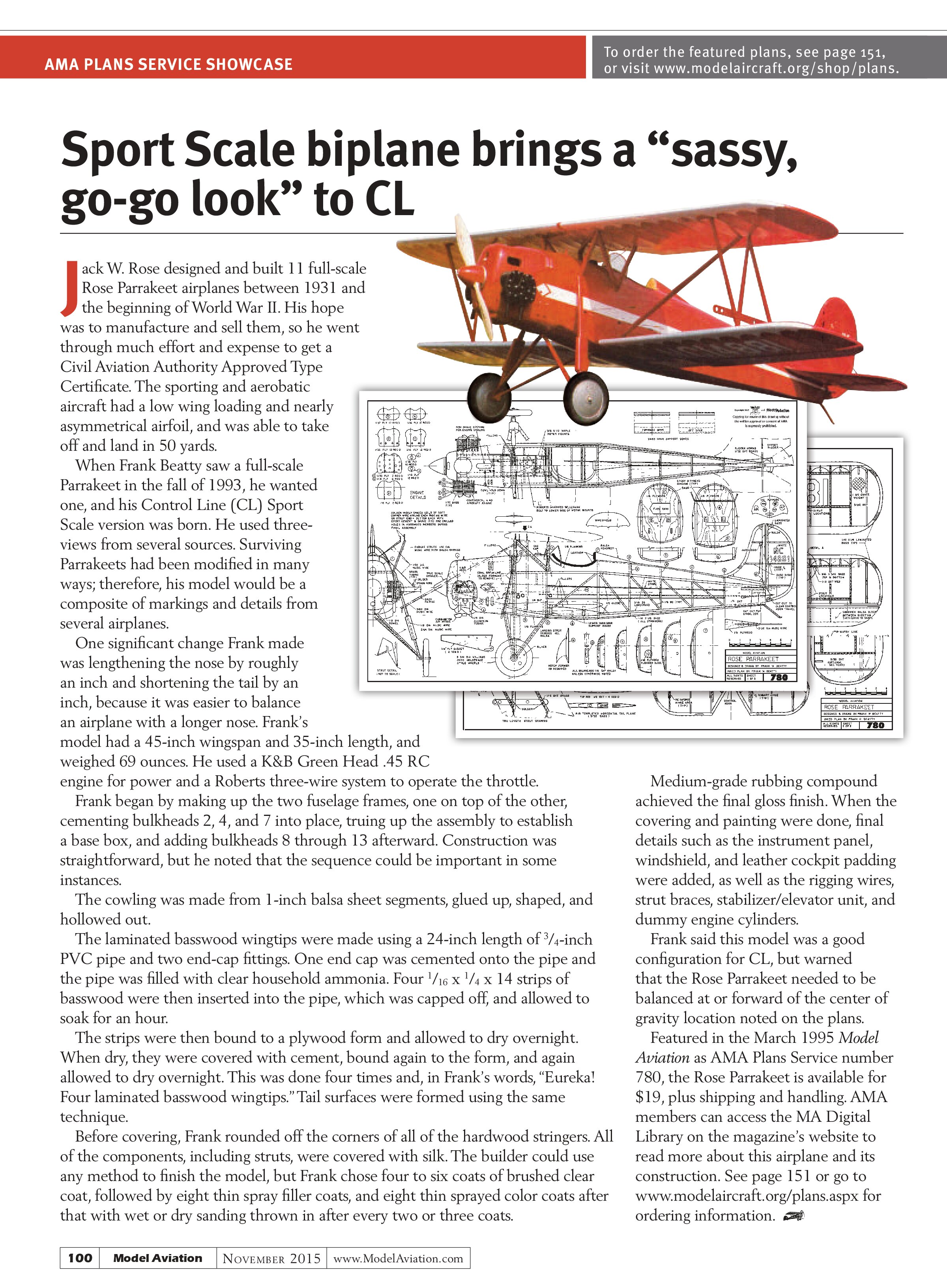
One significant change Frank made was lengthening the nose by roughly an inch and shortening the tail by an inch, because it was easier to balance an airplane with a longer nose. Frank’s model had a 45-inch wingspan and 35-inch length, and weighed 69 ounces. He used a K&B Green Head .45 RC engine for power and a Roberts three-wire system to operate the throttle.
Frank began by making up the two fuselage frames, one on top of the other, cementing bulkheads 2, 4, and 7 into place, truing up the assembly to establish a base box, and adding bulkheads 8 through 13 afterward. Construction was straightforward, but he noted that the sequence could be important in some instances.
The cowling was made from 1-inch balsa sheet segments, glued up, shaped, and hollowed out.
The laminated basswood wingtips were made using a 24-inch length of ¾-inch PVC pipe and two end-cap fittings. One end cap was cemented onto the pipe and the pipe was filled with clear household ammonia. Four 1/16 x 1/4 x 14 strips of basswood were then inserted into the pipe, which was capped off, and allowed to soak for an hour.
The strips were then bound to a plywood form and allowed to dry overnight. When dry, they were covered with cement, bound again to the form, and again allowed to dry overnight. This was done four times and, in Frank’s words, “Eureka! Four laminated basswood wingtips.” Tail surfaces were formed using the same technique.
Before covering, Frank rounded off the corners of all of the hardwood stringers. All of the components, including struts, were covered with silk. The builder could use any method to finish the model, but Frank chose four to six coats of brushed clear coat, followed by eight thin spray filler coats, and eight thin sprayed color coats after that with wet or dry sanding thrown in after every two or three coats. Medium-grade rubbing compound achieved the final gloss finish. When the covering and painting were done, final details such as the instrument panel, windshield, and leather cockpit padding were added, as well as the rigging wires, strut braces, stabilizer/elevator unit, and dummy engine cylinders.
Frank said this model was a good configuration for CL, but warned that the Rose Parrakeet needed to be balanced at or forward of the center of gravity location noted on the plans.
Featured in the March 1995 Model Aviation as AMA Plans Service number 780, the Rose Parrakeet is available for $19, plus shipping and handling. AMA members can access the MA Digital Library on the magazine’s website to read more about this airplane and its construction. See page 151 or go to www.modelaircraft.org/plans.aspx for ordering information.