indoor Nats
NFFS United States Indoor Free Flight Championships
by Don DeLoach

The first-ever Colorado stop for an AMA Nats was a big success. The historic Colorado Springs City Auditorium is a good, low-ceiling Indoor Free Flight (FF) site. It has been regularly used by the Magnificent Mountain Men Free Flight Club since 2001.
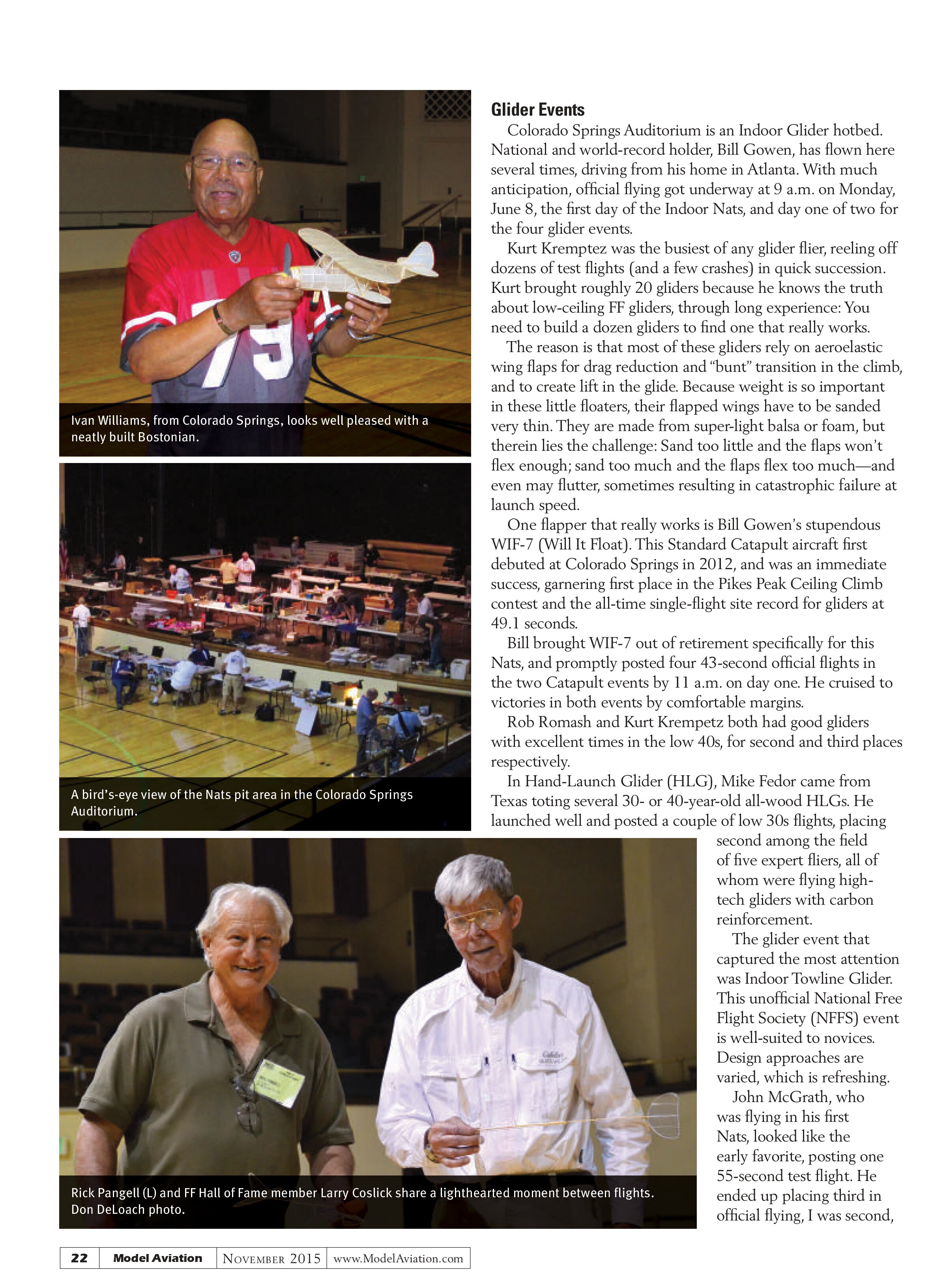
It is a beautifully preserved, 4,000-seat art deco amphitheater, with a hardwood floor and smooth acoustical ceiling. The ceiling height is a mere 37 feet at its peak, making this the second-lowest-ceiling Nats venue of all time.
Since the Indoor Nats began in 1922, most of the contests have been held in moderate to extremely high sites ranging from 65 to 150 feet or more. Only five Nats since 1922 have been held in sites with ceilings below 50 feet.
This is certainly the highest-elevation Nats in history. At 6,035 feet, Colorado Springs equates to roughly a 10% to 15% decrease in flight duration.
Glider Events
Colorado Springs Auditorium is an Indoor Glider hotbed. National and world-record holder, Bill Gowen, has flown here several times, driving from his home in Atlanta. With much anticipation, official flying got underway at 9 a.m. on Monday, June 8, the first day of the Indoor Nats, and day one of two for the four glider events.
Kurt Kremptetz was the busiest of any glider flier, reeling off dozens of test flights (and a few crashes) in quick succession. Kurt brought roughly 20 gliders because he knows the truth about low-ceiling FF gliders, through long experience: You need to build a dozen gliders to find one that really works.

The reason is that most of these gliders rely on aeroelastic wing flaps for drag reduction and “bunt” transition in the climb, and to create lift in the glide. Because weight is so important in these little floaters, their flapped wings have to be sanded very thin. They are made from super-light balsa or foam, but therein lies the challenge: Sand too little and the flaps won’t flex enough; sand too much and the flaps flex too much—and even may flutter, sometimes resulting in catastrophic failure at launch speed.
One flapper that really works is Bill Gowen’s stupendous WIF-7 (Will It Float). This Standard Catapult aircraft first debuted at Colorado Springs in 2012, and was an immediate success, garnering first place in the Pikes Peak Ceiling Climb contest and the all-time single-flight site record for gliders at 49.1 seconds.

Bill brought WIF-7 out of retirement specifically for this Nats, and promptly posted four 43-second official flights in the two Catapult events by 11 a.m. on day one. He cruised to victories in both events by comfortable margins.
Rob Romash and Kurt Krempetz both had good gliders with excellent times in the low 40s, for second and third places respectively.
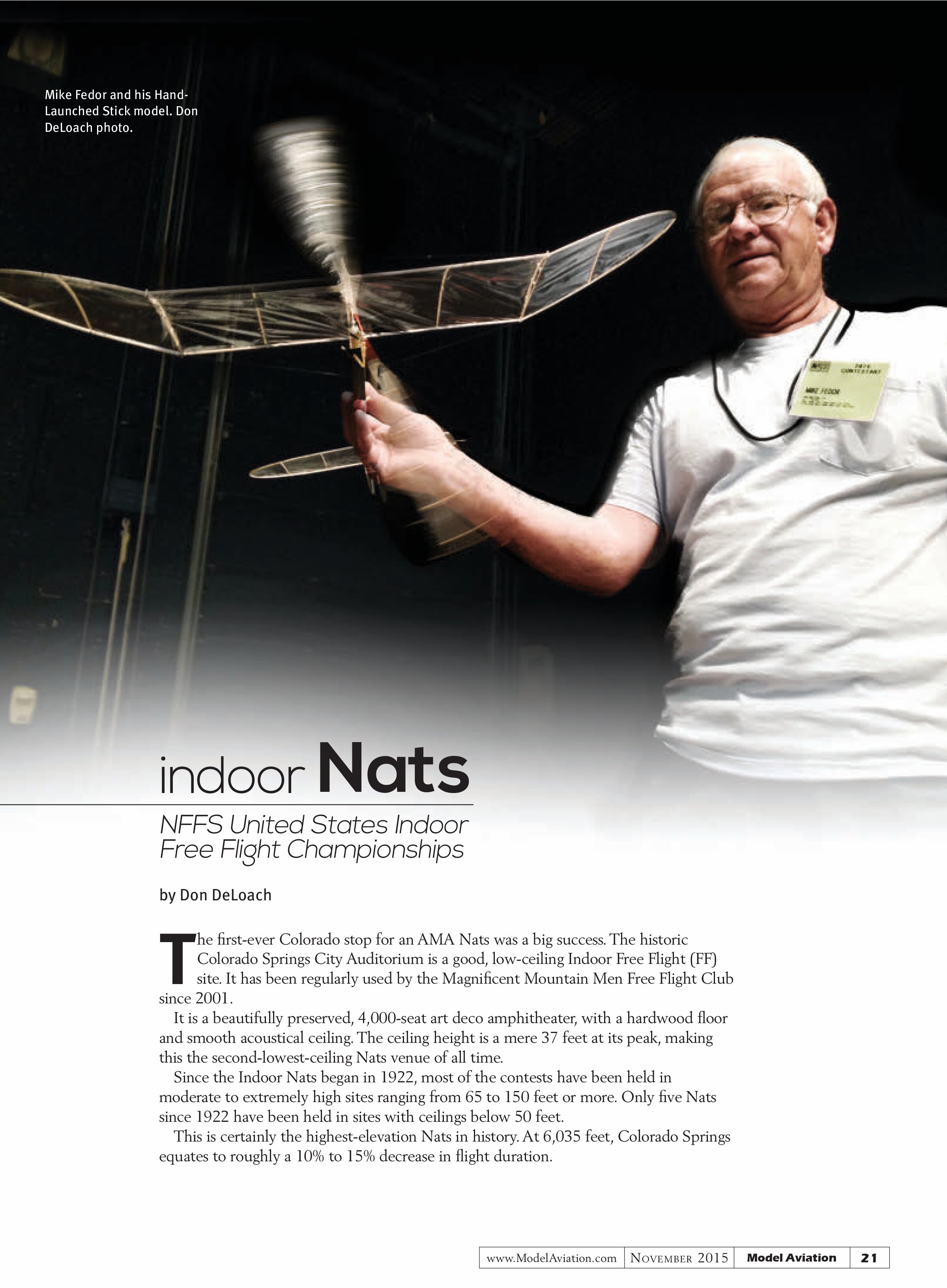
In Hand-Launch Glider (HLG), Mike Fedor came from Texas toting several 30- or 40-year-old all-wood HLGs. He launched well and posted a couple of low 30s flights, placing second among the field of five expert fliers, all of whom were flying high-tech gliders with carbon reinforcement.

The glider event that captured the most attention was Indoor Towline Glider. This unofficial National Free Flight Society (NFFS) event is well-suited to novices. Design approaches are varied, which is refreshing. John McGrath, who was flying in his first Nats, looked like the early favorite, posting one 55-second test flight. He ended up placing third in official flying, I was second, and Rob Romash took the win. A scant 0.7 seconds separated the top three finishers!
What makes Indoor Towline so great? I think the key component is the simplicity of the models. Unlike Catapult and Hand-Launch Glider, you don’t need exceptional wood or high-tech materials or techniques (I built mine in two hours from scrap Pennyplane parts).
You also don’t need exceptional physical skills. Towing one of these things is a low-speed, gentle affair that’s easy for almost anyone with decent eyesight and the ability to walk backward briskly.
Finally, you don’t need the Zen-like instincts and knowledge or secret stashes of the rare rubber batches. Indoor Towline is about having fun flying a super simple, low-tech model airplane, and the concept is resonating with a lot of people.
Mass Launches and Scale
In the Phantom Flash Mass Launch, Bill Carney had one of the best-flying models, but got knocked out by a midair in the first few seconds. Sixteen-year-old Jace Pivonka, from Denver, built his entry the night before, hastily trimmed it out in only a few minutes, and placed second with a hair-raising flight that went all the way to the ceiling.
Jace was beaten by Dick Wood, who had Rob Romash feverishly fixing his badly broken model a mere seconds before the launch signal. Whew! Who doesn’t love mass launches?
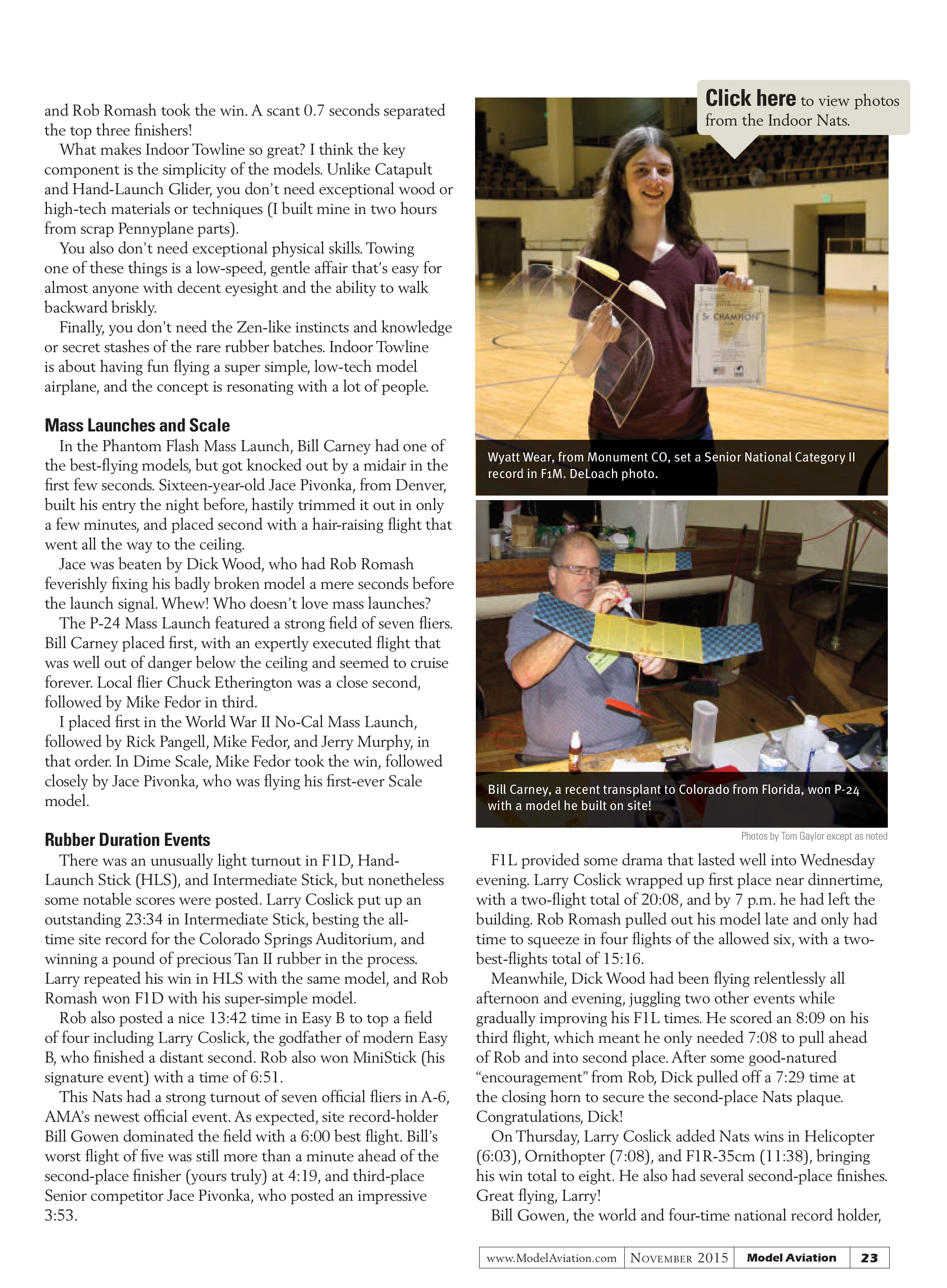
The P-24 Mass Launch featured a strong field of seven fliers. Bill Carney placed first, with an expertly executed flight that was well out of danger below the ceiling and seemed to cruise forever. Local flier Chuck Etherington was a close second, followed by Mike Fedor in third.
I placed first in the World War II No-Cal Mass Launch, followed by Rick Pangell, Mike Fedor, and Jerry Murphy, in that order. In Dime Scale, Mike Fedor took the win, followed closely by Jace Pivonka, who was flying his first-ever Scale model.
Rubber Duration Events
There was an unusually light turnout in F1D, Hand-Launch Stick (HLS), and Intermediate Stick, but nonetheless some notable scores were posted. Larry Coslick put up an outstanding 23:34 in Intermediate Stick, besting the all-time site record for the Colorado Springs Auditorium, and winning a pound of precious Tan II rubber in the process. Larry repeated his win in HLS with the same model, and Rob Romash won F1D with his super-simple model.
Rob also posted a nice 13:42 time in Easy B to top a field of four including Larry Coslick, the godfather of modern Easy B, who finished a distant second. Rob also won MiniStick (his signature event) with a time of 6:51.
This Nats had a strong turnout of seven official fliers in A-6, AMA’s newest official event. As expected, site record-holder Bill Gowen dominated the field with a 6:00 best flight. Bill’s worst flight of five was still more than a minute ahead of the second-place finisher (yours truly) at 4:19, and third-place Senior competitor Jace Pivonka, who posted an impressive 3:53.
F1L provided some drama that lasted well into Wednesday evening. Larry Coslick wrapped up first place near dinnertime, with a two-flight total of 20:08, and by 7 p.m. he had left the building. Rob Romash pulled out his model late and only had time to squeeze in four flights of the allowed six, with a two-best-flights total of 15:16.
Meanwhile, Dick Wood had been flying relentlessly all afternoon and evening, juggling two other events while gradually improving his F1L times. He scored an 8:09 on his third flight, which meant he only needed 7:08 to pull ahead of Rob and into second place. After some good-natured “encouragement” from Rob, Dick pulled off a 7:29 time at the closing horn to secure the second-place Nats plaque. Congratulations, Dick!
On Thursday, Larry Coslick added Nats wins in Helicopter (6:03), Ornithopter (7:08), and F1R-35cm (11:38), bringing his win total to eight. He also had several second-place finishes. Great flying, Larry!
Bill Gowen, the world and four-time national record holder,


put on a clinic in F1M. He set a new site record with a best single flight of 12:54, and a two-flight total of 26:20. Larry Coslick had trimming problems and managed 19:17 for second place. Another four fliers took part in this well-attended event.
The unofficial Nats Perseverance Award had to go to Wyatt Wear. He spent all week relentlessly testing (and repairing) his original-design F1M, finally posting a best flight of 6:18, which he submitted as a national record for Senior, Category II.
Friday afternoon featured the traditional closing Nats event: Limited Pennyplane. This year, 17 contestants tried their luck, and the competition was outstanding. In the end, Bill Gowen’s 8:11 time, posted early in the afternoon on his first flight, could not hold up. Late in the day on my fourth flight, I got lucky with an 8:33 and took the win.
In third place was Dudley Parker with an excellent 7:37, followed closely by Bud Layne with 7:30. Dudley and Bud traveled all the way from Kentucky for only one day of flying at this Nats, and they seemed to really enjoy themselves. They were extremely consistent as well—the hallmarks of great fliers—posting not a single flight below 6:30.
Wrap-Up
In closing, I want to thank Rob Romash and Jerry Murphy for having the vision and fortitude to plan and execute this Nats. Rob and Jerry are tirelessly devoted to furthering the interests of Free Flight model aviation and I am grateful.
Join us in 2016!
—Don DeLoach
ddeloach@comcast.net
SOURCES:
Nats
www.modelaircraft.org/events/nats.aspx
NatsNews
www.modelaircraft.org/events/nats/natsnews.aspx

P-18 Pro-Am
Wednesday was the day many of us were waiting for at the Indoor Nats in Colorado Springs. At 9 a.m., two dozen local students gathered for the much-anticipated first day of the P-18 Pro-Am contest.
The two-day event sold out quickly, thanks to ample publicity and generous sponsorship by FAI Model Supply, LaserCutPlanes.com, and the National Museum of World War II Aviation in Colorado Springs. Jerry Murphy and John McGrath did the heavy lifting—from promotions, to kit production, to volunteer coordination. They are to be greatly commended.
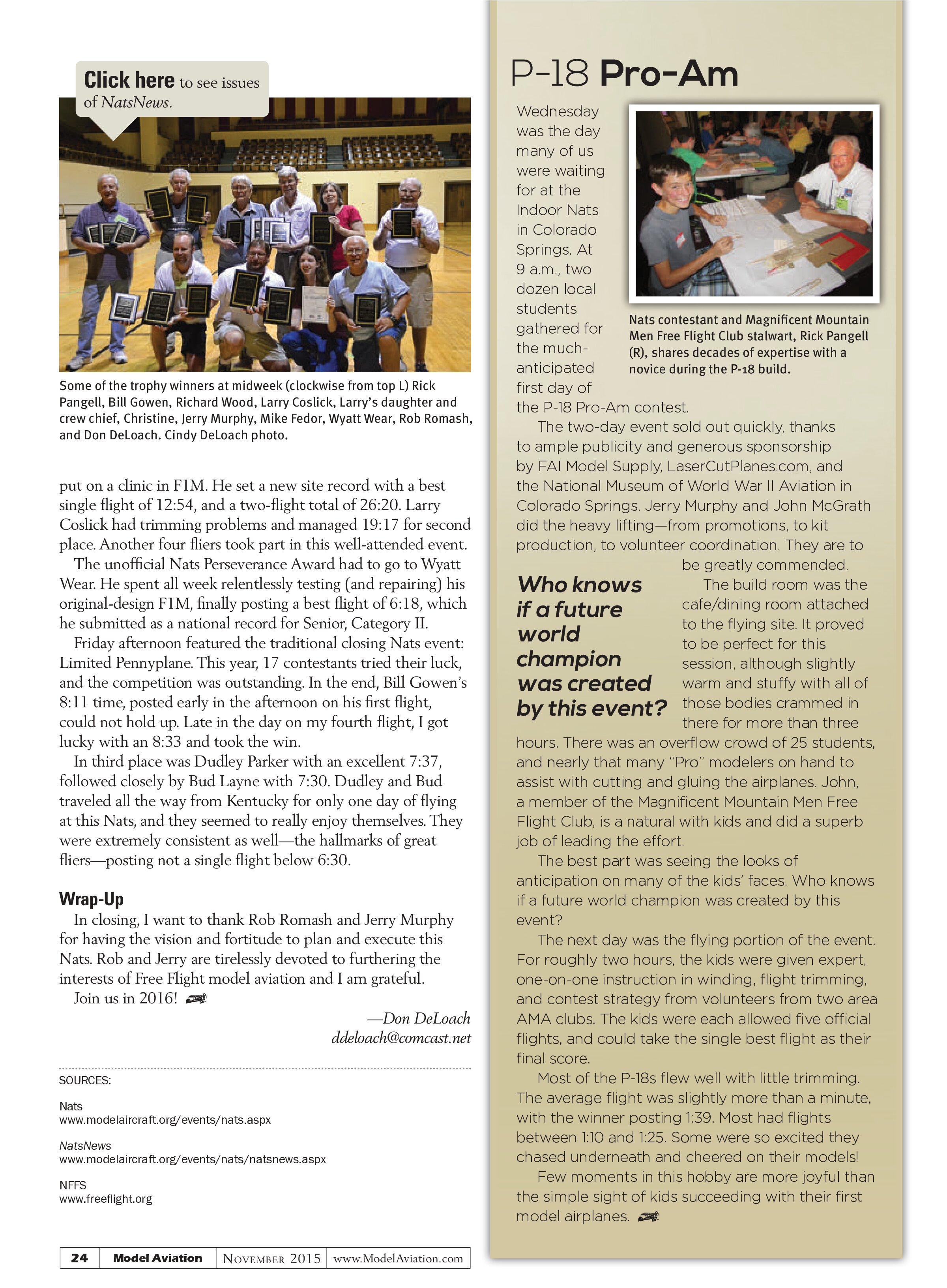
The build room was the cafe/dining room attached to the flying site. It proved to be perfect for this session, although slightly warm and stuffy with all of those bodies crammed in there for more than three hours. There was an overflow crowd of 25 students, and nearly that many “Pro” modelers on hand to assist with cutting and gluing the airplanes. John, a member of the Magnificent Mountain Men Free Flight Club, is a natural with kids and did a superb job of leading the effort.
The best part was seeing the looks of anticipation on many of the kids’ faces. Who knows if a future world champion was created by this event?
The next day was the flying portion of the event. For roughly two hours, the kids were given expert, one-on-one instruction in winding, flight trimming, and contest strategy from volunteers from two area AMA clubs. The kids were each allowed five official flights, and could take the single best flight as their final score.
Most of the P-18s flew well with little trimming. The average flight was slightly more than a minute, with the winner posting 1:39. Most had flights between 1:10 and 1:25. Some were so excited they chased underneath and cheered on their models!
Few moments in this hobby are more joyful than the simple sight of kids succeeding with their first model airplanes.