It’s not too soon to pick up a stocking stuffer!
by Gene Smith
grwhiskey@brightok.net
Do you need a stocking stuffer for Christmas? Order Alan Abriss’ Homegrown Television Productions video, 2015 Free Flight National Championships. Another option is the company’s 2014 Flying Aces Club National Championships.
Even if you don’t fly Flying Aces Club (FAC) Scale Free Flight (FF), you like airplanes if you’re reading this column. The FAC pilots build models of airplanes as common as a P-51 Mustang and others so obscure you have probably never heard of them. And, they are flying works of art—real eye candy.
One Design
Jays Bird and Reid Simpson’s Tornado, this year’s One-Design event models, are being carried over for 2016. If you didn’t get one on the building board or didn’t quite finish your model, you have a chance to compete with it next year.
Hank’s Upstart
Hank Sperzel is pleased with his Nostalgia Gas Upstart, which he has flown the past two years at the Nats in Muncie, Indiana. The model uses an O.S. .35 MAX III that puts the airplane up in a hurry. The high-aspect-ratio wing results in a great glide. Hank says it flies well.
Megascale
The brainchild of veteran FAC’er Vance Gilbert, the unofficial Megascale event was flown at this past summer’s FAC Non-Nats. Airplanes must have minimum 54-inch wingspans. The scoring, which is for bragging rights, is a combination of Scale judging and flight duration based upon, but not identical to, FAC Scale rules.
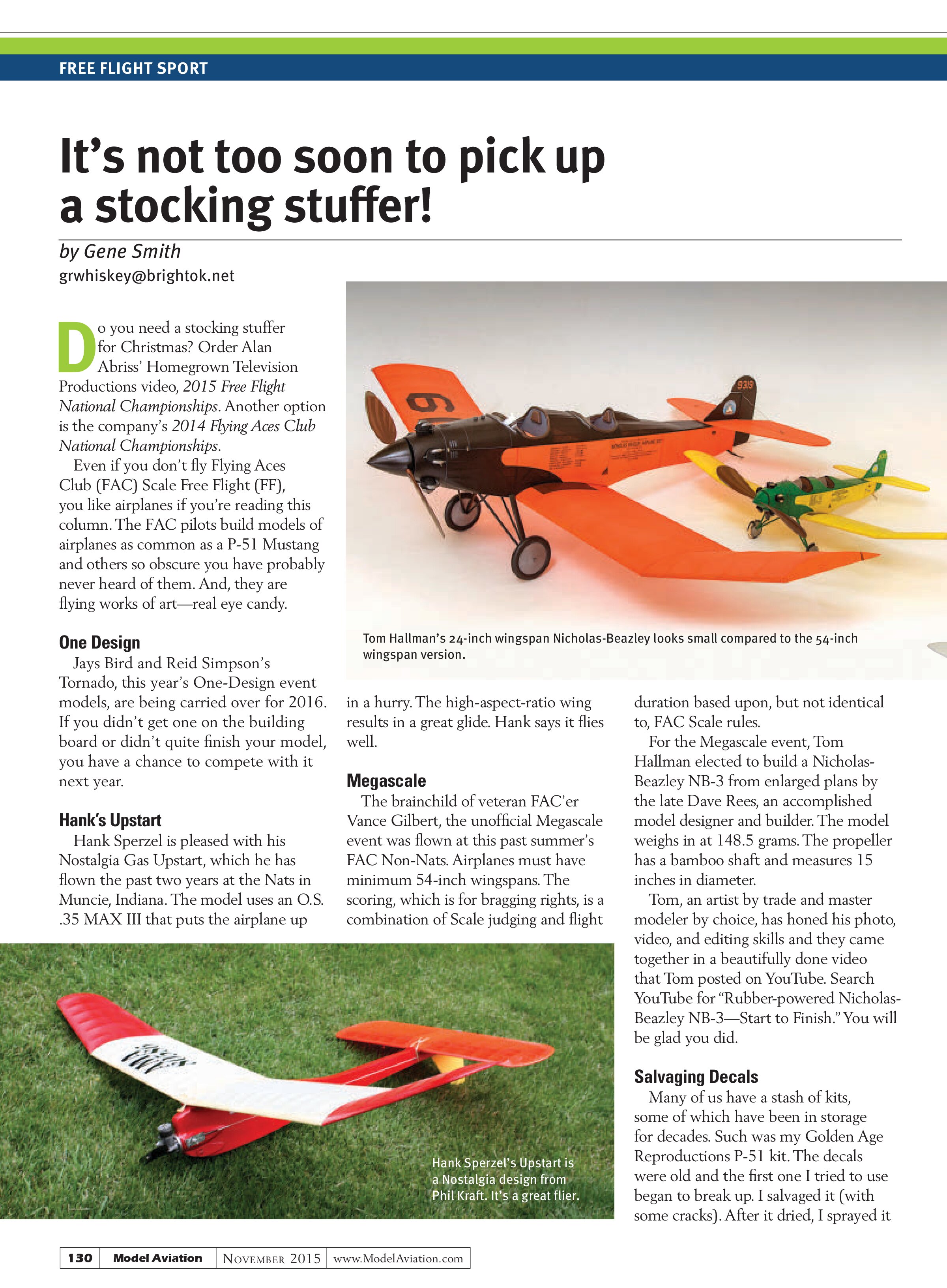
For the Megascale event, Tom Hallman elected to build a Nicholas-Beazley NB-3 from enlarged plans by the late Dave Rees, an accomplished model designer and builder. The model weighs in at 148.5 grams. The propeller has a bamboo shaft and measures 15 inches in diameter.
Tom, an artist by trade and master modeler by choice, has honed his photo, video, and editing skills and they came together in a beautifully done video that Tom posted on YouTube. Search YouTube for “Rubber-powered Nicholas-Beazley NB-3—Start to Finish.” You will be glad you did.

Salvaging Decals
Many of us have a stash of kits, some of which have been in storage for decades. Such was my Golden Age Reproductions P-51 kit. The decals were old and the first one I tried to use began to break up. I salvaged it (with some cracks). After it dried, I sprayed it and the remaining decals with two light coats of Krylon Crystal clear. They held together, but began curling after a few months on the model.
That brings me to a neat tip I saw from Grant Carson. He sends old decals to Callie Graphics to be copied and reproduced in thin vinyl. Great idea, Grant!
Pensacola Site 8
Jerry Klingaman dropped me a note about what might have been the last FF flying session at the great Pensacola Site 8 flying field. The Pensacola group is hoping that the local officials will let the group back on the field.
After flying at Site 8 for the past 26 years, it seems odd to not be allowed there. Jerry made the last flight with his 1933 Navy Pursuit. It flew very high on that final flight and required the dethermalizer (DT) to bring it down. The model has a bamboo wing, stabilizer, and fin tips. The aircraft markings are cut from Japanese tissue. The Felix the Cat logo on the side of the fuselage was computer printed directly onto the white tissue before covering.

The Navy Pursuit was designed by Julius Unrath and the plans were published in the January 1934 issue of Flying Aces magazine. It was a rudimentary interpretation of a military model airplane that can be seen repeated in drawings and wooden toys of that period.
Jerry built his model from an article and full-size plans in the July-August 2013 issue of MAXFAX, the newsletter of the DC Maxecuters. His version has a bamboo wing, stabilizer, and fin tips as did the original. The formation stripes, numbers, and stars are Japanese tissue doped onto the covering.
The color scheme generally follows the Flying Aces model. Jerry carved the 9-inch propeller from fairly hard balsa, but kept the blades thin. The wheels were turned from lightweight balsa then painted paper wheel covers were added. The airplane’s total weight, without rubber, is 51.6 grams.
Jerry flies the Navy Pursuit with two loops of 3/16 Super Sport weighing 10.5 grams. This motor provides plenty of power to get the aircraft up and away. It can be flown with four loops of 1/8 rubber, but life is exciting with that much torque.
The model has a fuse-type DT. To Julius Unrath’s credit, the Navy Pursuit is a great flier with its slightly swept, flat-bottom wing and 23 1/2-inch wingspan.
Long Shot Unlimited
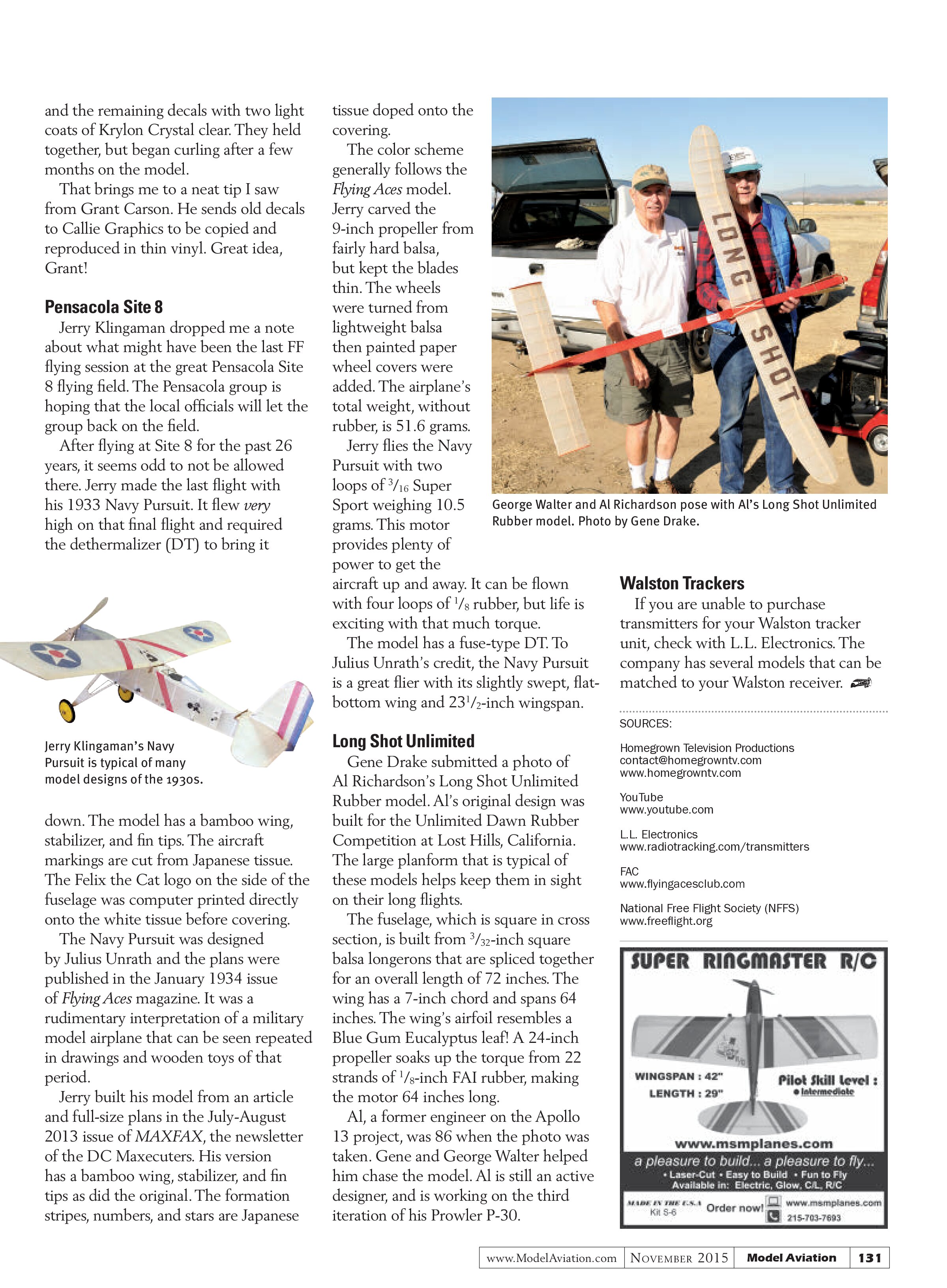
Gene Drake submitted a photo of Al Richardson’s Long Shot Unlimited Rubber model. Al’s original design was built for the Unlimited Dawn Rubber Competition at Lost Hills, California. The large planform that is typical of these models helps keep them in sight on their long flights.
The fuselage, which is square in cross section, is built from 3/32-inch square balsa longerons that are spliced together for an overall length of 72 inches. The wing has a 7-inch chord and spans 64 inches. The wing’s airfoil resembles a Blue Gum Eucalyptus leaf! A 24-inch propeller soaks up the torque from 22 strands of 1/8-inch FAI rubber, making the motor 64 inches long.
Al, a former engineer on the Apollo 13 project, was 86 when the photo was taken. Gene and George Walter helped him chase the model. Al is still an active designer, and is working on the third iteration of his Prowler P-30.

Walston Trackers
If you are unable to purchase transmitters for your Walston tracker unit, check with L.L. Electronics. The company has several models that can be matched to your Walston receiver.
SOURCES:
Homegrown Television Productions
contact@homegrowntv.com
www.homegrowntv.com
YouTube
www.youtube.com
L.L. Electronics
www.radiotracking.com/transmitters
National Free Flight Society (NFFS)
www.freeflight.org