Flyzone Sensei FS Trainer RTF with WISE
Chad Budreau
chadb@modelaircraft.org

The market has introduced a series of excellent flight-assisted trainers. While working for Model Aviation, I’ve been behind the sticks on many of those trainers. Some really impressed me. Others … eh, left me wanting more.
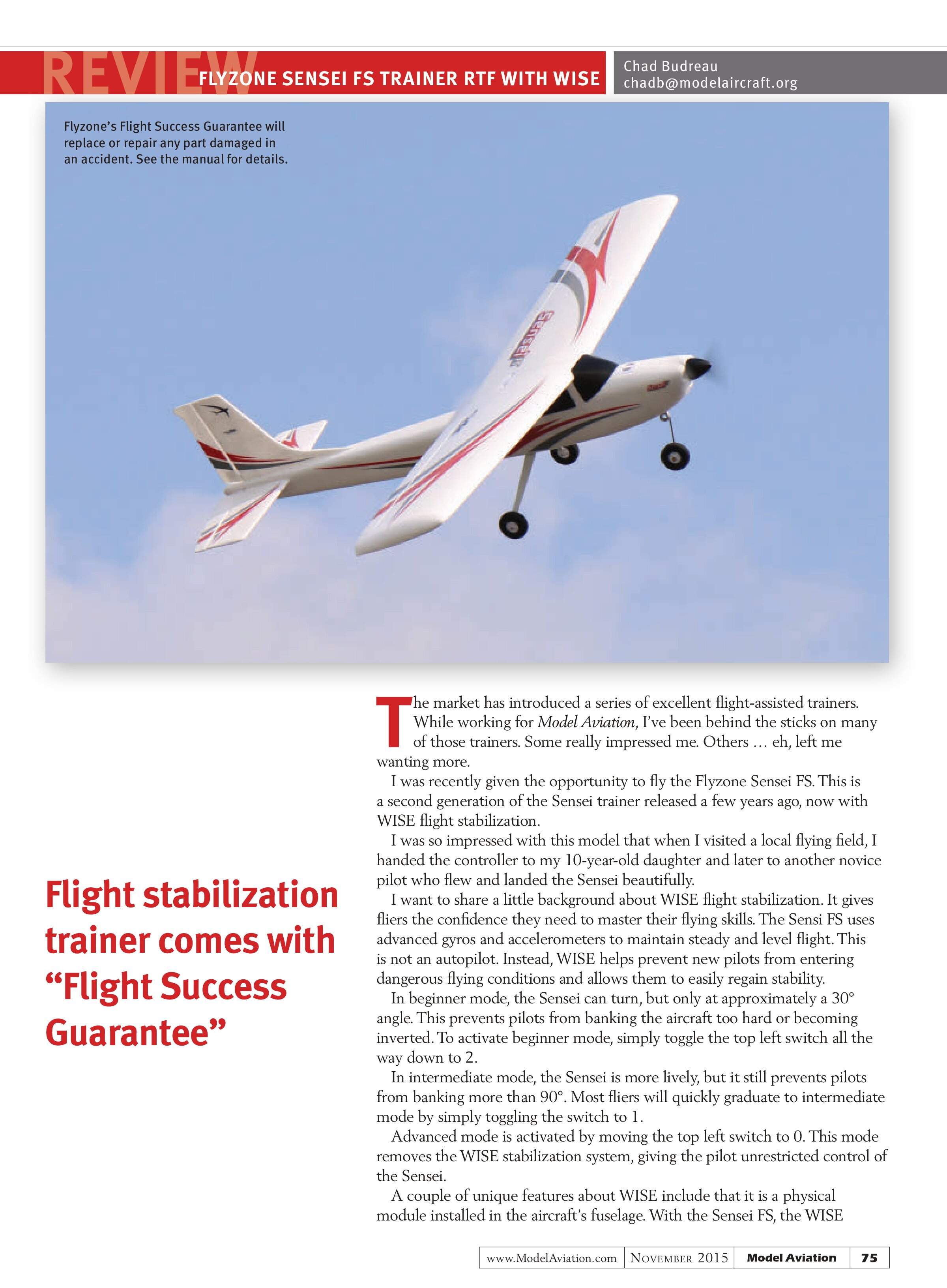
I was recently given the opportunity to fly the Flyzone Sensei FS. This is a second generation of the Sensei trainer released a few years ago, now with WISE flight stabilization.
I was so impressed with this model that when I visited a local flying field, I handed the controller to my 10-year-old daughter and later to another novice pilot who flew and landed the Sensei beautifully.
I want to share a little background about WISE flight stabilization. It gives fliers the confidence they need to master their flying skills. The Sensei FS uses advanced gyros and accelerometers to maintain steady and level flight. This is not an autopilot. Instead, WISE helps prevent new pilots from entering dangerous flying conditions and allows them to easily regain stability.
In beginner mode, the Sensei can turn, but only at approximately a 30° angle. This prevents pilots from banking the aircraft too hard or becoming inverted. To activate beginner mode, simply toggle the top left switch all the way down to 2.
In intermediate mode, the Sensei is more lively, but it still prevents pilots from banking more than 90°. Most fliers will quickly graduate to intermediate mode by simply toggling the switch to 1.
Advanced mode is activated by moving the top left switch to 0. This mode removes the WISE stabilization system, giving the pilot unrestricted control of the Sensei.
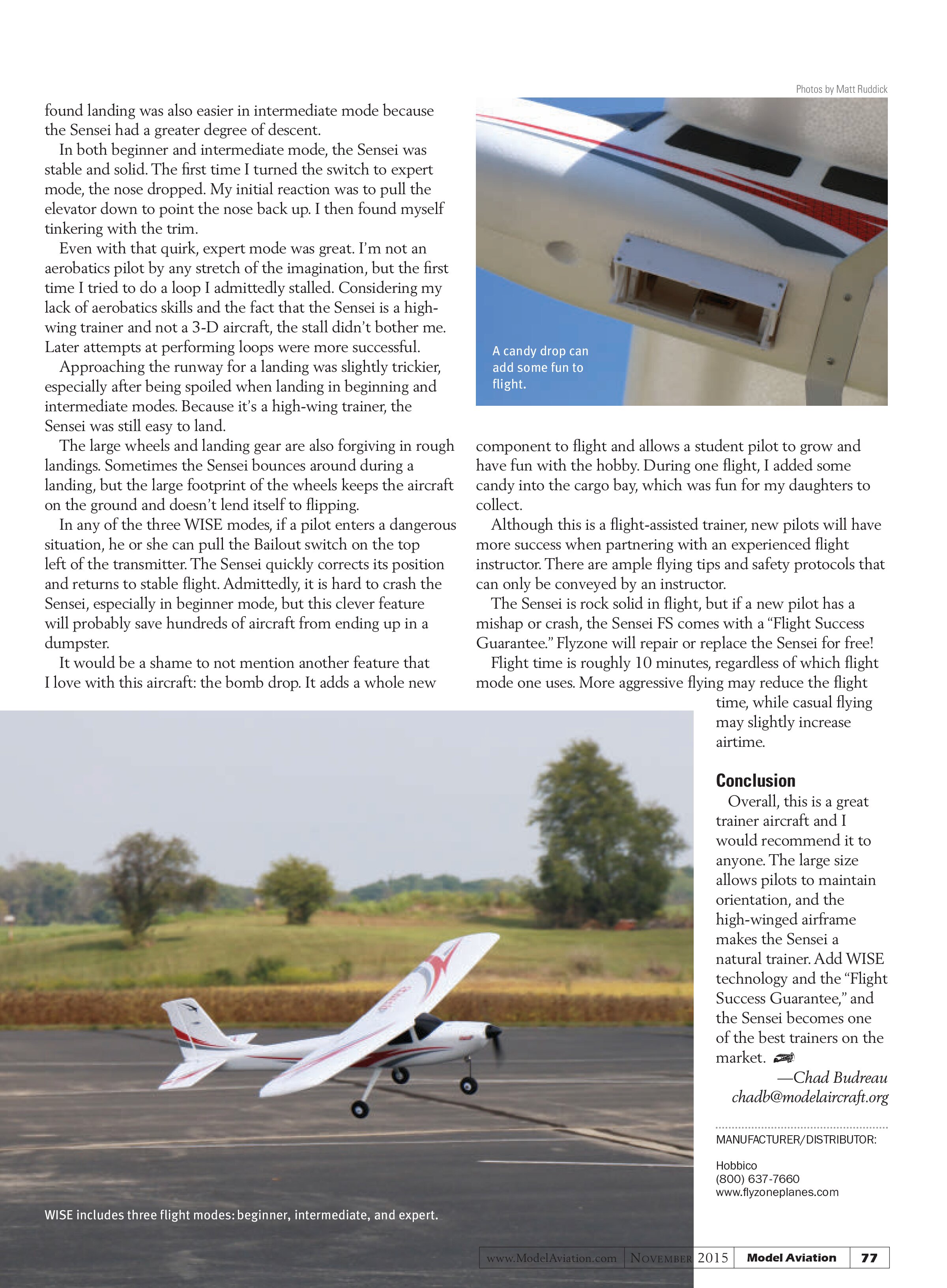
A couple of unique features about WISE include that it is a physical module installed in the aircraft’s fuselage. With the Sensei FS, the WISE
module comes preinstalled and is ready to go. The WISE system is also compatible with most RC transmitters, so you’re not limited to one radio brand.
WISE and the Sensei go together like peas and carrots. The Sensei airframe is a rock-solid high-wing trainer. I talked to an owner of the original Sensei who described his airplane as a great Sunday flier. Couple the Sensei with WISE, and it becomes an ideal trainer.
Assembly
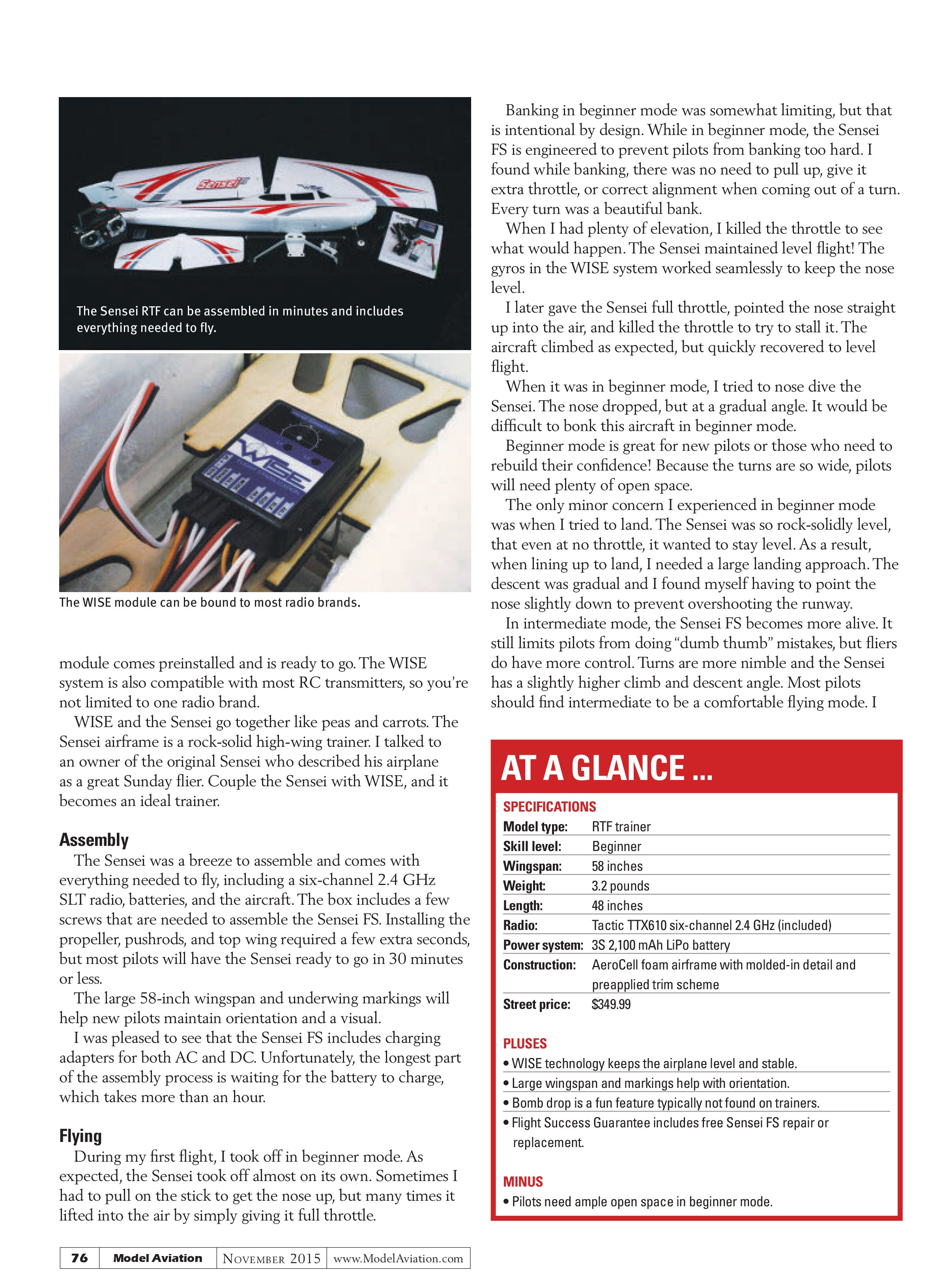
The Sensei was a breeze to assemble and comes with everything needed to fly, including a six-channel 2.4 GHz SLT radio, batteries, and the aircraft. The box includes a few screws that are needed to assemble the Sensei FS. Installing the propeller, pushrods, and top wing required a few extra seconds, but most pilots will have the Sensei ready to go in 30 minutes or less.
The large 58-inch wingspan and underwing markings will help new pilots maintain orientation and a visual.
I was pleased to see that the Sensei FS includes charging adapters for both AC and DC. Unfortunately, the longest part of the assembly process is waiting for the battery to charge, which takes more than an hour.
Flying
During my first flight, I took off in beginner mode. As expected, the Sensei took off almost on its own. Sometimes I had to pull on the stick to get the nose up, but many times it lifted into the air by simply giving it full throttle.
Banking in beginner mode was somewhat limiting, but that is intentional by design. While in beginner mode, the Sensei FS is engineered to prevent pilots from banking too hard. I found while banking, there was no need to pull up, give it extra throttle, or correct alignment when coming out of a turn. Every turn was a beautiful bank.
When I had plenty of elevation, I killed the throttle to see what would happen. The Sensei maintained level flight! The gyros in the WISE system worked seamlessly to keep the nose level.
I later gave the Sensei full throttle, pointed the nose straight up into the air, and killed the throttle to try to stall it. The aircraft climbed as expected, but quickly recovered to level flight.
When it was in beginner mode, I tried to nose dive the Sensei. The nose dropped, but at a gradual angle. It would be difficult to bonk this aircraft in beginner mode.
Beginner mode is great for new pilots or those who need to rebuild their confidence! Because the turns are so wide, pilots will need plenty of open space.
The only minor concern I experienced in beginner mode was when I tried to land. The Sensei was so rock-solidly level, that even at no throttle, it wanted to stay level. As a result, when lining up to land, I needed a large landing approach. The descent was gradual and I found myself having to point the nose slightly down to prevent overshooting the runway.
In intermediate mode, the Sensei FS becomes more alive. It still limits pilots from doing “dumb thumb” mistakes, but fliers do have more control. Turns are more nimble and the Sensei has a slightly higher climb and descent angle. Most pilots should find intermediate to be a comfortable flying mode. I found landing was also easier in intermediate mode because the Sensei had a greater degree of descent.
In both beginner and intermediate mode, the Sensei was stable and solid. The first time I turned the switch to expert mode, the nose dropped. My initial reaction was to pull the elevator down to point the nose back up. I then found myself tinkering with the trim.
Even with that quirk, expert mode was great. I’m not an aerobatics pilot by any stretch of the imagination, but the first time I tried to do a loop I admittedly stalled. Considering my lack of aerobatics skills and the fact that the Sensei is a high-wing trainer and not a 3-D aircraft, the stall didn’t bother me. Later attempts at performing loops were more successful.
Approaching the runway for a landing was slightly trickier, especially after being spoiled when landing in beginning and intermediate modes. Because it’s a high-wing trainer, the Sensei was still easy to land.
The large wheels and landing gear are also forgiving in rough landings. Sometimes the Sensei bounces around during a landing, but the large footprint of the wheels keeps the aircraft on the ground and doesn’t lend itself to flipping.
In any of the three WISE modes, if a pilot enters a dangerous situation, he or she can pull the Bailout switch on the top left of the transmitter. The Sensei quickly corrects its position and returns to stable flight. Admittedly, it is hard to crash the Sensei, especially in beginner mode, but this clever feature will probably save hundreds of aircraft from ending up in a dumpster.
It would be a shame to not mention another feature that I love with this aircraft: the bomb drop. It adds a whole new component to flight and allows a student pilot to grow and have fun with the hobby. During one flight, I added some candy into the cargo bay, which was fun for my daughters to collect.
Although this is a flight-assisted trainer, new pilots will have more success when partnering with an experienced flight instructor. There are ample flying tips and safety protocols that can only be conveyed by an instructor.
The Sensei is rock solid in flight, but if a new pilot has a mishap or crash, the Sensei FS comes with a “Flight Success Guarantee.” Flyzone will repair or replace the Sensei for free!
Flight time is roughly 10 minutes, regardless of which flight mode one uses. More aggressive flying may reduce the flight time, while casual flying may slightly increase airtime.
Conclusion
Overall, this is a great trainer aircraft and I would recommend it to anyone. The large size allows pilots to maintain orientation, and the high-winged airframe makes the Sensei a natural trainer. Add WISE technology and the “Flight Success Guarantee,” and the Sensei becomes one of the best trainers on the market.
—Chad Budreau
chadb@modelaircraft.org
MANUFACTURER/DISTRIBUTOR:
Hobbico
(800) 637-7660
www.flyzoneplanes.com