Education Through Aviation
by Bill Pritchett, Education Director

“We keep moving forward, opening new doors, and doing new things, because we’re curious and curiosity keeps leading us down new paths.” —Walt Disney
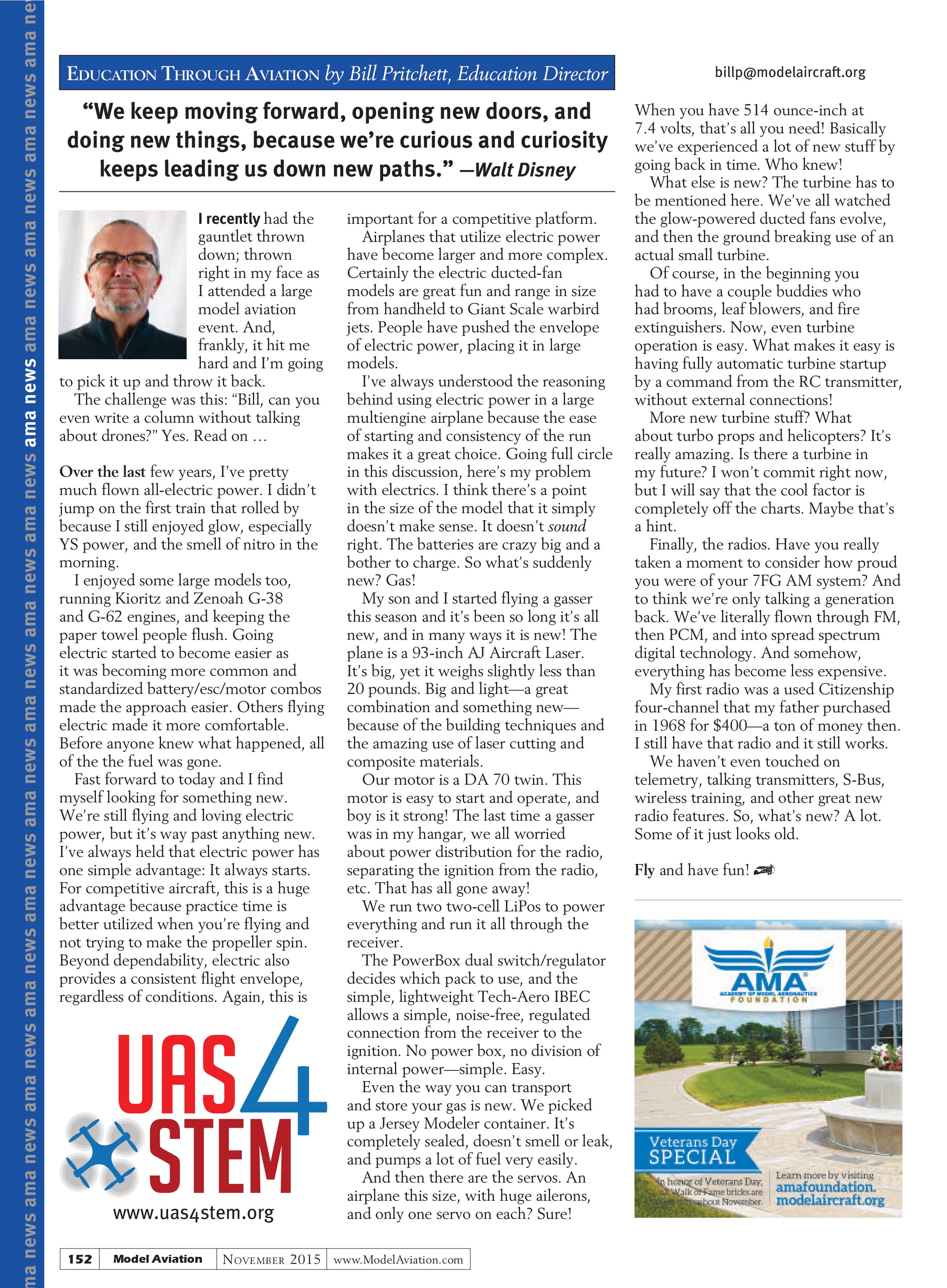
I recently had the gauntlet thrown down; thrown right in my face as I attended a large model aviation event. And, frankly, it hit me hard and I’m going to pick it up and throw it back.
The challenge was this: “Bill, can you even write a column without talking about drones?” Yes. Read on …
Over the last few years, I’ve pretty much flown all-electric power. I didn’t jump on the first train that rolled by because I still enjoyed glow, especially YS power, and the smell of nitro in the morning.
I enjoyed some large models too, running Kioritz and Zenoah G-38 and G-62 engines, and keeping the paper towel people flush. Going electric started to become easier as it was becoming more common and standardized battery/esc/motor combos made the approach easier. Others flying electric made it more comfortable. Before anyone knew what happened, all of the the fuel was gone.
Fast forward to today and I find myself looking for something new. We’re still flying and loving electric power, but it’s way past anything new. I’ve always held that electric power has one simple advantage: It always starts. For competitive aircraft, this is a huge advantage because practice time is better utilized when you’re flying and not trying to make the propeller spin. Beyond dependability, electric also provides a consistent flight envelope, regardless of conditions. Again, this is important for a competitive platform.
Airplanes that utilize electric power have become larger and more complex. Certainly the electric ducted-fan models are great fun and range in size from handheld to Giant Scale warbird jets. People have pushed the envelope of electric power, placing it in large models.
I’ve always understood the reasoning behind using electric power in a large multiengine airplane because the ease of starting and consistency of the run makes it a great choice. Going full circle in this discussion, here’s my problem with electrics. I think there’s a point in the size of the model that it simply doesn’t make sense. It doesn’t sound right. The batteries are crazy big and a bother to charge. So what’s suddenly new? Gas!
My son and I started flying a gasser this season and it’s been so long it’s all new, and in many ways it is new! The plane is a 93-inch AJ Aircraft Laser. It’s big, yet it weighs slightly less than 20 pounds. Big and light—a great combination and something new—because of the building techniques and the amazing use of laser cutting and composite materials.
Our motor is a DA 70 twin. This motor is easy to start and operate, and boy is it strong! The last time a gasser was in my hangar, we all worried about power distribution for the radio, separating the ignition from the radio, etc. That has all gone away!
We run two two-cell LiPos to power everything and run it all through the receiver.
The PowerBox dual switch/regulator decides which pack to use, and the simple, lightweight Tech-Aero IBEC allows a simple, noise-free, regulated connection from the receiver to the ignition. No power box, no division of internal power—simple. Easy.
Even the way you can transport and store your gas is new. We picked up a Jersey Modeler container. It’s completely sealed, doesn’t smell or leak, and pumps a lot of fuel very easily.
And then there are the servos. An airplane this size, with huge ailerons, and only one servo on each? Sure!
When you have 514 ounce-inch at 7.4 volts, that’s all you need! Basically we’ve experienced a lot of new stuff by going back in time. Who knew!
What else is new? The turbine has to be mentioned here. We’ve all watched the glow-powered ducted fans evolve, and then the ground breaking use of an actual small turbine.
Of course, in the beginning you had to have a couple buddies who had brooms, leaf blowers, and fire extinguishers. Now, even turbine operation is easy. What makes it easy is having fully automatic turbine startup by a command from the RC transmitter, without external connections!
More new turbine stuff? What about turbo props and helicopters? It’s really amazing. Is there a turbine in my future? I won’t commit right now, but I will say that the cool factor is completely off the charts. Maybe that’s a hint.
Finally, the radios. Have you really taken a moment to consider how proud you were of your 7FG AM system? And to think we’re only talking a generation back. We’ve literally flown through FM, then PCM, and into spread spectrum digital technology. And somehow, everything has become less expensive.
My first radio was a used Citizenship four-channel that my father purchased in 1968 for $400—a ton of money then. I still have that radio and it still works.
We haven’t even touched on telemetry, talking transmitters, S-Bus, wireless training, and other great new radio features. So, what’s new? A lot. Some of it just looks old.
Fly and have fun!