
And they will be missed ...
by Bob Hunt
robinhunt@rcn.com
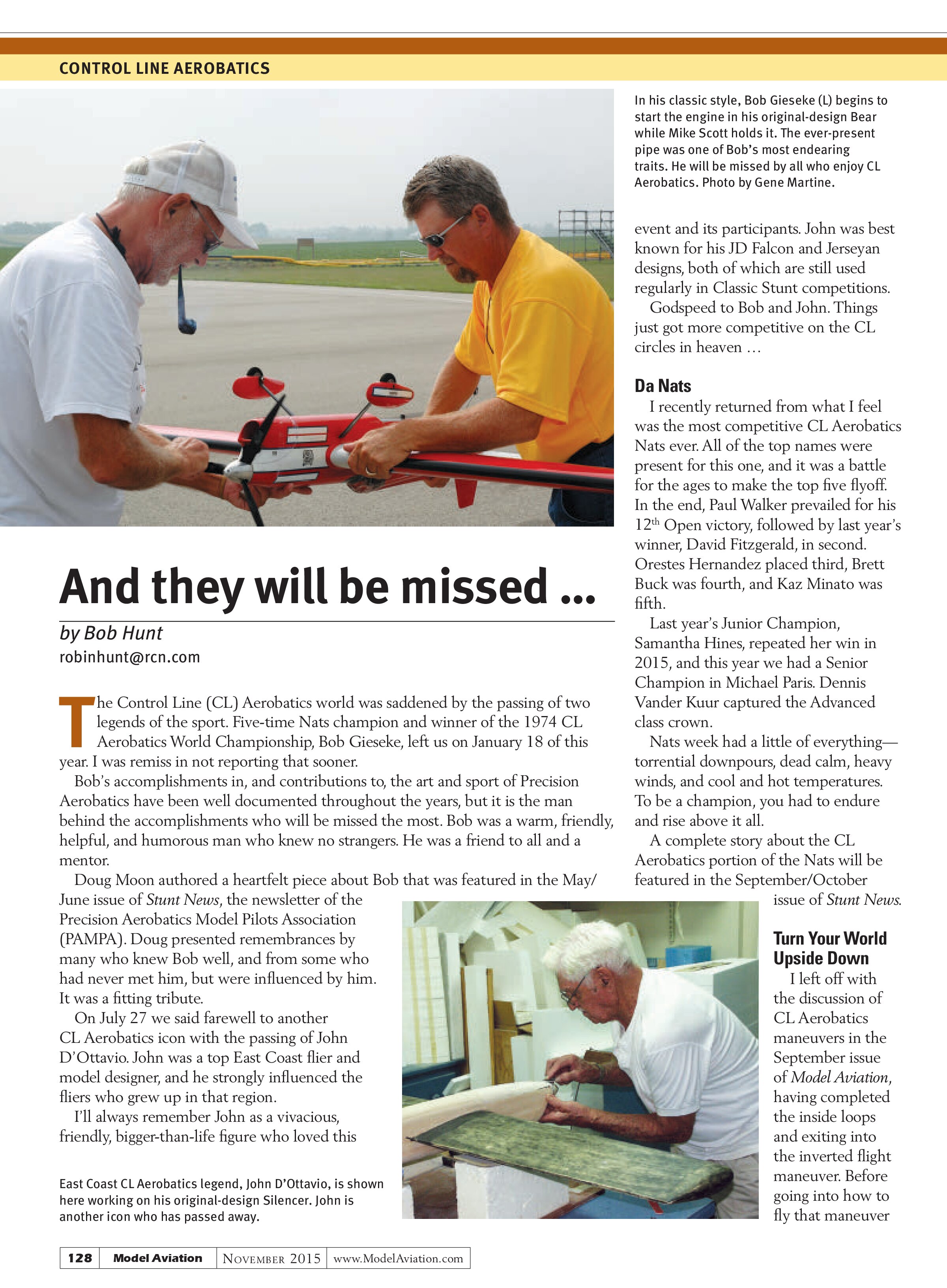
The Control Line (CL) Aerobatics world was saddened by the passing of two legends of the sport. Five-time Nats champion and winner of the 1974 CL Aerobatics World Championship, Bob Gieseke, left us on January 18 of this year. I was remiss in not reporting that sooner.
Bob’s accomplishments in, and contributions to, the art and sport of Precision Aerobatics have been well documented throughout the years, but it is the man behind the accomplishments who will be missed the most. Bob was a warm, friendly, helpful, and humorous man who knew no strangers. He was a friend to all and a mentor.
Doug Moon authored a heartfelt piece about Bob that was featured in the May/June issue of Stunt News, the newsletter of the Precision Aerobatics Model Pilots Association (PAMPA). Doug presented remembrances by many who knew Bob well, and from some who had never met him, but were influenced by him. It was a fitting tribute.
On July 27 we said farewell to another CL Aerobatics icon with the passing of John D’Ottavio. John was a top East Coast flier and model designer, and he strongly influenced the fliers who grew up in that region.
I’ll always remember John as a vivacious, friendly, bigger-than-life figure who loved this event and its participants. John was best known for his JD Falcon and Jerseyan designs, both of which are still used regularly in Classic Stunt competitions. Godspeed to Bob and John. Things just got more competitive on the CL circles in heaven …
Da Nats
I recently returned from what I feel was the most competitive CL Aerobatics Nats ever. All of the top names were present for this one, and it was a battle for the ages to make the top five flyoff. In the end, Paul Walker prevailed for his 12th Open victory, followed by last year’s winner, David Fitzgerald, in second. Orestes Hernandez placed third, Brett Buck was fourth, and Kaz Minato was fifth.
Last year’s Junior Champion, Samantha Hines, repeated her win in 2015, and this year we had a Senior Champion in Michael Paris. Dennis Vander Kuur captured the Advanced class crown.
Nats week had a little of everything—torrential downpours, dead calm, heavy winds, and cool and hot temperatures. To be a champion, you had to endure and rise above it all.
A complete story about the CL Aerobatics portion of the Nats will be featured in the September/October issue of Stunt News.

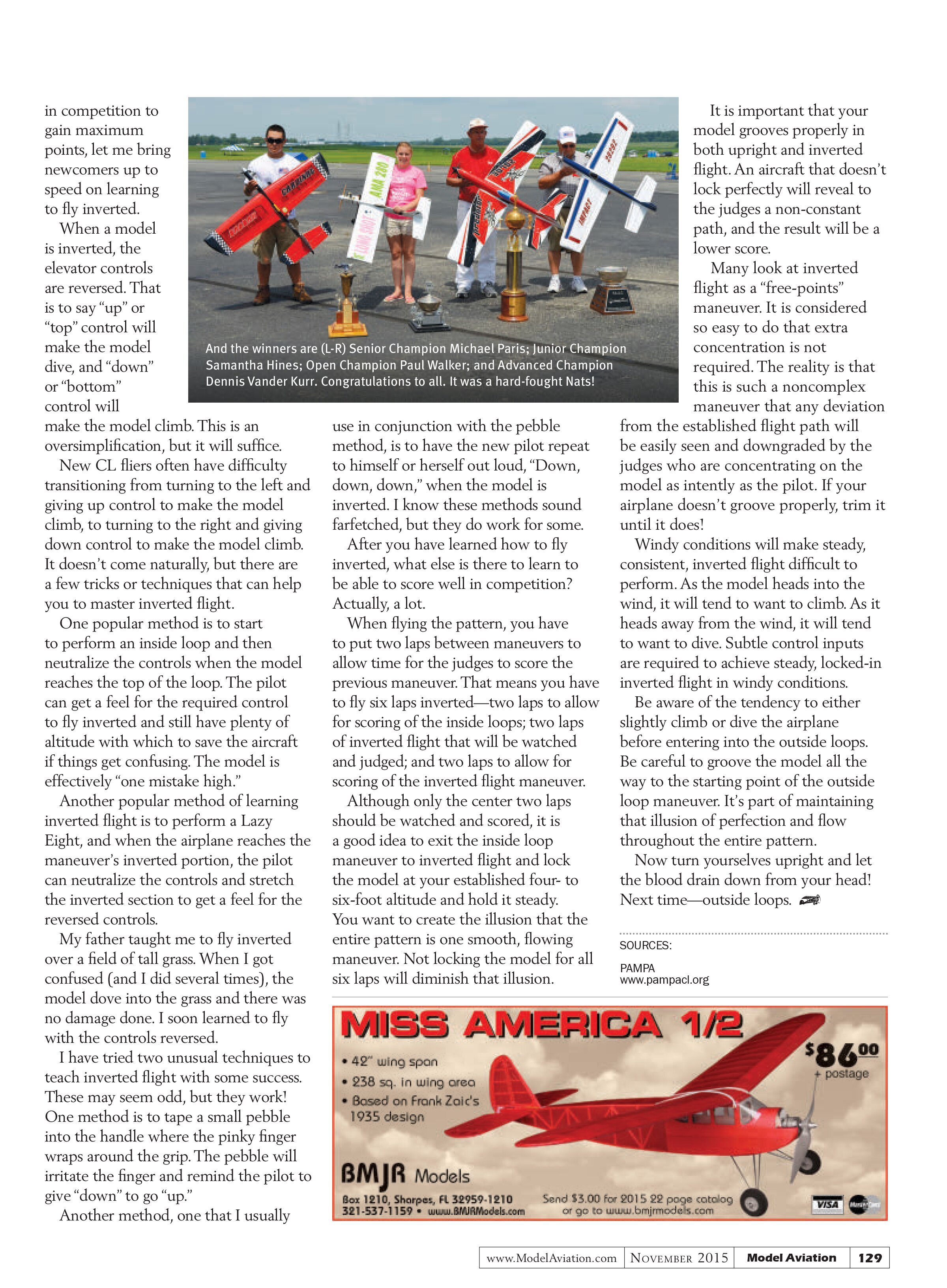
East Coast CL Aerobatics legend, John D’Ottavio, is shown here working on his original-design Silencer. John is another icon who has passed away.
Turn Your World Upside Down
I left off with the discussion of CL Aerobatics maneuvers in the September issue of Model Aviation, having completed the inside loops and exiting into the inverted flight maneuver. Before going into how to fly that maneuver in competition to gain maximum points, let me bring newcomers up to speed on learning to fly inverted.
When a model is inverted, the elevator controls are reversed. That is to say “up” or “top” control will make the model dive, and “down” or “bottom” control will make the model climb. This is an oversimplification, but it will suffice.
New CL fliers often have difficulty transitioning from turning to the left and giving up control to make the model climb, to turning to the right and giving down control to make the model climb. It doesn’t come naturally, but there are a few tricks or techniques that can help you to master inverted flight.
One popular method is to start to perform an inside loop and then neutralize the controls when the model reaches the top of the loop. The pilot can get a feel for the required control to fly inverted and still have plenty of altitude with which to save the aircraft if things get confusing. The model is effectively “one mistake high.”
Another popular method of learning inverted flight is to perform a Lazy Eight, and when the airplane reaches the maneuver’s inverted portion, the pilot can neutralize the controls and stretch the inverted section to get a feel for the reversed controls.
My father taught me to fly inverted over a field of tall grass. When I got confused (and I did several times), the model dove into the grass and there was no damage done. I soon learned to fly with the controls reversed.
I have tried two unusual techniques to teach inverted flight with some success. These may seem odd, but they work! One method is to tape a small pebble into the handle where the pinky finger wraps around the grip. The pebble will irritate the finger and remind the pilot to give “down” to go “up.”
Another method, one that I usually use in conjunction with the pebble method, is to have the new pilot repeat to himself or herself out loud, “Down, down, down,” when the model is inverted. I know these methods sound farfetched, but they do work for some.
After you have learned how to fly inverted, what else is there to learn to be able to score well in competition? Actually, a lot.
When flying the pattern, you have to put two laps between maneuvers to allow time for the judges to score the previous maneuver. That means you have to fly six laps inverted—two laps to allow for scoring of the inside loops; two laps of inverted flight that will be watched and judged; and two laps to allow for scoring of the inverted flight maneuver.
Although only the center two laps should be watched and scored, it is a good idea to exit the inside loop maneuver to inverted flight and lock the model at your established four- to six-foot altitude and hold it steady. You want to create the illusion that the entire pattern is one smooth, flowing maneuver. Not locking the model for all six laps will diminish that illusion.

It is important that your model grooves properly in both upright and inverted flight. An aircraft that doesn’t lock perfectly will reveal to the judges a non-constant path, and the result will be a lower score.
Many look at inverted flight as a “free-points” maneuver. It is considered so easy to do that extra concentration is not required. The reality is that this is such a noncomplex maneuver that any deviation from the established flight path will be easily seen and downgraded by the judges who are concentrating on the model as intently as the pilot. If your airplane doesn’t groove properly, trim it until it does!
Windy conditions will make steady, consistent, inverted flight difficult to perform. As the model heads into the wind, it will tend to want to climb. As it heads away from the wind, it will tend to want to dive. Subtle control inputs are required to achieve steady, locked-in inverted flight in windy conditions.
Be aware of the tendency to either slightly climb or dive the airplane before entering into the outside loops. Be careful to groove the model all the way to the starting point of the outside loop maneuver. It’s part of maintaining that illusion of perfection and flow throughout the entire pattern.
Now turn yourselves upright and let the blood drain down from your head! Next time—outside loops.
SOURCES:
PAMPA
www.pampacl.org