Feeding the dream
Thayer Syme

Before I get started, let me note that when you send photos to me, please send the original file. I’ve received several emails with great photos that are much too small to consider putting into this column. Select the highest quality or largest image option available when you send them to me. Please don’t crop, sharpen, color correct, or otherwise manipulate your images. What looks good on your screen is not what we need for printing. That bit of business over, let’s get started.
Anticipation
One of the joys of building and flying models is anticipating your next project. A common “affliction” that I share with many of my friends is an ever-expanding list of must-build designs. It seems that nearly every time I flip through a previously unknown reference volume—and often even one that is well dog-eared—another three-view or photo grabs my attention, begging to be modeled.

The same thing happens when I’m out at the field. While I’m attending events across the country, I often see an airplane I hadn’t previously considered building. Seeing new subjects in person and watching how well they fly can be the catalyst for breaking out my notebook and adding yet another model to my list.
Like most interests in life, my list is a dynamic—almost organic—concept, ebbing and flowing much like the ocean’s tides. My highest-priority projects often shift, although the core group typically includes a selection of scale and sport designs that reflect my general preference for waterborne craft, World War I and Golden Age fliers, and a smattering of other oddball subjects.

Choosing a new project may seem as fickle as the weather, although more often than not the final selection has been percolating near the top shelf for a while.
Throughout the years, I’ve found that choosing to build a new addition to my list isn’t always the best option. More than once I have launched full of gusto into a new build, only to find I don’t maintain interest long enough to see it through to a timely maiden flight. Ultimately, all but a few of these false starts have been finished and flown, but I prefer to avoid a protracted intermission whenever I can.
Two of my favorite sources of inspiration are old magazines and plans, and based on what I have seen in other workshops, I am not alone in this regard. Paging endlessly through treasured back issues, I read and reread construction articles, gleaning tidbits about aviation history and each design’s unique personality.
It is surprising how much translates into the characteristics they exhibit in the air. The story that surrounds an airplane often proves to be as compelling as its shape or mission, nudging it closer to my workbench.
Similarly, pouring over plans can reveal untold answers, buried in construction details worked out by designers who are much more experienced than I. Depending on my project, I often find consulting a stack of plans from the likes of Earl Stahl, Dave Rees, Hurst Bowers, Don Srull, Gordon Whitehead, Henry Haffke, and countless others will help me find the “right” approach for any sticking point I might stumble upon along the way.

While working through deciding what comes next, I usually “juggle the numbers” of a few strong candidates. A simple spreadsheet helps ponder overall dimensions, propeller clearance, and wing and power loadings, comparing them to my past successful favorites.
The ready availability of common details such as pilot figures, wheels, and spinners can also prove persuasive when deciding on a project’s final scale. Type-specific details also come into play.
Rubber motor clearance for Free Flight projects, ready access to batteries within electric models, or scalelike strut fittings and rigging wire terminations that won’t force endless fidgeting at the field—all of these deserve attention before starting a new build.
Such deliberation is often referred to as “armchair modeling” and can be as enjoyable a part of the process as shaping parts, handcrafting unique details, or going out to fly. I’ve spent numerous late hours on the telephone with friends, firing “what if” questions back and forth, often generating design solutions that ultimately make it into the air.
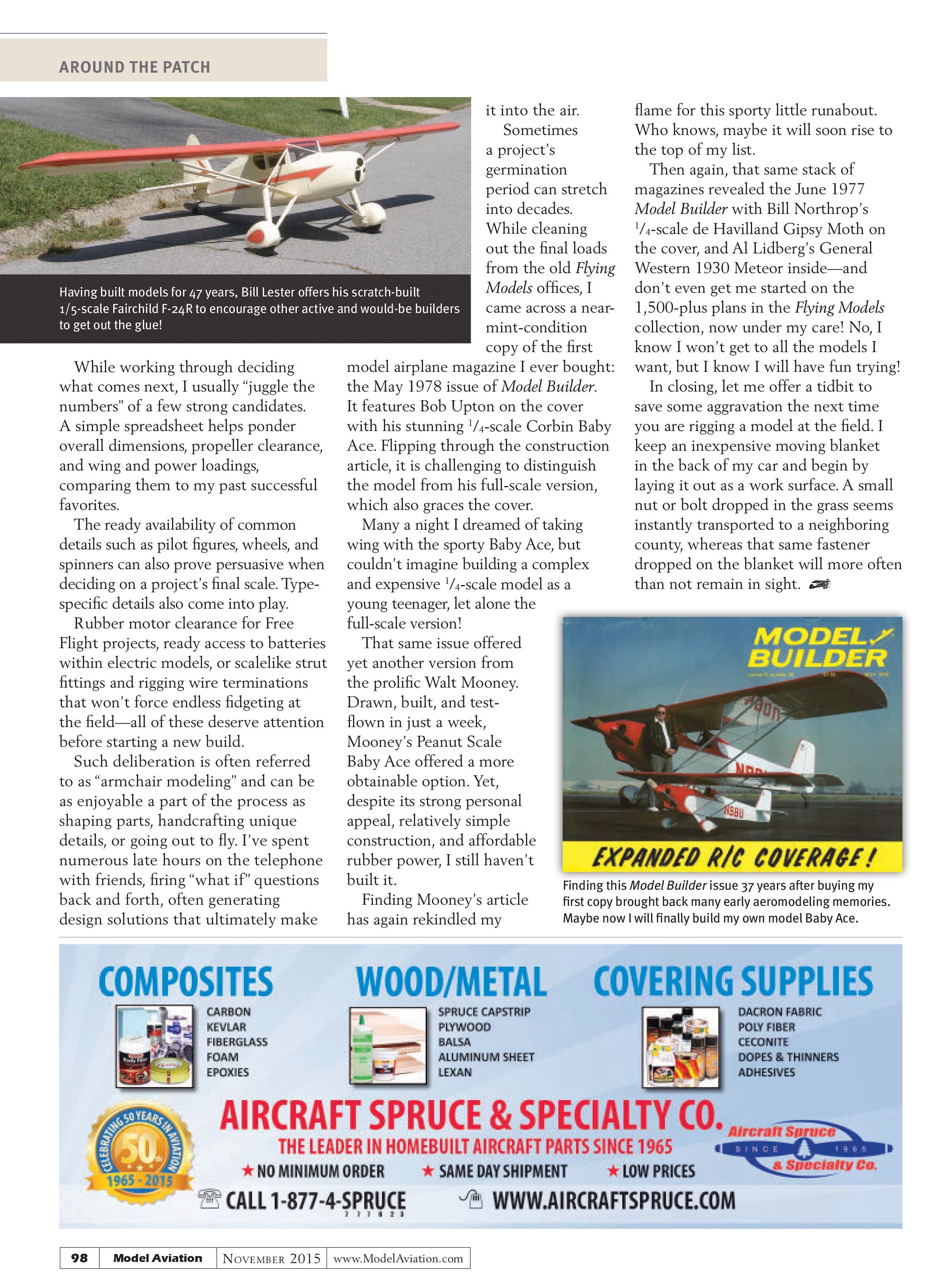
Sometimes a project’s germination period can stretch into decades. While cleaning out the final loads from the old Flying Models offices, I came across a near-mint-condition copy of the first model airplane magazine I ever bought: the May 1978 issue of Model Builder. It features Bob Upton on the cover with his stunning ¼-scale Corbin Baby Ace. Flipping through the construction article, it is challenging to distinguish the model from his full-scale version, which also graces the cover.
Many a night I dreamed of taking wing with the sporty Baby Ace, but couldn’t imagine building a complex and expensive ¼-scale model as a young teenager, let alone the full-scale version!
That same issue offered yet another version from the prolific Walt Mooney. Drawn, built, and test-flown in just a week, Mooney’s Peanut Scale Baby Ace offered a more obtainable option. Yet, despite its strong personal appeal, relatively simple construction, and affordable rubber power, I still haven’t built it.
Finding Mooney’s article has again rekindled my flame for this sporty little runabout. Who knows, maybe it will soon rise to the top of my list.
Then again, that same stack of magazines revealed the June 1977 Model Builder with Bill Northrop’s ¼-scale de Havilland Gipsy Moth on the cover, and Al Lidberg’s General Western 1930 Meteor inside—and don’t even get me started on the 1,500-plus plans in the Flying Models collection, now under my care! No, I know I won’t get to all the models I want, but I know I will have fun trying!
In closing, let me offer a tidbit to save some aggravation the next time you are rigging a model at the field. I keep an inexpensive moving blanket in the back of my car and begin by laying it out as a work surface. A small nut or bolt dropped in the grass seems instantly transported to a neighboring county, whereas that same fastener dropped on the blanket will more often than not remain in sight.