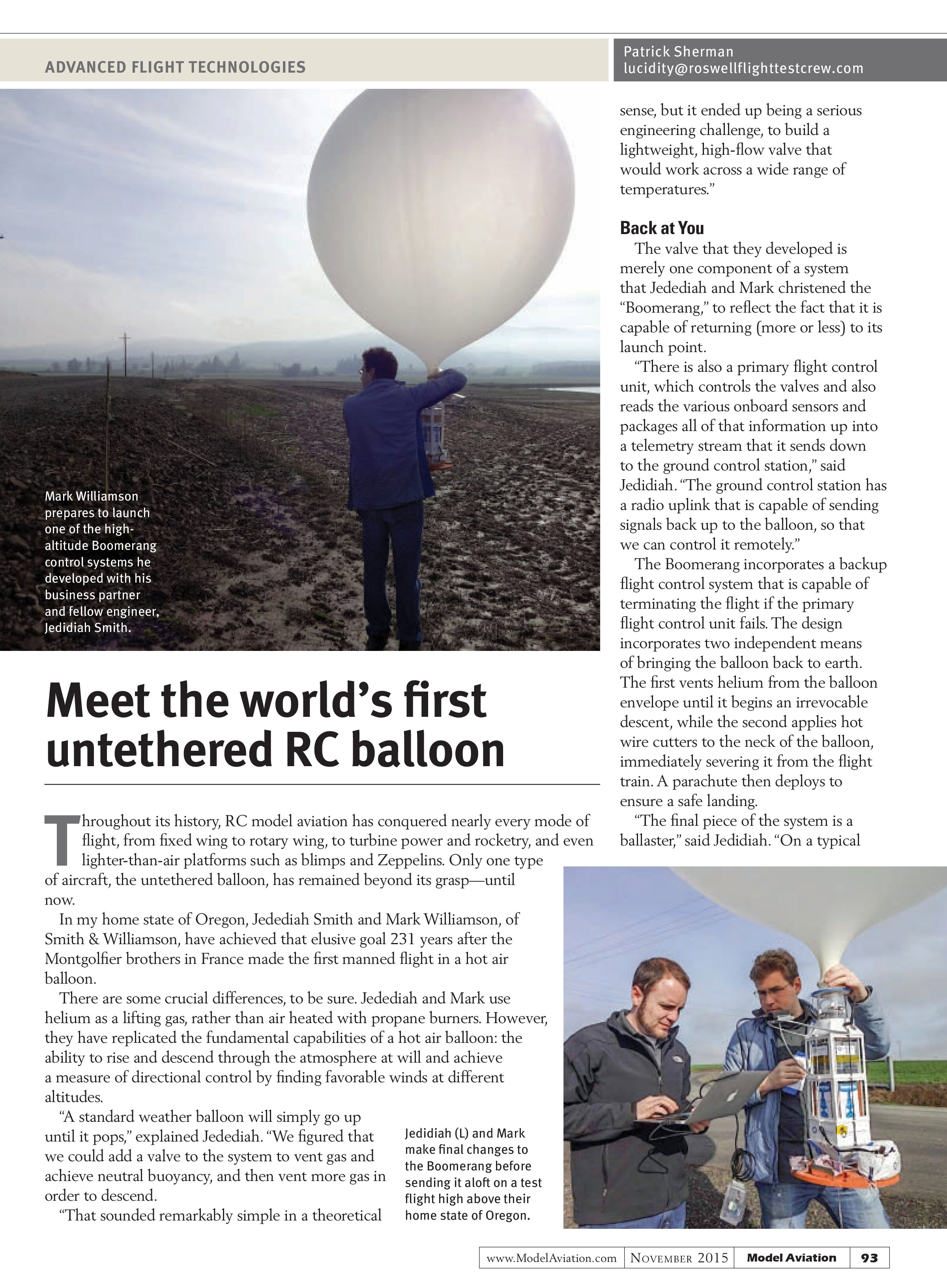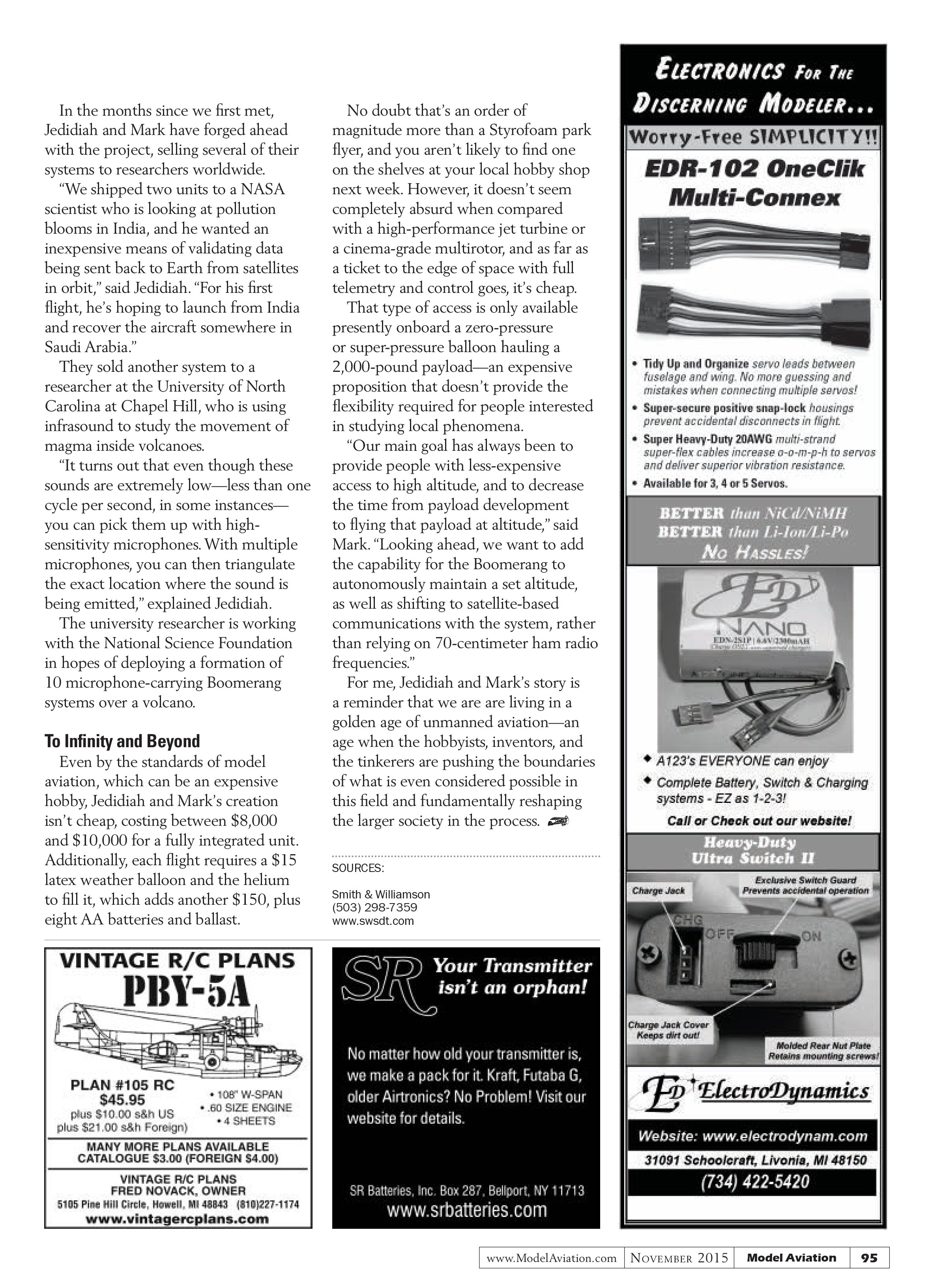

Meet the world’s first untethered RC balloon
Throughout its history, RC model aviation has conquered nearly every mode of flight, from fixed wing to rotary wing, to turbine power and rocketry, and even lighter-than-air platforms such as blimps and Zeppelins. Only one type of aircraft, the untethered balloon, has remained beyond its grasp—until now.
In my home state of Oregon, Jedediah Smith and Mark Williamson, of Smith & Williamson, have achieved that elusive goal 231 years after the Montgolfier brothers in France made the first manned flight in a hot air balloon.
There are some crucial differences, to be sure. Jedediah and Mark use helium as a lifting gas, rather than air heated with propane burners. However, they have replicated the fundamental capabilities of a hot air balloon: the ability to rise and descend through the atmosphere at will and achieve a measure of directional control by finding favorable winds at different altitudes.
“A standard weather balloon will simply go up until it pops,” explained Jedediah. “We figured that we could add a valve to the system to vent gas and achieve neutral buoyancy, and then vent more gas in order to descend.
“That sounded remarkably simple in a theoretical sense, but it ended up being a serious engineering challenge, to build a lightweight, high-flow valve that would work across a wide range of temperatures.”
Back at You
The valve that they developed is merely one component of a system that Jedediah and Mark christened the “Boomerang,” to reflect the fact that it is capable of returning (more or less) to its launch point.
“There is also a primary flight control unit, which controls the valves and also reads the various onboard sensors and packages all of that information up into a telemetry stream that it sends down to the ground control station,” said Jedediah. “The ground control station has a radio uplink that is capable of sending signals back up to the balloon, so that we can control it remotely.”
The Boomerang incorporates a backup flight control system that is capable of terminating the flight if the primary flight control unit fails. The design incorporates two independent means of bringing the balloon back to earth. The first vents helium from the balloon envelope until it begins an irrevocable descent, while the second applies hot wire cutters to the neck of the balloon, immediately severing it from the flight train. A parachute then deploys to ensure a safe landing.
“The final piece of the system is a ballaster,” said Jedediah. “On a typical

In the months since we first met, Jedidiah and Mark have forged ahead with the project, selling several of their systems to researchers worldwide.
“We shipped two units to a NASA scientist who is looking at pollution blooms in India, and he wanted an inexpensive means of validating data being sent back to Earth from satellites in orbit,” said Jedidiah. “For his first flight, he’s hoping to launch from India and recover the aircraft somewhere in Saudi Arabia.”
They sold another system to a researcher at the University of North Carolina at Chapel Hill, who is using infrasound to study the movement of magma inside volcanoes.
“It turns out that even though these sounds are extremely low—less than one cycle per second, in some instances—you can pick them up with high-sensitivity microphones. With multiple microphones, you can then triangulate the exact location where the sound is being emitted,” explained Jedidiah.
The university researcher is working with the National Science Foundation in hopes of deploying a formation of 10 microphone-carrying Boomerang systems over a volcano.
To Infinity and Beyond
Even by the standards of model aviation, which can be an expensive hobby, Jedidiah and Mark’s creation isn’t cheap, costing between $8,000 and $10,000 for a fully integrated unit. Additionally, each flight requires a $15 latex weather balloon and the helium to fill it, which adds another $150, plus eight AA batteries and ballast.
No doubt that’s an order of magnitude more than a Styrofoam park flyer, and you aren’t likely to find one on the shelves at your local hobby shop next week. However, it doesn’t seem completely absurd when compared with a high-performance jet turbine or a cinema-grade multirotor, and as far as a ticket to the edge of space with full telemetry and control goes, it’s cheap.
That type of access is only available presently onboard a zero-pressure or super-pressure balloon hauling a 2,000-pound payload—an expensive proposition that doesn’t provide the flexibility required for people interested in studying local phenomena.
“Our main goal has always been to provide people with less-expensive access to high altitude, and to decrease the time from payload development to flying that payload at altitude,” said Mark. “Looking ahead, we want to add the capability for the Boomerang to autonomously maintain a set altitude, as well as shifting to satellite-based communications with the system, rather than relying on 70-centimeter ham radio frequencies.”
For me, Jedidiah and Mark’s story is a reminder that we are are living in a golden age of unmanned aviation—an age when the hobbyists, inventors, and the tinkerers are pushing the boundaries of what is even considered possible in this field and fundamentally reshaping the larger society in the process.
SOURCES:
Smith & Williamson
(503) 298-7359
www.swsdt.com