Small Model Airplane Lovers’ League
Twenty-six years of flying small models
by Larry Kruse

One of the purest events in the country, in terms of the sheer love of model airplanes, took place June 4-7, 2015, near Little Rock, Arkansas, in the small town of Wrightsville. It was the 26th consecutive SMALL event.
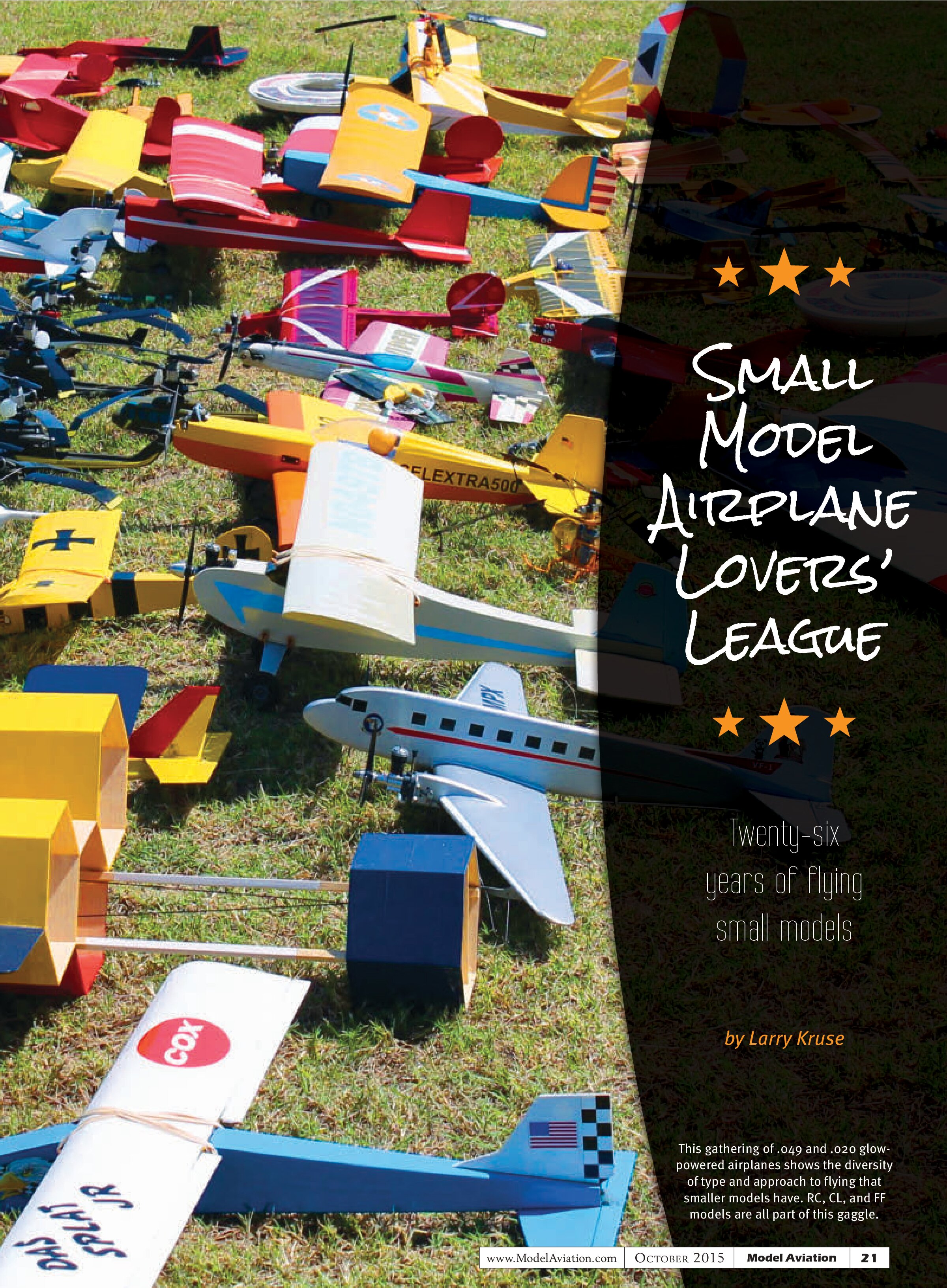
SMALL, the acronym for Small Model Airplane Lovers’ League, is unique in that it isn’t an organization at all. SMALL has no membership roster, no dues, no slate of officers, or any of the trappings that characterize most modeling enterprises. It’s simply a group of like-minded people who come together annually to enjoy each other’s company and models of all types—RC, Control Line (CL), and Free Flight (FF)—that feature engines no larger than .25-cubic-inch displacement—in effect, small models.
Although that engine limitation has blurred slightly throughout the years with the advent of electric power advancements and an accommodation for up to .35-size piston engines powering CL models for the sake of practicality, the airplanes are still considerably different and diverse in this age of increasingly larger models.
Begun as the brainchild of the late Randy Randolph, who was a prolific designer of small RC sport models, the inaugural event for small models was called SMALL Steps. The informal gathering took place in Dallas in 1989. Randy invited friends in the area, and two of the original attendees were Steve Staples and the late Emmett Fry, both from near Little Rock.
After some good-natured bantering with the Dallas contingent during the course of that gathering, Emmett and Steve challenged that they could stage an even bigger and better event in Arkansas the following year, and so the gauntlet was thrown.
Several attendees at the inaugural event have a perfect attendance record at SMALL, and have lost none of their affinity and excitement over small models during those years.
SMALL has changed venues during its history because of field availability and the ability of area clubs to host the event, but it has essentially remained in the Little Rock vicinity. Since 2009, it has been hosted by the Fraternal Association of Radio Control Modelers (FARM) club on the southeastern edge of Wrightsville.
Given the agrarian location, the FARM field is well-named, featuring a 700 x 130-foot grass runway, a heated and air-conditioned club house, electrical outlets for primitive camping, and a lighted pit area.
This year’s event was met with four days of perfect weather, sandwiched between storm fronts that dropped heavy rain over the central part of the country. Except for the hordes of buffalo gnats that seemed to thrive on every type of bug spray and repellent intended to discourage them, the lack of substantial wind and only moderate heat provided a setting for pure flying pleasure.
The event drew fliers from 14 states, including New York, California, North and South Carolina, Nebraska, New Mexico, Illinois, and Alaska. While FARM members Bobby Moran and Marshall Singer served as the CD and safety officer respectively, other club members handled the registration and the lunchtime hamburger and hot dog grill duties.
From the standpoint of continuity and promotion, much of the heavy lifting rested in the hands of Steve Staples, backed by the enthusiasm of Dan Berry, a former FF champion and proponent of anything that flies. Their efforts were supported


and enhanced by many postings on the SMALL forums on RCGroups and RC Universe websites, which built interest and shared the latest information throughout the year.
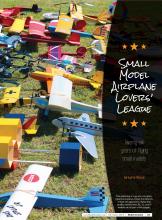
The pilots brought an amazing collection of nearly 200 models, almost equally divided between piston engines and electric power. Most of the models were RC, but CL and FF models were well represented. There was great innovation demonstrated by the variety of aircraft in each category. The models ranged from weird to wonderful, all enthusiastically flown by their builders and owners. In the weird category, no commentary would be complete without mentioning the annual—and so far unsuccessful—attempt to fly a CL cow pie; hexagonal- and octagonal-winged flying sticks; a classic British Charybdis with an engine and one lifting blade; a flying pie pan; a wedge-winged biplane; and a strange-looking autogyro.
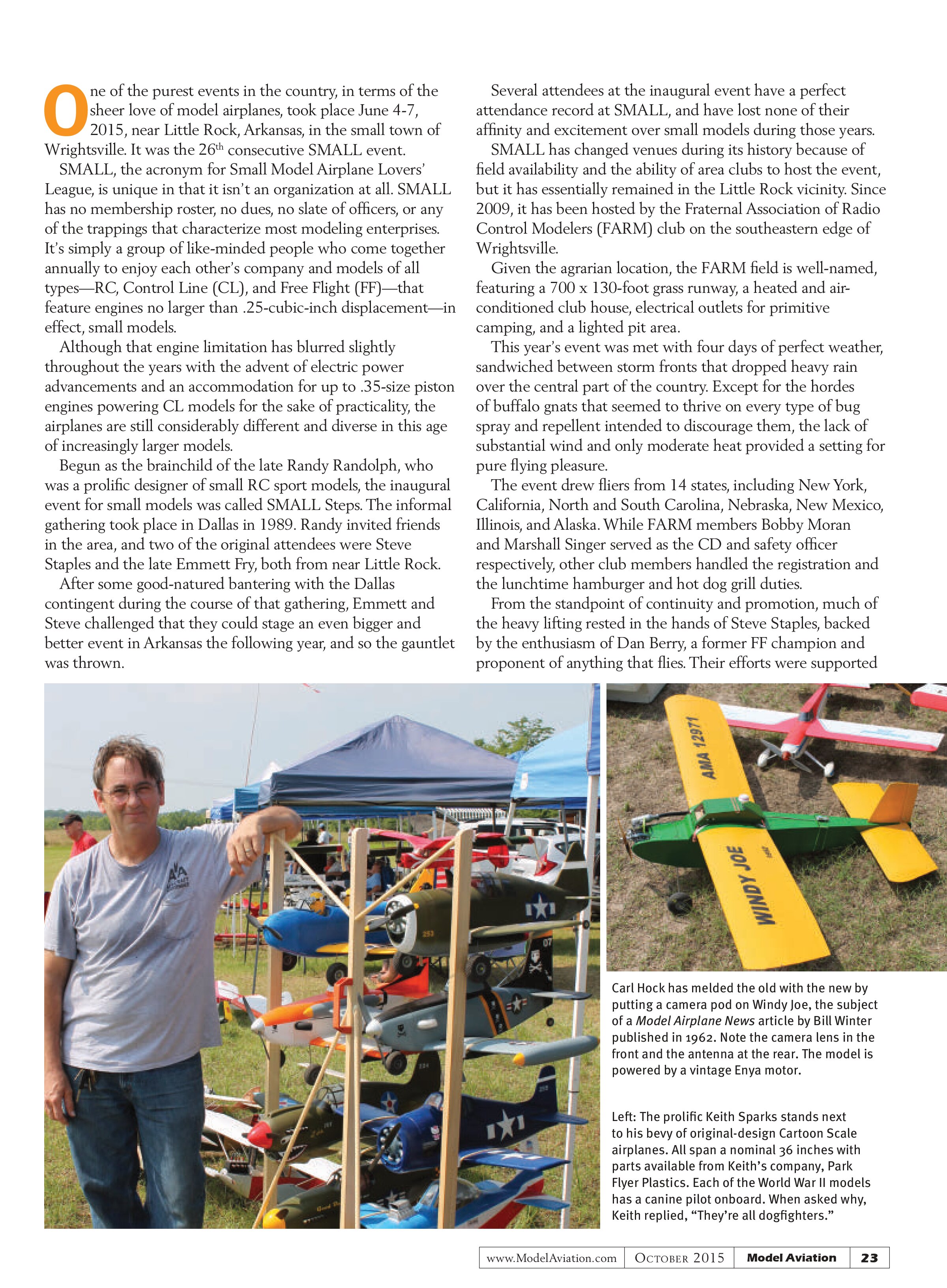
In the wonderful category, the airplanes by Manzano Laser Works, BMJR Models, Keith Sparks’ impressive array of Scale and Cartoon Scale models, and Bob and Janell Selman’s airplanes from BSD Micro RC need to be mentioned.
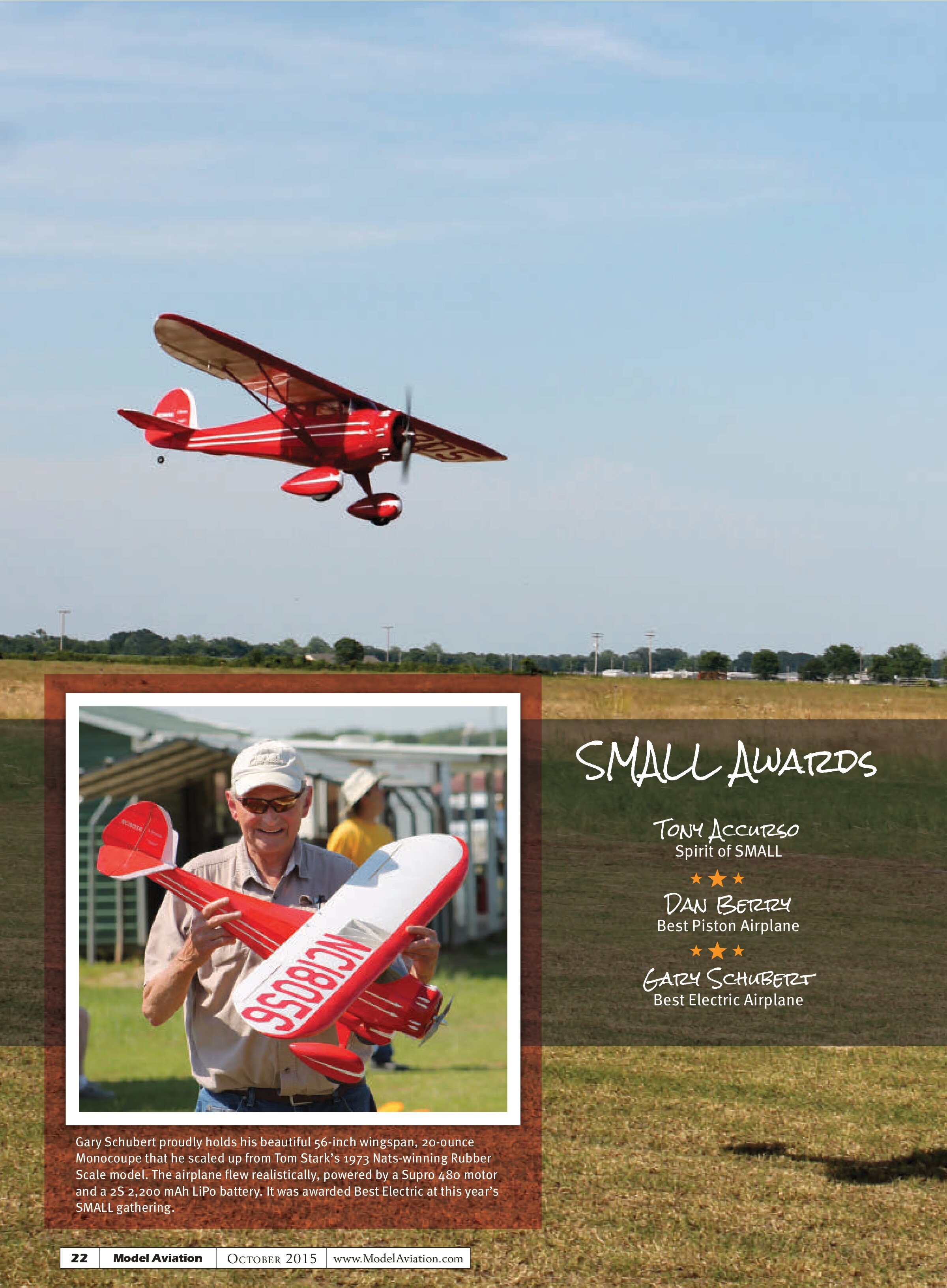
A one-off effort by Gary Schubert from Carlyle, Illinois, stole the show and was named the Best Electric Airplane. Gary developed his 56-inch wingspan Monocoupe by scaling up Tom Stark’s Sig Monocoupe kit plans and using clever construction techniques to keep the airplane at a scant 20 ounces without the battery. It was magnificent in the air and on the ground.
Because there was no flying or event schedule, people flew what and when they wanted, resulting in nonstop activity throughout all four days. Trying not to miss anything was challenging, although whenever five or six modelers were gathered, you knew something interesting was about to happen. Joining any of these impromptu gatherings was worthwhile to see

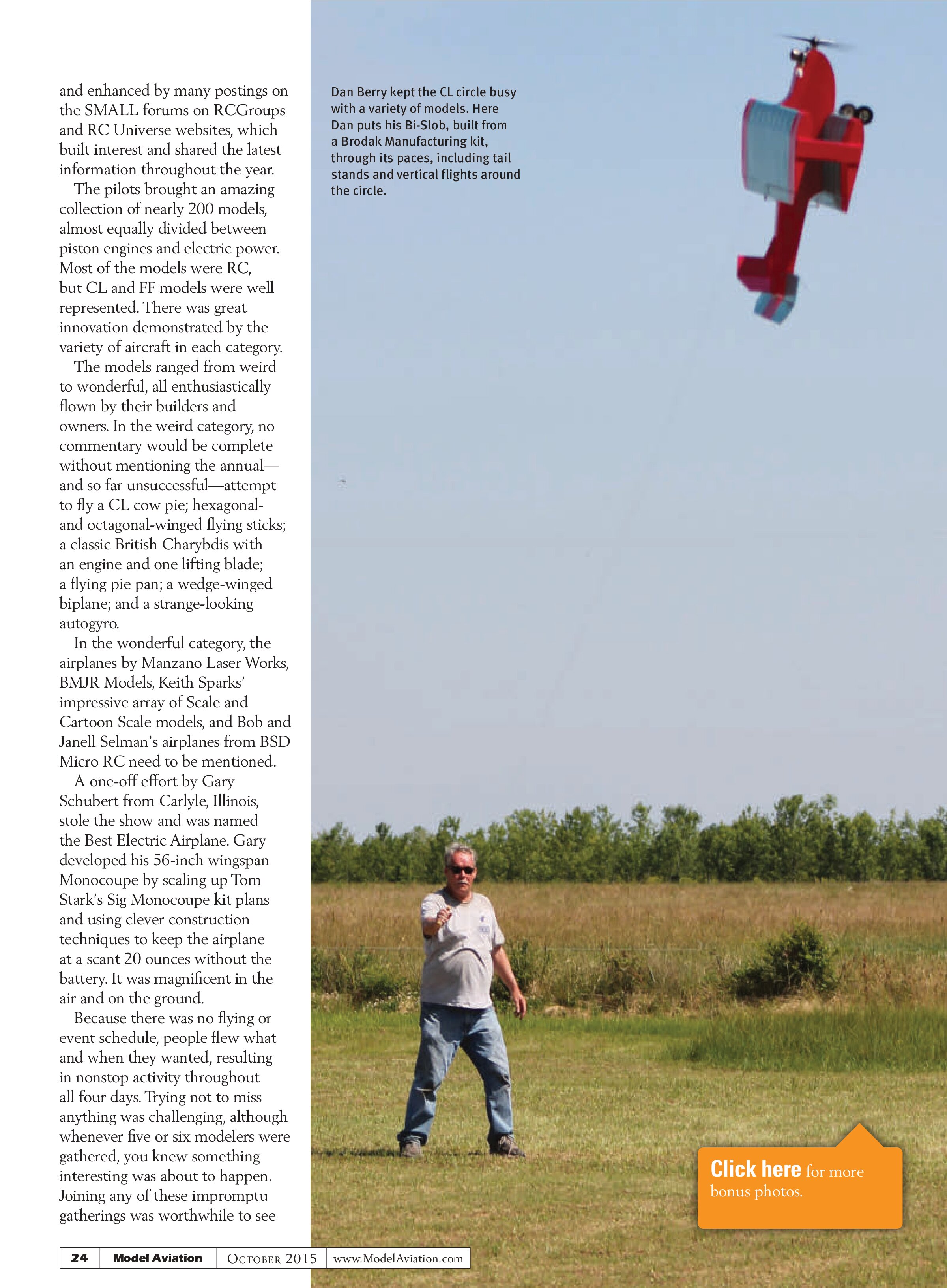
Dan Berry kept the CL circle busy with a variety of models. Here Dan puts his Bi-Slob, built from a Brodak Manufacturing kit, through its paces, including tail stands and vertical flights around the circle.


how others did things or to pick up new knowledge.
Circulating between the FF area at the north end of the field, the CL area at the south end of the field, and the always-busy RC center of the field was a delight for participants and kibitzers.
Perhaps SMALL’s popularity is because it’s not really an event. It is a four-day series of happenings and interactions among and between those who enjoy each other’s company, their modeling accomplishments, and their whimsical approach to the hobby.
It remains fresh and appealing because it is unstructured, governed by only the broadest of parameters, and guaranteed to bring together friends who begin looking forward to the following year’s gathering immediately upon the conclusion of the current one.
By any measure, the 26th annual SMALL event was a great success, and conversations about next year’s get-together are already showing up in the electronic media. Plan to count yourself in on the 27th edition of the Small Model Airplane Lovers’ League in 2016. You’ll get a heaping helping of pure modeling enjoyment.
—Larry Kruse
aircats@att.net
SOURCES:
Farm Club
www.farmrclub.com
Hip Pocket Aeronautics
www.hippocketaeronautics.com