How to get started in Scale
by Stan Alexander
onawing4602@att.net

This is typically the issue of Model Aviation that has a building theme, so I will take some time to look at one of the key items in Scale: how to build a Scale model.
Beginners don’t usually start with the P-51D Mustang. They choose something slightly easier to build, such as a J-3 Cub, which has square fuselage sides, a flat-bottom wing, fixed gear, and is controlled by a four-channel radio. But discussing building and how to get others involved in Scale has had a lot of people within AMA’s Scale community collectively scratching their heads.
Dale Arvin came up with the idea of having the Rough River Scale Rally this past spring at a park in Kentucky called Rough River Dam State Park. Many Scale modelers in the region have been to this park. We planned to go there and fly on the beautiful full-scale runway and hold Scale seminars.
A call went out to the entire National Association of Scale Aeromodelers (NASA) membership and ideas came in, as well as volunteers who would present seminars about different aspects of Scale. These included:
Larry Folk: Three-views, laser cutting, and using SketchUp and other programs to laser cut parts. Larry brought several computers and demonstrated how to use the programs to replicate designs from the past.
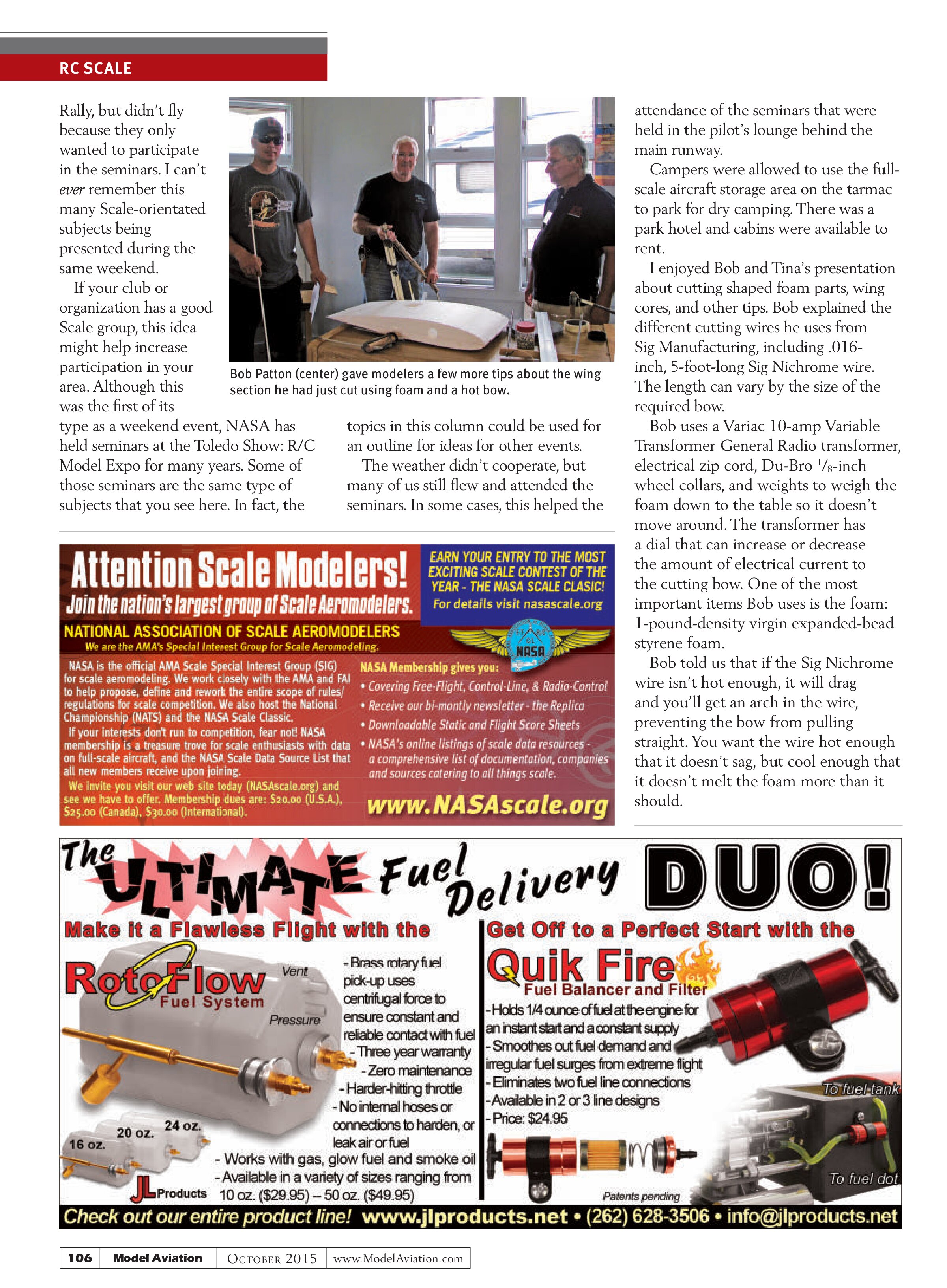
Bob and Tina Patton: How to cut foam wings from templates with a hot wire.
Jim Martin: Flight judging information and how to get 10s on every maneuver. Jim reviewed the rule book and some tricks he has learned throughout the years. Jim is the Nats RC Scale event director, as well as a Scale flight judge at the Top Gun Invitational and other events.
One thing that Jim and I agree on is that many
Scale modelers don’t give themselves enough time to set up for the next maneuver, which can put the aircraft in the wrong starting position. He also discussed the AMA Scale rules and picked apart different items that should help a newcomer at events. Go to AMA’s website and download the Scale portion of the rules and regulations. Do you have a question? Let us know and we’ll do our best to answer it.
Earl Dever Sr. and Earl Dever Jr.: Static judging, and how to present your aircraft and documentation to the judges.
Mike Barbee and John Boyko: How to fly your aircraft in a scalelike manner to achieve maximum flight scores.
Dale Arvin: Getting started in Scale competition, selecting the right aircraft, and checking into the right class in which to fly.
Stan Alexander: Scale documentation, finding and selecting the right documentation, and presenting it for your project.
There were 38 participants at the rally from many states, with some from as far away as Florida and Michigan. Some attended the Rough River Scale

Rally, but didn’t fly because they only wanted to participate in the seminars. I can’t ever remember this many Scale-orientated subjects being presented during the same weekend.
If your club or organization has a good Scale group, this idea might help increase participation in your area. Although this was the first of its type as a weekend event, NASA has held seminars at the Toledo Show: R/C Model Expo for many years. Some of those seminars are the same type of subjects that you see here. In fact, the

topics in this column could be used for an outline for ideas for other events.
The weather didn’t cooperate, but many of us still flew and attended the seminars. In some cases, this helped the
attendance of the seminars that were held in the pilot’s lounge behind the main runway.
Campers were allowed to use the full-scale aircraft storage area on the tarmac to park for dry camping. There was a park hotel and cabins were available to rent.
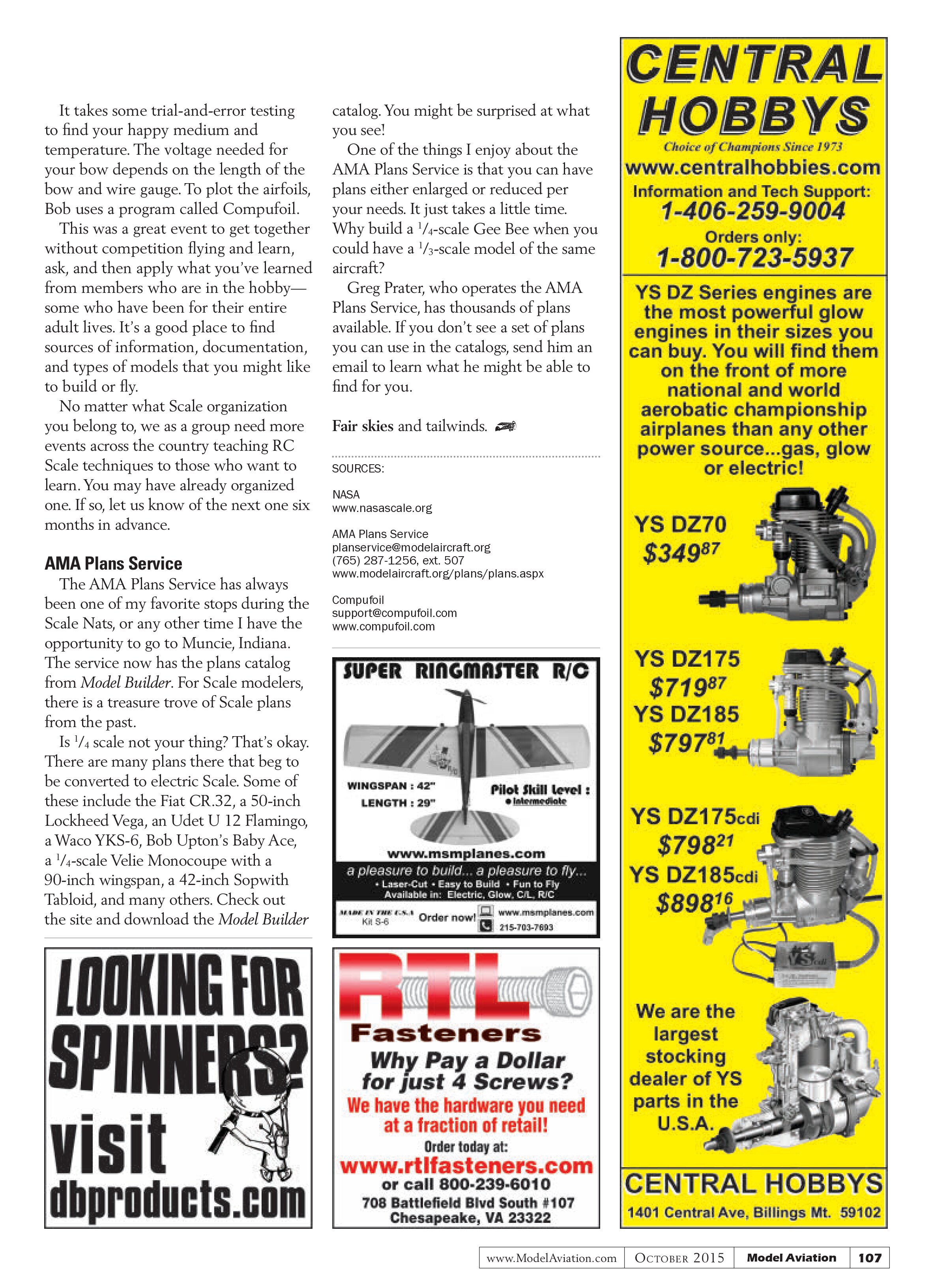
I enjoyed Bob and Tina’s presentation about cutting shaped foam parts, wing cores, and other tips. Bob explained the different cutting wires he uses from Sig Manufacturing, including .016-inch, 5-foot-long Sig Nichrome wire. The length can vary by the size of the required bow.
Bob uses a Variac 10-amp Variable Transformer General Radio transformer, electrical zip cord, Du-Bro ⅛-inch wheel collars, and weights to weigh the foam down to the table so it doesn’t move around. The transformer has a dial that can increase or decrease the amount of electrical current to the cutting bow. One of the most important items Bob uses is the foam: 1-pound-density virgin expanded-bead styrene foam.
Bob told us that if the Sig Nichrome wire isn’t hot enough, it will drag and you’ll get an arch in the wire, preventing the bow from pulling straight. You want the wire hot enough that it doesn’t sag, but cool enough that it doesn’t melt the foam more than it should.
It takes some trial-and-error testing to find your happy medium and temperature. The voltage needed for your bow depends on the length of the bow and wire gauge. To plot the airfoils, Bob uses a program called Compufoil.
This was a great event to get together without competition flying and learn, ask, and then apply what you’ve learned from members who are in the hobby—some who have been for their entire adult lives. It’s a good place to find sources of information, documentation, and types of models that you might like to build or fly.
No matter what Scale organization you belong to, we as a group need more events across the country teaching RC Scale techniques to those who want to learn. You may have already organized one. If so, let us know of the next one six months in advance.
AMA Plans Service
The AMA Plans Service has always been one of my favorite stops during the Scale Nats, or any other time I have the opportunity to go to Muncie, Indiana. The service now has the plans catalog from Model Builder. For Scale modelers, there is a treasure trove of Scale plans from the past.
Is ¼ scale not your thing? That’s okay. There are many plans there that beg to be converted to electric Scale. Some of these include the Fiat CR.32, a 50-inch Lockheed Vega, an Udet U 12 Flamingo, a Waco YKS-6, Bob Upton’s Baby Ace, a ¼-scale Velie Monocoupe with a 90-inch wingspan, a 42-inch Sopwith Tabloid, and many others. Check out the site and download the Model Builder catalog. You might be surprised at what you see!
One of the things I enjoy about the AMA Plans Service is that you can have plans either enlarged or reduced per your needs. It just takes a little time. Why build a ¼-scale Gee Bee when you could have a ⅓-scale model of the same aircraft?
Greg Prater, who operates the AMA Plans Service, has thousands of plans available. If you don’t see a set of plans you can use in the catalogs, send him an email to learn what he might be able to find for you.
Fair skies and tailwinds.
SOURCES:
AMA Plans Service
planservice@modelaircraft.org
(765) 287-1256, ext. 507
www.modelaircraft.org/plans/plans.aspx