Crash aftermath
Chris Mulcahy
cspaced@gmail.com

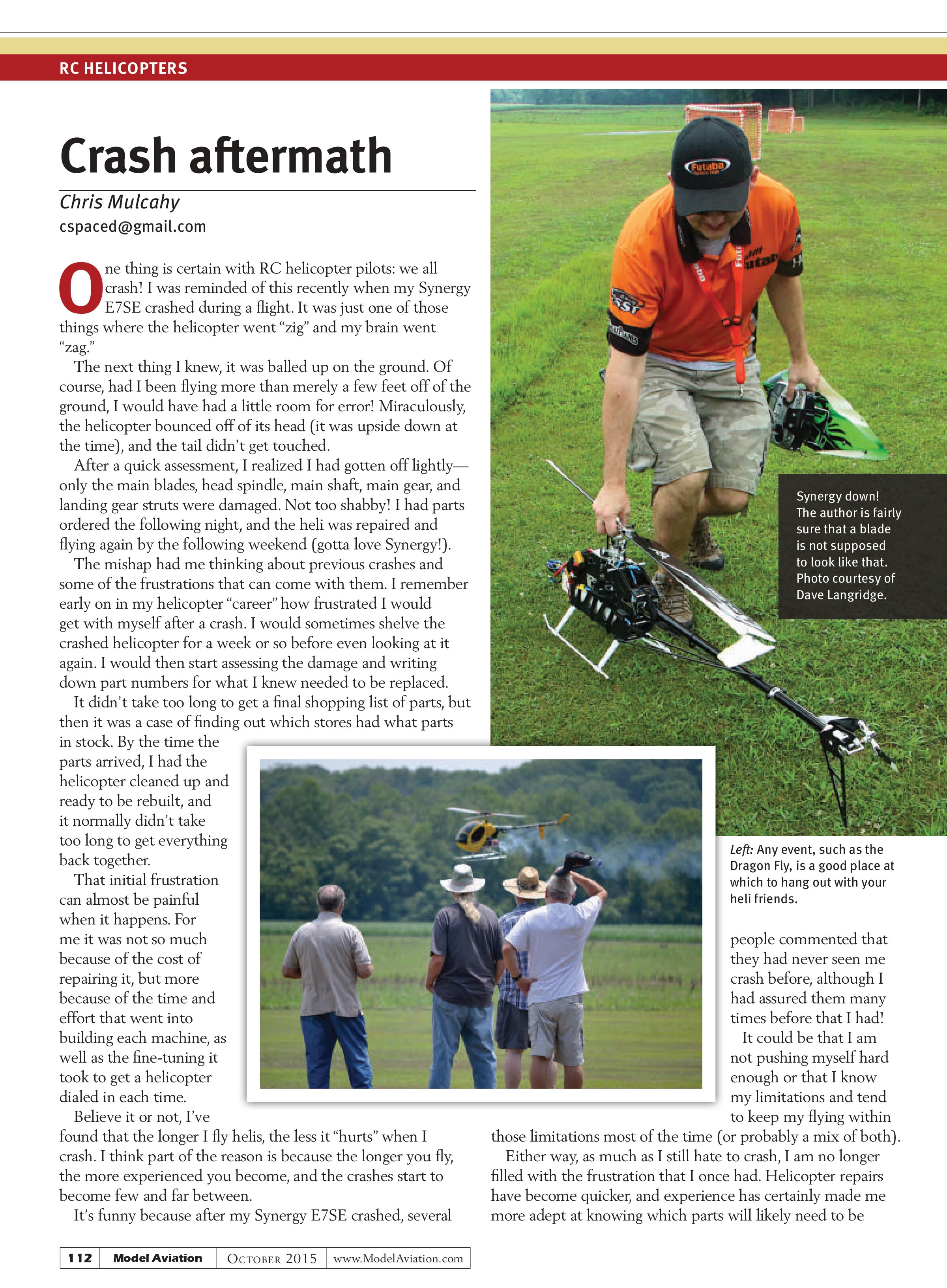
One thing is certain with RC helicopter pilots: we all crash! I was reminded of this recently when my Synergy E7SE crashed during a flight. It was just one of those things where the helicopter went “zig” and my brain went “zag.”
The next thing I knew, it was balled up on the ground. Of course, had I been flying more than merely a few feet off of the ground, I would have had a little room for error! Miraculously, the helicopter bounced off of its head (it was upside down at the time), and the tail didn’t get touched.
After a quick assessment, I realized I had gotten off lightly—only the main blades, head spindle, main shaft, main gear, and landing gear struts were damaged. Not too shabby! I had parts ordered the following night, and the heli was repaired and flying again by the following weekend (gotta love Synergy!).
The mishap had me thinking about previous crashes and some of the frustrations that can come with them. I remember early on in my helicopter “career” how frustrated I would get with myself after a crash. I would sometimes shelve the crashed helicopter for a week or so before even looking at it again. I would then start assessing the damage and writing down part numbers for what I knew needed to be replaced.
It didn’t take too long to get a final shopping list of parts, but then it was a case of finding out which stores had what parts in stock. By the time the parts arrived, I had the helicopter cleaned up and ready to be rebuilt, and it normally didn’t take too long to get everything back together.

That initial frustration can almost be painful when it happens. For me it was not so much because of the cost of repairing it, but more because of the time and effort that went into building each machine, as well as the fine-tuning it took to get a helicopter dialed in each time.
Believe it or not, I’ve found that the longer I fly helis, the less it “hurts” when I crash. I think part of the reason is because the longer you fly, the more experienced you become, and the crashes start to become few and far between.
It’s funny because after my Synergy E7SE crashed, several people commented that they had never seen me crash before, although I had assured them many times before that I had! It could be that I am not pushing myself hard enough or that I know my limitations and tend to keep my flying within those limitations most of the time (or probably a mix of both).
Either way, as much as I still hate to crash, I am no longer filled with the frustration that I once had. Helicopter repairs have become quicker, and experience has certainly made me more adept at knowing which parts will likely need to be replaced. The best part? Unlike airplanes, after helicopters are repaired they weigh the same and fly just as well as before the crash!
Successful Event
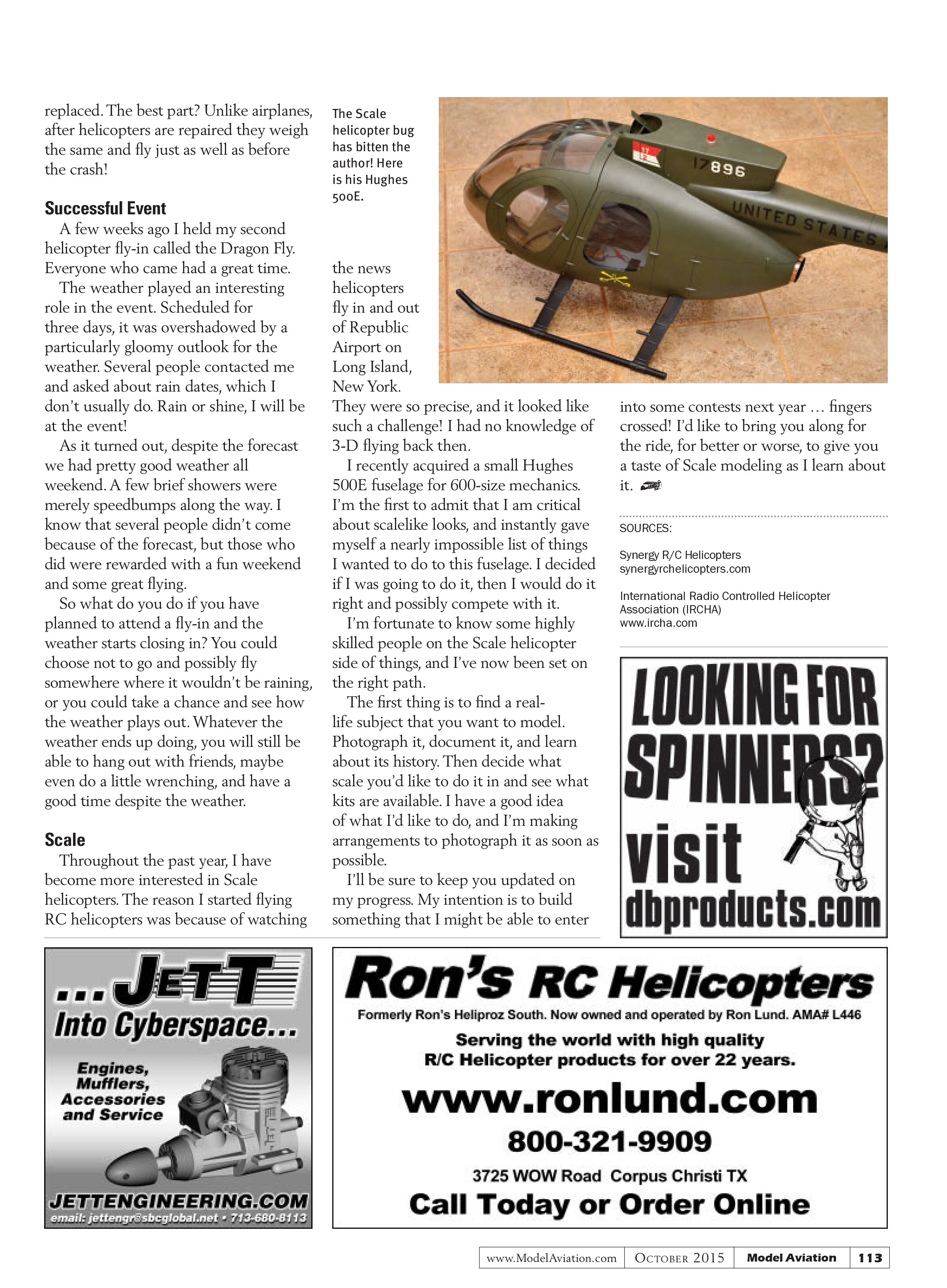
A few weeks ago I held my second helicopter fly-in called the Dragon Fly. Everyone who came had a great time.
The weather played an interesting role in the event. Scheduled for three days, it was overshadowed by a particularly gloomy outlook for the weather. Several people contacted me and asked about rain dates, which I don’t usually do. Rain or shine, I will be at the event!
As it turned out, despite the forecast we had pretty good weather all weekend. A few brief showers were merely speedbumps along the way. I know that several people didn’t come because of the forecast, but those who did were rewarded with a fun weekend and some great flying.
So what do you do if you have planned to attend a fly-in and the weather starts closing in? You could choose not to go and possibly fly somewhere where it wouldn’t be raining, or you could take a chance and see how the weather plays out. Whatever the weather ends up doing, you will still be able to hang out with friends, maybe even do a little wrenching, and have a good time despite the weather.
Scale
Throughout the past year, I have become more interested in Scale helicopters. The reason I started flying RC helicopters was because of watching the news helicopters fly in and out of Republic Airport on Long Island, New York. They were so precise, and it looked like such a challenge! I had no knowledge of 3-D flying back then.
I recently acquired a small Hughes 500E fuselage for 600-size mechanics. I’m the first to admit that I am critical about scalelike looks, and instantly gave myself a nearly impossible list of things I wanted to do to this fuselage. I decided if I was going to do it, then I would do it right and possibly compete with it.
I’m fortunate to know some highly skilled people on the Scale helicopter side of things, and I’ve now been set on the right path.
The first thing is to find a real-life subject that you want to model. Photograph it, document it, and learn about its history. Then decide what scale you’d like to do it in and see what kits are available. I have a good idea of what I’d like to do, and I’m making arrangements to photograph it as soon as possible.
I’ll be sure to keep you updated on my progress. My intention is to build something that I might be able to enter into some contests next year … fingers crossed! I’d like to bring you along for the ride, for better or worse, to give you a taste of Scale modeling as I learn about it.

Sources:
Synergy R/C Helicopters
synergy rchelicopters.com
International Radio Controlled Helicopter Association (IRCHA)
www.ircha.com