Winner of the guess-the-aircraft contest
by Sal Calvagna
rcgiants@optonline.net

Welcome back. What happened? I blinked and summer was history. No worries; there’s plenty of good flying weather ahead, so enjoy the rest of the season.
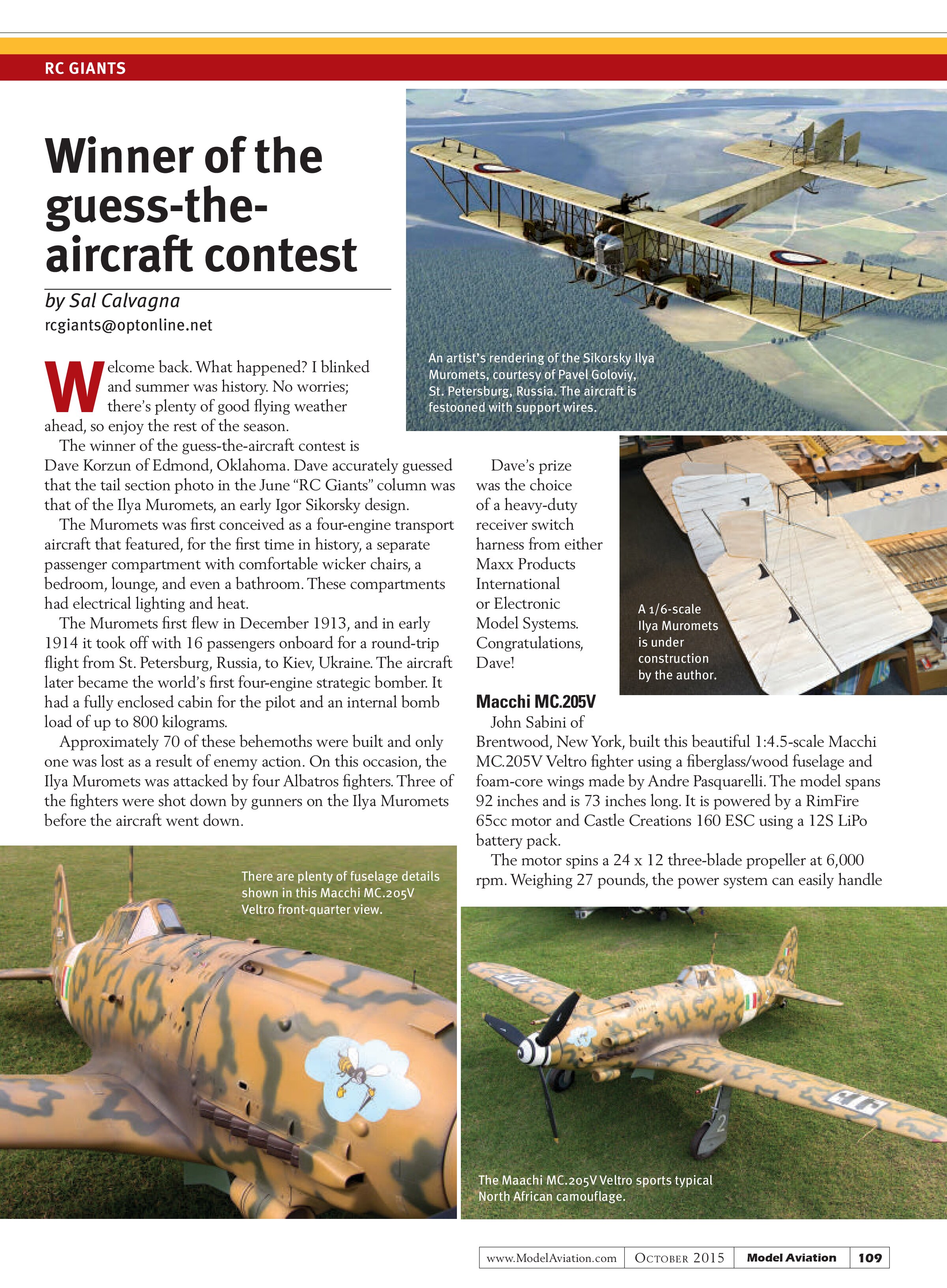
The winner of the guess-the-aircraft contest is Dave Korzun of Edmond, Oklahoma. Dave accurately guessed that the tail section photo in the June “RC Giants” column was that of the Ilya Muromets, an early Igor Sikorsky design.
The Muromets was first conceived as a four-engine transport aircraft that featured, for the first time in history, a separate passenger compartment with comfortable wicker chairs, a bedroom, lounge, and even a bathroom. These compartments had electrical lighting and heat.
The Muromets first flew in December 1913, and in early 1914 it took off with 16 passengers onboard for a round-trip flight from St. Petersburg, Russia, to Kiev, Ukraine. The aircraft later became the world’s first four-engine strategic bomber. It had a fully enclosed cabin for the pilot and an internal bomb load of up to 800 kilograms.
Approximately 70 of these behemoths were built and only one was lost as a result of enemy action. On this occasion, the Ilya Muromets was attacked by four Albatros fighters. Three of the fighters were shot down by gunners on the Ilya Muromets before the aircraft went down.
Dave’s prize was the choice of a heavy-duty receiver switch harness from either Maxx Products International or Electronic Model Systems. Congratulations, Dave!
Macchi MC.205V
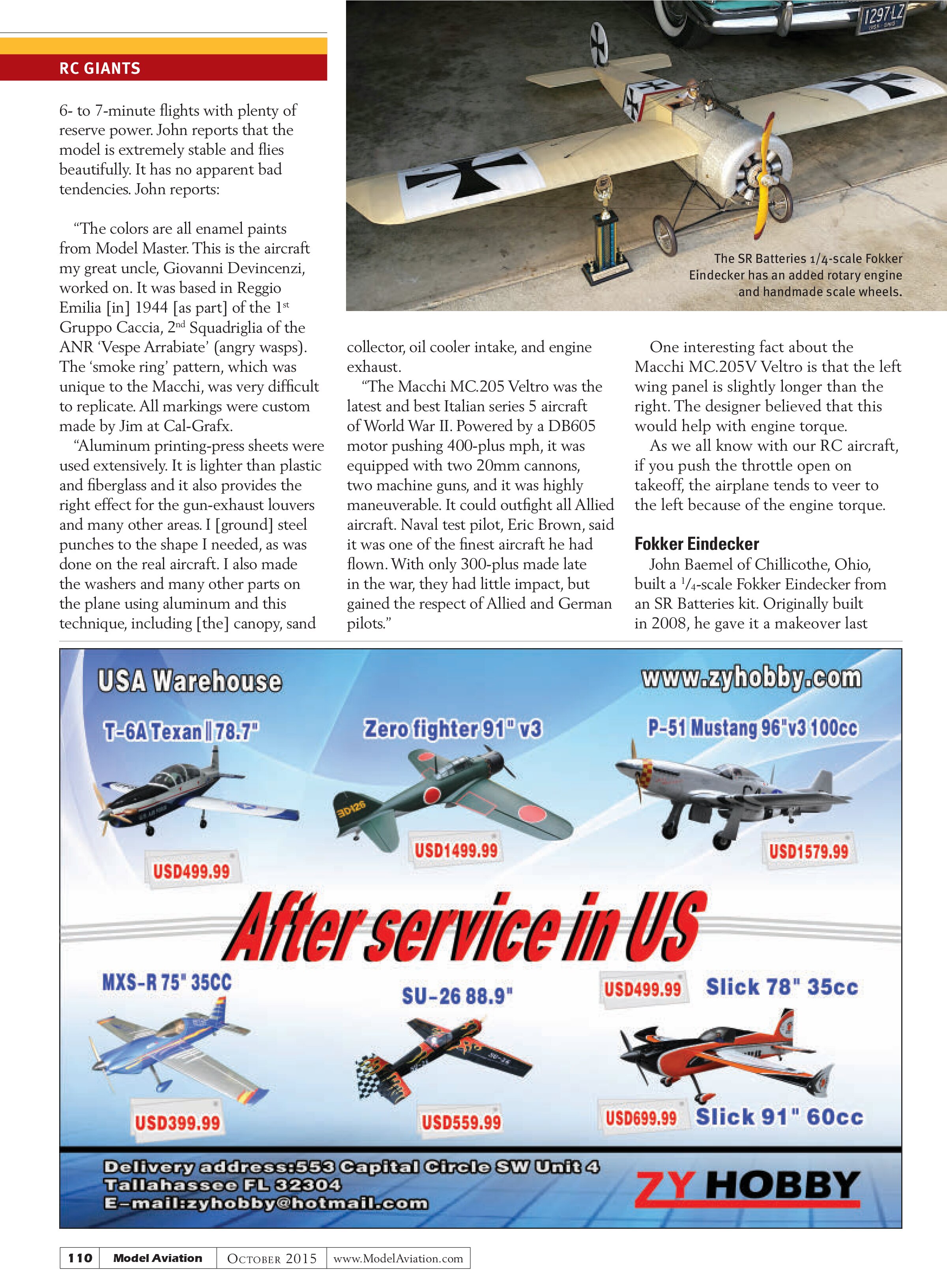
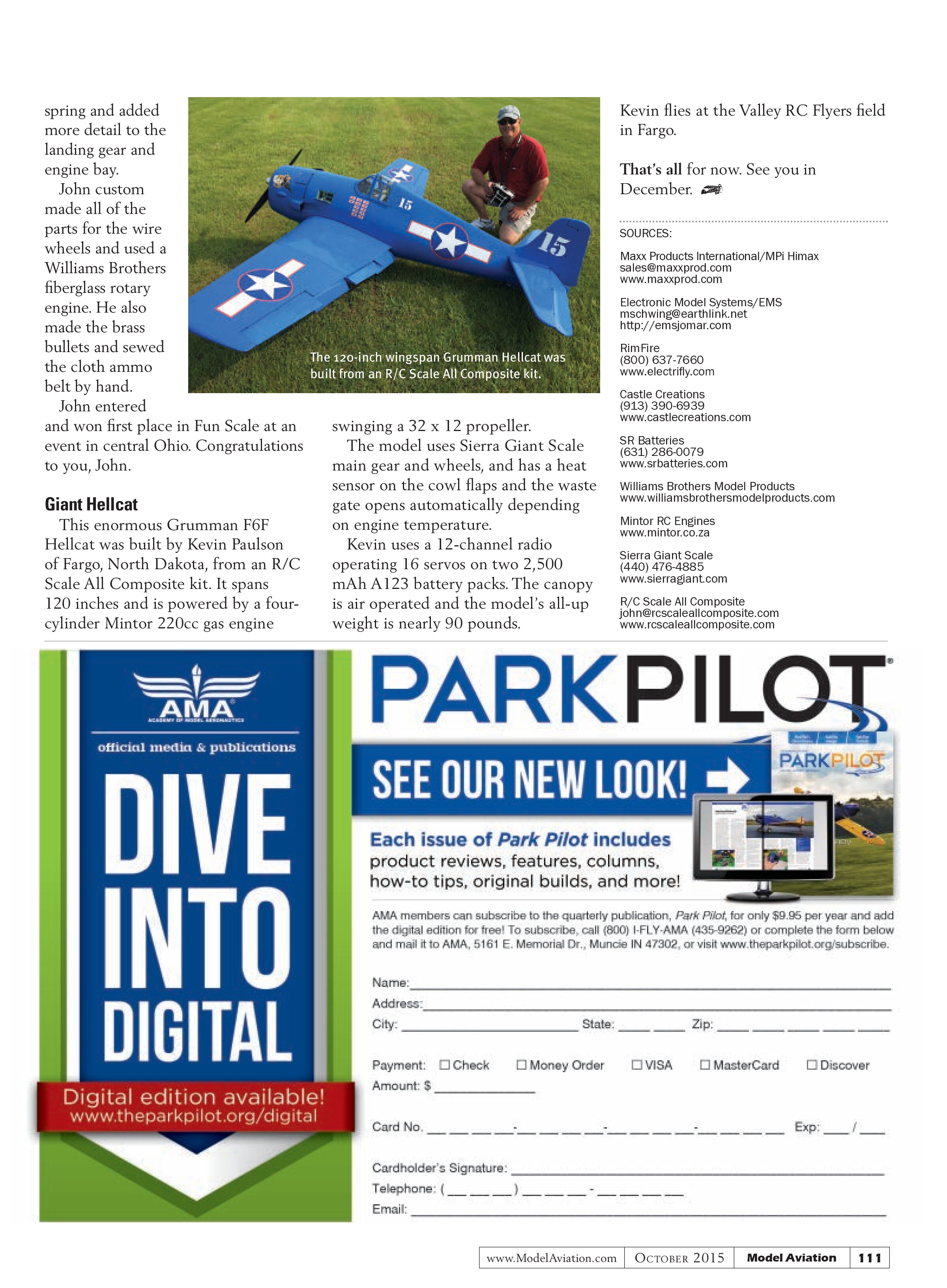
John Sabini of Brentwood, New York, built this beautiful 1:4.5-scale Macchi MC.205V Veltro fighter using a fiberglass/wood fuselage and foam-core wings made by Andre Pasquarelli. The model spans 92 inches and is 73 inches long. It is powered by a RimFire 65cc motor and Castle Creations 160 ESC using a 12S LiPo battery pack.
The motor spins a 24 x 12 three-blade propeller at 6,000 rpm. Weighing 27 pounds, the power system can easily handle


6- to 7-minute flights with plenty of reserve power. John reports that the model is extremely stable and flies beautifully. It has no apparent bad tendencies. John reports:
“The colors are all enamel paints from Model Master. This is the aircraft my great uncle, Giovanni Devincenzi, worked on. It was based in Reggio Emilia [in] 1944 [as part] of the 1st Gruppo Caccia, 2nd Squadriglia of the ANR ‘Vespe Arrabiate’ (angry wasps). The ‘smoke ring’ pattern, which was unique to the Macchi, was very difficult to replicate. All markings were custom made by Jim at Cal-Grafx.
“Aluminum printing-press sheets were used extensively. It is lighter than plastic and fiberglass and it also provides the right effect for the gun-exhaust louvers and many other areas. I [ground] steel punches to the shape I needed, as was done on the real aircraft. I also made the washers and many other parts on the plane using aluminum and this technique, including [the] canopy, sand
collector, oil cooler intake, and engine exhaust.
“The Macchi MC.205 Veltro was the latest and best Italian series 5 aircraft of World War II. Powered by a DB605 motor pushing 400-plus mph, it was equipped with two 20mm cannons, two machine guns, and it was highly maneuverable. It could outfight all Allied aircraft. Naval test pilot, Eric Brown, said it was one of the finest aircraft he had flown. With only 300-plus made late in the war, they had little impact, but gained the respect of Allied and German pilots.”
One interesting fact about the Macchi MC.205V Veltro is that the left wing panel is slightly longer than the right. The designer believed that this would help with engine torque.
As we all know with our RC aircraft, if you push the throttle open on takeoff, the airplane tends to veer to the left because of the engine torque.
Fokker Eindecker
John Baemel of Chillicothe, Ohio, built a 1/4-scale Fokker Eindecker from an SR Batteries kit. Originally built in 2008, he gave it a makeover last

spring and added more detail to the landing gear and engine bay. John custom made all of the parts for the wire wheels and used a Williams Brothers fiberglass rotary engine. He also made the brass bullets and sewed the cloth ammo belt by hand.
John entered and won first place in Fun Scale at an event in central Ohio. Congratulations to you, John.
Giant Hellcat
This enormous Grumman F6F Hellcat was built by Kevin Paulson of Fargo, North Dakota, from an R/C Scale All Composite kit. It spans 120 inches and is powered by a four-cylinder Mintor 220cc gas engine
swinging a 32 x 12 propeller.
The model uses Sierra Giant Scale main gear and wheels, and has a heat sensor on the cowl flaps and the waste gate opens automatically depending on engine temperature.
Kevin uses a 12-channel radio operating 16 servos on two 2,500 mAh A123 battery packs. The canopy is air operated and the model’s all-up weight is nearly 90 pounds.

Kevin flies at the Valley RC Flyers field in Fargo.
That’s all for now. See you in December.
SOURCES:
Maxx Products International/MPi Himax
sales@maxxprod.com
www.maxxprod.com
Electronic Model Systems/EMS
mschwing@earthlink.net
http://emsjomar.com
RimFire
(800) 637-7660
www.electrifly.com
Castle Creations
(913) 390-6939
www.castlecreations.com
SR Batteries
(631) 286-0079
www.srbatteries.com
Williams Brothers Model Products
www.williamsbrothersmodelproducts.com
Mintor RC Engines
www.mintor.co.za
Sierra Giant Scale
(440) 476-4885
www.sierragiant.com
R/C Scale All Composite
john@rcscaleallcomposite.com
www.rcscaleallcomposite.com