Italian monoplane proves to be a fun, winning FF Rubber model


Looking for a Free Flight (FF) Rubber Scale model for a DC Maxecuters World War II Combat event, Pat Daily fell in love with the “fat little fuselage” of the Fiat G-50, an Italian aircraft that was the first low-wing, all-metal monoplane with retractable landing gear for the Regia Aeronautica Italiana air ministry. He located Bill Winter plans from the June 1940 Model Airplane News, and built it with a few modifications.
The Fiat’s construction was light, but strong, although it was a large model. Pat preferred hard, thin stringers, and carefully selected the wood for weight and grain. The fuselage was built using the keel and half-shell former method that involved laminating the upper, lower, and two side master stringers over the plans, using two pieces of hard 1/16 square for the final dimension of 1/8 x 1/16. The left half of the fuselage was constructed first, with the left master stringer added. The shell was removed and the right side formers and the master stringers were added. The rest of the stringers were symmetrically added.
The inboard wing sections were assembled as part of the fuselage, with the leading edges hand tapered to fit from rib B to rib A on both sides. The trailing edge was laminated from two pieces of 1/16 x 1/8 balsa and tapered and glued from rib A to the stringers, paralleling the bottom master stringer.
The cowling was built up separately and attached to the front of the fuselage at former number 1 then covered with damp, soft 1/32 A-grain balsa. Pat noted to be sure to cut a “key” in the cowling’s front bulkhead to fit the removable noseblock.
Seven Williams Brothers 3/4-inch scale cylinders were cut in half and added to the noseblock, and gun troughs were fashioned from wet 1/32-inch soft balsa and fitted into cut slots at the top of the cowling. An oil cooler scoop was made from medium-weight balsa. The scoop also made an effective belly skid if the Fiat was built with the gear up. Pat added a tail wheel, dashboard, and windshield.
The outboard wing sections were built separately and then attached to rib B. The wingtips were laminated from three thicknesses of 1/32 x 3/32 balsa. Wing ribs were made from hard balsa. Rudder and elevator surface construction was straightforward, with the surfaces hinged with wire, making it necessary for double spars.
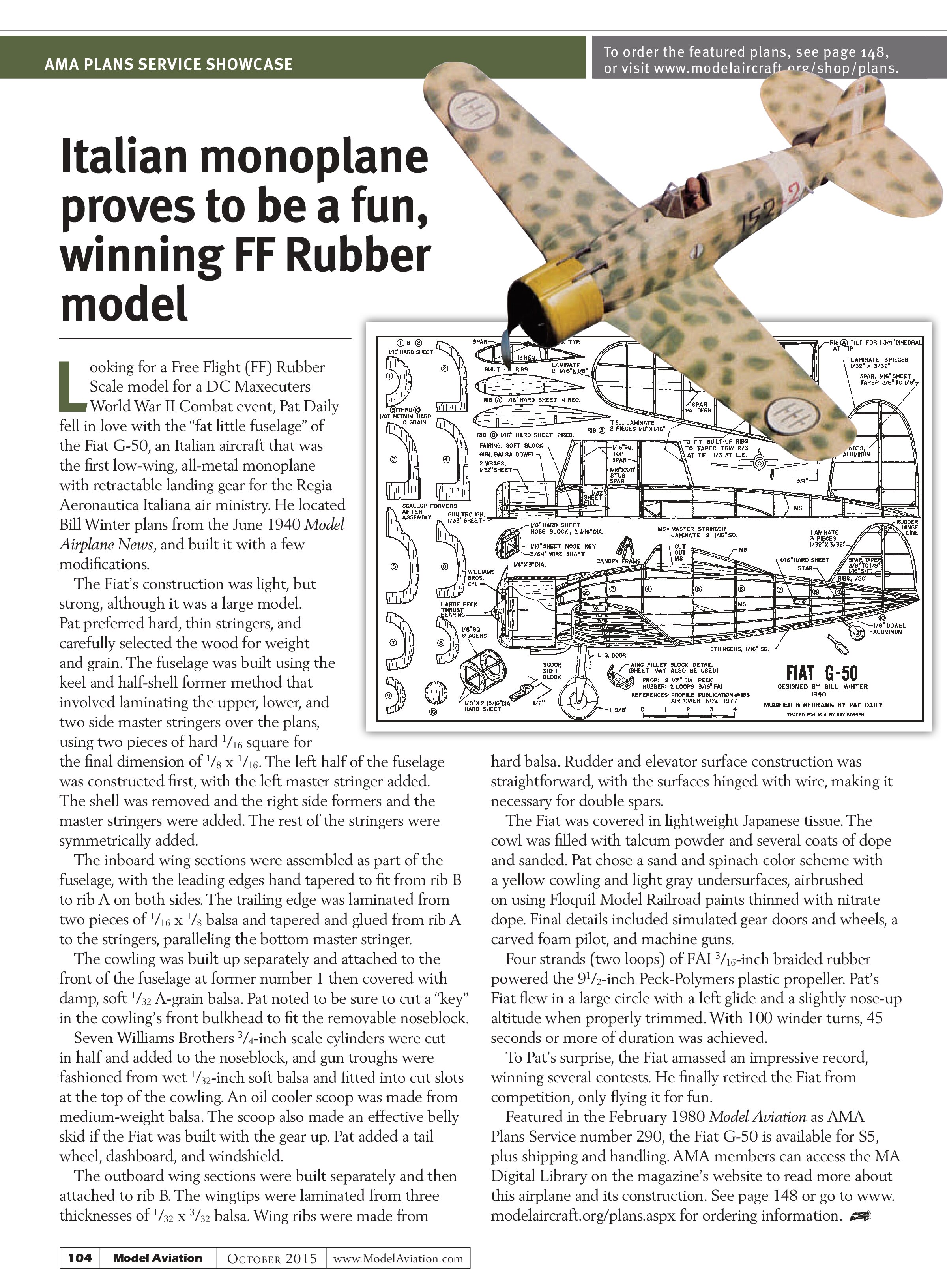
The Fiat was covered in lightweight Japanese tissue. The cowl was filled with talcum powder and several coats of dope and sanded. Pat chose a sand and spinach color scheme with a yellow cowling and light gray undersurfaces, airbrushed on using Floquil Model Railroad paints thinned with nitrate dope. Final details included simulated gear doors and wheels, a carved foam pilot, and machine guns.
Four strands (two loops) of FAI 3/16-inch braided rubber powered the 9 1/2-inch Peck-Polymers plastic propeller. Pat’s Fiat flew in a large circle with a left glide and a slightly nose-up altitude when properly trimmed. With 100 winder turns, 45 seconds or more of duration was achieved.
To Pat’s surprise, the Fiat amassed an impressive record, winning several contests. He finally retired the Fiat from competition, only flying it for fun.
Featured in the February 1980 Model Aviation as AMA Plans Service number 290, the Fiat G-50 is available for $5, plus shipping and handling. AMA members can access the MA Digital Library on the magazine’s website to read more about this airplane and its construction. See page 148 or go to www.modelaircraft.org/plans.aspx for ordering information.