Starting small
Bob Angel
A quick note to non-Old-Timer (OT) pilots: Unless you live in a mild climate or you are hardy, you don’t fly year-round. After assembling that ARF for the coming season, you’ll probably have plenty of time to construct a model or two out of balsa wood. As you may have noticed through articles in Model Aviation and elsewhere, there’s a resurgence of model building.
Many aeromodelers consider building to be a hobby in its own right—whether they plan to actually fly their creations or not. An easy path to building is to start small, so I’ll open the discussion with small models and competition classes. I’ll try to complement, rather than infringe on, fellow contributors Paul Bradley’s “Small-Field Flying” column and Joe Malinchak’s “Micro-Flying” column, both of which appear bimonthly in this magazine.
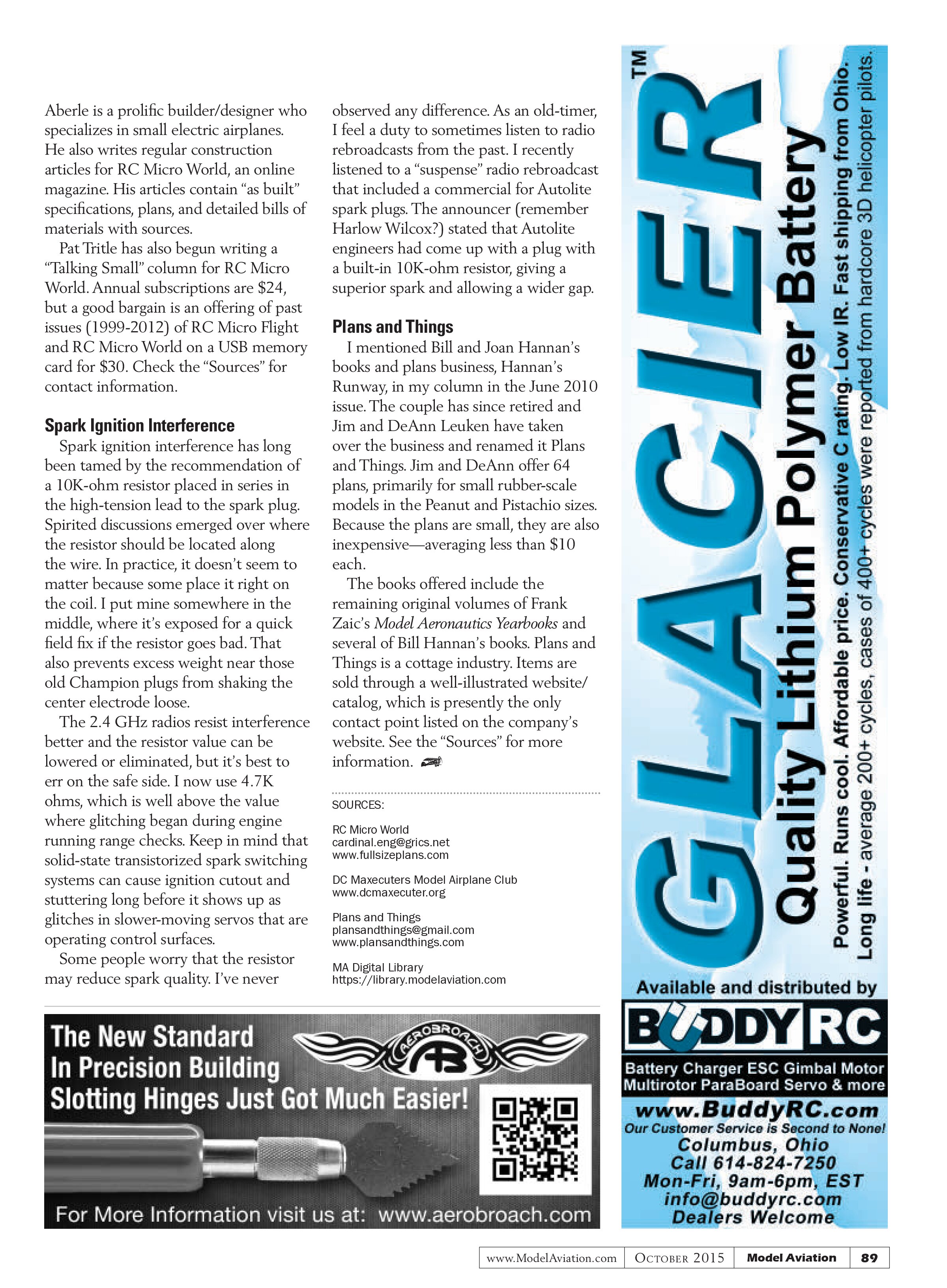
The DC Maxecuters Model Airplane Club comes to mind when I think of neat, small models. These modelers are craftsmen, with many specializing in detailed, rubber-powered Scale models. For those who like seldom-modeled

designs, most of their creations fit into that category. Many of their projects look as though they’d be impossible to trim for flight as a Free Flight (FF) model, but fly they do!
Maxecuters members also fly small RC aircraft with electric motors or glow-fuel-powered engines. The group has a nice website with hundreds of good, close-up photos—both static and in flight. Small models lend themselves to flight testing of experimental designs, so you’ll also see some of those. Check the “Sources” listing for website information.
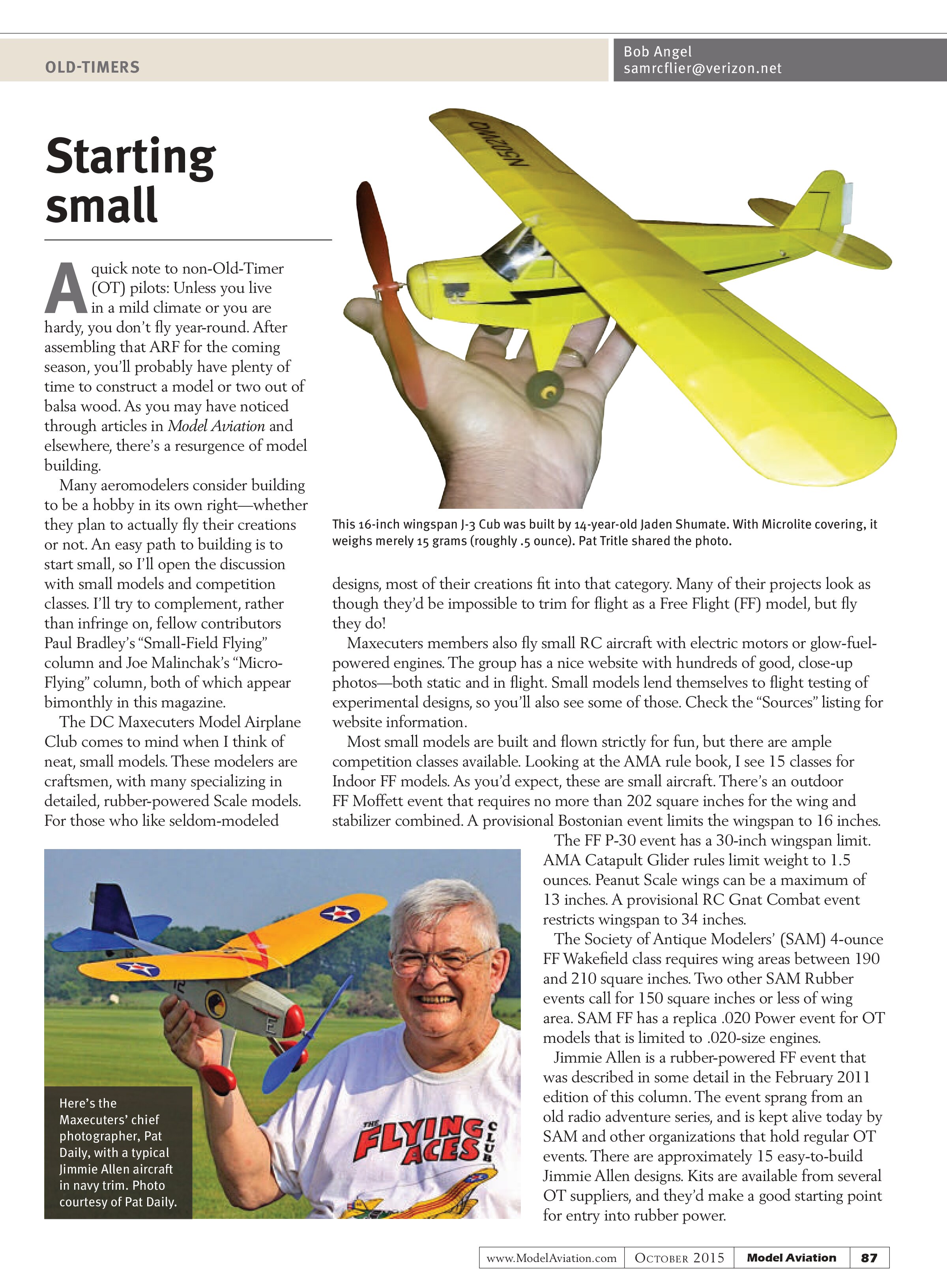
Most small models are built and flown strictly for fun, but there are ample competition classes available. Looking at the AMA rule book, I see 15 classes for Indoor FF models. As you’d expect, these are small aircraft. There’s an outdoor FF Moffett event that requires no more than 202 square inches for the wing and stabilizer combined. A provisional Bostonian event limits the wingspan to 16 inches.
The FF P-30 event has a 30-inch wingspan limit. AMA Catapult Glider rules limit weight to 1.5 ounces. Peanut Scale wings can be a maximum of 13 inches. A provisional RC Gnat Combat event restricts wingspan to 34 inches.
The Society of Antique Modelers’ (SAM) 4-ounce FF Wakefield class requires wing areas between 190 and 210 square inches. Two other SAM Rubber events call for 150 square inches or less of wing area. SAM FF has a replica .020 Power event for OT models that is limited to .020-size engines.
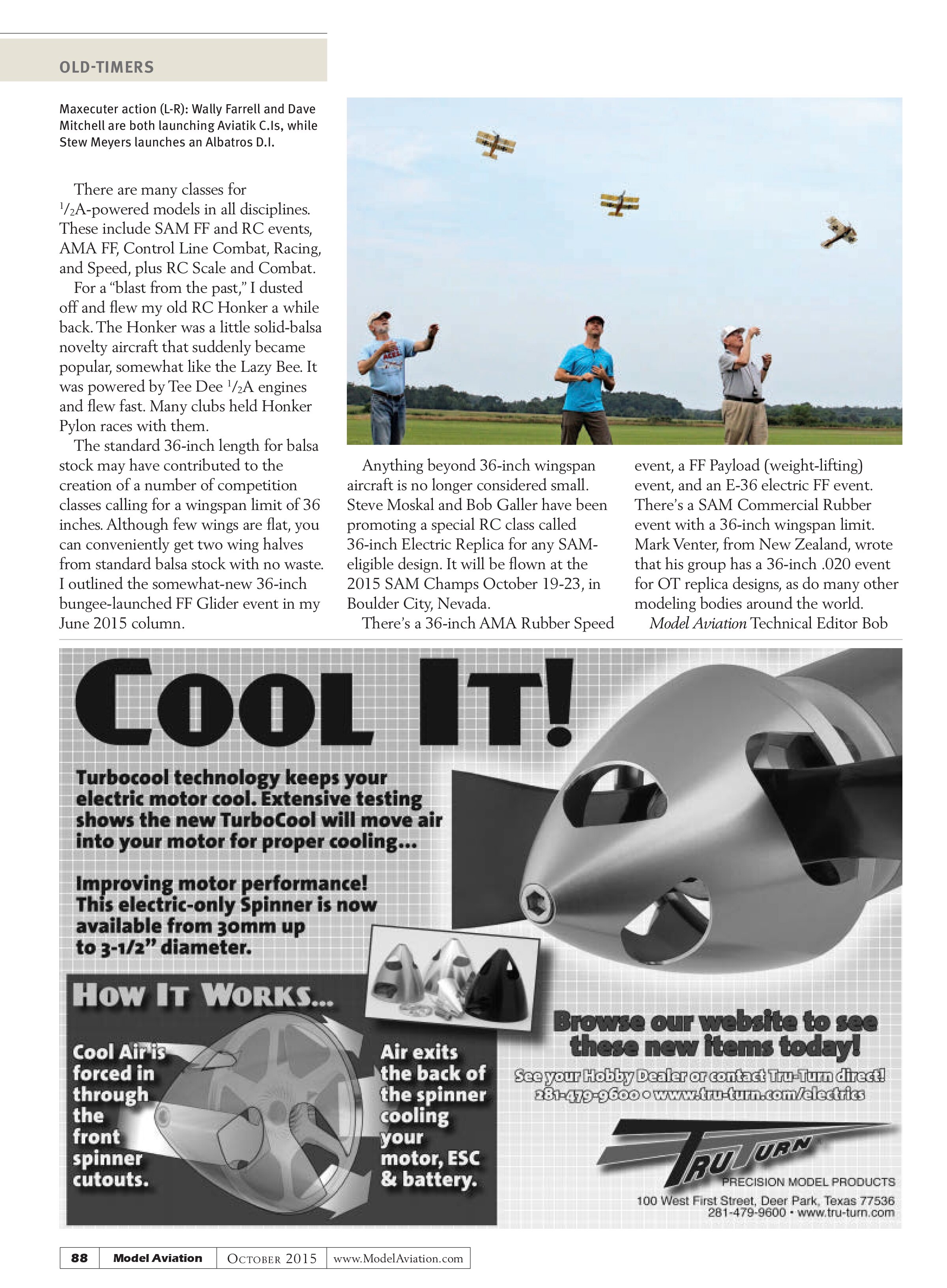
Jimmie Allen is a rubber-powered FF event that was described in some detail in the February 2011 edition of this column. The event sprang from an old radio adventure series, and is kept alive today by SAM and other organizations that hold regular OT events. There are approximately 15 easy-to-build Jimmie Allen designs. Kits are available from several OT suppliers, and they’d make a good starting point for entry into rubber power.

There are many classes for ½A-powered models in all disciplines. These include SAM FF and RC events, AMA FF, Control Line Combat, Racing, and Speed, plus RC Scale and Combat.
For a “blast from the past,” I dusted off and flew my old RC Honker a while back. The Honker was a little solid-balsa novelty aircraft that suddenly became popular, somewhat like the Lazy Bee. It was powered by Tee Dee ½A engines and flew fast. Many clubs held Honker Pylon races with them.
The standard 36-inch length for balsa stock may have contributed to the creation of a number of competition classes calling for a wingspan limit of 36 inches. Although few wings are flat, you can conveniently get two wing halves from standard balsa stock with no waste. I outlined the somewhat-new 36-inch bungee-launched FF Glider event in my June 2015 column.

Anything beyond 36-inch wingspan aircraft is no longer considered small. Steve Moskal and Bob Galler have been promoting a special RC class called 36-inch Electric Replica for any SAM-eligible design. It will be flown at the 2015 SAM Champs October 19-23, in Boulder City, Nevada.
There’s a 36-inch AMA Rubber Speed event, a FF Payload (weight-lifting) event, and an E-36 electric FF event. There’s a SAM Commercial Rubber event with a 36-inch wingspan limit. Mark Venter, from New Zealand, wrote that his group has a 36-inch .020 event for OT replica designs, as do many other modeling bodies around the world. Model Aviation Technical Editor Bob Aberle is a prolific builder/designer who specializes in small electric airplanes. He also writes regular construction articles for RC Micro World, an online magazine. His articles contain “as built” specifications, plans, and detailed bills of materials with sources.
Pat Trittle has also begun writing a “Talking Small” column for RC Micro World. Annual subscriptions are $24, but a good bargain is an offering of past issues (1999-2012) of RC Micro Flight and RC Micro World on a USB memory card for $30. Check the “Sources” for contact information.
Spark Ignition Interference
Spark ignition interference has long been tamed by the recommendation of a 10K-ohm resistor placed in series in the high-tension lead to the spark plug. Spirited discussions emerged over where the resistor should be located along the wire. In practice, it doesn’t seem to matter because some place it right on the coil. I put mine somewhere in the middle, where it’s exposed for a quick field fix if the resistor goes bad. That also prevents excess weight near those old Champion plugs from shaking the center electrode loose.
The 2.4 GHz radios resist interference better and the resistor value can be lowered or eliminated, but it’s best to err on the safe side. I now use 4.7K ohms, which is well above the value where glitching began during engine running range checks. Keep in mind that solid-state transistorized spark switching systems can cause ignition cutout and stuttering long before it shows up as glitches in slower-moving servos that are operating control surfaces.
Some people worry that the resistor may reduce spark quality. I’ve never observed any difference. As an old-timer, I feel a duty to sometimes listen to radio rebroadcasts from the past. I recently listened to a “suspense” radio rebroadcast that included a commercial for Autolite spark plugs. The announcer (remember Harlow Wilcox?) stated that Autolite engineers had come up with a plug with a built-in 10K-ohm resistor, giving a superior spark and allowing a wider gap.
Plans and Things
I mentioned Bill and Joan Hannan’s books and plans business, Hannan’s Runway, in my column in the June 2010 issue. The couple has since retired and Jim and DeAnn Leuken have taken over the business and renamed it Plans and Things. Jim and DeAnn offer 64 plans, primarily for small rubber-scale models in the Peanut and Pistachio sizes. Because the plans are small, they are also inexpensive—averaging less than $10 each.
The books offered include the remaining original volumes of Frank Zaic’s Model Aeronautics Yearbooks and several of Bill Hannan’s books. Plans and Things is a cottage industry. Items are sold through a well-illustrated website/catalog, which is presently the only contact point listed on the company’s website. See the “Sources” for more information.
SOURCES:
RC Micro World
cardinal.eng@grics.net
www.fullsizeplans.com
DC Maxecuters Model Airplane Club
www.dcmaxecuter.org
Plans and Things
plansandthings@gmail.com
www.plansandthings.com
MA Digital Library
https://library.modelaviation.com