Electric motor arming system
Q618: I realize that by merely applying power to an electric motor, it can start. You don’t have to fuel or prime the motor, it simply runs.
Throughout the years, concern for an accidental startup has led to the use of arming switches. The switch has to be turned on first before the motor will start. Having the proper current rating for a switch can be a problem. Too much current and the switch can fail. I hear there are ways of installing a shorting plug into the motor circuit. Can you explain that to me and indicate where I might purchase the necessary hardware?
A618: I’ve seen several shorting-plug-type arming systems throughout the years. They all follow the concept of breaking into the main power line and inserting a shorting plug that allows the current to flow for normal operation. Then, when not flying, you pull the shorting plug and the circuit opens. In that situation, the electric motor can’t run.
I saw an advertisement for a company named Schumacher Products LLC, in Belmont, New Hampshire. The
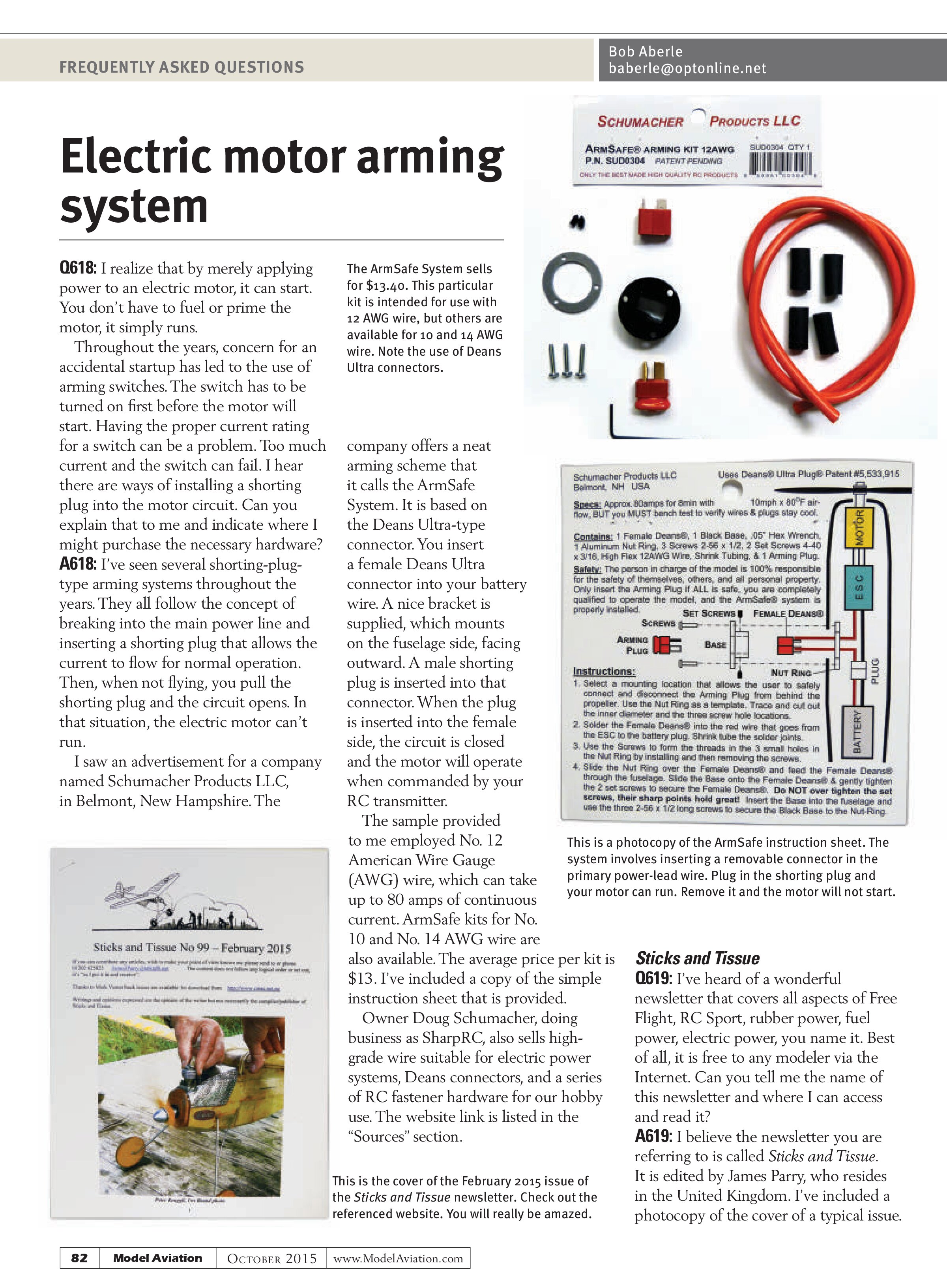
The ArmSafe System sells for $13.40. This particular kit is intended for use with 12 AWG wire, but others are available for 10 and 14 AWG wire. Note the use of Deans Ultra connectors.

company offers a neat arming scheme that it calls the ArmSafe System. It is based on the Deans Ultra-type connector. You insert a female Deans Ultra connector into your battery wire. A nice bracket is supplied, which mounts on the fuselage side, facing outward. A male shorting plug is inserted into that connector. When the plug is inserted into the female side, the circuit is closed and the motor will operate when commanded by your RC transmitter.
The sample provided to me employed No. 12 American Wire Gauge (AWG) wire, which can take up to 80 amps of continuous current. ArmSafe kits for No. 10 and No. 14 AWG wire are also available. The average price per kit is $13. I’ve included a copy of the simple instruction sheet that is provided.
Owner Doug Schumacher, doing business as SharpRC, also sells high-grade wire suitable for electric power systems, Deans connectors, and a series of RC fastener hardware for our hobby use. The website link is listed in the “Sources” section.

This is a photocopy of the ArmSafe instruction sheet. The system involves inserting a removable connector in the primary power-lead wire. Plug in the shorting plug and your motor can run. Remove it and the motor will not start.
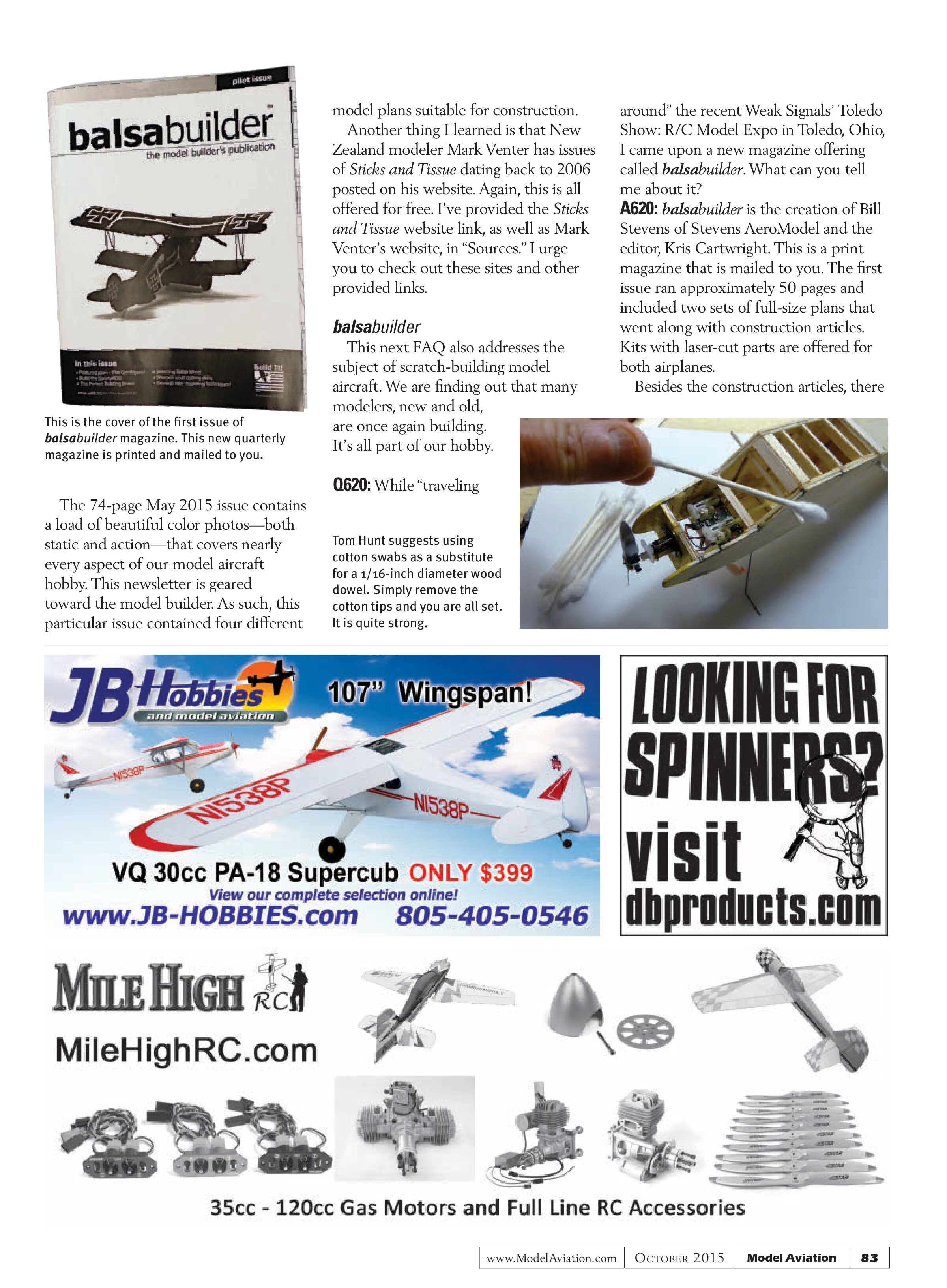
This is the cover of the February 2015 issue of the Sticks and Tissue newsletter. Check out the referenced website. You will really be amazed.

Sticks and Tissue
Q619: I’ve heard of a wonderful newsletter that covers all aspects of Free Flight, RC Sport, rubber power, fuel power, electric power, you name it. Best of all, it is free to any modeler via the Internet. Can you tell me the name of this newsletter and where I can access and read it?
A619: I believe the newsletter you are referring to is called Sticks and Tissue. It is edited by James Parry, who resides in the United Kingdom. I’ve included a photocopy of the cover of a typical issue.
The 74-page May 2015 issue contains a load of beautiful color photos—both static and action—that covers nearly every aspect of our model aircraft hobby. This newsletter is geared toward the model builder. As such, this particular issue contained four different model plans suitable for construction.
Another thing I learned is that New Zealand modeler Mark Venter has issues of Sticks and Tissue dating back to 2006 posted on his website. Again, this is all offered for free. I’ve provided the Sticks and Tissue website link, as well as Mark Venter’s website, in “Sources.” I urge you to check out these sites and other provided links.
balsabuilder
This next FAQ also addresses the subject of scratch-building model aircraft. We are finding out that many modelers, new and old, are once again building. It’s all part of our hobby.
Q620: While “traveling around” the recent Weak Signals’ Toledo Show: R/C Model Expo in Toledo, Ohio, I came upon a new magazine offering called balsabuilder. What can you tell me about it?
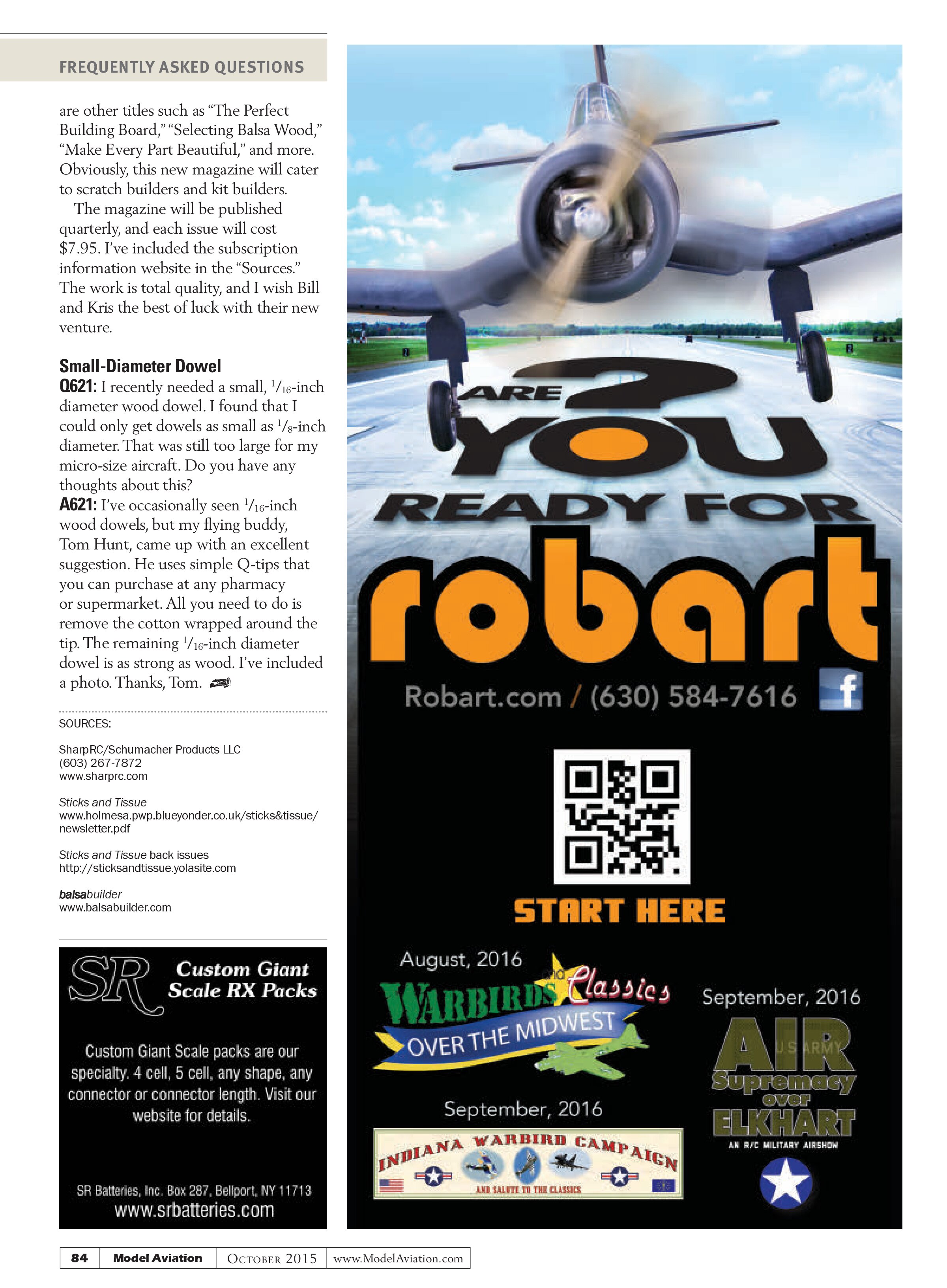
A620: balsabuilder is the creation of Bill Stevens of Stevens AeroModel and the editor, Kris Cartwright. This is a print magazine that is mailed to you. The first issue ran approximately 50 pages and included two sets of full-size plans that went along with construction articles. Kits with laser-cut parts are offered for both airplanes.
Besides the construction articles, there

This is the cover of the first issue of balsabuilder magazine. This new quarterly magazine is printed and mailed to you.
Q620: Tom Hunt suggests using cotton swabs as a substitute for a 1/16-inch diameter wood dowel. Simply remove the cotton tips and you are all set. It is quite strong.

are other titles such as “The Perfect Building Board,” “Selecting Balsa Wood,” “Make Every Part Beautiful,” and more. Obviously, this new magazine will cater to scratch builders and kit builders. The magazine will be published quarterly, and each issue will cost $7.95. I’ve included the subscription information website in the “Sources.” The work is total quality, and I wish Bill and Kris the best of luck with their new venture.
Small-Diameter Dowel
Q621: I recently needed a small, ¹/₁₆-inch diameter wood dowel. I found that I could only get dowels as small as ¹/₈-inch diameter. That was still too large for my micro-size aircraft. Do you have any thoughts about this?
A621: I’ve occasionally seen ¹/₁₆-inch wood dowels, but my flying buddy, Tom Hunt, came up with an excellent suggestion. He uses simple Q-tips that you can purchase at any pharmacy or supermarket. All you need to do is remove the cotton wrapped around the tip. The remaining ¹/₁₆-inch diameter dowel is as strong as wood. I’ve included a photo. Thanks, Tom.

SOURCES:
SharpRC/Schumacher Products LLC
(603) 267-7872
www.sharprc.com
Sticks and Tissue
www.holmesa.pwp.blueyonder.co.uk/sticks&tissue/newsletter.pdf
Sticks and Tissue back issues
http://sticksandtissue.yolasite.com
balsabuilder
www.balsabuilder.com