Battery management
Greg Gimlick
maelectrics@gimlick.com

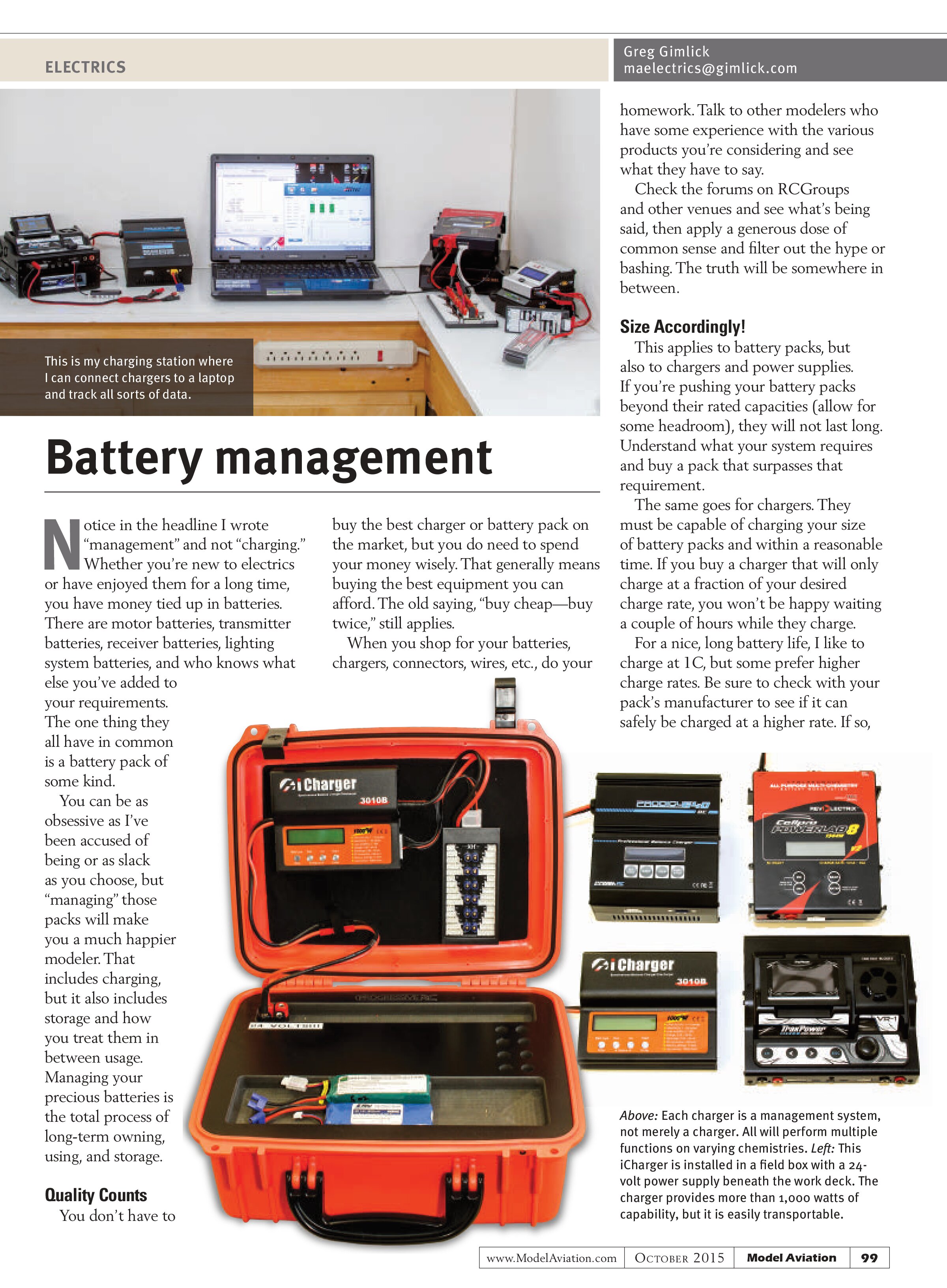
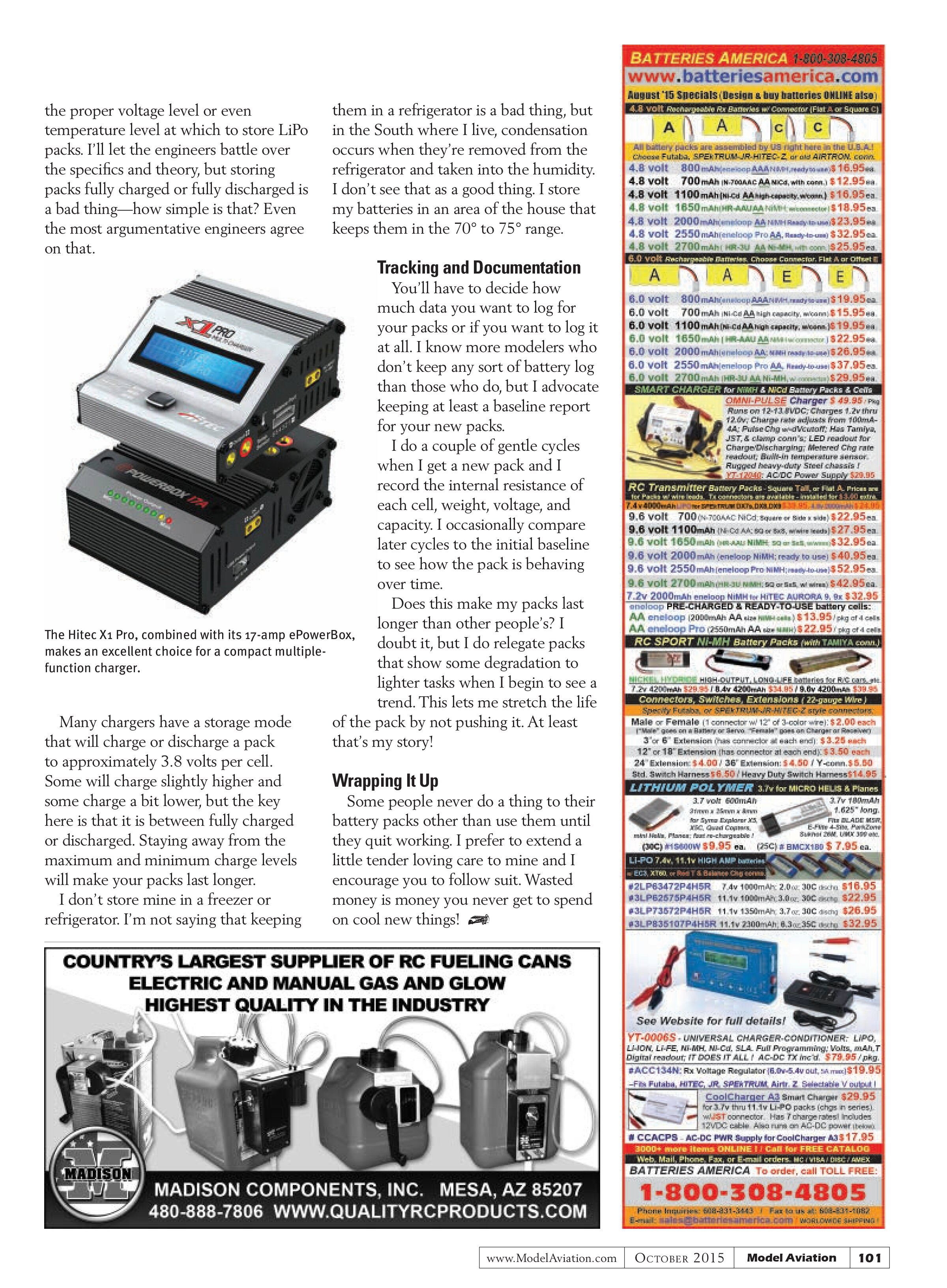
Notice in the headline I wrote “management” and not “charging.” Whether you’re new to electrics or have enjoyed them for a long time, you have money tied up in batteries. There are motor batteries, transmitter batteries, receiver batteries, lighting system batteries, and who knows what else you’ve added to your requirements. The one thing they all have in common is a battery pack of some kind.
You can be as obsessive as I’ve been accused of being or as slack as you choose, but “managing” those packs will make you a much happier modeler. That includes charging, but it also includes storage and how you treat them in between usage. Managing your precious batteries is the total process of long-term owning, using, and storage.
Quality Counts
You don’t have to buy the best charger or battery pack on the market, but you do need to spend your money wisely. That generally means buying the best equipment you can afford. The old saying, “buy cheap—buy twice,” still applies.
When you shop for your batteries, chargers, connectors, wires, etc., do your homework. Talk to other modelers who have some experience with the various products you’re considering and see what they have to say. Check the forums on RCGroups and other venues and see what’s being said, then apply a generous dose of common sense and filter out the hype or bashing. The truth will be somewhere in between.
Size Accordingly!
This applies to battery packs, but also to chargers and power supplies. If you’re pushing your battery packs beyond their rated capacities (allow for some headroom), they will not last long. Understand what your system requires and buy a pack that surpasses that requirement.
The same goes for chargers. They must be capable of charging your size of battery packs and within a reasonable time. If you buy a charger that will only charge at a fraction of your desired charge rate, you won’t be happy waiting a couple of hours while they charge.
For a nice, long battery life, I like to charge at 1C, but some prefer higher charge rates. Be sure to check with your pack’s manufacturer to see if it can safely be charged at a higher rate. If so,

the proper voltage level or even temperature level at which to store LiPo packs. I’ll let the engineers battle over the specifics and theory, but storing packs fully charged or fully discharged is a bad thing—how simple is that? Even the most argumentative engineers agree on that.

Many chargers have a storage mode that will charge or discharge a pack to approximately 3.8 volts per cell. Some will charge slightly higher and some charge a bit lower, but the key here is that it is between fully charged or discharged. Staying away from the maximum and minimum charge levels will make your packs last longer.
I don’t store mine in a freezer or refrigerator. I’m not saying that keeping them in a refrigerator is a bad thing, but in the South where I live, condensation occurs when they’re removed from the refrigerator and taken into the humidity. I don’t see that as a good thing. I store my batteries in an area of the house that keeps them in the 70° to 75° range.
Tracking and Documentation
You’ll have to decide how much data you want to log for your packs or if you want to log it at all. I know more modelers who don’t keep any sort of battery log than those who do, but I advocate keeping at least a baseline report for your new packs.
I do a couple of gentle cycles when I get a new pack and I record the internal resistance of each cell, weight, voltage, and capacity. I occasionally compare later cycles to the initial baseline to see how the pack is behaving over time.
Does this make my packs last longer than other people’s? I doubt it, but I do relegate packs that show some degradation to lighter tasks when I begin to see a trend. This lets me stretch the life of the pack by not pushing it. At least that’s my story!
Wrapping It Up
Some people never do a thing to their battery packs other than use them until they quit working. I prefer to extend a little tender loving care to mine and I encourage you to follow suit. Wasted money is money you never get to spend on cool new things!