Education Through Aviation
by Bill Pritchett, Education Director

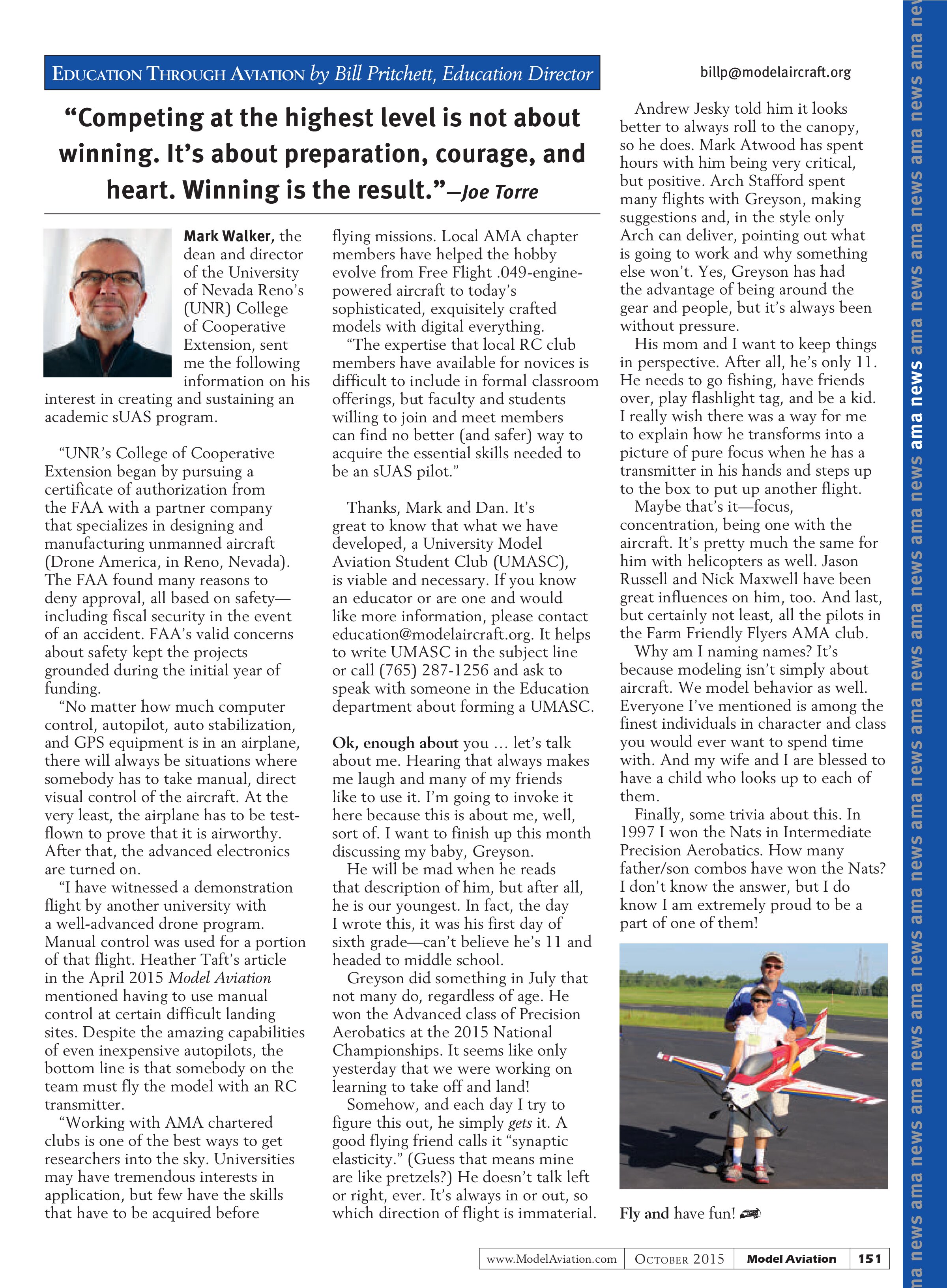
Mark Walker, the dean and director of the University of Nevada Reno’s (UNR) College of Cooperative Extension, sent me the following information on his interest in creating and sustaining an academic sUAS program.
“UNR’s College of Cooperative Extension began by pursuing a certificate of authorization from the FAA with a partner company that specializes in designing and manufacturing unmanned aircraft (Drone America, in Reno, Nevada). The FAA found many reasons to deny approval, all based on safety—including fiscal security in the event of an accident. FAA’s valid concerns about safety kept the projects grounded during the initial year of funding.
“No matter how much computer control, autopilot, auto stabilization, and GPS equipment is in an airplane, there will always be situations where somebody has to take manual, direct visual control of the aircraft. At the very least, the airplane has to be test-flown to prove that it is airworthy. After that, the advanced electronics are turned on.
“I have witnessed a demonstration flight by another university with a well-advanced drone program. Manual control was used for a portion of that flight. Heather Taft’s article in the April 2015 Model Aviation mentioned having to use manual control at certain difficult landing sites. Despite the amazing capabilities of even inexpensive autopilots, the bottom line is that somebody on the team must fly the model with an RC transmitter.
“Working with AMA chartered clubs is one of the best ways to get researchers into the sky. Universities may have tremendous interests in application, but few have the skills that have to be acquired before flying missions. Local AMA chapter members have helped the hobby evolve from Free Flight .049-engine-powered aircraft to today’s sophisticated, exquisitely crafted models with digital everything.
“The expertise that local RC club members have available for novices is difficult to include in formal classroom offerings, but faculty and students willing to join and meet members can find no better (and safer) way to acquire the essential skills needed to be an sUAS pilot.”
Thanks, Mark and Dan. It’s great to know that what we have developed, a University Model Aviation Student Club (UMASC), is viable and necessary. If you know an educator or are one and would like more information, please contact education@modelaircraft.org. It helps to write UMASC in the subject line or call (765) 287-1256 and ask to speak with someone in the Education department about forming a UMASC.
Ok, enough about you … let’s talk about me. Hearing that always makes me laugh and many of my friends like to use it. I’m going to invoke it here because this is about me, well, sort of. I want to finish up this month discussing my baby, Greyson.
He will be mad when he reads that description of him, but after all, he is our youngest. In fact, the day I wrote this, it was his first day of sixth grade—can’t believe he’s 11 and headed to middle school.
Greyson did something in July that not many do, regardless of age. He won the Advanced class of Precision Aerobatics at the 2015 National Championships. It seems like only yesterday that we were working on learning to take off and land!
Somehow, and each day I try to figure this out, he simply gets it. A good flying friend calls it “synaptic elasticity.” (Guess that means mine are like pretzels?) He doesn’t talk left or right, ever. It’s always in or out, so which direction of flight is immaterial.
Andrew Jesky told him it looks better to always roll to the canopy, so he does. Mark Atwood has spent hours with him being very critical, but positive. Arch Stafford spent many flights with Greyson, making suggestions and, in the style only Arch can deliver, pointing out what is going to work and why something else won’t. Yes, Greyson has had the advantage of being around the gear and people, but it’s always been without pressure.
His mom and I want to keep things in perspective. After all, he’s only 11. He needs to go fishing, have friends over, play flashlight tag, and be a kid. I really wish there was a way for me to explain how he transforms into a picture of pure focus when he has a transmitter in his hands and steps up to the box to put up another flight.
Maybe that’s it—focus, concentration, being one with the aircraft. It’s pretty much the same for him with helicopters as well. Jason Russell and Nick Maxwell have been great influences on him, too. And last, but certainly not least, all the pilots in the Farm Friendly Flyers AMA club.
Why am I naming names? It’s because modeling isn’t simply about aircraft. We model behavior as well. Everyone I’ve mentioned is among the finest individuals in character and class you would ever want to spend time with. And my wife and I are blessed to have a child who looks up to each of them.
Finally, some trivia about this. In 1997 I won the Nats in Intermediate Precision Aerobatics. How many father/son combos have won the Nats? I don’t know the answer, but I do know I am extremely proud to be a part of one of them!