Ooops!
by Dick Perry
tailhooker@comcast.net
In my discussion of the Southwest Regional Control Line (CL) Championships in the July issue, I credited the Blackburn Firebrand to Ted Snow. The model was in fact built by Marvin Martinez and was brought to the Southwest Regionals by Ted Kraver. I’ll have more on that later.
The Seafire that Burt Brokaw flew was actually built for CL Navy Carrier by Ted Snow in the late 1980s or early ’90s, rather than in 1967 as I previously reported. The 1967 model was a Spitfire originally built for CL Scale. The Seafire was a Spitfire variant with a tailhook and folding wings, but the outlines were the same.
Ted built fiberglass fuselages for many of his models, so after fabricating the original mold, building subsequent models became easier, thus the logical transition from the Scale Spitfire to the Carrier Seafire.
More Snow Family Designs
Randy Snow is building a Class I Nostalgia Boeing XF8B-1 based on his father’s design. The model will have a wood fuselage because Randy cannot locate the mold for the Boeing’s original fiberglass fuselage.
The XF8B-1 was a huge fighter—bigger than the AD Skyraider or the twin-engine Grumman F7F Tigercat. I’ve admired the XF8B-1 as a potential CL Carrier model for many years, and I look forward to seeing Randy’s aircraft when it’s finished.
Randy is a great fan of biplanes, and he has also framed up a Boeing F4B-2 for Nostalgia Class I. He started with

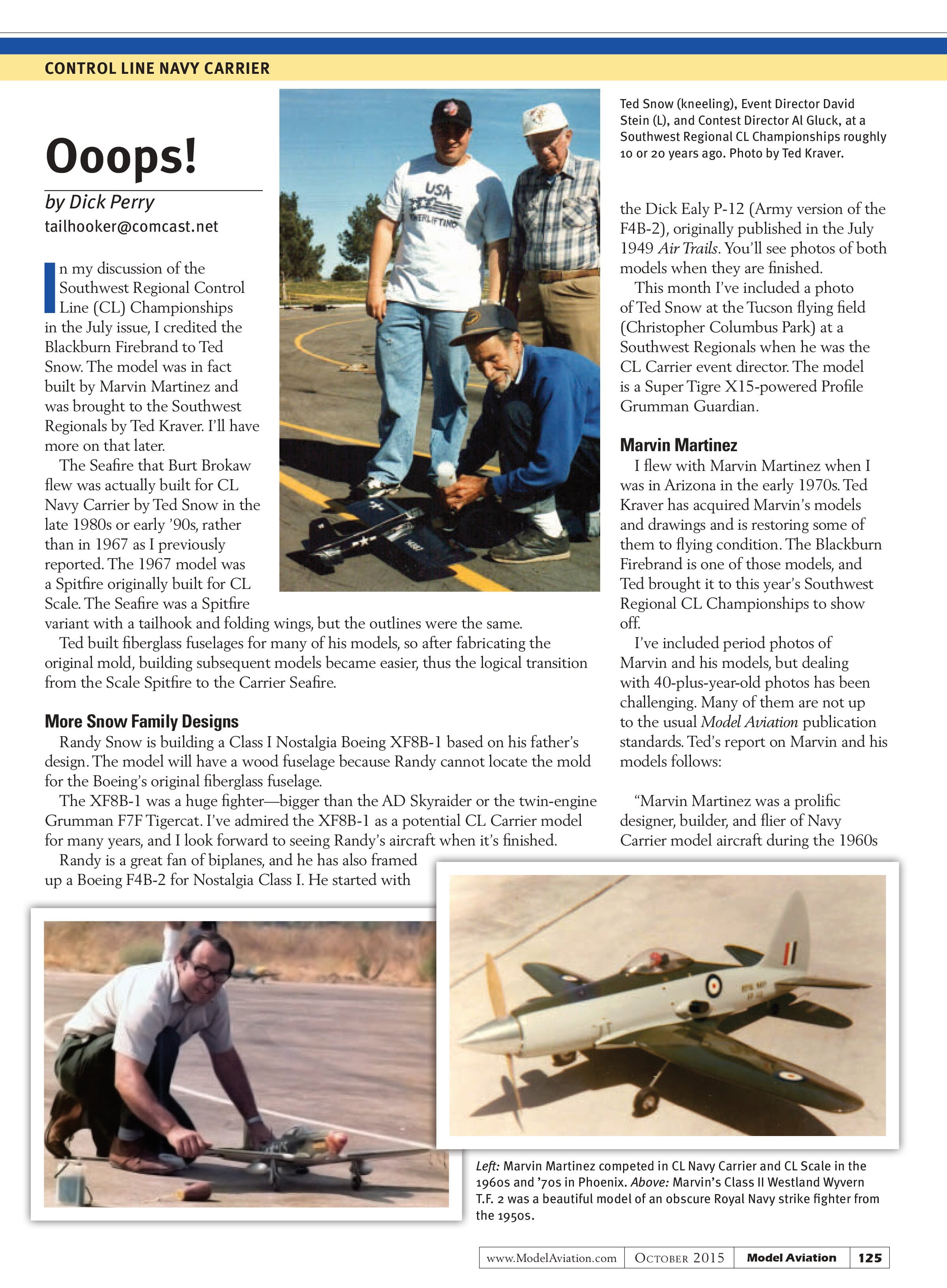
This month I’ve included a photo of Ted Snow at the Tucson flying field (Christopher Columbus Park) at a Southwest Regionals when he was the CL Carrier event director. The model is a Super Tigre X15-powered Profile Grumman Guardian.
Marvin Martinez
I flew with Marvin Martinez when I was in Arizona in the early 1970s. Ted Kraver has acquired Marvin’s models and drawings and is restoring some of them to flying condition. The Blackburn Firebrand is one of those models, and Ted brought it to this year’s Southwest Regional CL Championships to show off.
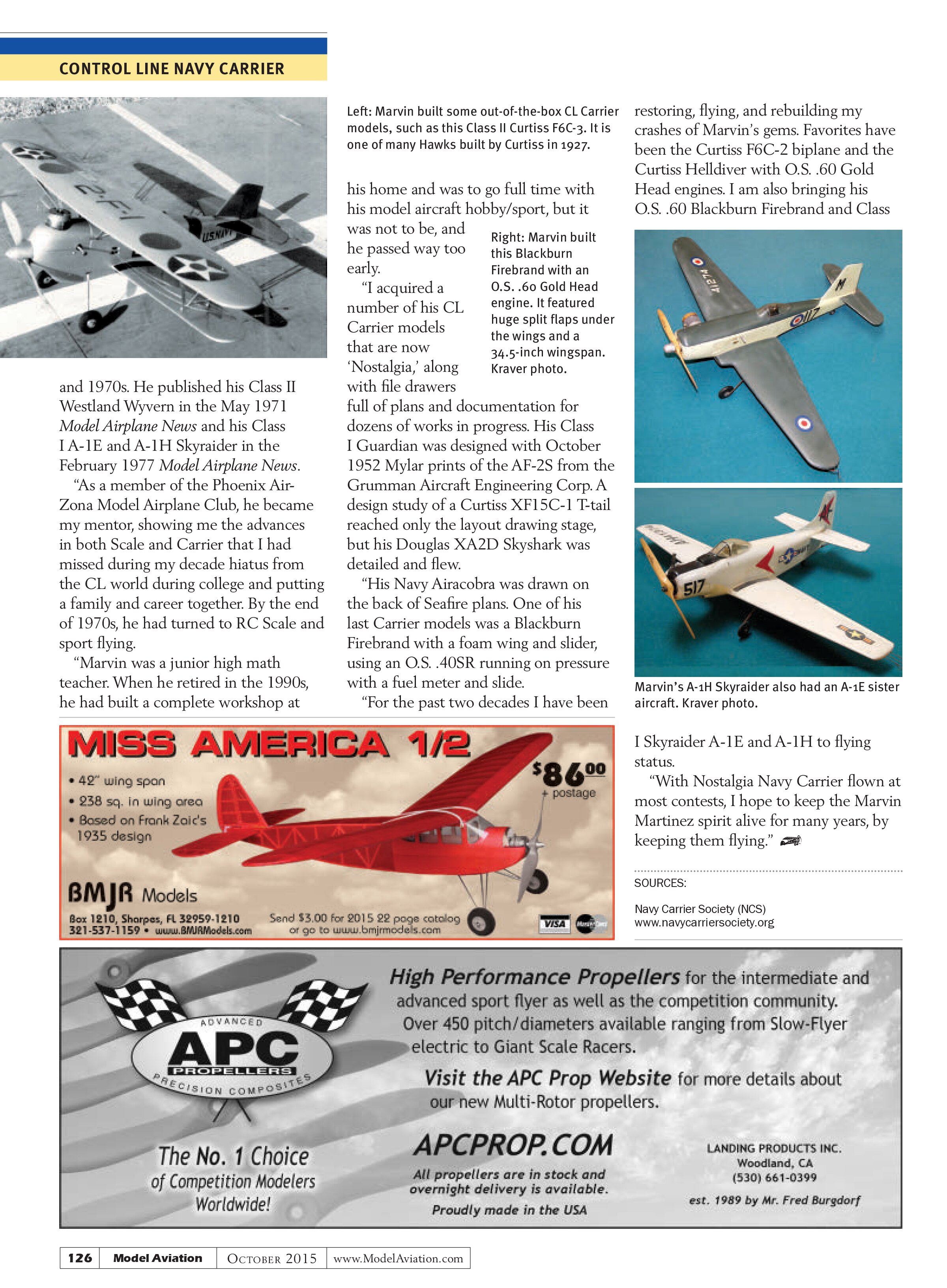
I’ve included period photos of Marvin and his models, but dealing with 40-plus-year-old photos has been challenging. Many of them are not up to the usual Model Aviation publication standards. Ted’s report on Marvin and his models follows:
“Marvin Martinez was a prolific designer, builder, and flier of Navy Carrier model aircraft during the 1960s


and 1970s. He published his Class II Westland Wyvern in the May 1971 Model Airplane News and his Class I A-1E and A-1H Skyraider in the February 1977 Model Airplane News.
“As a member of the Phoenix Air-Zona Model Airplane Club, he became my mentor, showing me the advances in both Scale and Carrier that I had missed during my decade hiatus from the CL world during college and putting a family and career together. By the end of 1970s, he had turned to RC Scale and sport flying.
“Marvin was a junior high math teacher. When he retired in the 1990s, he had built a complete workshop at his home and was to go full time with his model aircraft hobby/sport, but it was not to be, and he passed way too early.
“I acquired a number of his CL Carrier models that are now ‘Nostalgia,’ along with file drawers full of plans and documentation for dozens of works in progress. His Class I Guardian was designed with October 1952 Mylar prints of the AF-2S from the Grumman Aircraft Engineering Corp. A design study of a Curtiss XF15C-1 T-tail reached only the layout drawing stage, but his Douglas XA2D Skyshark was detailed and flew.
“His Navy Airacobra was drawn on the back of Seafire plans. One of his last Carrier models was a Blackburn Firebrand with a foam wing and slider, using an O.S. .40SR running on pressure with a fuel meter and slide.
“For the past two decades I have been restoring, flying, and rebuilding my crashes of Marvin’s gems. Favorites have been the Curtiss F6C-2 biplane and the Curtiss Helldiver with O.S. .60 Gold Head engines. I am also bringing his O.S. .60 Blackburn Firebrand and Class


“With Nostalgia Navy Carrier flown at most contests, I hope to keep the Marvin Martinez spirit alive for many years, by keeping them flying.”
SOURCES:
Navy Carrier Society (NCS)
www.navycarriersociety.org