Electric Free Flight “push-pull” model
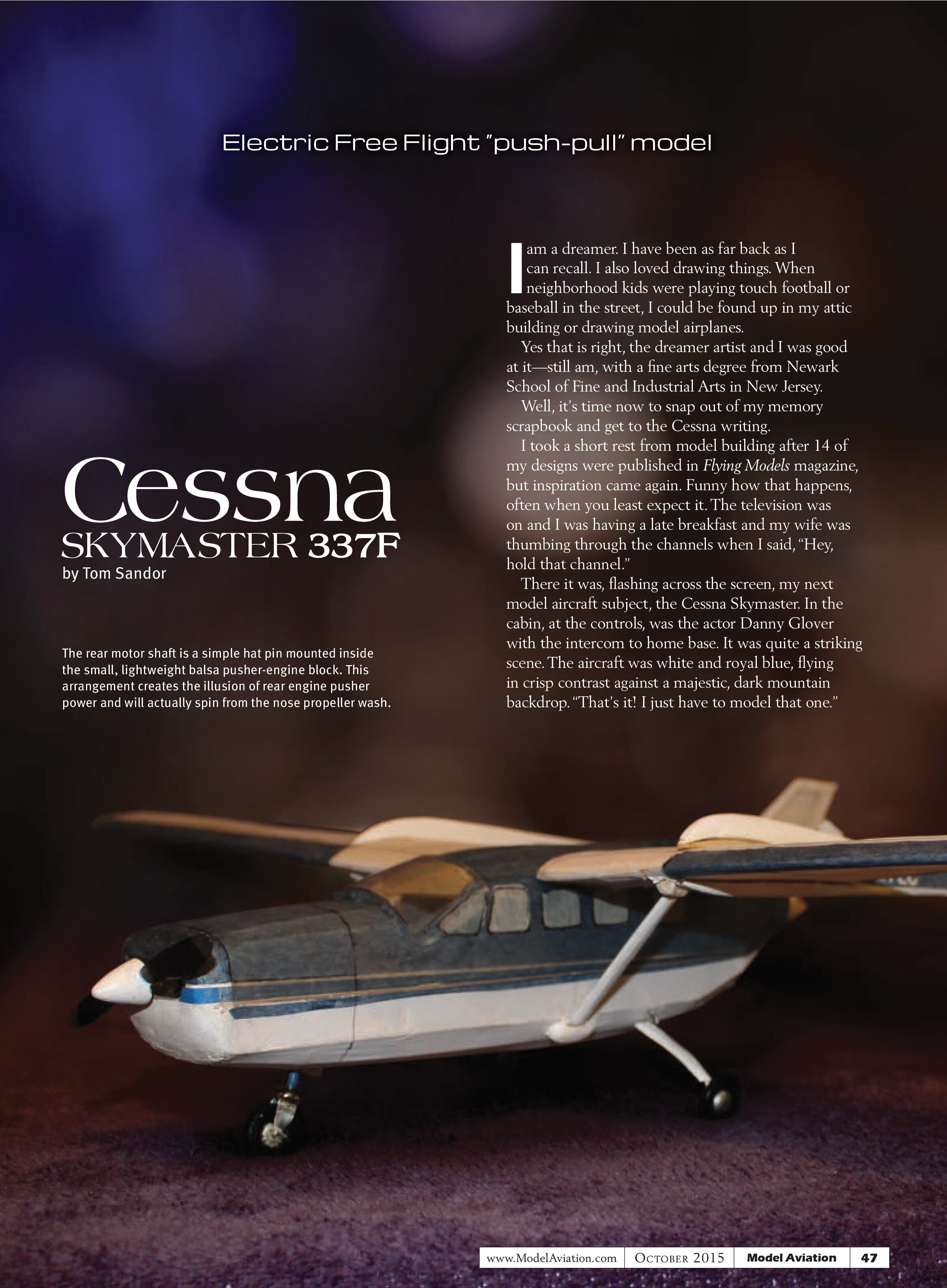
Cessna SKYMASTER 337F
by Tom Sandor

I am a dreamer. I have been as far back as I can recall. I also loved drawing things. When neighborhood kids were playing touch football or baseball in the street, I could be found up in my attic building or drawing model airplanes.
Yes that is right, the dreamer artist and I was good at it—still am, with a fine arts degree from Newark School of Fine and Industrial Arts in New Jersey.
Well, it’s time now to snap out of my memory scrapbook and get to the Cessna writing.
I took a short rest from model building after 14 of my designs were published in Flying Models magazine, but inspiration came again. Funny how that happens, often when you least expect it. The television was on and I was having a late breakfast and my wife was thumbing through the channels when I said, “Hey, hold that channel.”
There it was, flashing across the screen, my next model aircraft subject, the Cessna Skymaster. In the cabin, at the controls, was the actor Danny Glover with the intercom to home base. It was quite a striking scene. The aircraft was white and royal blue, flying in crisp contrast against a majestic, dark mountain backdrop. “That’s it! I just have to model that one.”

The Cessna Skymaster is a twin-engine civil utility aircraft built in a push-pull configuration with one engine mounted in the nose and the other behind its pod-style fuselage. This model is fashioned after the Cessna 337F Skymaster with two continental 10-360 GB-210 hp piston engines. The wingspan is 38.2 feet and length is 29.8 feet.
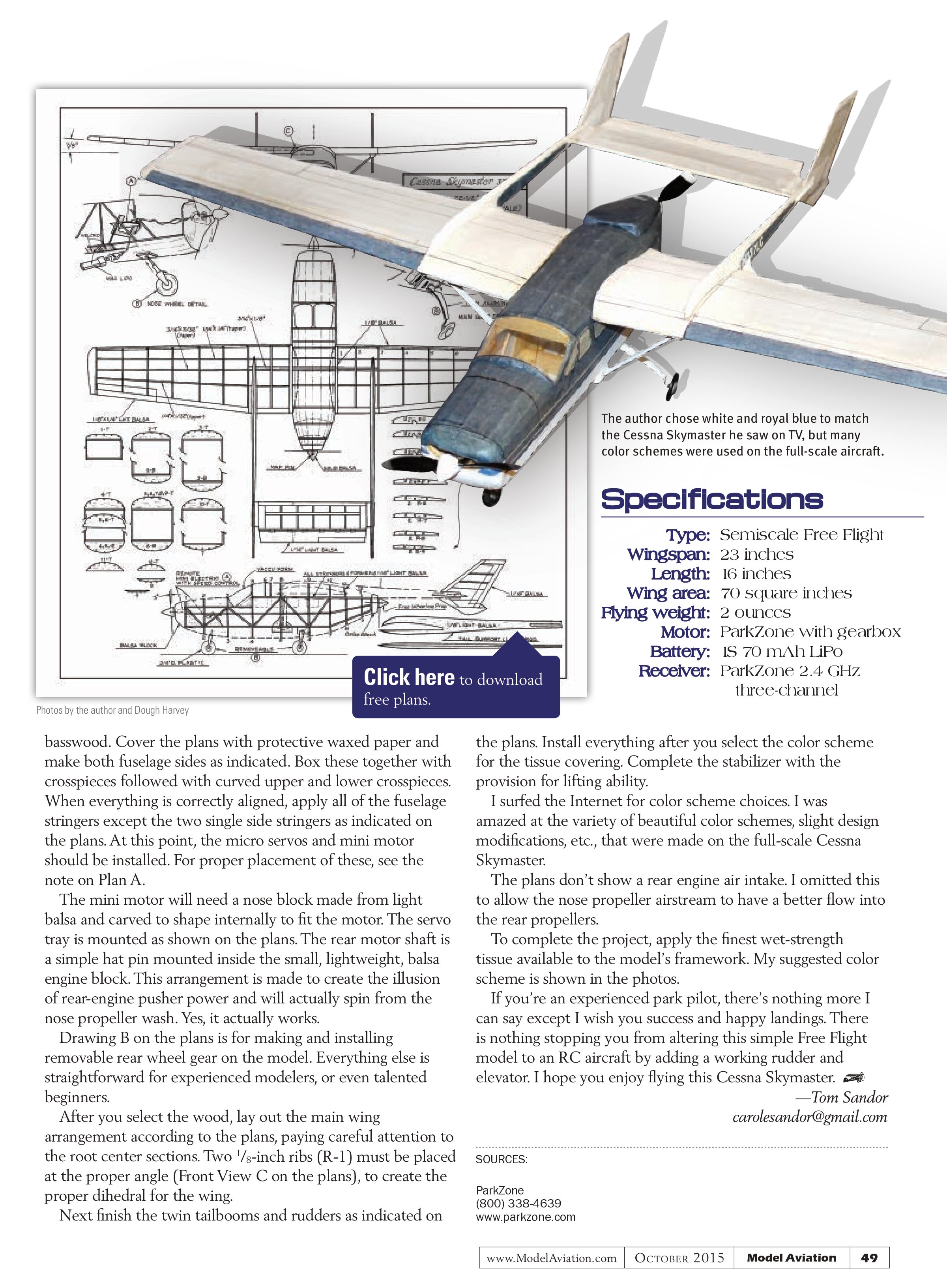
Free plans for the Cessna Skymaster can be downloaded at www.ModelAviation.com.
Construction
Start with the airframe using medium grain 1/16-inch balsa or 1/20-inch basswood.


The 1/32-inch balsa wing sheeting reinforces the area from the fuselage to the tailboom. Battery access is on the bottom of the fuselage.
Cover the plans with protective waxed paper and make both fuselage sides as indicated. Box these together with crosspieces followed with curved upper and lower crosspieces. When everything is correctly aligned, apply all of the fuselage stringers except the two single side stringers as indicated on the plans. At this point, the micro servos and mini motor should be installed. For proper placement of these, see the note on Plan A.
The mini motor will need a nose block made from light balsa and carved to shape internally to fit the motor. The servo tray is mounted as shown on the plans. The rear motor shaft is a simple hat pin mounted inside the small, lightweight, balsa engine block. This arrangement is made to create the illusion of rear-engine pusher power and will actually spin from the nose propeller wash. Yes, it actually works.
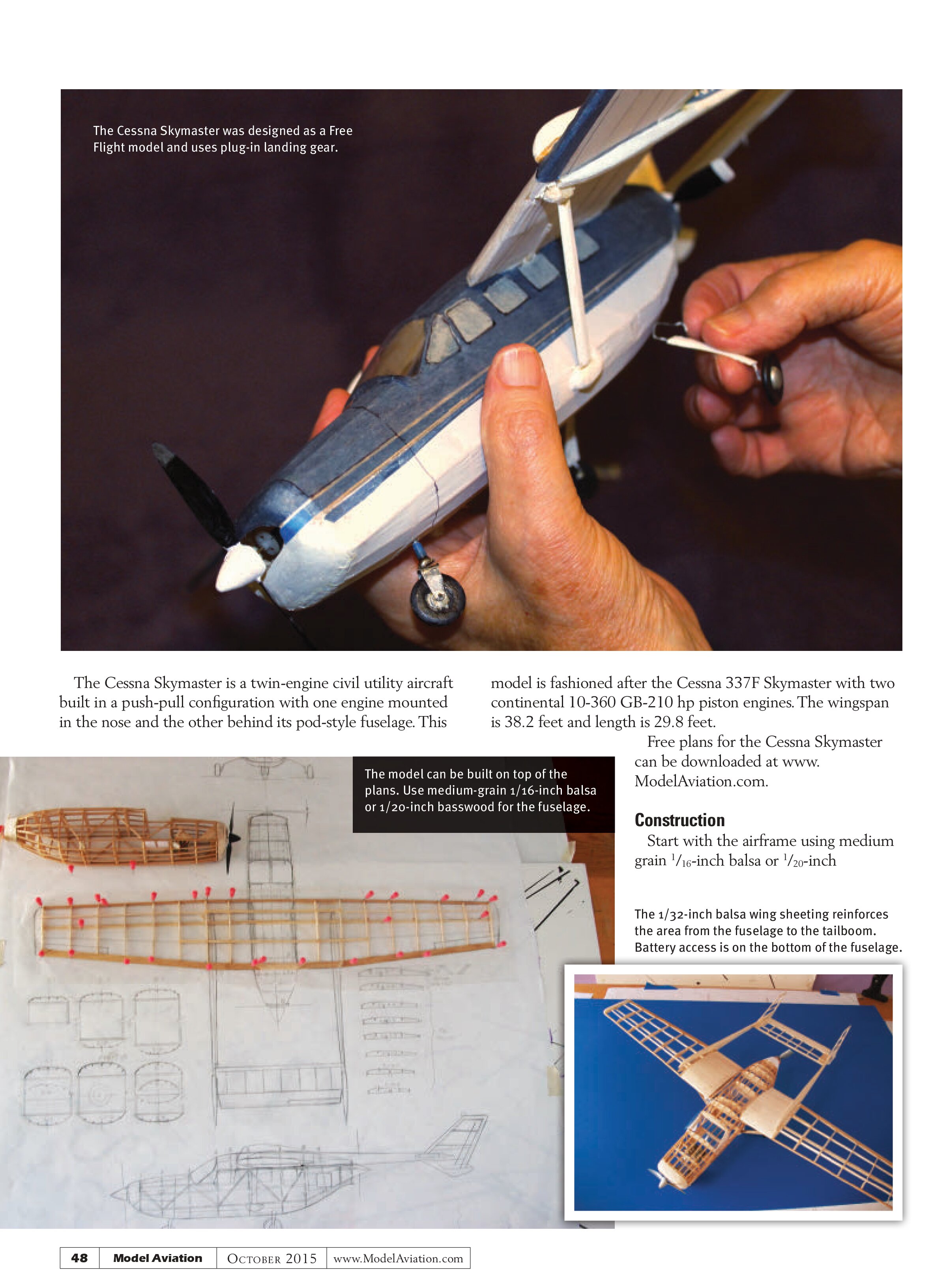
Drawing B on the plans is for making and installing removable rear wheel gear on the model. Everything else is straightforward for experienced modelers, or even talented beginners.
After you select the wood, lay out the main wing arrangement according to the plans, paying careful attention to the root center sections. Two 1/8-inch ribs (R-1) must be placed at the proper angle (Front View C on the plans), to create the proper dihedral for the wing.
Next finish the twin tailbooms and rudders as indicated on the plans. Install everything after you select the color scheme for the tissue covering. Complete the stabilizer with the provision for lifting ability.
I surfed the Internet for color scheme choices. I was amazed at the variety of beautiful color schemes, slight design modifications, etc., that were made on the full-scale Cessna Skymaster.
The plans don’t show a rear engine air intake. I omitted this to allow the nose propeller airstream to have a better flow into the rear propellers.
To complete the project, apply the finest wet-strength tissue available to the model’s framework. My suggested color scheme is shown in the photos.
If you’re an experienced park pilot, there’s nothing more I can say except I wish you success and happy landings. There is nothing stopping you from altering this simple Free Flight model to an RC aircraft by adding a working rudder and elevator. I hope you enjoy flying this Cessna Skymaster.
—Tom Sandor
carolesandor@gmail.com

Sources:
ParkZone
(800) 338-4639
www.parkzone.com