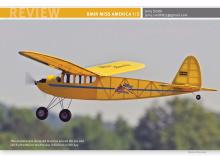
BMJR MISS AMERICA 1/2
All the enjoyment of the original at half the size
Jerry Smith
jerry.smith875@gmail.com

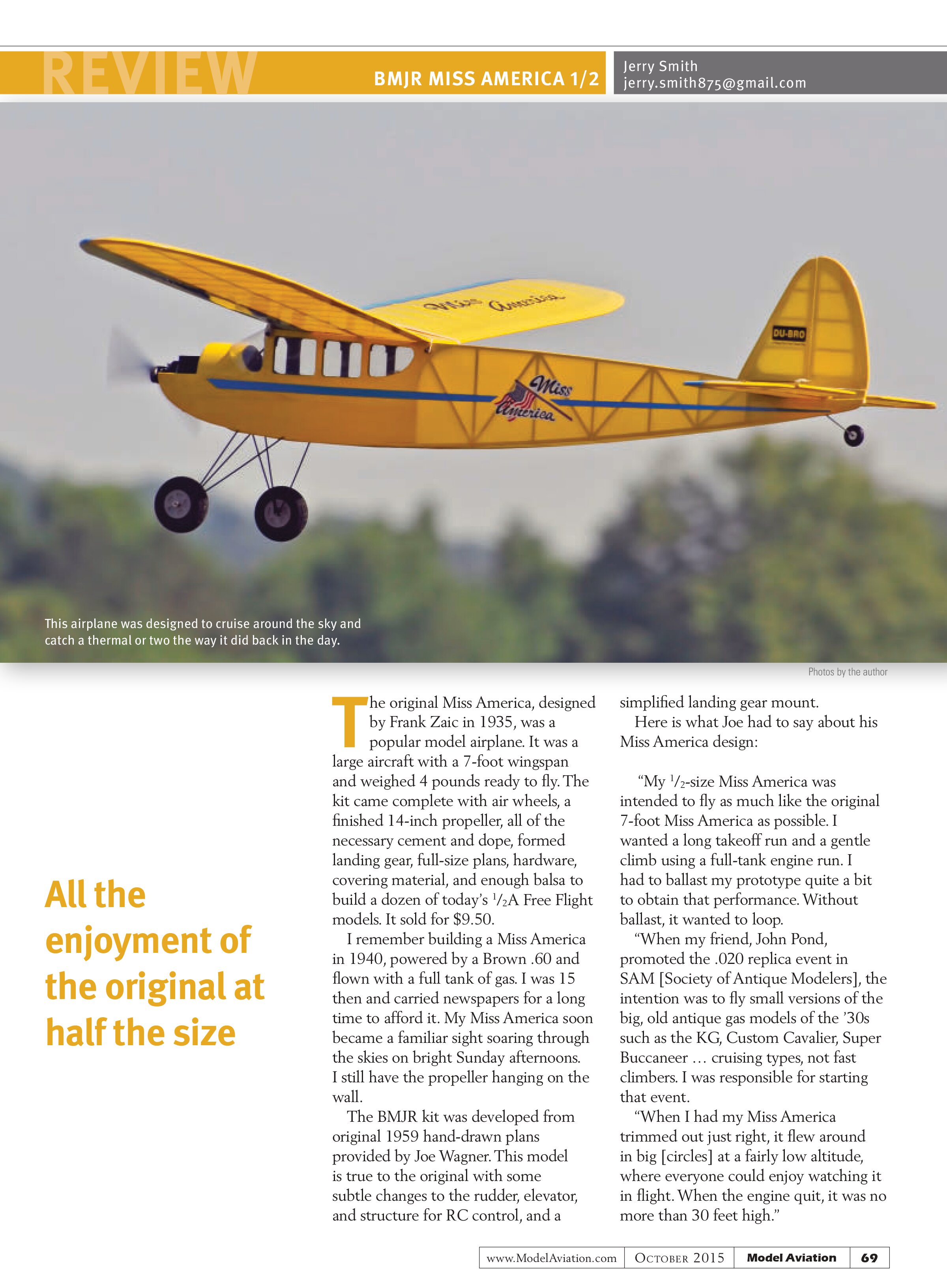
The original Miss America, designed by Frank Zaic in 1935, was a popular model airplane. It was a large aircraft with a 7-foot wingspan and weighed 4 pounds ready to fly. The kit came complete with air wheels, a finished 14-inch propeller, all of the necessary cement and dope, formed landing gear, full-size plans, hardware, covering material, and enough balsa to build a dozen of today’s ½A Free Flight models. It sold for $9.50.
I remember building a Miss America in 1940, powered by a Brown .60 and flown with a full tank of gas. I was 15 then and carried newspapers for a long time to afford it. My Miss America soon became a familiar sight soaring through the skies on bright Sunday afternoons. I still have the propeller hanging on the wall.
The BMJR kit was developed from original 1959 hand-drawn plans provided by Joe Wagner. This model is true to the original with some subtle changes to the rudder, elevator, and structure for RC control, and a simplified landing gear mount.
Here is what Joe had to say about his Miss America design:
“My ½-size Miss America was intended to fly as much like the original 7-foot Miss America as possible. I wanted a long takeoff run and a gentle climb using a full-tank engine run. I had to ballast my prototype quite a bit to obtain that performance. Without ballast, it wanted to loop.
“When my friend, John Pond, promoted the .020 replica event in SAM [Society of Antique Modelers], the intention was to fly small versions of the big, old antique gas models of the ’30s such as the KG, Custom Cavalier, Super Buccaneer … cruising types, not fast climbers. I was responsible for starting that event.
“When I had my Miss America trimmed out just right, it flew around in big [circles] at a fairly low altitude, where everyone could enjoy watching it in flight. When the engine quit, it was no more than 30 feet high.”
The Build
Building the BMJR Miss America is not for beginners. The manual points out only the major build points and does not cover every aspect. Therefore, some building skills are needed.
If you are not accustomed to building smaller airplanes such as this one, have a little patience when dealing with 1/32-inch sheeting and 1/16-inch square balsa. When you go from building larger airplanes to smaller ones, things change. Several times, I gripped it too hard and broke it, so be prepared.
The Miss America is built the traditional way with modern building methods. It’s nothing really complicated. The parts are smaller, but the build goes slightly faster with laser-cut parts and CA glue.
By the way, all laser-cut kits are not the same. Some have parts that interlock and others don’t. This kit uses the tab-and-slot method, but the parts do not interlock.
The wood I received with the kit was good and approximately the right hardness. The laser-cut parts fit well, but I found that one piece was missing. BMJR has corrected this.
The airframe builds up fast. The manual is short and sweet, with pictures and not much in the way of commentary. Remember what I stated about building experience? This is where you need it.
The landing gear is not formed. The plans show the landing gear configuration. A length of 1/16-inch music wire is provided to form the landing gear. I soldered the two front struts together near the axle using the old standard method of copper wire wrap (wire included) and Stay Brite solder.
The rear strut is slightly wide as shown on the plans, but make it the same width as the front strut. You are instructed to bend the rear strut around the axle then solder it. I found that this was hard to do and it was difficult to make it look good. Instead, I used a small washer, soldered it on the end of each of the struts, slipped it over the axle, and soldered it all to the front strut, which worked out great. Make sure you position the front and rear struts as they will be mounted on the airplane before soldering them.
The landing gear is lashed to a plywood plate with nylon thread. I did this and tack glued it in place, then

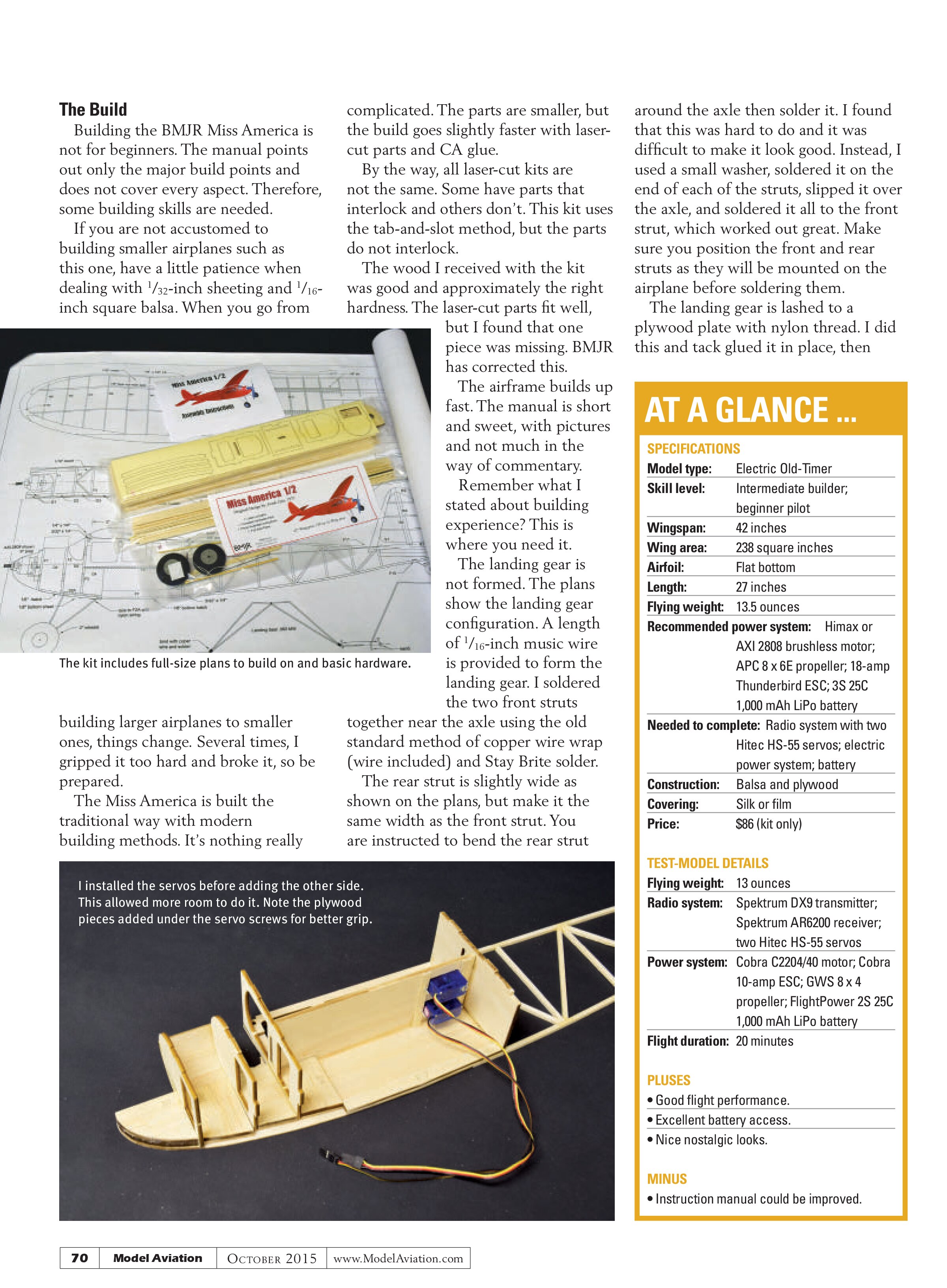
The kit includes full-size plans to build on and basic hardware.

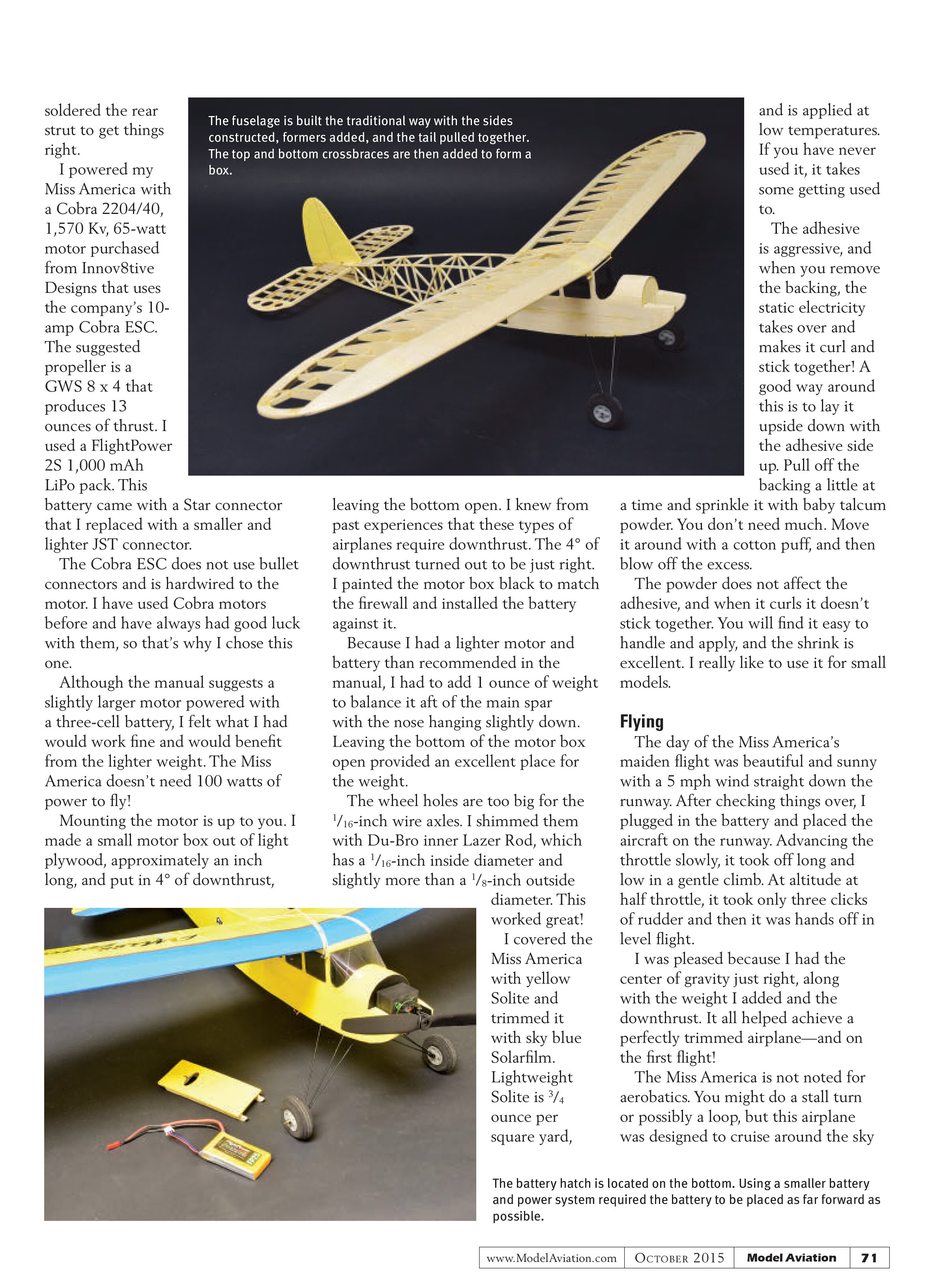
I installed the servos before adding the other side. This allowed more room to do it. Note the plywood pieces added under the servo screws for better grip.
soldered the rear strut to get things right.
I powered my Miss America with a Cobra 2204/40, 1,570 Kv, 65-watt motor purchased from Innov8tive Designs that uses the company’s 10-amp Cobra ESC. The suggested propeller is a GWS 8 x 4 that produces 13 ounces of thrust. I used a FlightPower 2S 1,000 mAh LiPo pack. This battery came with a Star connector that I replaced with a smaller and lighter JST connector.
The Cobra ESC does not use bullet connectors and is hardwired to the motor. I have used Cobra motors before and have always had good luck with them, so that’s why I chose this one.
Although the manual suggests a slightly larger motor powered with a three-cell battery, I felt what I had would work fine and would benefit from the lighter weight. The Miss America doesn’t need 100 watts of power to fly!
Mounting the motor is up to you. I made a small motor box out of light plywood, approximately an inch long, and put in 4° of downthrust, leaving the bottom open. I knew from past experiences that these types of airplanes require downthrust. The 4° of downthrust turned out to be just right. I painted the motor box black to match the firewall and installed the battery against it.
Because I had a lighter motor and battery than recommended in the manual, I had to add 1 ounce of weight to balance it aft of the main spar with the nose hanging slightly down. Leaving the bottom of the motor box open provided an excellent place for the weight.
The wheel holes are too big for the 1/16-inch wire axles. I shimmed them with Du-Bro Inner Lazer Rod, which has a 1/16-inch inside diameter and slightly more than a 1/8-inch outside diameter. This worked great!
I covered the Miss America with yellow Solite and trimmed it with sky blue Solarfilm. Lightweight Solite is 3/4 ounce per square yard, and is applied at low temperatures. If you have never used it, it takes some getting used to.
The adhesive is aggressive, and when you remove the backing, the static electricity takes over and makes it curl and stick together! A good way around this is to lay it upside down with the adhesive side up. Pull off the backing a little at a time and sprinkle it with baby talcum powder. You don’t need much. Move it around with a cotton puff, and then blow off the excess.
The powder does not affect the adhesive, and when it curls it doesn’t stick together. You will find it easy to handle and apply, and the shrink is excellent. I really like to use it for small models.
Flying
The day of the Miss America’s maiden flight was beautiful and sunny with a 5 mph wind straight down the runway. After checking things over, I plugged in the battery and placed the aircraft on the runway. Advancing the throttle slowly, it took off long and low in a gentle climb. At altitude at half throttle, it took only three clicks of rudder and then it was hands off in level flight.
I was pleased because I had the center of gravity just right, along with the weight I added and the downthrust. It all helped achieve a perfectly trimmed airplane—and on the first flight!
The Miss America is not noted for aerobatics. You might do a stall turn or possibly a loop, but this airplane was designed to cruise around the sky

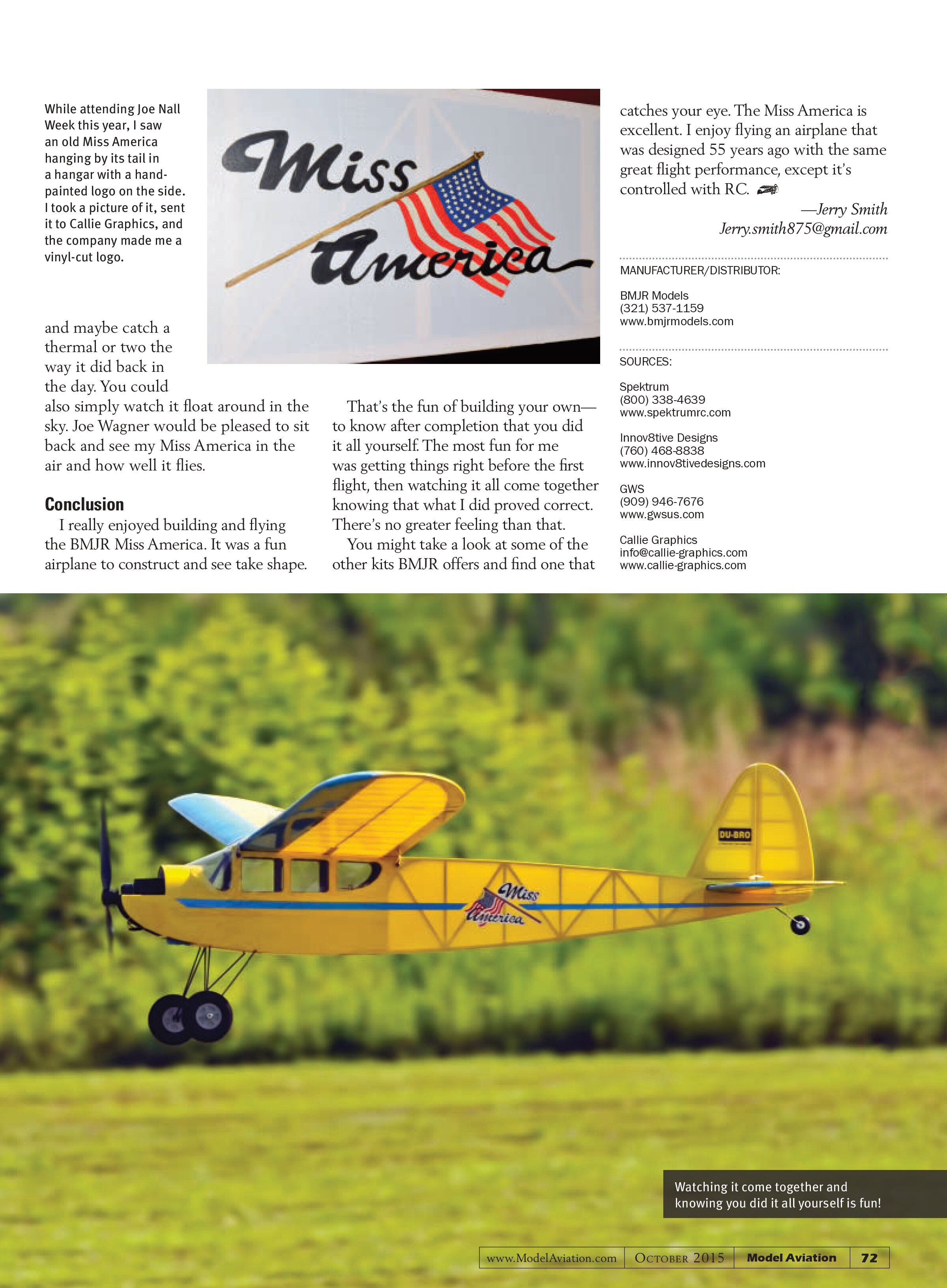
The fuselage is built the traditional way with the sides constructed, formers added, and the tail pulled together. The top and bottom crossbraces are then added to form a box.

The battery hatch is located on the bottom. Using a smaller battery and power system required the battery to be placed as far forward as possible.
While attending Joe Nall Week this year, I saw an old Miss America hanging by its tail in a hangar with a hand-painted logo on the side. I took a picture of it, sent it to Callie Graphics, and the company made me a vinyl-cut logo.

and maybe catch a thermal or two the way it did back in the day. You could also simply watch it float around in the sky. Joe Wagner would be pleased to sit back and see my Miss America in the air and how well it flies.
Conclusion
I really enjoyed building and flying the BMJR Miss America. It was a fun airplane to construct and see take shape.
That’s the fun of building your own—to know after completion that you did it all yourself. The most fun for me was getting things right before the first flight, then watching it all come together knowing that what I did proved correct. There’s no greater feeling than that.
You might take a look at some of the other kits BMJR offers and find one that catches your eye. The Miss America is excellent. I enjoy flying an airplane that was designed 55 years ago with the same great flight performance, except it’s controlled with RC.
—Jerry Smith
Jerry.smith875@gmail.com
MANUFACTURER/DISTRIBUTOR:
BMJR Models
(321) 537-1159
www.bmj rmodels.com
SOURCES:
Spektrum
(800) 338-4639
www.spektrumrc.com
Innov8tive Designs
(760) 468-8838
www.innov8tivedesigns.com
GWS
(909) 946-7676
www.gwsus.com
Callie Graphics
info@callie-graphics.com
www.callie-graphics.com