Foreign objects wreak havoc
Claude Vest sent me a great story about his lawnmower adventure. It was a serious matter that could have been worse without his level-headed response. However, his way of telling it struck my funny bone, and now I feel bad about being so undignified.

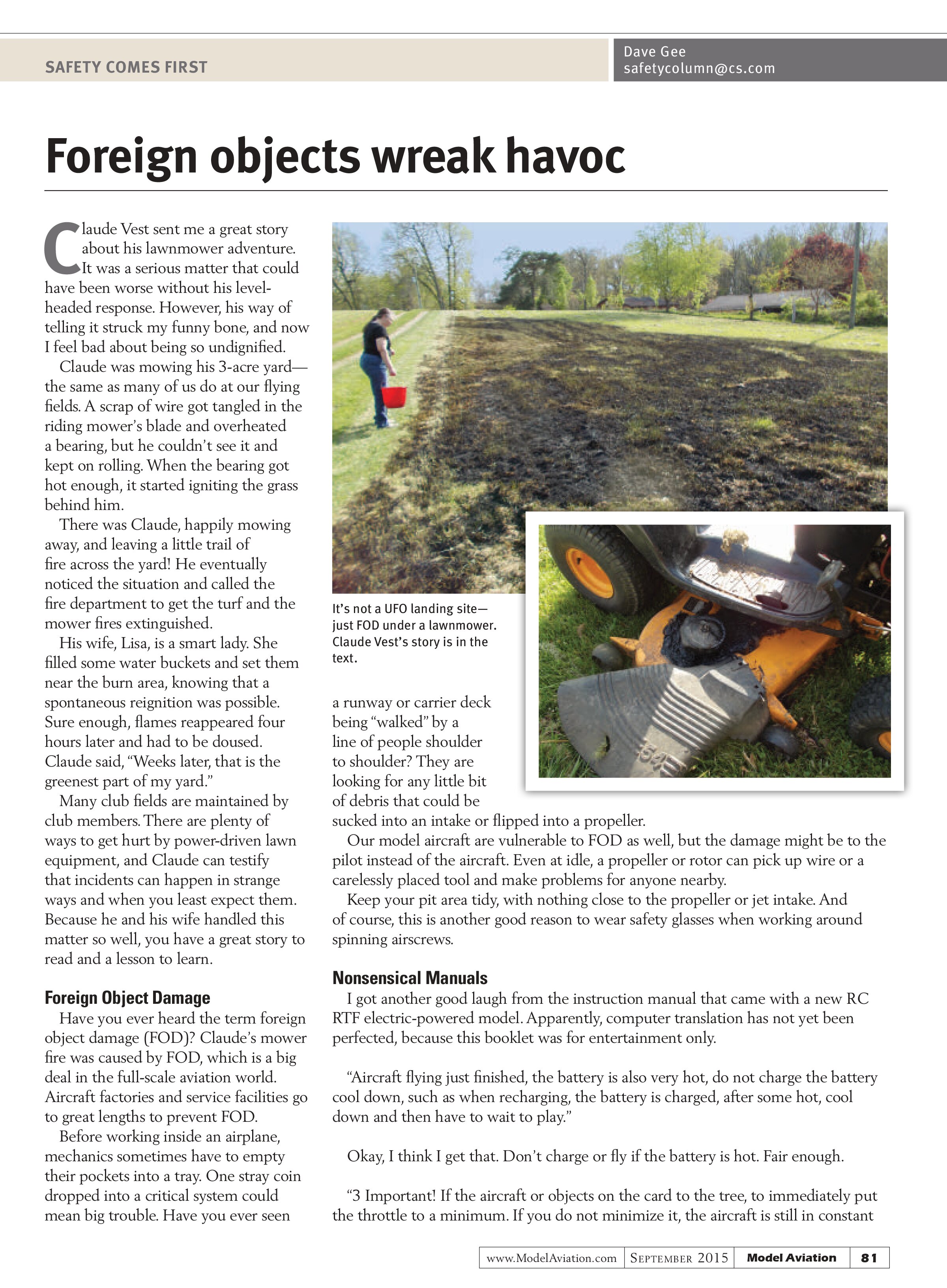
Claude was mowing his 3-acre yard—the same as many of us do at our flying fields. A scrap of wire got tangled in the riding mower’s blade and overheated a bearing, but he couldn’t see it and kept on rolling. When the bearing got hot enough, it started igniting the grass behind him.
There was Claude, happily mowing away, and leaving a little trail of fire across the yard. He eventually noticed the situation and called the fire department to get the turf and the mower fires extinguished.
His wife, Lisa, is a smart lady. She filled some water buckets and set them near the burn area, knowing that a spontaneous reignition was possible. Sure enough, flames reappeared four hours later and had to be doused. Claude said, “Weeks later, that is the greenest part of my yard.”
Many club fields are maintained by club members. There are plenty of ways to get hurt by power-driven lawn equipment, and Claude can testify that incidents can happen in strange ways and when you least expect them. Because he and his wife handled this matter so well, you have a great story to read and a lesson to learn.
Foreign Object Damage
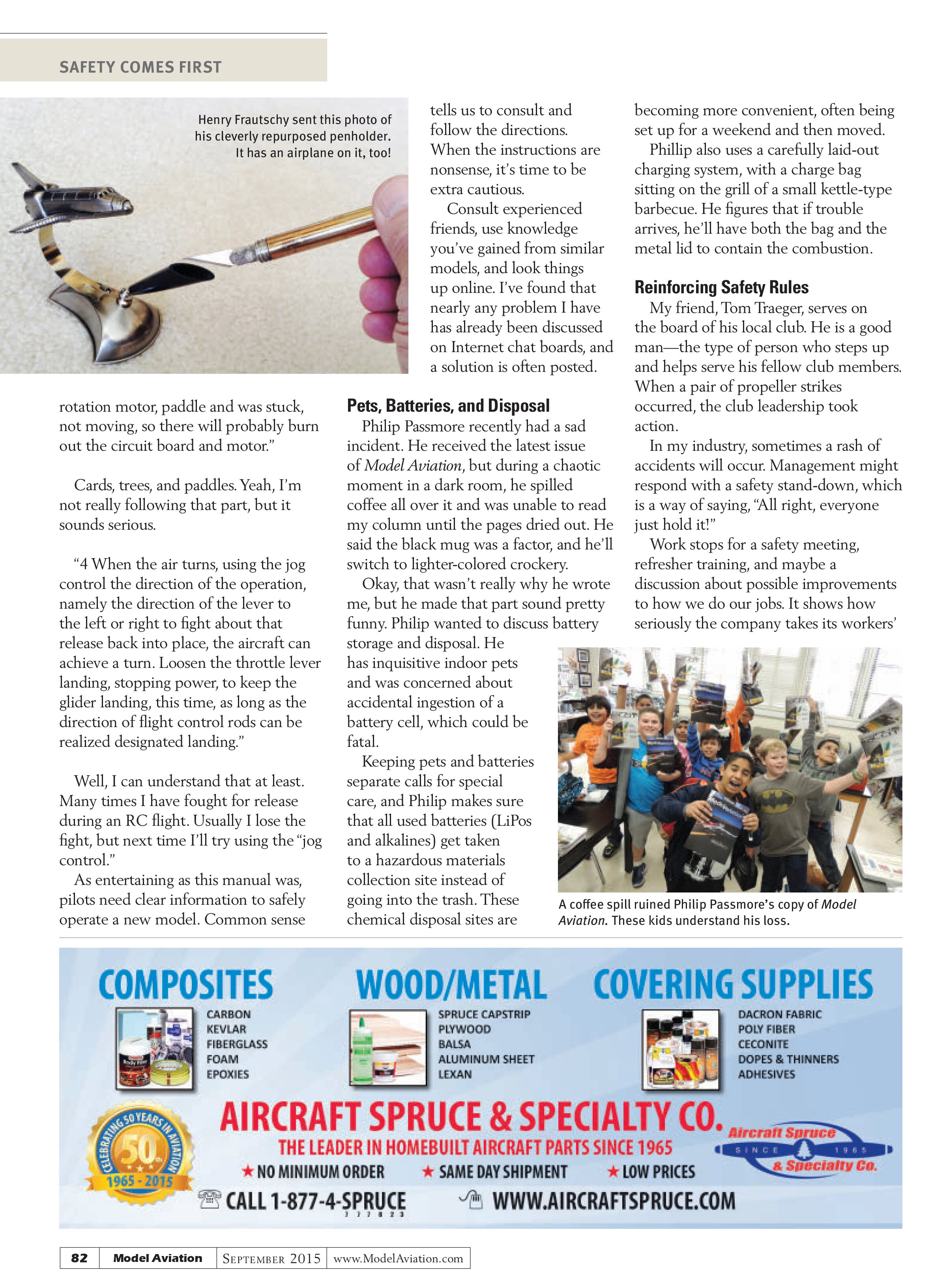
Have you ever heard the term foreign object damage (FOD)? Claude’s mower fire was caused by FOD, which is a big deal in the full-scale aviation world. Aircraft factories and service facilities go to great lengths to prevent FOD.
Before working inside an airplane, mechanics sometimes have to empty their pockets into a tray. One stray coin dropped into a critical system could mean big trouble. Have you ever seen
a runway or carrier deck being “walked” by a line of people shoulder to shoulder? They are looking for any little bit of debris that could be sucked into an intake or flipped into a propeller.

Our model aircraft are vulnerable to FOD as well, but the damage might be to the pilot instead of the aircraft. Even at idle, a propeller or rotor can pick up wire or a carelessly placed tool and make problems for anyone nearby.
Keep your pit area tidy, with nothing close to the propeller or jet intake. And of course, this is another good reason to wear safety glasses when working around spinning airscrews.
Nonsensical Manuals
I got another good laugh from the instruction manual that came with a new RC RTF electric-powered model. Apparently, computer translation has not yet been perfected, because this booklet was for entertainment only.
“Aircraft flying just finished, the battery is also very hot, do not charge the battery cool down, such as when recharging, the battery is charged, after some hot, cool down and then have to wait to play.”
Okay, I think I get that. Don’t charge or fly if the battery is hot. Fair enough.
“3 Important! If the aircraft or objects on the card to the tree, to immediately put the throttle to a minimum. If you do not minimize it, the aircraft is still in constant
rotation motor, paddle and was stuck, not moving, so there will probably burn out the circuit board and motor.”
Cards, trees, and paddles. Yeah, I’m not really following that part, but it sounds serious.
“4 When the air turns, using the jog control the direction of the operation, namely the direction of the lever to the left or right to fight about that release back into place, the aircraft can achieve a turn. Loosen the throttle lever landing, stopping power, to keep the glider landing, this time, as long as the direction of flight control rods can be realized designated landing.”
Well, I can understand that at least. Many times I have fought for release during an RC flight. Usually I lose the fight, but next time I’ll try using the “jog control.”
As entertaining as this manual was, pilots need clear information to safely operate a new model. Common sense tells us to consult and follow the directions. When the instructions are nonsense, it’s time to be extra cautious.
Consult experienced friends, use knowledge you’ve gained from similar models, and look things up online. I’ve found that nearly any problem I have has already been discussed on Internet chat boards, and a solution is often posted.
Pets, Batteries, and Disposal
Philip Passmore recently had a sad incident. He received the latest issue of Model Aviation, but during a chaotic moment in a dark room, he spilled coffee all over it and was unable to read my column until the pages dried out. He said the black mug was a factor, and he’ll switch to lighter-colored crockery.
Okay, that wasn’t really why he wrote me, but he made that part sound pretty funny. Philip wanted to discuss battery storage and disposal. He has inquisitive indoor pets and was concerned about accidental ingestion of a battery cell, which could be fatal.
Keeping pets and batteries separate calls for special care, and Philip makes sure that all used batteries (LiPos and alkalines) get taken to a hazardous materials collection site instead of going into the trash. These chemical disposal sites are becoming more convenient, often being set up for a weekend and then moved. Phillip also uses a carefully laid-out charging system, with a charge bag sitting on the grill of a small kettle-type barbecue. He figures that if trouble arrives, he’ll have both the bag and the metal lid to contain the combustion.
Reinforcing Safety Rules
My friend, Tom Traeger, serves on the board of his local club. He is a good man—the type of person who steps up and helps serve his fellow club members. When a pair of propeller strikes occurred, the club leadership took action.
In my industry, sometimes a rash of accidents will occur. Management might respond with a safety stand-down, which is a way of saying, “All right, everyone just hold it!”
Work stops for a safety meeting, refresher training, and maybe a discussion about possible improvements to how we do our jobs. It shows how seriously the company takes its workers’ well-being. Financial loss is nothing compared to the cost of a workplace injury. The company hopes that a “reboot” of the system will end the string of accidents.
Tom’s club tried something similar. It reinforced the basic safety rules (although the two accidents were not related to any rule violation), and advised all pilots to write and use a checklist for preflight inspections. A timeout was called and each pilot was asked to step back to reconsider his or her routine and treat his or her model like a full-scale aircraft. Not a bad response to the situation!
Hobby Knife Holder
Henry Frautschy read my recent stories of hobby knife incidents and sent a photo of his own clever solution for storing these knives. An inexpensive penholder from a discount store did the trick—and it even has an aircraft on it. He said a bit of foam stuffed inside protects the blade.