A star is born
by Gordon Buckland
gordon@gatorf3b.com

When something amazing happens, it’s often difficult to put a finger on exactly what the catalyst is. Sometimes, it’s simply fate that plays a part in shaping the future and not one specific thing. If you can identify exactly what it is, then you can recreate those same circumstances and cause more amazing events to occur.
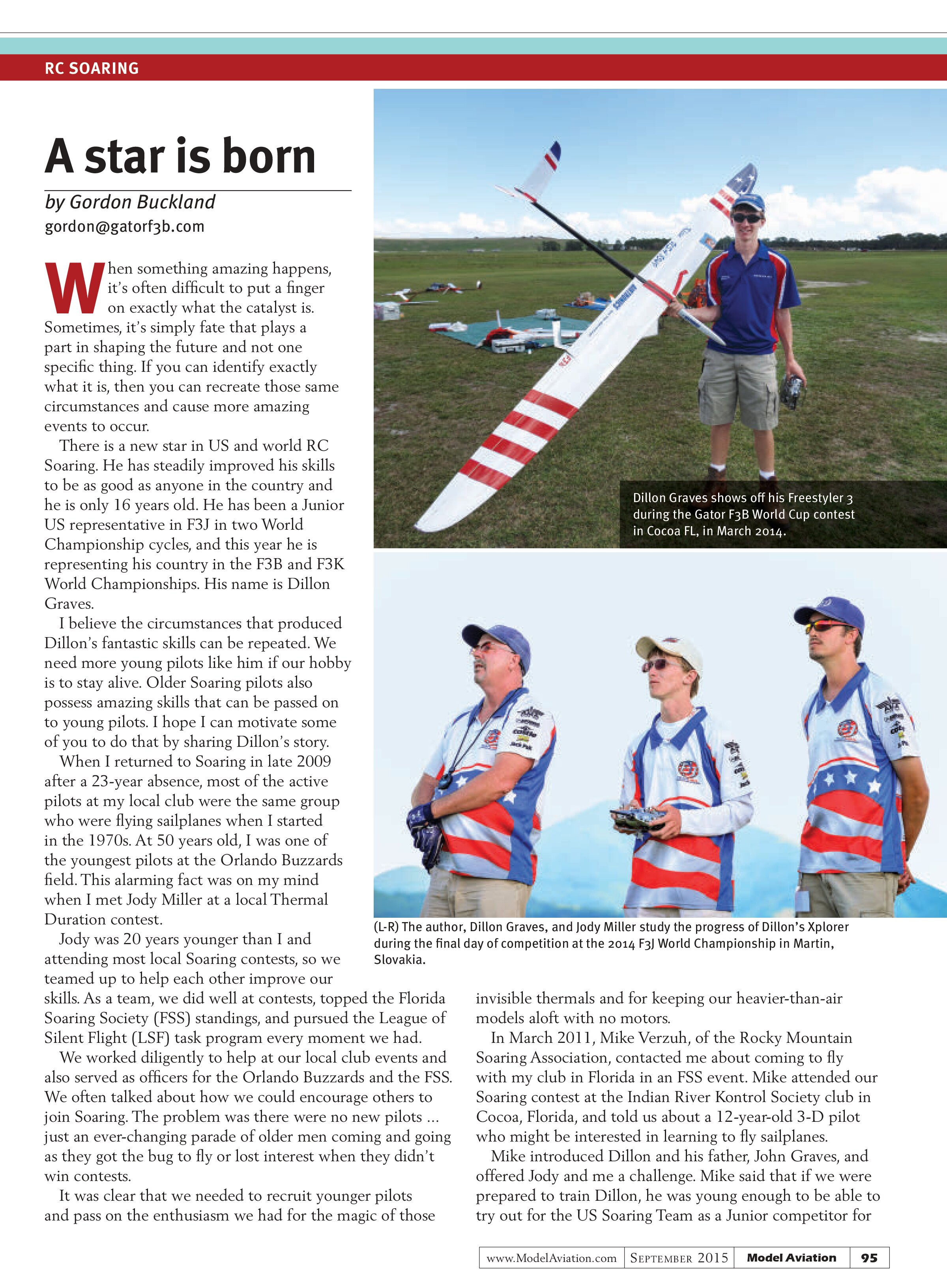
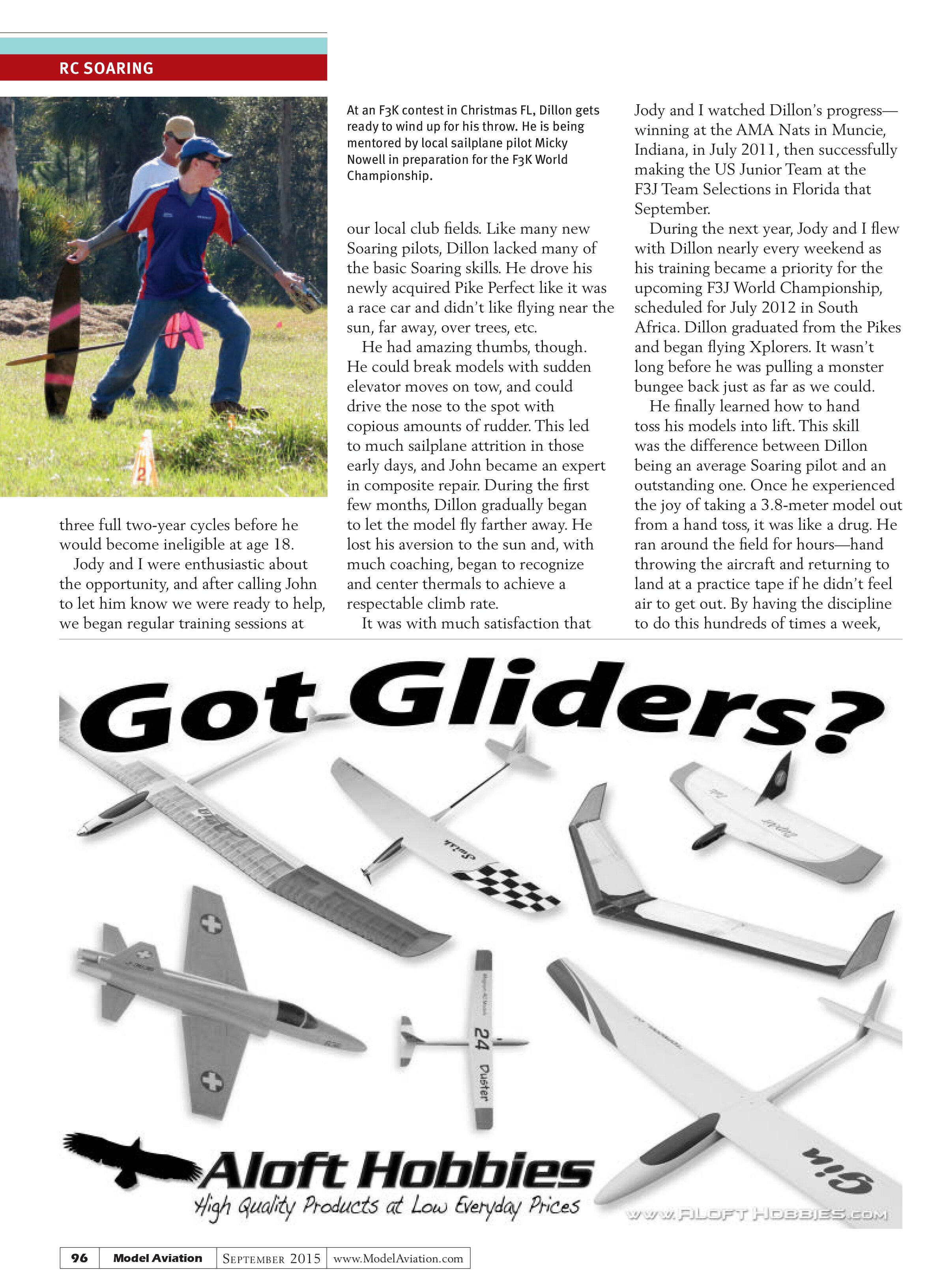
There is a new star in US and world RC Soaring. He has steadily improved his skills to be as good as anyone in the country and he is only 16 years old. He has been a Junior US representative in F3J in two World Championship cycles, and this year he is representing his country in the F3B and F3K World Championships. His name is Dillon Graves.
I believe the circumstances that produced Dillon’s fantastic skills can be repeated. We need more young pilots like him if our hobby is to stay alive. Older Soaring pilots also possess amazing skills that can be passed on to young pilots. I hope I can motivate some of you to do that by sharing Dillon’s story.
When I returned to Soaring in late 2009 after a 23-year absence, most of the active pilots at my local club were the same group who were flying sailplanes when I started in the 1970s. At 50 years old, I was one of the youngest pilots at the Orlando Buzzards field. This alarming fact was on my mind when I met Jody Miller at a local Thermal Duration contest.
Jody was 20 years younger than I and attending most local Soaring contests, so we teamed up to help each other improve our skills. As a team, we did well at contests, topped the Florida Soaring Society (FSS) standings, and pursued the League of Silent Flight (LSF) task program every moment we had.
We worked diligently to help at our local club events and also served as officers for the Orlando Buzzards and the FSS. We often talked about how we could encourage others to join Soaring. The problem was there were no new pilots … just an ever-changing parade of older men coming and going as they got the bug to fly or lost interest when they didn’t win contests.
It was clear that we needed to recruit younger pilots and pass on the enthusiasm we had for the magic of those invisible thermals and for keeping our heavier-than-air models aloft with no motors.

In March 2011, Mike Verzuh, of the Rocky Mountain Soaring Association, contacted me about coming to fly with my club in Florida in an FSS event. Mike attended our Soaring contest at the Indian River Kontrol Society club in Cocoa, Florida, and told us about a 12-year-old 3-D pilot who might be interested in learning to fly sailplanes.
Mike introduced Dillon and his father, John Graves, and offered Jody and me a challenge. Mike said that if we were prepared to train Dillon, he was young enough to be able to try out for the US Soaring Team as a Junior competitor for
three full two-year cycles before he would become ineligible at age 18.
Jody and I were enthusiastic about the opportunity, and after calling John to let him know we were ready to help, we began regular training sessions at

our local club fields. Like many new Soaring pilots, Dillon lacked many of the basic Soaring skills. He drove his newly acquired Pike Perfect like it was a race car and didn’t like flying near the sun, far away, over trees, etc.
He had amazing thumbs, though. He could break models with sudden elevator moves on tow, and could drive the nose to the spot with copious amounts of rudder. This led to much sailplane attrition in those early days, and John became an expert in composite repair. During the first few months, Dillon gradually began to let the model fly farther away. He lost his aversion to the sun and, with much coaching, began to recognize and center thermals to achieve a respectable climb rate.
It was with much satisfaction that Jody and I watched Dillon’s progress—winning at the AMA Nats in Muncie, Indiana, in July 2011, then successfully making the US Junior Team at the F3J Team Selections in Florida that September.
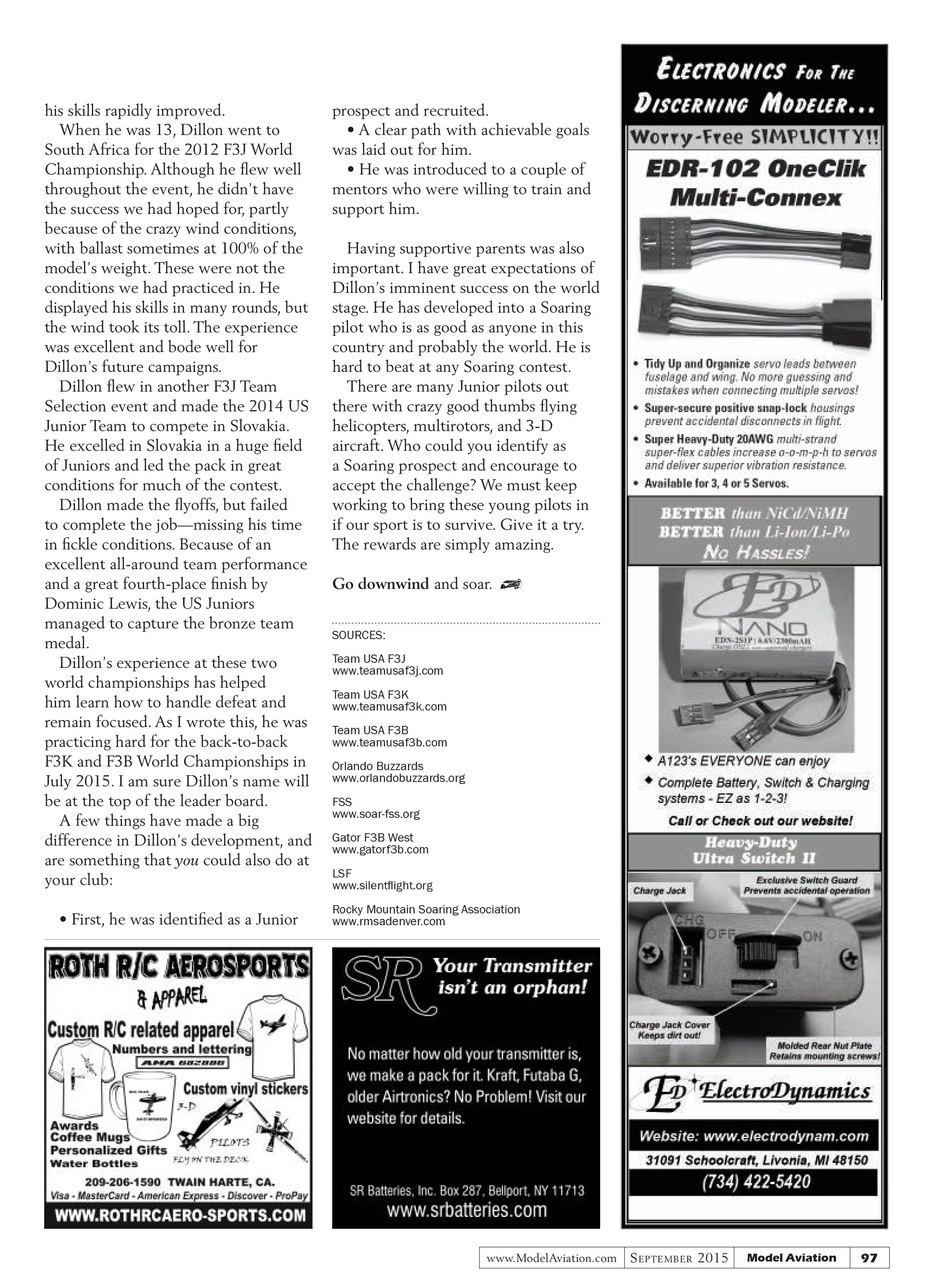
During the next year, Jody and I flew with Dillon nearly every weekend as his training became a priority for the upcoming F3J World Championship, scheduled for July 2012 in South Africa. Dillon graduated from the Pikes and began flying Xplorers. It wasn’t long before he was pulling a monster bungee back just as far as we could.
He finally learned how to hand toss his models into lift. This skill was the difference between Dillon being an average Soaring pilot and an outstanding one. Once he experienced the joy of taking a 3.8-meter model out from a hand toss, it was like a drug. He ran around the field for hours—hand throwing the aircraft and returning to land at a practice tape if he didn’t feel air to get out. By having the discipline to do this hundreds of times a week, his skills rapidly improved.
When he was 13, Dillon went to South Africa for the 2012 F3J World Championship. Although he flew well throughout the event, he didn’t have the success we had hoped for, partly because of the crazy wind conditions, with ballast sometimes at 100% of the model’s weight. These were not the conditions we had practiced in. He displayed his skills in many rounds, but the wind took its toll. The experience was excellent and bode well for Dillon’s future campaigns.
Dillon flew in another F3J Team Selection event and made the 2014 US Junior Team to compete in Slovakia. He excelled in Slovakia in a huge field of Juniors and led the pack in great conditions for much of the contest.
Dillon made the flyoffs, but failed to complete the job—missing his time in fickle conditions. Because of an excellent all-around team performance and a great fourth-place finish by Dominic Lewis, the US Juniors managed to capture the bronze team medal.
Dillon’s experience at these two world championships has helped him learn how to handle defeat and remain focused. As I wrote this, he was practicing hard for the back-to-back F3K and F3B World Championships in July 2015. I am sure Dillon’s name will be at the top of the leaderboard.
A few things have made a big difference in Dillon’s development, and are something that you could also do at your club:
- First, he was identified as a Junior prospect and recruited.
- A clear path with achievable goals was laid out for him.
- He was introduced to a couple of mentors who were willing to train and support him.
Having supportive parents was also important. I have great expectations of Dillon’s imminent success on the world stage. He has developed into a Soaring pilot who is as good as anyone in this country and probably the world. He is hard to beat at any Soaring contest.
There are many Junior pilots out there with crazy good thumbs flying helicopters, multirotors, and 3-D aircraft. Who could you identify as a Soaring prospect and encourage to accept the challenge? We must keep working to bring these young pilots in if our sport is to survive. Give it a try. The rewards are simply amazing.
Go downwind and soar.
SOURCES:
Team USA F3J
www.teamusaf3j.com
Team USA F3K
www.teamusaf3k.com
Team USA F3B
www.teamusaf3b.com
Orlando Buzzards
www.orlandobuzzards.org
Gator F3B West
www.gatorf3b.com
Rocky Mountain Soaring Association
www.rmsadenver.com