Judging seminars
by Mike Riggs
rcaerobatics@gmail.com
In real-life terms, a judging seminar is just another way of saying, “Getting together with friends to talk about flying model airplanes.”
This past April, four of us in Boise, Idaho, joined a group of people 500 miles away in Oregon via teleconference for a 1½-day National Society of Radio Controlled Aerobatics (NSRCA) District VIII judging seminar. Regarding the Sportsman schedule this year, I noted the following:
- Altitude adjustments are allowed in any turnaround maneuver, except the turnaround between straight flight out and straight flight back.
- Only box entrances are required to be called. Calling box exits is not required.

I encourage anyone with an interest in Pattern to attend a judging seminar. It’s a great opportunity to learn better flying techniques. You do not have to be a contestant to attend.
Flying Pattern
In the spirit of the contest season, let’s continue examining flying the Sportsman schedule. In my last column, I defined “the box” as the 120° area directly in front of the pilot. All maneuvers are performed in the box, wind corrected, and parallel to the runway.
Sportsman Maneuvers
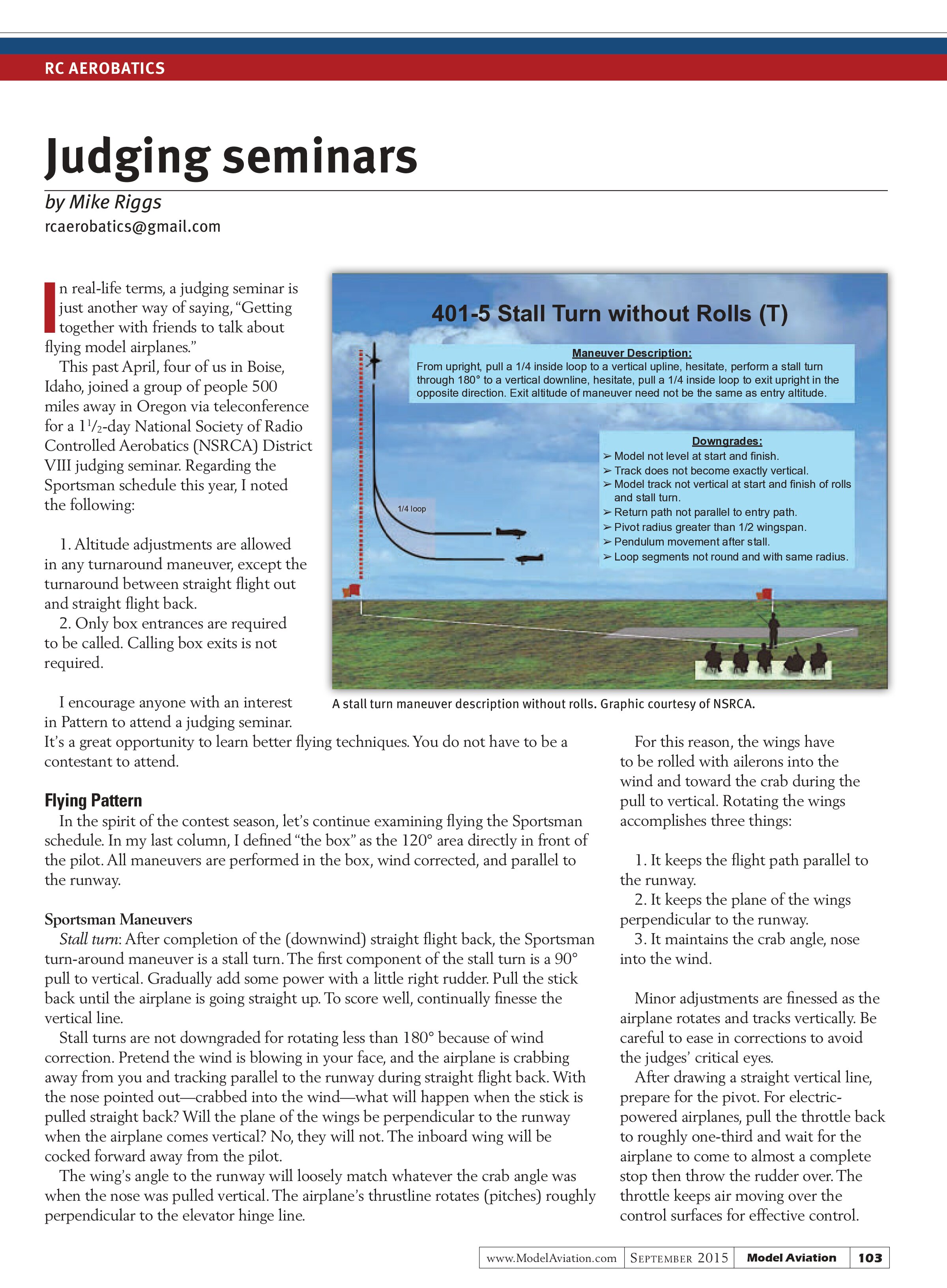
Stall turn: After completion of the (downwind) straight flight back, the Sportsman turn-around maneuver is a stall turn. The first component of the stall turn is a 90° pull to vertical. Gradually add some power with a little right rudder. Pull the stick back until the airplane is going straight up. To score well, continually finesse the vertical line.
Stall turns are not downgraded for rotating less than 180° because of wind correction. Pretend the wind is blowing in your face, and the airplane is crabbing away from you and tracking parallel to the runway during straight flight back. With the nose pointed out—crabbed into the wind—what will happen when the stick is pulled straight back? Will the plane of the wings be perpendicular to the runway when the airplane comes vertical? No, they will not. The inboard wing will be cocked forward away from the pilot.
The wing’s angle to the runway will loosely match whatever the crab angle was when the nose was pulled vertical. The airplane’s thrustline rotates (pitches) roughly perpendicular to the elevator hinge line.
For this reason, the wings have to be rolled with ailerons into the wind and toward the crab during the pull to vertical. Rotating the wings accomplishes three things:
- It keeps the flight path parallel to the runway.
- It keeps the plane of the wings perpendicular to the runway.
- It maintains the crab angle, nose into the wind.
Minor adjustments are finessed as the airplane rotates and tracks vertically. Be careful to ease in corrections to avoid the judges’ critical eyes.
After drawing a straight vertical line, prepare for the pivot. For electric-powered airplanes, pull the throttle back to roughly one-third and wait for the airplane to come to almost a complete stop then throw the rudder over. The throttle keeps air moving over the control surfaces for effective control.
After the outside wing comes over the top, reduce throttle to idle. Many airplanes require a small amount of opposite aileron as the airplane pivots. Whether pivoting in or out, points will be deducted if the wings do not remain perpendicular to the runway during the pivot.
As the nose drops to vertical, slowly ease the rudder. Gradually match the downline heading to the crab angle used in the upline. During the downline is another opportunity to make minor, sneaky, adjustments. Note that as the airspeed increases, the crab angle lessens.
Pull the airplane level with the same radius used when pulling vertical. Bring the throttle to its cruise setting, rolling the wings into the wind to level them. As discussed in the last column, the pull offers an opportunity to skid the airplane in or out of the box, using the rudder to control the skid and ailerons to keep the wings level.
Breathe: Take a deep breath as the airplane flies straight and level toward the center of the box.
Double Immelmann: Here’s a funny story. A few years ago we held a club Pattern contest. All seven contestants flew the Sportsman sequence. I’ll never forget hearing a caller call “Double Immelmann” and the pilot responding, “What the heck is a Double Immelmann?” as he flew through the box and out the other end.
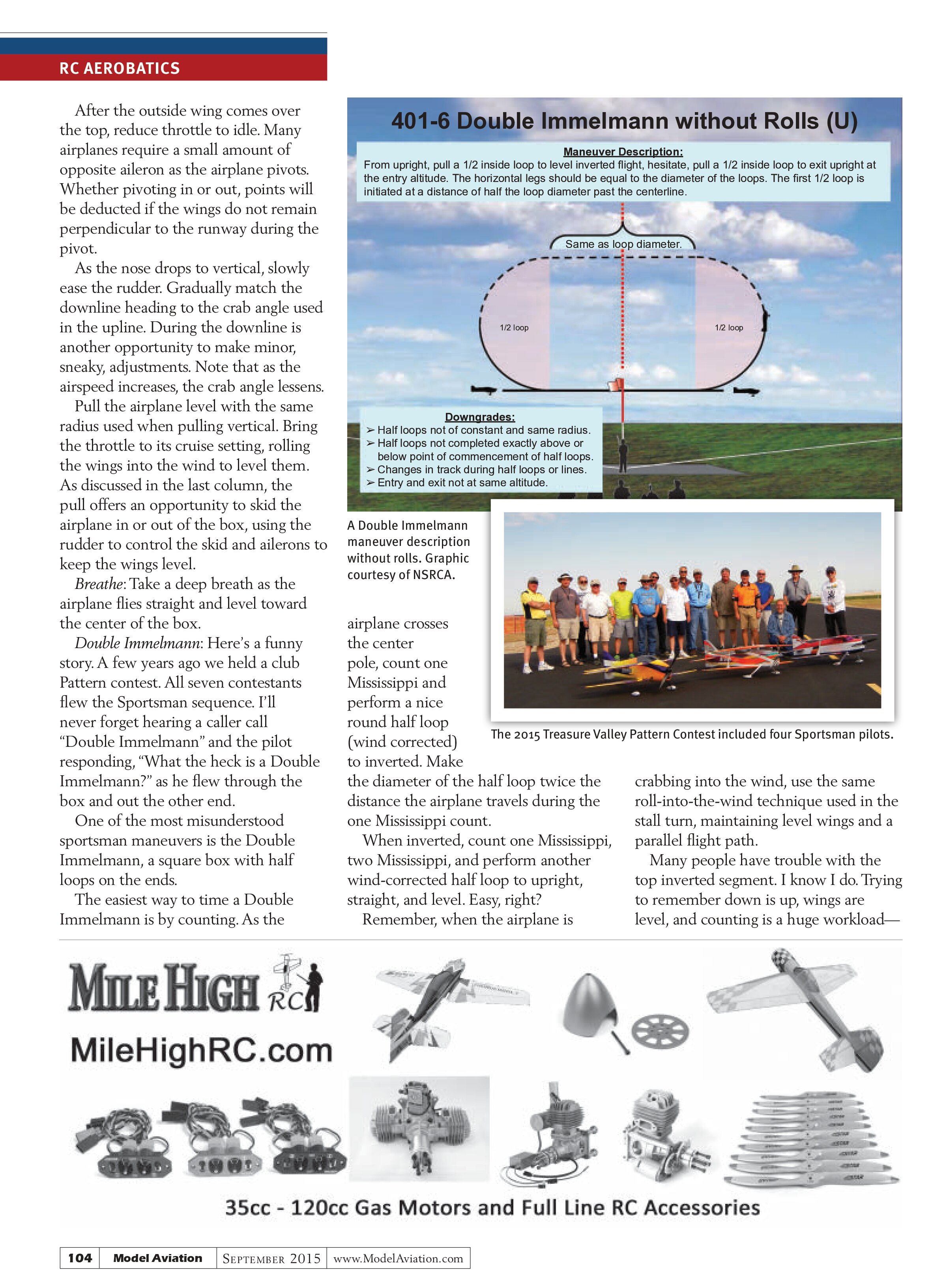
One of the most misunderstood sportsman maneuvers is the Double Immelmann, a square box with half loops on the ends.
The easiest way to time a Double Immelmann is by counting. As the airplane crosses the center pole, count one Mississippi and perform a nice round half loop (wind corrected) to inverted. Make the diameter of the half loop twice the distance the airplane travels during the one Mississippi count.
When inverted, count one Mississippi, two Mississippi, and perform another wind-corrected half loop to upright, straight, and level. Easy, right?
Remember, when the airplane is crabbing into the wind, use the same roll-into-the-wind technique used in the stall turn, maintaining level wings and a parallel flight path.
Many people have trouble with the top inverted segment. I know I do. Trying to remember down is up, wings are level, and counting is a huge workload—especially for a fledgling Pattern pilot. Inevitably, a pull without the wings being level will result in being inverted on a bad in/out heading. How do you fix that?
There are many methods of remembering correct inverted rudder input. What works for me is moving the inside wingtip with the rudder stick. Try it. Roll inverted. Establish that the wings are level, and the flight path is parallel to the runway. Now move the rudder back and forth. Take it easy at first. Chances are that you’re going to need aileron input to keep the wings level.
Congratulations, the Double Immelmann is in your rearview mirror.
Breathe: Take a deep breath as the airplane flies a straight line headed upwind out of the box. Now relax; the judging is turned off. At this point in a contest, you may be slightly rattled, which is why the sequence committee includes box exits in the Sportsman sequence.
Take your time, fly circles if you want, and stay upwind of the box marker. Check your switches. Are they all in the right position? In general, try to relax. Shake it out, and get ready to head back into the box for more fun.
Next Time
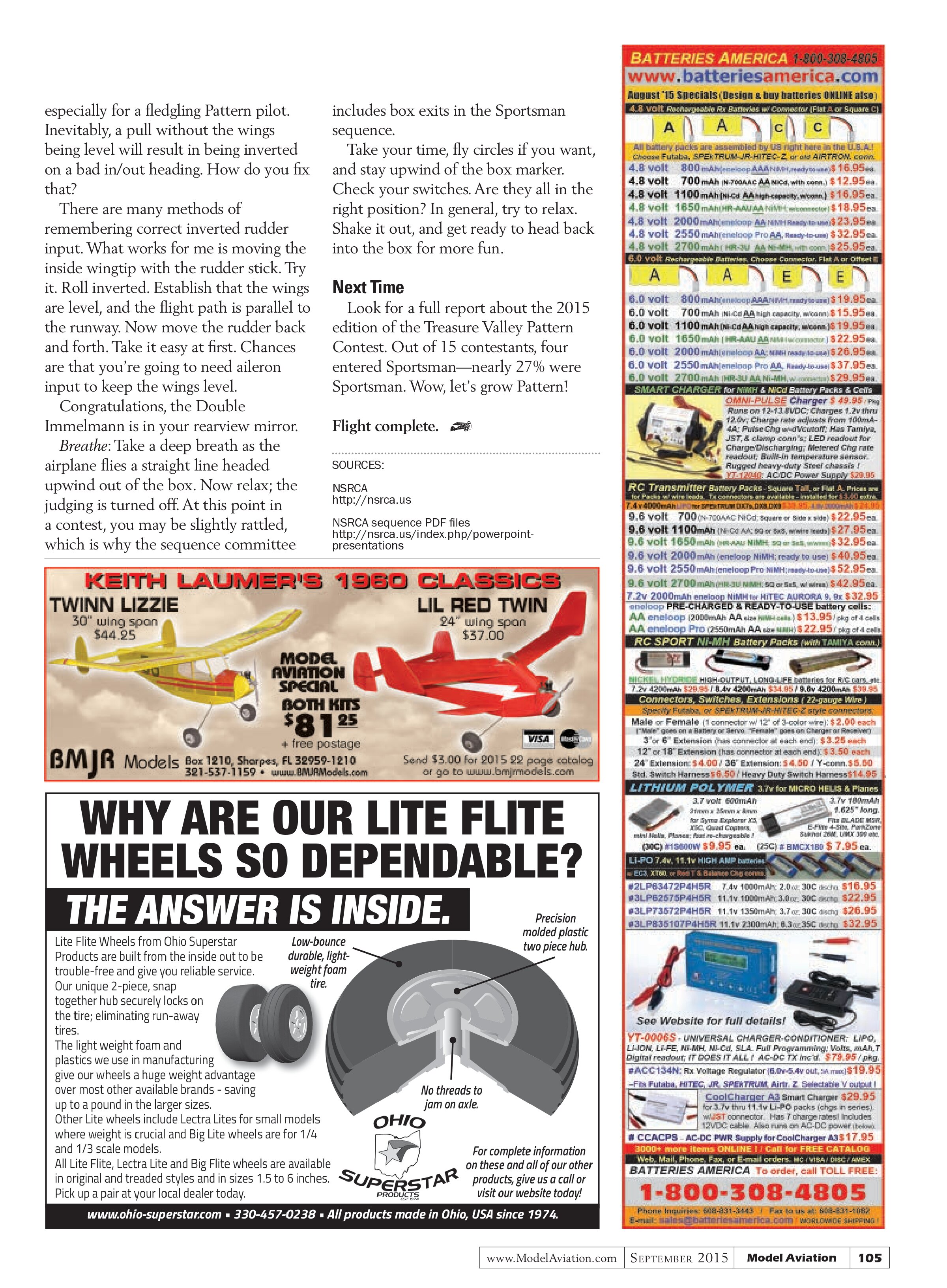
Look for a full report about the 2015 edition of the Treasure Valley Pattern Contest. Out of 15 contestants, four entered Sportsman—nearly 27% were Sportsman. Wow, let’s grow Pattern!
Flight complete.
SOURCES:
NSRCA
http://nsrca.us
NSRCA sequence PDF files
http://nsrca.us/index.php/powerpoint-presentations