Versatile racer makes flying fun
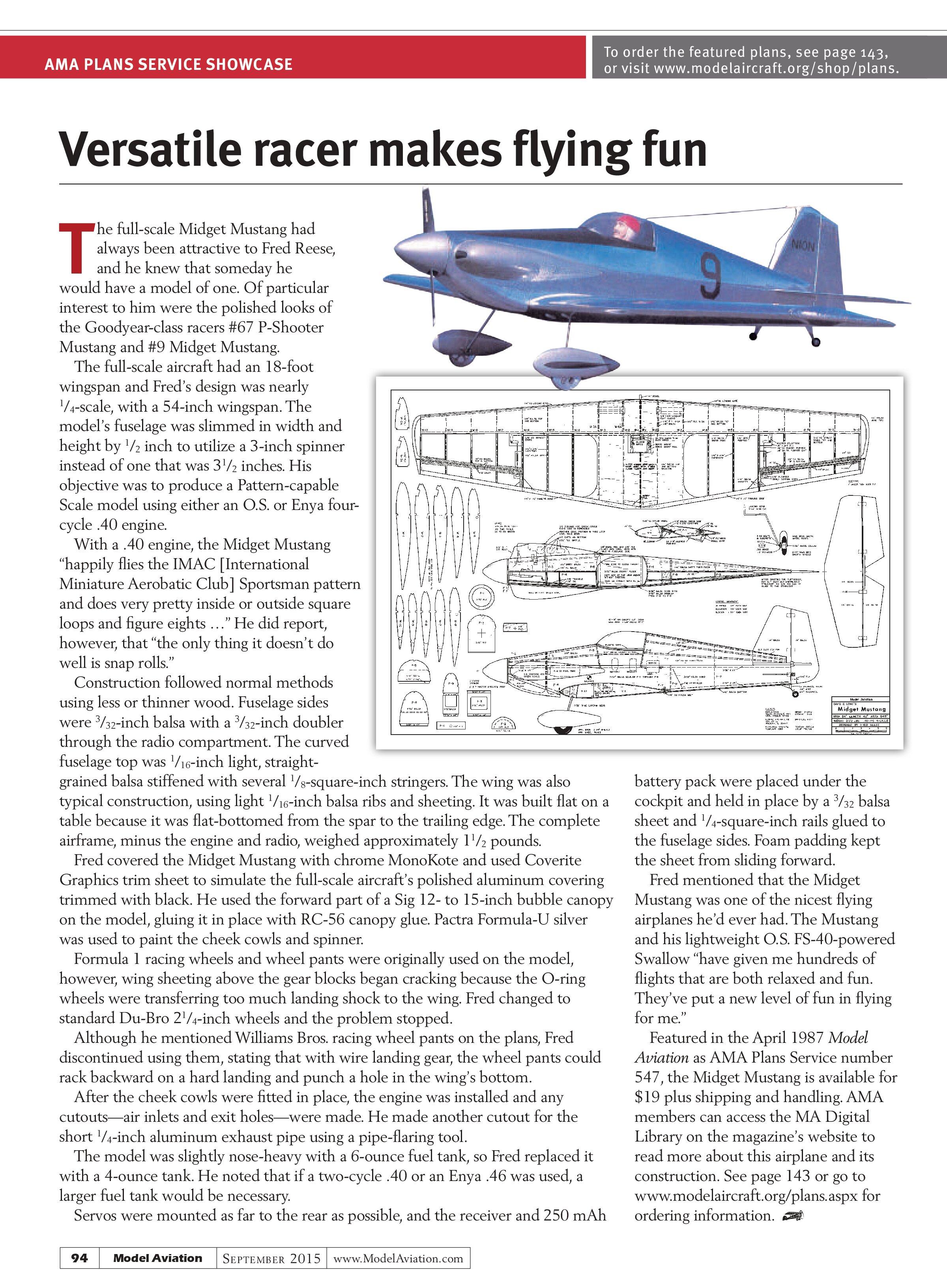
The full-scale Midget Mustang had always been attractive to Fred Reese, and he knew that someday he would have a model of one. Of particular interest to him were the polished looks of the Goodyear-class racers #67 P-Shooter Mustang and #9 Midget Mustang.
The full-scale aircraft had an 18-foot wingspan and Fred’s design was nearly 1/4-scale, with a 54-inch wingspan. The model’s fuselage was slimmed in width and height by 1/2 inch to utilize a 3-inch spinner instead of one that was 3 1/2 inches. His objective was to produce a Pattern-capable Scale model using either an O.S. or Enya four-cycle .40 engine.
With a .40 engine, the Midget Mustang “happily flies the IMAC [International Miniature Aerobatic Club] Sportsman pattern and does very pretty inside or outside square loops and figure eights . . .” He did report, however, that “the only thing it doesn’t do well is snap rolls.”


Construction followed normal methods using less or thinner wood. Fuselage sides were 3/32-inch balsa with a 3/32-inch doubler through the radio compartment. The curved fuselage top was 1/16-inch light, straight-grained balsa stiffened with several 1/8-square-inch stringers. The wing was also typical construction, using light 1/16-inch balsa ribs and sheeting. It was built flat on a table because it was flat-bottomed from the spar to the trailing edge. The complete airframe, minus the engine and radio, weighed approximately 1 1/2 pounds.
Fred covered the Midget Mustang with chrome MonoKote and used Coverite Graphics trim sheet to simulate the full-scale aircraft’s polished aluminum covering trimmed with black. He used the forward part of a Sig 12- to 15-inch bubble canopy on the model, gluing it in place with RC-56 canopy glue. Pactra Formula-U silver was used to paint the cheek cowls and spinner.
Formula 1 racing wheels and wheel pants were originally used on the model, however, wing sheeting above the gear blocks began cracking because the O-ring wheels were transferring too much landing shock to the wing. Fred changed to standard Du-Bro 2 1/4-inch wheels and the problem stopped.
Although he mentioned Williams Bros. racing wheel pants on the plans, Fred discontinued using them, stating that with wire landing gear, the wheel pants could rack backward on a hard landing and punch a hole in the wing’s bottom.
After the cheek cowls were fitted in place, the engine was installed and any cutouts—air inlets and exit holes—were made. He made another cutout for the short 1/4-inch aluminum exhaust pipe using a pipe-flaring tool.
The model was slightly nose-heavy with a 6-ounce fuel tank, so Fred replaced it with a 4-ounce tank. He noted that if a two-cycle .40 or an Enya .46 was used, a larger fuel tank would be necessary.
Servos were mounted as far to the rear as possible, and the receiver and 250 mAh battery pack were placed under the cockpit and held in place by a 3/32 balsa sheet and 1/4-square-inch rails glued to the fuselage sides. Foam padding kept the sheet from sliding forward.
Fred mentioned that the Midget Mustang was one of the nicest flying airplanes he’d ever had. The Mustang and his lightweight O.S. FS-40-powered Swallow “have given me hundreds of flights that are both relaxed and fun. They’ve put a new level of fun in flying for me.”
Featured in the April 1987 Model Aviation as AMA Plans Service number 547, the Midget Mustang is available for $19 plus shipping and handling. AMA members can access the MA Digital Library on the magazine’s website to read more about this airplane and its construction. See page 143 or go to www.modelaircraft.org/plans.aspx for ordering information.