Choosing the right motor
Joe Malinchak
One of the questions that I’m frequently asked is: What size motor should I use for my micro RC project? The question is not easily answered because several factors can affect the decision.
First you must determine what type of aircraft you will model. Is it 3-D, scale, or maybe a slow-flying sport model? You also need to consider the model’s weight, wing area, or wing loading. Then you must decide whether to go with a direct-drive brushed motor, geared, or brushless motor. All of this can be challenging for a novice or even for an experienced modeler trying to get a complex project to fly just right!
The easiest way to find the right motor is to learn what others are using in similar projects, or use the same motor setup as an ultra-micro RTF airplane of the approximate size and weight of the aircraft you are modeling. This approach may not work in some cases, so you must do some testing to find the right fit!
Today we have more choices than ever in the micro motor department! Along with all of the new micro RC aircraft that manufacturers are releasing, more powerful and reliable motors are also being released. I recently tested some 6mm brushed motors from micro quadcopters and got great results.
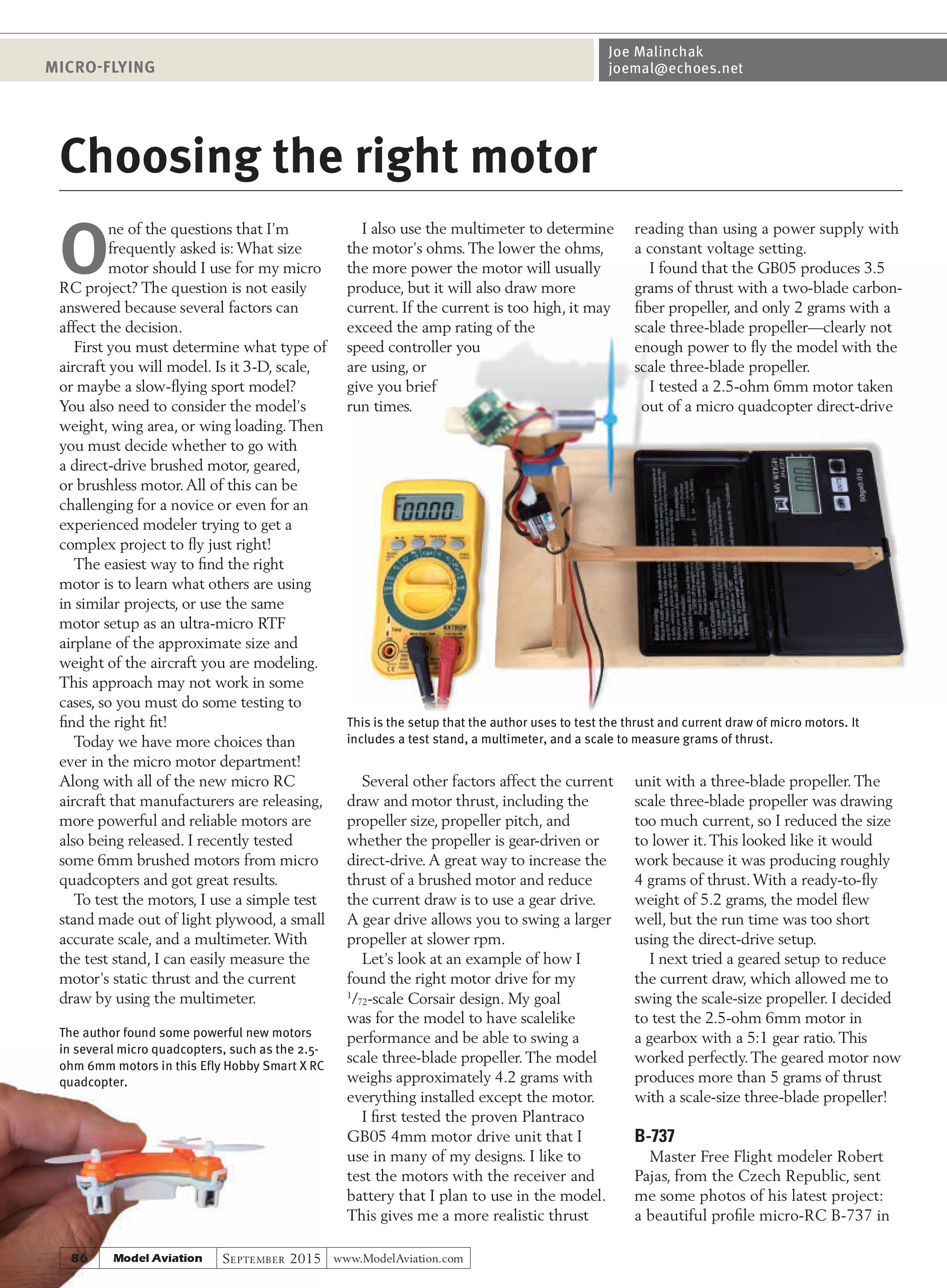
To test the motors, I use a simple test stand made out of light plywood, a small accurate scale, and a multimeter. With the test stand, I can easily measure the motor’s static thrust and the current draw by using the multimeter.
The author found some powerful new motors in several micro quadcopters, such as the 2.5-ohm 6mm motors in this Efly Hobby Smart X RC quadcopter.

I also use the multimeter to determine the motor’s ohms. The lower the ohms, the more power the motor will usually produce, but it will also draw more current. If the current is too high, it may exceed the amp rating of the speed controller you are using, or give you brief run times.

Several other factors affect the current draw and motor thrust, including the propeller size, propeller pitch, and whether the propeller is gear-driven or direct-drive. A great way to increase the thrust of a brushed motor and reduce the current draw is to use a gear drive. A gear drive allows you to swing a larger propeller at slower rpm.
Let’s look at an example of how I found the right motor drive for my 1/72-scale Corsair design. My goal was for the model to have scalelike performance and be able to swing a scale three-blade propeller. The model weighs approximately 4.2 grams with everything installed except the motor.
I first tested the proven Plantraco GB05 4mm motor drive unit that I use in many of my designs. I like to test the motors with the receiver and battery that I plan to use in the model. This gives me a more realistic thrust reading than using a power supply with a constant voltage setting.
I found that the GB05 produces 3.5 grams of thrust with a two-blade carbon-fiber propeller, and only 2 grams with a scale three-blade propeller—clearly not enough power to fly the model with the scale three-blade propeller.
I tested a 2.5-ohm 6mm motor taken out of a micro quadcopter direct-drive unit with a three-blade propeller. The scale three-blade propeller was drawing too much current, so I reduced the size to lower it. This looked like it would work because it was producing roughly 4 grams of thrust. With a ready-to-fly weight of 5.2 grams, the model flew well, but the run time was too short using the direct-drive setup.
I next tried a geared setup to reduce the current draw, which allowed me to swing the scale-size propeller. I decided to test the 2.5-ohm 6mm motor in a gearbox with a 5:1 gear ratio. This worked perfectly. The geared motor now produces more than 5 grams of thrust with a scale-size three-blade propeller!
B-737
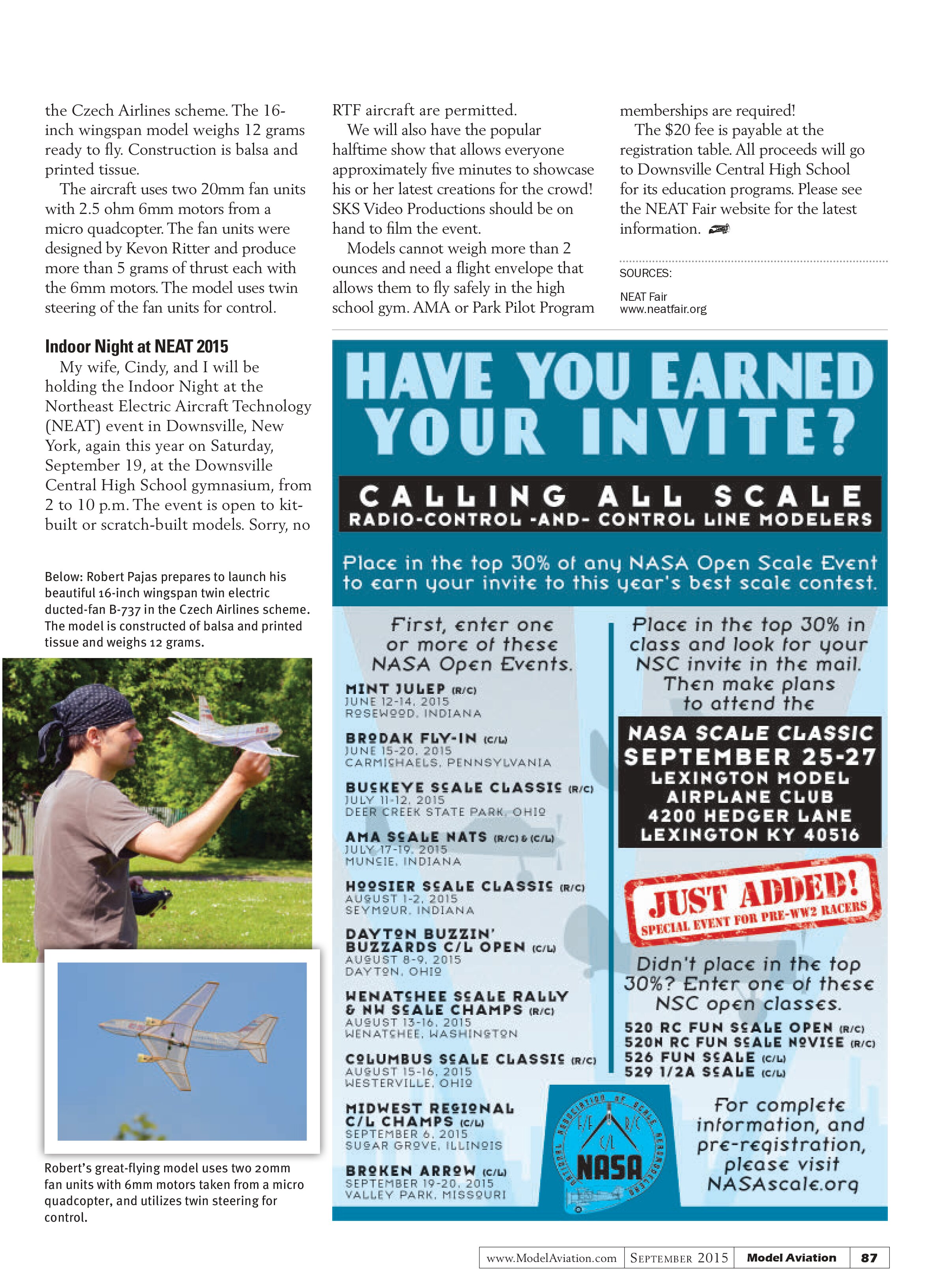
Master Free Flight modeler Robert Pajas, from the Czech Republic, sent me some photos of his latest project: a beautiful profile micro-RC B-737 in the Czech Airlines scheme. The 16-inch wingspan model weighs 12 grams ready to fly. Construction is balsa and printed tissue.
The aircraft uses two 20mm fan units with 2.5 ohm 6mm motors from a micro quadcopter. The fan units were designed by Kevon Ritter and produce more than 5 grams of thrust each with the 6mm motors. The model uses twin steering of the fan units for control.
Indoor Night at NEAT 2015
My wife, Cindy, and I will be holding the Indoor Night at the Northeast Electric Aircraft Technology (NEAT) event in Downsville, New York, again this year on Saturday, September 19, at the Downsville Central High School gymnasium, from 2 to 10 p.m. The event is open to kit-built or scratch-built models. Sorry, no RTF aircraft are permitted.
We will also have the popular halftime show that allows everyone approximately five minutes to showcase his or her latest creations for the crowd! SKS Video Productions should be on hand to film the event.
Models cannot weigh more than 2 ounces and need a flight envelope that allows them to fly safely in the high school gym. AMA or Park Pilot Program memberships are required!
The $20 fee is payable at the registration table. All proceeds will go to Downsville Central High School for its education programs. Please see the NEAT Fair website for the latest information.

Below: Robert Pajas prepares to launch his beautiful 16-inch wingspan twin electric ducted-fan B-737 in the Czech Airlines scheme. The model is constructed of balsa and printed tissue and weighs 12 grams.