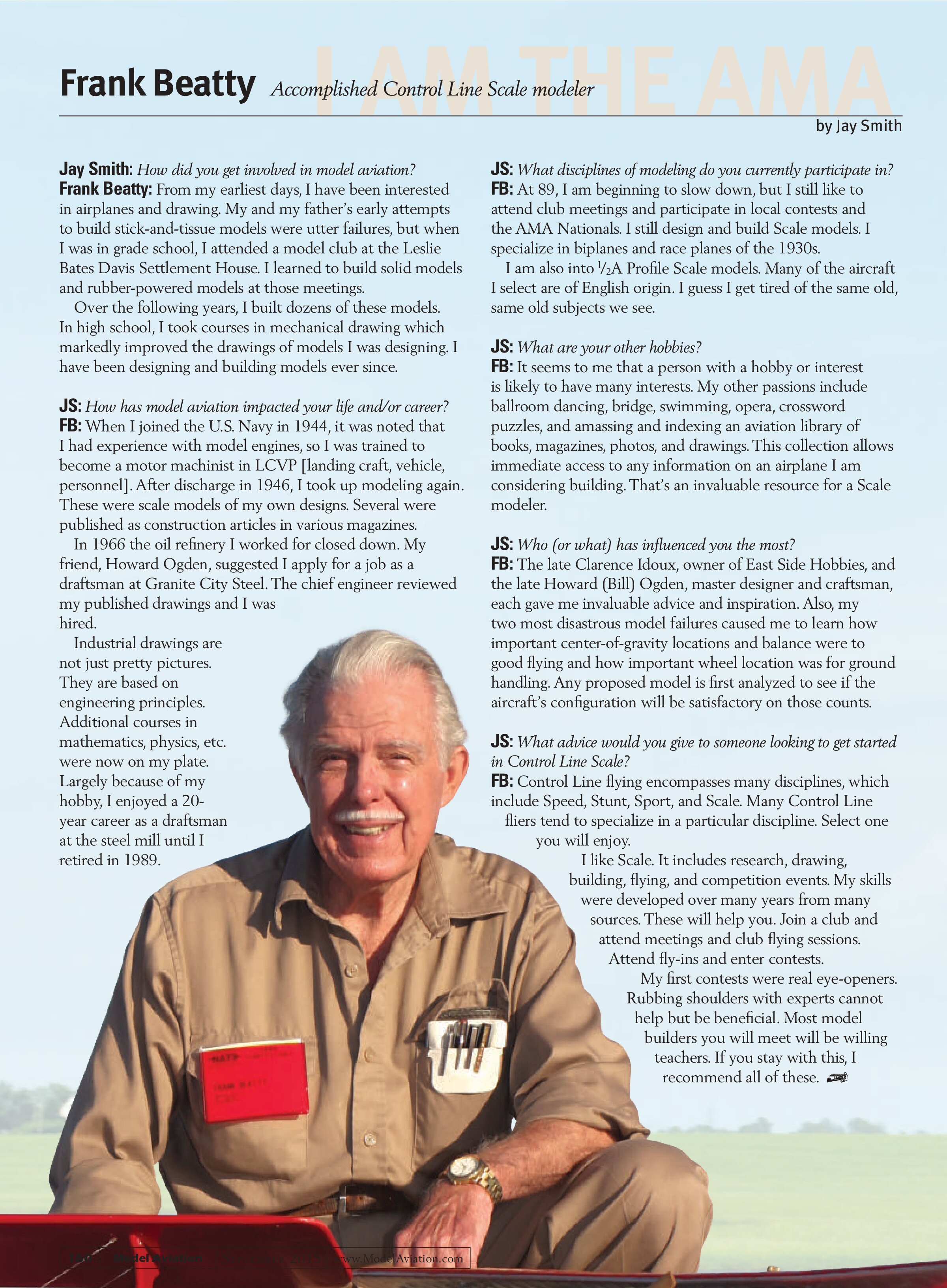
I AM THE AMA
Jay Smith

Jay Smith: How did you get involved in model aviation?
Frank Beatty: From my earliest days, I have been interested in airplanes and drawing. My and my father’s early attempts to build stick-and-tissue models were utter failures, but when I was in grade school, I attended a model club at the Leslie Bates Davis Settlement House. I learned to build solid models and rubber-powered models at those meetings.
Over the following years, I built dozens of these models. In high school, I took courses in mechanical drawing which markedly improved the drawings of models I was designing. I have been designing and building models ever since.
JS: How has model aviation impacted your life and/or career?
FB: When I joined the U.S. Navy in 1944, it was noted that I had experience with model engines, so I was trained to become a motor machinist in LCVP [landing craft, vehicle, personnel]. After discharge in 1946, I took up modeling again. These were scale models of my own designs. Several were published as construction articles in various magazines.
In 1966 the oil refinery I worked for closed down. My friend, Howard Ogden, suggested I apply for a job as a draftsman at Granite City Steel. The chief engineer reviewed my published drawings and I was hired.
Industrial drawings are not just pretty pictures. They are based on engineering principles. Additional courses in mathematics, physics, etc. were now on my plate. Largely because of my hobby, I enjoyed a 20-year career as a draftsman at the steel mill until I retired in 1989.
JS: What disciplines of modeling do you currently participate in?
FB: At 89, I am beginning to slow down, but I still like to attend club meetings and participate in local contests and the AMA Nationals. I still design and build Scale models. I specialize in biplanes and race planes of the 1930s.
I am also into ½A Profile Scale models. Many of the aircraft I select are of English origin. I guess I get tired of the same old, same old subjects we see.
JS: What are your other hobbies?
FB: It seems to me that a person with a hobby or interest is likely to have many interests. My other passions include ballroom dancing, bridge, swimming, opera, crossword puzzles, and amassing and indexing an aviation library of books, magazines, photos, and drawings. This collection allows immediate access to any information on an airplane I am considering building. That’s an invaluable resource for a Scale modeler.
JS: Who (or what) has influenced you the most?
FB: The late Clarence Idoux, owner of East Side Hobbies, and the late Howard (Bill) Ogden, master designer and craftsman, each gave me invaluable advice and inspiration. Also, my two most disastrous model failures caused me to learn how important center-of-gravity locations and balance were to good flying and how important wheel location was for ground handling. Any proposed model is first analyzed to see if the aircraft’s configuration will be satisfactory on those counts.
JS: What advice would you give to someone looking to get started in Control Line Scale?
FB: Control Line flying encompasses many disciplines, which include Speed, Stunt, Sport, and Scale. Many Control Line fliers tend to specialize in a particular discipline. Select one you will enjoy.
I like Scale. It includes research, drawing, building, flying, and competition events. My skills were developed over many years from many sources. These will help you. Join a club and attend meetings and club flying sessions.
Attend fly-ins and enter contests.
My first contests were real eye-openers. Rubbing shoulders with experts cannot help but be beneficial. Most model builders you will meet will be willing teachers. If you stay with this, I recommend all of these.