New models and new methods
by Gene Smith
grwhiskey@brightok.net
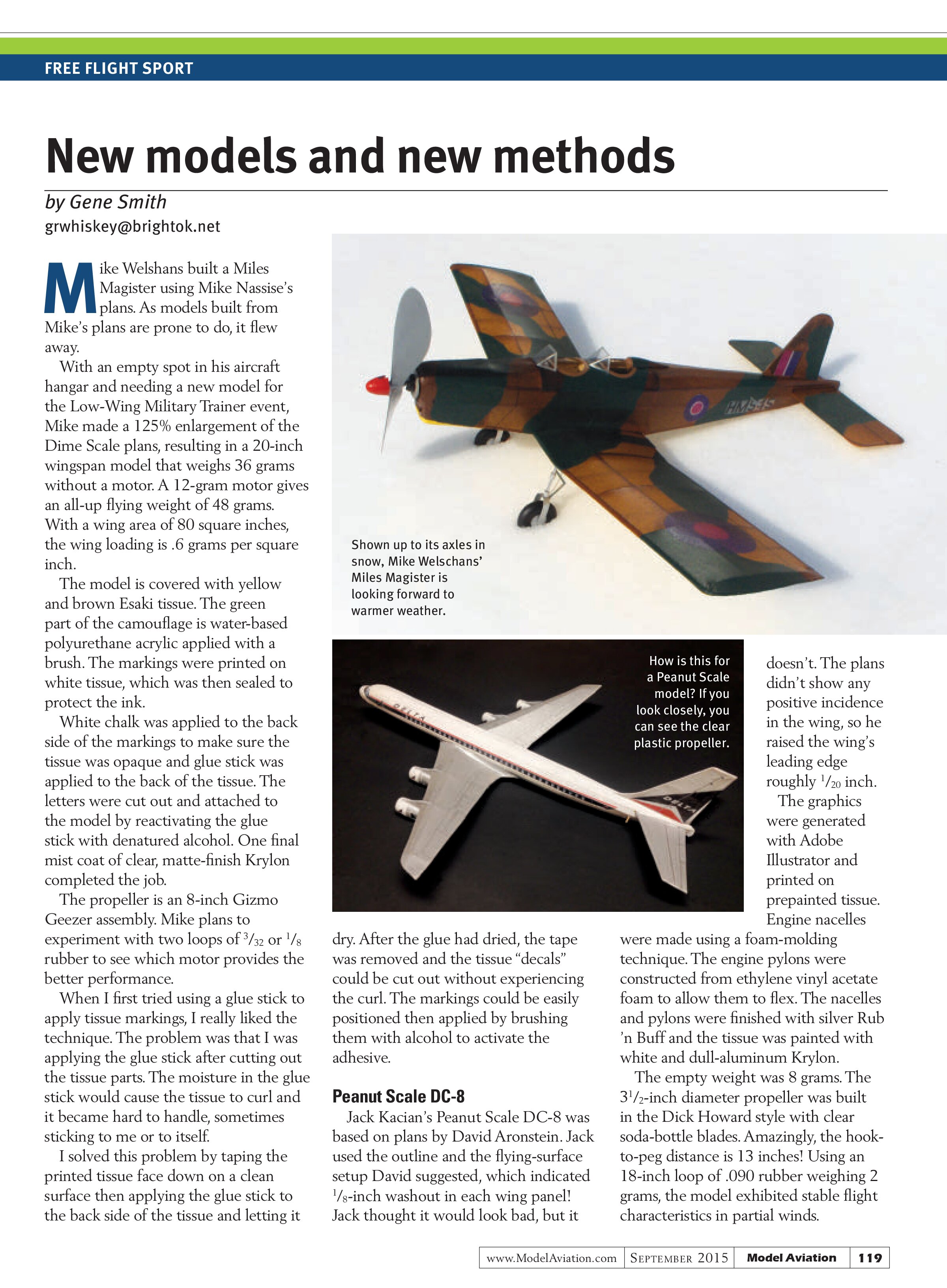
Mike Welshans built a Miles Magister using Mike Nassise’s plans. As models built from Mike’s plans are prone to do, it flew away.

With an empty spot in his aircraft hangar and needing a new model for the Low-Wing Military Trainer event, Mike made a 125% enlargement of the Dime Scale plans, resulting in a 20-inch wingspan model that weighs 36 grams without a motor. A 12-gram motor gives an all-up flying weight of 48 grams. With a wing area of 80 square inches, the wing loading is .6 grams per square inch.
The model is covered with yellow and brown Esaki tissue. The green part of the camouflage is water-based polyurethane acrylic applied with a brush. The markings were printed on white tissue, which was then sealed to protect the ink.
White chalk was applied to the back side of the markings to make sure the tissue was opaque and glue stick was applied to the back of the tissue. The letters were cut out and attached to the model by reactivating the glue stick with denatured alcohol. One final mist coat of clear, matte-finish Krylon completed the job.
The propeller is an 8-inch Gizmo Geezer assembly. Mike plans to experiment with two loops of 3/32 or 1/8 rubber to see which motor provides the better performance.
When I first tried using a glue stick to apply tissue markings, I really liked the technique. The problem was that I was applying the glue stick after cutting out the tissue parts. The moisture in the glue stick would cause the tissue to curl and it became hard to handle, sometimes sticking to me or to itself.
I solved this problem by taping the printed tissue face down on a clean surface then applying the glue stick to the back side of the tissue and letting it dry. After the glue had dried, the tape was removed and the tissue “decals” could be cut out without experiencing the curl. The markings could be easily positioned then applied by brushing them with alcohol to activate the adhesive.

Peanut Scale DC-8
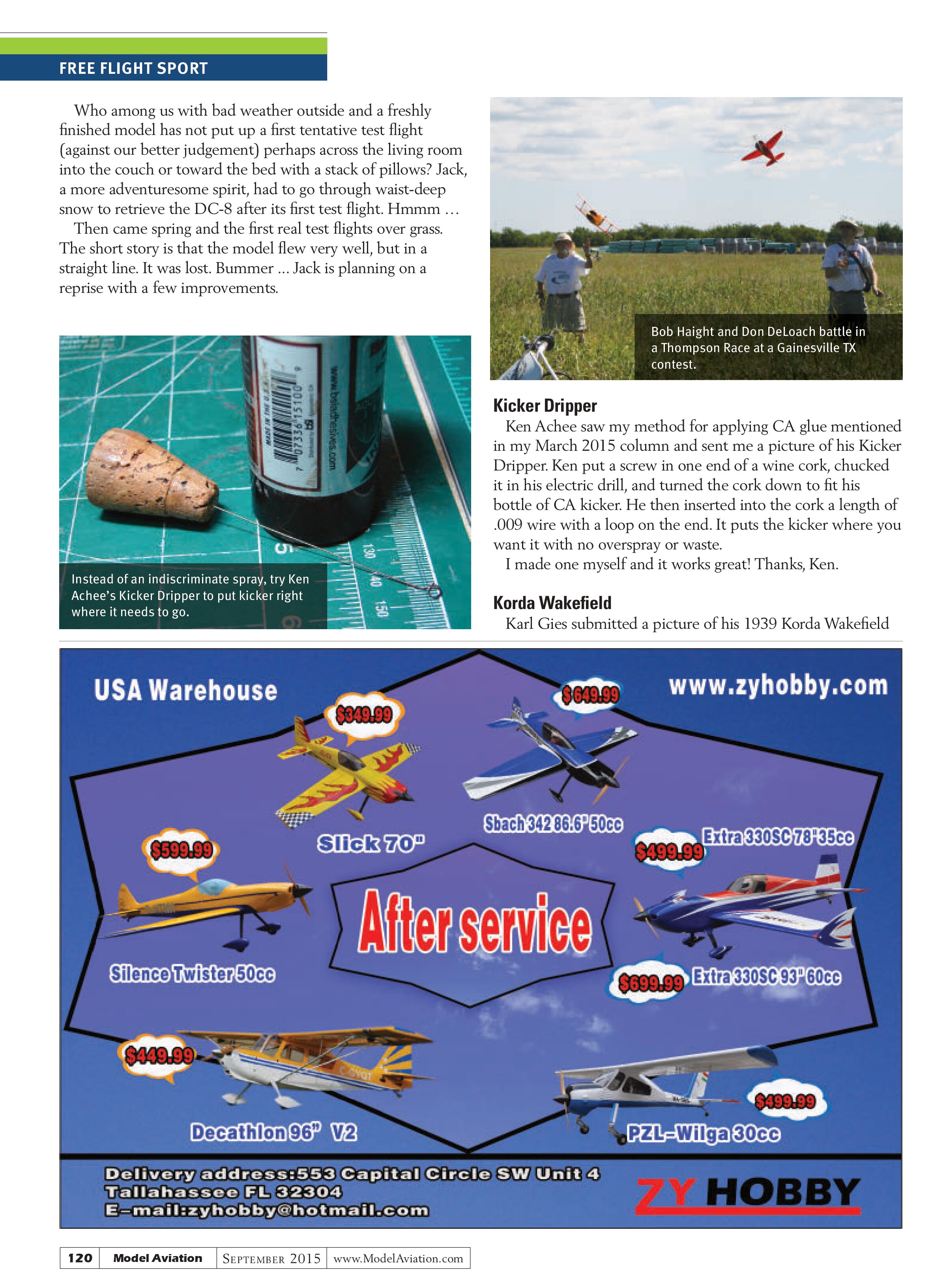
Jack Kacian’s Peanut Scale DC-8 was based on plans by David Aronstein. Jack used the outline and the flying-surface setup David suggested, which indicated 1/8-inch washout in each wing panel! Jack thought it would look bad, but it doesn’t. The plans didn’t show any positive incidence in the wing, so he raised the wing’s leading edge roughly 1/20 inch.
The graphics were generated with Adobe Illustrator and printed on prepainted tissue. Engine nacelles were made using a foam-molding technique. The engine pylons were constructed from ethylene vinyl acetate foam to allow them to flex. The nacelles and pylons were finished with silver Rub ’n Buff and the tissue was painted with white and dull-aluminum Krylon.
The empty weight was 8 grams. The 3½-inch diameter propeller was built in the Dick Howard style with clear soda-bottle blades. Amazingly, the hook-to-peg distance is 13 inches! Using an 18-inch loop of .090 rubber weighing 2 grams, the model exhibited stable flight characteristics in partial winds.
Who among us with bad weather outside and a freshly finished model has not put up a first tentative test flight (against our better judgement) perhaps across the living room into the couch or toward the bed with a stack of pillows? Jack, a more adventuresome spirit, had to go through waist-deep snow to retrieve the DC-8 after its first test flight. Hmmm … Then came spring and the first real test flights over grass. The short story is that the model flew very well, but in a straight line. It was lost. Bummer … Jack is planning on a reprise with a few improvements.

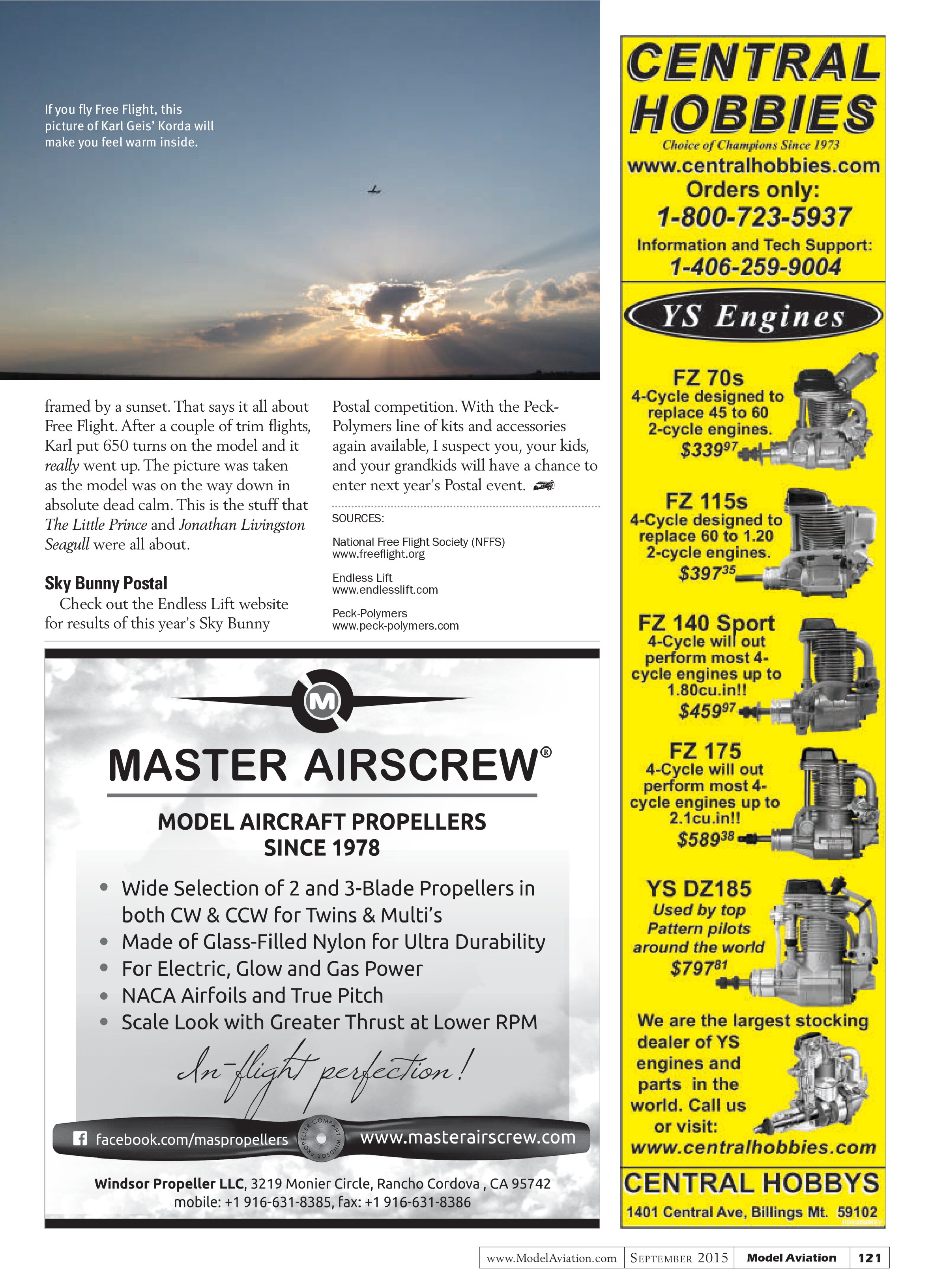
Bob Height and Don DeLoach battle in a Thompson Race at a Gainesville TX contest.

Kicker Dripper
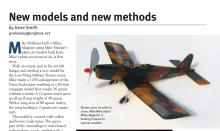
Ken Achee saw my method for applying CA glue mentioned in my March 2015 column and sent me a picture of his Kicker Dripper. Ken put a screw in one end of a wine cork, chucked it in his electric drill, and turned the cork down to fit his bottle of CA kicker. He then inserted into the cork a length of .009 wire with a loop on the end. It puts the kicker where you want it with no overspray or waste. I made one myself and it works great! Thanks, Ken.
Korda Wakefield
Karl Gies submitted a picture of his 1939 Korda Wakefield

framed by a sunset. That says it all about Free Flight. After a couple of trim flights, Karl put 650 turns on the model and it really went up. The picture was taken as the model was on the way down in absolute dead calm. This is the stuff that The Little Prince and Jonathan Livingston Seagull were all about.
Sky Bunny Postal
Check out the Endless Lift website for results of this year’s Sky Bunny Postal competition. With the Peck-Polymers line of kits and accessories again available, I suspect you, your kids, and your grandkids will have a chance to enter next year’s Postal event.
SOURCES:
National Free Flight Society (NFFS)
www.freeflight.org
Endless Lift
www.endlesslift.com
Peck-Polymers
www.peck-polymers.com